

ICD-10 code S61.201A: Open wound of left index finger without nail damage
ICD-10 code S61.201A covers a left index finger wound of unstated type ICD-10 co...

Last Updated: Oct 16, 2026
Billable Code Specific Code
S72.446E is the billable ICD-10-CM code for nondisplaced fracture of lower epiphysis (separation) of unspecified femur, subsequent encounter for open fracture type I or II with routine healing.
According to the CDC/NCHS ICD-10-CM web tool, S72.446E sits inside the S72 category, which covers fractures of the femur. Four conditions have to hold before the code fits. The break is a separation of the lower epiphysis, and the fragments are still in alignment. The wound was an open type I or II, and the patient is back for follow-up with healing on track.
The unspecified sixth character is what makes this code fragile on a claim. S72.446 means the record never said right or left. Payers read that as incomplete documentation, so the same injury coded to S72.444 or S72.445 travels far more easily.
Let Pabau's smart automation suggest the right codes, reduce claim denials, and keep your practice compliant—effortlessly.
Automate repetitive tasks and focus on what matters most—your patients.
Reduce coding errors and ensure compliance with the latest regulations.
Clean claims, fewer denials, and faster reimbursements.
Powerful insights and reporting to help your practice thrive.
HIPAA compliant SOC 2 certified GDPR-compliant Trusted by 4,000+ clinics worldwide

ICD-10 code S72.446E describes a nondisplaced fracture of the lower epiphysis (separation) of an unspecified femur. It applies at a subsequent encounter for an open type I or II fracture healing routinely.
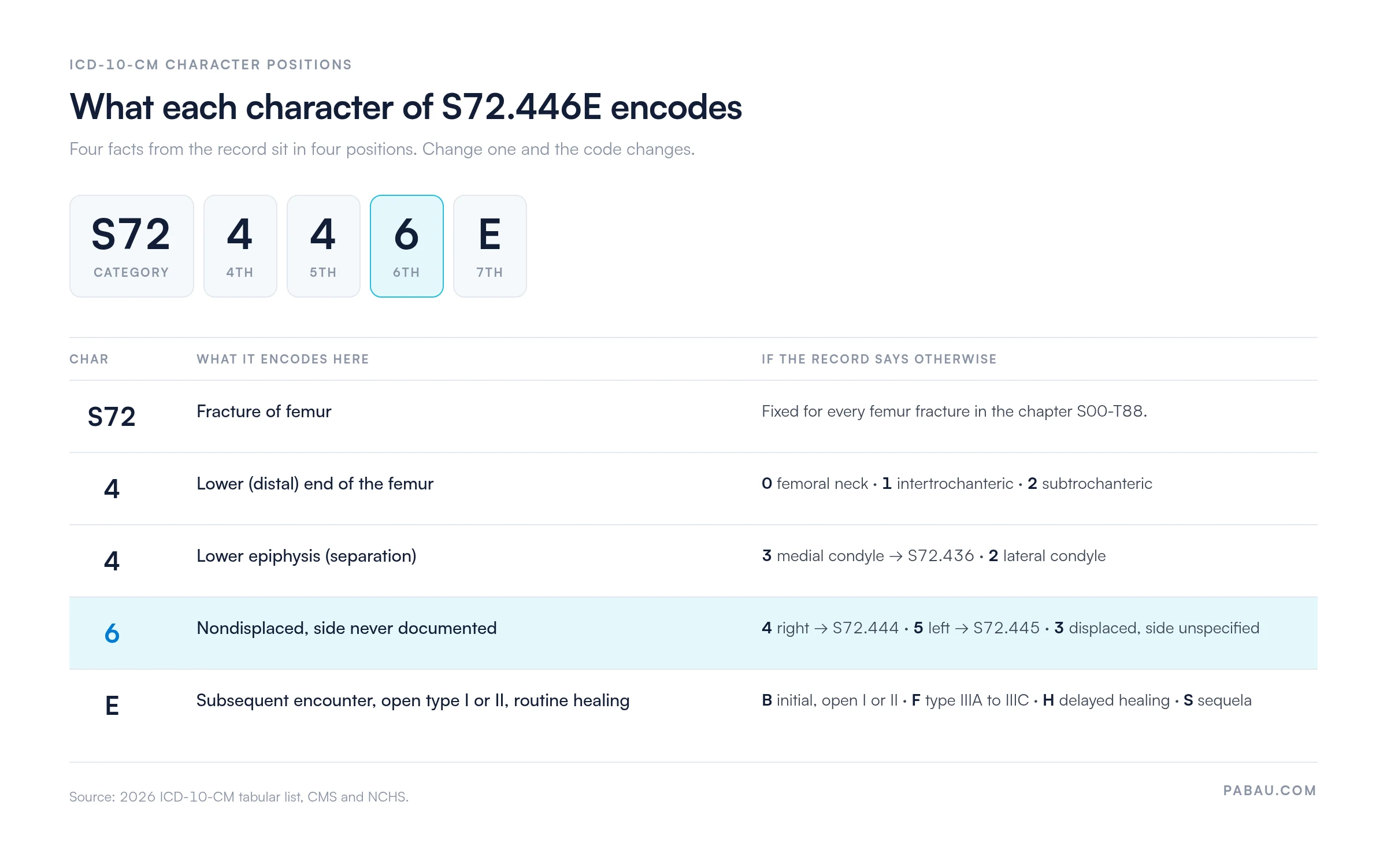
The sixth character 6 means the side was never documented. Use S72.444E for the right femur or S72.445E for the left whenever the record names a side.
S72.446E is a billable ICD-10-CM code, valid for fiscal year 2026 and effective October 1, 2025. It is exempt from present-on-admission reporting.
S72.44 and S72.43 are easy to swap. A nondisplaced medial condyle fracture of the left femur is S72.435E, not S72.446E.
Pabau’s claims management software integrates with Claim.MD to validate ICD-10 diagnostic codes before submission, reducing denials caused by incorrect encounter characters or missing laterality.
The table below summarizes the reference facts for ICD-10 code S72.446E as published in the 2026 ICD-10-CM tabular list.
ICD-10 code S72.446E belongs to a well-defined hierarchy in the CMS ICD-10-CM code set. Reading the parent-to-child path is the fastest way to check that a suggested code really matches the documented site.
The S72.4 subcategory covers the lower (distal) end of the femur only. That separates these injuries from femoral neck fractures (S72.0), intertrochanteric fractures (S72.1), and subtrochanteric fractures (S72.2). Inside S72.4, the fifth character names the part that broke.
S72 runs unusually deep for a fracture category. Site, displacement, side, and encounter each get their own character position, so one mistyped digit changes the documented diagnosis. The breakdown below maps each character of S72.446E to the fact in the record it stands for.
The lower epiphysis of the femur is the bone segment at the distal end, beyond the growth plate. It forms the upper half of the knee joint. A separation means that segment has parted from the shaft along or close to the physis. The fracture line runs through the epiphyseal region rather than through a single condyle.
These injuries take considerable force. A fall from height, a motor vehicle collision, or a valgus or hyperextension load at the knee will all do it. The pattern is most common in adolescents, whose distal femoral physis has not yet closed. Pediatric and sports medicine records carry a large share of these injuries.
Nondisplaced means the bone has cracked or separated but the fragments remain in anatomical alignment. The distinction drives the code, because ICD-10-CM splits displaced from nondisplaced throughout the S72 family. The tabular note at S72 is blunt about the default: a fracture not indicated as displaced or nondisplaced is coded to displaced.
That default has a practical consequence. If the radiology report never uses the word nondisplaced, S72.446 is the wrong stem, and the claim should carry a displaced code instead.
The tabular list also treats open and closed the same way. A fracture not indicated as open or closed is coded to closed, and the open fracture designations follow the Gustilo classification.
S72.446 has two close neighbors that produce the wrong claim rather than a rejected one. One is the medial condyle group at S72.43. The other is the Salter-Harris physeal group at S79.1.
Both sub-subcategories sit under S72.4, both carry nondisplaced stems, and both use the same laterality order. Only the fifth character tells them apart, so a mistyped digit changes the documented site without changing anything else about the code.
The table exposes the trap immediately. A nondisplaced medial condyle fracture of the left femur at a subsequent open type I or II encounter is S72.435E, not S72.446E. Any tool that suggests a code from a text string needs a coder to confirm the site against the imaging report.
An Excludes1 note at S72.44 bars Salter-Harris Type I physeal fracture of the lower end of the femur (S79.11-) from ever being coded here. One level up, S72.4 carries an Excludes2 note for physeal fracture of the lower end of the femur (S79.1-).
Read together, the two notes send any graded physeal fracture to S79.1 and leave S72.44 for an epiphyseal separation the record does not grade. If the operative note or radiology report names a Salter-Harris type, the code comes from this group instead.
The 7th character in ICD-10 code S72.446E is the most consequential element for billing. The letter E designates a subsequent encounter for an open fracture type I or II with routine healing. Under the ICD-10-CM Official Guidelines, subsequent encounters cover every visit after the initial treatment while active care continues.
Three facts combine to produce the E qualifier. First, this is a subsequent encounter, not an initial visit or a sequela. Second, the underlying fracture was open type I or II. Third, healing is progressing normally, with no delayed union, nonunion, or malunion documented. Change any one of the three and a different 7th character applies.
HIPAA mandates ICD-10-CM for every covered entity, so the encounter character carries the same weight in every specialty. Submitting an initial-encounter code on a follow-up visit, or a subsequent-encounter code on a first visit, is an error payers actively audit.
Audit your encounter documentation before coding. The 7th character has to match what the clinical note says. A note reading ‘patient returns for follow-up on open distal femur fracture, healing well’ points to E, while ‘new fracture’ points to B instead. Never code the encounter type from memory.
ICD-10 code S72.446E is tied to open fractures classified as Gustilo type I or type II. The Gustilo-Anderson classification is the standard orthopedic grading system for open fractures, separating them by wound size, contamination level, and soft-tissue damage.
The split between type I/II and type IIIA, IIIB and IIIC drives different 7th character values across the whole S72 family. A type IIIA fracture that heals routinely uses F, not E. Conflating the two is a documented source of claim denials in orthopedic billing.
S72.446 is the code stem for a nondisplaced fracture of the lower epiphysis (separation) of an unspecified femur. Every valid 7th character extension produces a separate billable code. The table below covers all sixteen of them.
S72.446E is a valid code, but it should be the last one you choose. The sixth character is the laterality position, and 6 states that the documentation never named a side. That is a fact about the record, not a fact about the patient.
Every distal femur has a side, so an unspecified code on a paired bone reads to a payer as incomplete documentation. Medical-necessity review and duplicate-claim edits both lean on laterality. A follow-up series coded S72.446E at every visit gives the reviewer nothing to match against the initial encounter.
The side is usually already in the chart. Check the initial radiology report, the operative note, the triage note, and the therapy plan of care. Do that before you settle for the x6 stem, because one provider query resolves most of these claims.
Unspecified laterality is still legitimate in a narrow set of situations. Outside records may arrive with the side missing, an image may be unread, or a transfer may land with no usable documentation at all. In those cases, record that the query happened so an auditor can see the reasoning behind the code.
S72.446E belongs to the S72.44 sub-subcategory, which covers fractures of the lower epiphysis of the femur only. Six stems split that group by displacement and side. Confirm both from the source documentation, then check the stem you picked against our wider ICD-10-CM code library.
For reference, verify any related code against the 2026 ICD-10-CM listing for S72.446E. It mirrors the official CMS and NCHS files and is updated each fiscal year.
Check the code validity year before submission. S72.446E is valid for FY2026, effective October 1, 2025. If your practice management system auto-populates codes, confirm it is running the 2026 ICD-10-CM code set rather than a prior year’s database.
The 2026 CMS General Equivalence Mappings convert S72.446E to a single legacy code: V54.15, aftercare for healing traumatic fracture of upper leg. That one mapping says a lot about how the two code sets differ.
ICD-9-CM had no way to carry the encounter inside the injury code. A follow-up visit therefore moved to an aftercare V code. That code described the care but dropped the site detail, the displacement, and the open fracture grade. ICD-10-CM folds all of it into one code by using the 7th character.
That matters for trend reporting. Volumes built on V54.15 will never line up cleanly with volumes built on S72.446, because the old code pooled every healing upper-leg fracture. Treat the mapping as a rough bridge for legacy data, not a substitute for coding from the record.
S72.446E is billable and specific, so it goes on a claim without a more detailed companion code. On an inpatient claim it groups to MS-DRG 559, 560 or 561, all three of which cover aftercare for the musculoskeletal system and connective tissue. Which one applies depends on whether an MCC or a CC is also reported.
The code is exempt from present-on-admission reporting, so no POA indicator is required. Two chapter-level instructions still apply. Chapter 20 asks for a secondary external cause code to explain the injury. The S00-T88 note asks for an additional code to identify any retained foreign body (Z18.-).
Five documented elements decide whether this code survives review. Each one maps to a character position or a payer edit.
Errors on S72.446E claims fall into five predictable patterns. Catching each one at documentation capture prevents the rework. Orthopedic practices trace much of their denial management workload back to these five points.
Every one of these five errors is auditable. CMS and commercial payers run coding edit software that flags fracture codes where the encounter character conflicts with the episode timeline on record.
Orthopedic and physical therapy teams see dozens of fracture follow-up visits per provider each week. Each one needs a correct 7th character, a confirmed side, and a documented healing status. Pabau is practice management software for medical and aesthetic practices. Its clinical documentation tools capture that encounter context at the point of care, so the coder works from what the provider recorded.
Pabau integrates with Claim.MD, a US medical claims clearinghouse that connects to thousands of payers. A claim carrying ICD-10 code S72.446E goes out through that connection. The clearinghouse runs eligibility checks and validates the code set before transmission. Rejections caused by a wrong encounter character or a mismatched open fracture type surface there, before the payer opens an adjudication queue.
For practices managing high volumes of fracture follow-ups, Pabau’s claims management software tracks denial reasons per code. Coders can then spot patterns such as repeated E-versus-F confusion, or a provider whose notes omit laterality. The fix lands on the source rather than on the claim, and the pattern data feeds coding education directly.


Pabau integrates with Claim.MD to validate ICD-10 diagnosis codes before submission. Orthopedic and physical therapy practices catch missing laterality, wrong encounter characters, and open-fracture type mismatches before they reach the payer.

ICD-10 code S72.446E is precise about three things and silent about one. It describes a nondisplaced separation of the lower femoral epiphysis, seen at a subsequent encounter, with an open type I or II wound healing routinely. What it does not say is which leg.
That silence is the part worth acting on. When the record names a side, S72.444E or S72.445E carries the same clinical picture with none of the audit exposure. Save S72.446E for the claim where a provider query has already come back empty. Keep the fifth character honest too, so a condyle fracture never lands here.
For practices that want clean claims on the first submission, Pabau validates ICD-10 diagnostic codes before they reach the payer. Book a demo to walk through the documentation and billing workflow behind a fracture follow-up claim.

Coding a medial condyle fracture instead? ICD-10 code S72.436C covers the S72.43 site that gets swapped for the lower epiphysis most often.
Does the record say displaced rather than nondisplaced? ICD-10 code S72.442C is the displaced left-femur stem inside the same S72.44 group.
Has the report graded a Salter-Harris type? ICD-10 code S79.141A shows where a graded physeal fracture of the distal femur belongs.
Working through rejections on fracture claims? Denial management in healthcare explains how to reduce rejections from encounter-type errors and coding mismatches.
ICD-10 code S72.446E is a billable diagnosis code for a nondisplaced fracture of the lower epiphysis (separation) of an unspecified femur. It applies at a subsequent encounter where the fracture was open type I or II and healing is routine. It is valid for fiscal year 2026 under the ICD-10-CM code set maintained by CMS and NCHS.
Yes. S72.446E is a billable and specific ICD-10-CM code that can be submitted directly on a claim for reimbursement. It needs no more specific companion code, and it is valid for dates of service on or after October 1, 2025. It is also exempt from present-on-admission reporting.
Neither one specifically. The sixth character 6 means the documentation never named a side. When the record does name it, use S72.444E for the right femur or S72.445E for the left. Unspecified laterality on a paired bone invites payer scrutiny, so query the provider before you settle for S72.446E.
The 7th character E designates a subsequent encounter for an open fracture classified as Gustilo type I or type II, with routine healing documented. It applies to follow-up visits after the initial treatment, where the wound was small to moderate and healing is progressing normally. Delayed healing uses H, nonunion uses M, and malunion uses Q.
S72.446A is the initial encounter for a closed nondisplaced fracture of the lower epiphysis of an unspecified femur. S72.446E is a subsequent encounter for an open type I or II fracture at the same site with routine healing. Encounter type, wound status, and the healing documentation requirement all differ.
Site is the only difference. S72.446 is a nondisplaced fracture of the lower epiphysis (separation) of an unspecified femur. S72.436 is a nondisplaced fracture of the medial condyle of an unspecified femur. Both sit under S72.4, so only the fifth character separates them.
Not when the record grades it. An Excludes1 note at S72.44 keeps Salter-Harris Type I physeal fractures of the lower femur (S79.11-) out of this group. One level up, S72.4 carries an Excludes2 note for physeal fracture of the lower end of the femur (S79.1-). A named Salter-Harris type is coded from S79.1 instead.
Answer three questions in sequence. Is this an initial encounter (A, B, or C), a subsequent encounter (D through R), or a sequela (S)? If the fracture is open, is it Gustilo type I or II, or type IIIA, IIIB, or IIIC? What healing status is documented: routine, delayed, nonunion, or malunion? Each combination maps to one 7th character.



