ICD-10 Code Y74.2: General hospital and personal-use implant failure
ICD-10 code Y74.2: Definition, descriptor, and billable status ICD-10 code Y74.2...

Last Updated: Oct 29, 2026
Billable Code Specific Code
S72.101H is the billable ICD-10-CM code for unspecified trochanteric fracture of right femur, subsequent encounter for open fracture type I or II with delayed healing.
Coders use it at follow-up visits for an open trochanteric fracture of the right femur, Gustilo type I or II. The physician must document that union is not progressing as expected. The H suffix is where most denials originate. Payers reject claims when the progress note never states delayed healing. They also reject them when the fracture was closed (G) or type III (J), or when active treatment called for B.
Let Pabau's smart automation suggest the right codes, reduce claim denials, and keep your practice compliant—effortlessly.
Automate repetitive tasks and focus on what matters most—your patients.
Reduce coding errors and ensure compliance with the latest regulations.
Clean claims, fewer denials, and faster reimbursements.
Powerful insights and reporting to help your practice thrive.
HIPAA compliant SOC 2 certified GDPR-compliant Trusted by 4,000+ clinics worldwide

S72.101H is a billable ICD-10-CM code for delayed healing at a follow-up after an open type I or II trochanteric fracture of the right femur
The 7th character H means a follow-up visit, an original open fracture of Gustilo type I or II, and documented delayed healing
Use G instead for a closed fracture with delayed healing, and J for an open type IIIA, IIIB or IIIC fracture
The 6th character 1 means the right femur, so use S72.102H for the left side and S72.109H only when the record names no side
During a 90-day global period, modifier 24 applies only to an E/M visit unrelated to the original surgery
ICD-10 code S72.101H carries the official descriptor: Unspecified trochanteric fracture of right femur, subsequent encounter for open fracture type I or II with delayed healing. It sits in category S72 (Fracture of femur) within Chapter 19 of ICD-10-CM, the injury chapter (S00-T88). The code is billable and valid for FY 2027, per the CMS ICD-10-CM annual code files.
An unspecified trochanteric fracture is a break in the trochanteric region of the proximal femur where the record does not name the fracture subtype. The trochanteric region includes the greater trochanter, the lesser trochanter, and the intertrochanteric area between them.
In S72.101H, “unspecified” refers to the fracture subtype. The side is set by the 6th character, and here that character is 1, the right femur. The trochanteric codes split like this:
Trochanteric fractures in older adults are often classified clinically as hip fractures. For coding purposes, the anatomical location determines the S72.1 subcategory. The lay term “hip fracture” can point to several different code categories.
The 7th character in S72 codes carries three facts at once: The encounter type, whether the fracture was open or closed, and the healing status. For S72.101H, the H means a follow-up encounter for an open fracture of Gustilo type I or II, with delayed healing documented by the physician. It does not mean the fracture is untreated, and it does not mean nonunion.
The open fracture types come from the Gustilo-Anderson classification. Type I is an open fracture with a clean wound under 1 cm, and type II has a larger wound without extensive soft-tissue damage. Types IIIA, IIIB and IIIC involve extensive soft-tissue injury, periosteal stripping, or an arterial injury that needs repair. An open fracture with no documented type is coded as type I or II.
The full S72 7th-character set, from the ICD-10-CM Tabular List, is below. The three delayed healing characters (G, H and J) are where coders slip most often:
The original wound decides between H, G and J. A closed trochanteric fracture of the right femur with delayed healing is S72.101G. An open type IIIA, IIIB or IIIC fracture with delayed healing is S72.101J. Only an open type I or II fracture, or an open fracture with no documented type, lands on S72.101H. The three questions below walk a follow-up note to the right character.
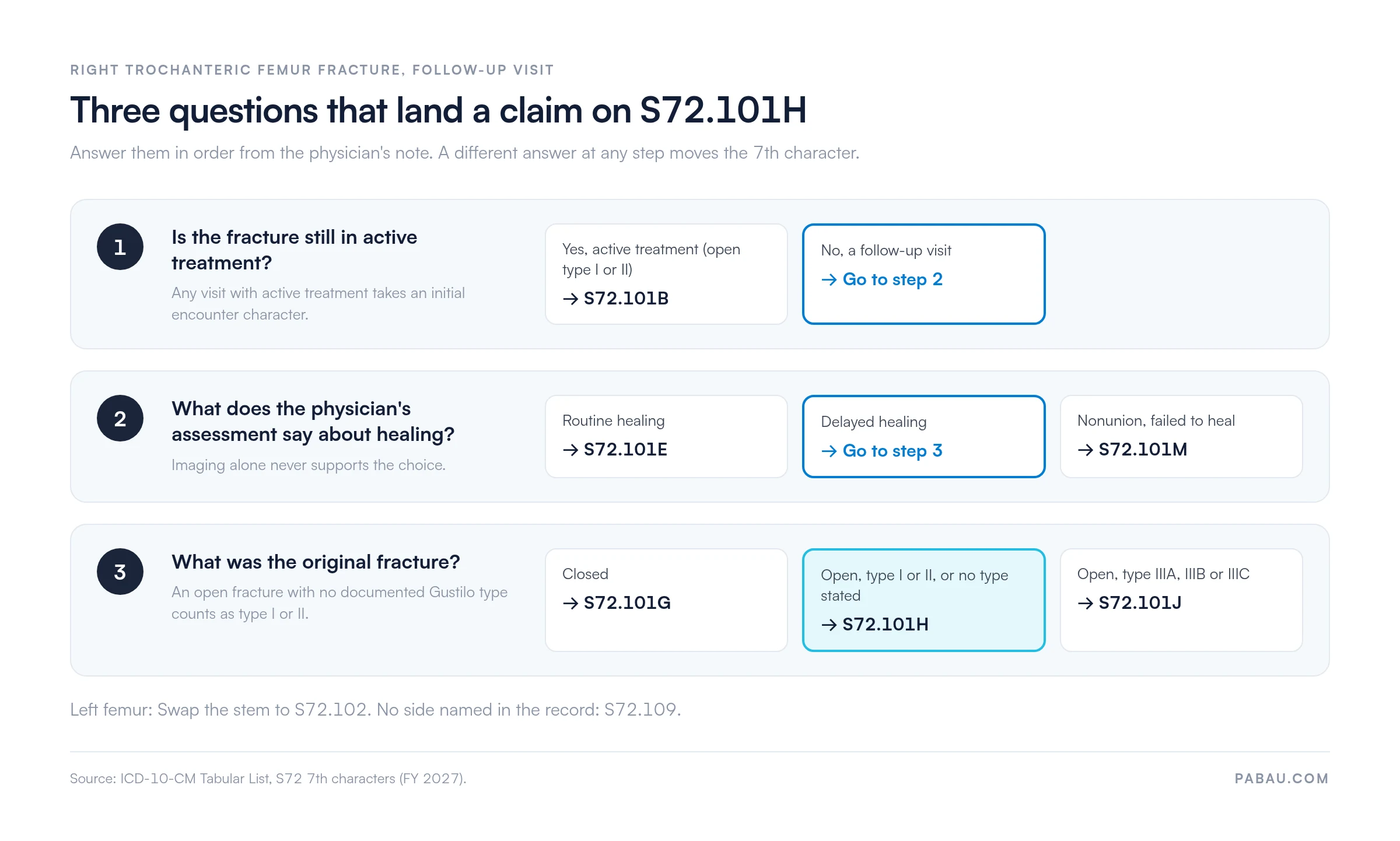
Delayed healing means the fracture is still healing, but more slowly than expected. Nonunion (M for an open type I or II fracture) means it has failed to heal. A radiologist’s note of “no bridging callus at 12 weeks” can support delayed healing. Even so, the physician’s assessment must state the diagnosis before H can be coded.
S72.101H sits among dozens of close siblings in the S72.1 subcategory. Picking the wrong one is a common cause of rejected orthopedic and emergency department claims. The table below covers the codes coders most often confuse:
The S72.101H versus S72.101M split matters most for payer review. Delayed healing usually means continued monitoring, while a documented nonunion can open a separate authorization pathway for revision surgery. Verify the physician’s exact language before choosing between them.
ICD-10-CM Official Guidelines require coders to assign codes based only on diagnoses the treating provider documents. For S72.101H, five documentation elements must be present before the code can be assigned. Claims management software that flags an incomplete record before submission lets an orthopedic practice fix the note before the claim goes out.
Coders who infer delayed healing from imaging reports without a matching physician diagnosis are assigning a code not supported by the documentation. That practice fails payer audits and constitutes an overstated claim under federal billing rules.
At a follow-up for delayed healing, the procedure codes billed alongside S72.101H depend on what the provider did at that visit. The trochanteric fracture repair codes 27244 and 27245 are billed at the operative encounter and are not billed again at follow-ups. The table below lists the pairings an orthopedic practice sees most often across those follow-up visits.
Pabau, the practice management and billing platform we build, sends these claims electronically through Claim.MD, its US clearinghouse integration. Claim.MD checks modifier and code combinations before the claim leaves the practice. Claim.MD connects to thousands of US payers. That real-time edit catches mismatched modifiers and unbundling flags before they reach the payer and generate a denial.
Medicare and most commercial payers treat delayed healing fracture management as a coverage-sensitive service. Local Coverage Determinations (LCDs) from Medicare Administrative Contractors (MACs) set which interventions are covered at follow-up encounters. They also set the documentation payers need before approving them.
Key payer requirements to confirm before submitting a clean claim with S72.101H:
Claim denials tied to ICD-10 code S72.101H cluster around a predictable set of documentation and sequencing errors. Each one comes back on the remittance with a denial code that points to its cause. Practices with structured denial management workflows fix these patterns at the source rather than one claim at a time.
Run a denial pattern report quarterly for the S72.1 delayed healing codes (G, H and J). Separate denials by root cause (documentation, open or closed status, modifier, laterality) rather than by individual code. A single workflow fix often clears most of these denials at once. One example is a follow-up note template that records the Gustilo type and healing status.
The CDC/NCHS ICD-10-CM Official Guidelines for Chapter 19 establish specific rules governing how S72 fracture codes are assigned. These rules apply to S72.101H and its entire sibling code family:
Understanding these rules is part of broader medical billing compliance requirements for orthopedic practices. Misapplying the open or closed rule, or the active treatment definition, is a common source of encounter coding errors. The ResDAC coding resources page provides additional guidance on how these rules apply within Medicare claims data.
Orthopedic and musculoskeletal practices managing hip fracture patients across multiple follow-up visits need billing workflows that catch 7th-character errors before they reach the payer. Pabau covers the full medical billing workflow, from diagnosis code selection through claim submission via Claim.MD.
Pabau helps orthopedic teams structure clinical notes around the elements S72.101H requires: Encounter type, open fracture and Gustilo type, delayed healing language, imaging, and laterality. When the care team captures those fields at the point of care, coders can assign the correct 7th character with confidence. They no longer need to query the provider after the fact.
Book a demo to see how Pabau handles orthopedic billing documentation end to end.

Pabau helps orthopedic and musculoskeletal practices capture the documentation behind the correct 7th character at every follow-up. That cuts denials on complex fracture codes before the claim goes out.

Assign S72.101H only when the treating physician’s assessment names delayed healing in an open type I or II fracture of the right femur. Imaging can prompt a query to the physician, but it cannot replace that diagnosis on the claim.
The fix that pays off sits upstream of coding. A follow-up note template that records the Gustilo type, the side and the healing status lets coders pick G, H or J without querying anyone. Pabau’s electronic remittance advice tools then surface the remaining denials by code, so your team fixes the workflow instead of chasing single claims.
Book a demo to see how Pabau keeps your fracture follow-up claims on the right 7th character.

Need to understand how claim denials are tracked and resolved? Denial management in healthcare covers the end-to-end workflow for identifying, appealing, and preventing common payer rejections.
Preparing a clean claim for a fracture follow-up visit? Submitting a clean claim walks through the specific data elements payers check before processing a payment.
Want to understand the clearinghouse that validates your S72 claims? Claim.MD clearinghouse overview explains how electronic claim validation works before submission to thousands of US payers.
ICD-10 code S72.101H is the billable diagnosis code for an unspecified trochanteric fracture of the right femur. It covers a subsequent encounter for an open type I or II fracture with delayed healing. The S72.101 stem identifies a right-sided trochanteric fracture whose subtype is not specified. The 7th character H marks a follow-up visit for a Gustilo type I or II open fracture, where the physician has documented delayed healing.
S72.101B applies to the initial encounter for an open type I or II fracture, meaning any visit where the fracture receives active treatment. S72.101H applies to later follow-up visits where the physician has documented delayed healing. The two cannot be used interchangeably: Using H during active treatment, or B on a delayed healing follow-up, leads to claim denial or audit exposure.
Use H when three conditions are met: A follow-up visit, an open fracture of Gustilo type I or II, and documented delayed healing. An open fracture with no documented type also counts as type I or II. Use G for a closed fracture, J for an open type IIIA, IIIB or IIIC fracture, and E when healing is routine.
Use S72.102H for the left femur and S72.109H when the record names no side. All three codes share the 7th character H, so the open type I or II fracture and the delayed healing must still be documented.
The diagnosis code itself takes no modifier, but an E/M billed alongside it in a 90-day global period may. Modifier 24 applies only when the visit is unrelated to the original surgery. Medicare bundles follow-up of complications that don’t need a return to the operating room into the global surgical fee.
S72.101H (delayed healing) means the fracture is still healing, but more slowly than expected. S72.101M (nonunion, open fracture type I or II) means the fracture has failed to unite. The distinction matters for payer review, because a documented nonunion can open a separate authorization pathway for revision surgery or a bone growth stimulator.
Yes. S72.101H is an active, billable ICD-10-CM code valid for fiscal years 2026 and 2027 (FY2027 began Oct 1, 2026). Verify against the CDC/NCHS ICD-10-CM web tool for any mid-year addenda before submitting claims, as CMS publishes both October (FY start) and April (mid-year) updates.