

ICD-10 code S61.201A: Open wound of left index finger without nail damage
ICD-10 code S61.201A covers a left index finger wound of unstated type ICD-10 co...

Last Updated: Oct 16, 2026
Billable Code Specific Code
S72.102P is the billable ICD-10-CM code for unspecified trochanteric fracture of left femur, subsequent encounter for closed fracture with malunion.
Let Pabau's smart automation suggest the right codes, reduce claim denials, and keep your practice compliant—effortlessly.
Automate repetitive tasks and focus on what matters most—your patients.
Reduce coding errors and ensure compliance with the latest regulations.
Clean claims, fewer denials, and faster reimbursements.
Powerful insights and reporting to help your practice thrive.
HIPAA compliant SOC 2 certified GDPR-compliant Trusted by 4,000+ clinics worldwide

ICD-10 Code S72.102P describes an unspecified trochanteric fracture of the left femur at a subsequent encounter. The closed fracture has healed in the wrong position.
S72.102P is a billable ICD-10-CM code for FY2026, effective October 1, 2025, and valid for reimbursement submission.
The seventh character P is the differentiator. It marks a closed fracture with malunion, while Q and R carry the same meaning for open fractures.
The S72.102 family takes 16 valid seventh characters. Each one pairs an encounter phase with a fracture type and a healing status.
Practice management software like Pabau integrates with Claim.MD, so orthopedic claims like S72.102P get submitted, tracked, and reconciled in one place.
ICD-10 Code S72.102P is a billable ICD-10-CM diagnosis code. Specifically, it covers an unspecified trochanteric fracture of the left femur at a subsequent encounter for a closed fracture with malunion. According to the Centers for Medicare and Medicaid Services (CMS), the FY2026 edition took effect on October 1, 2025.
Each part of the code carries a piece of the clinical story. For example, “unspecified trochanteric” places the fracture in the trochanteric region of the femur, without classifying it as intertrochanteric or pertrochanteric. Meanwhile, “left femur” shows which side is affected.
“Subsequent encounter” places this visit after the active treatment phase, and “closed fracture with malunion” names the healing complication. In short, the fracture has healed, but in the wrong position.
The seventh character is where these claims go wrong. P is the malunion character for a closed fracture, while the neighboring characters Q and R carry the same malunion meaning for open fractures, split by Gustilo severity. As a result, swapping P for Q on a closed injury tells the payer the skin was broken.
The table below lists the key facts coders need before submitting a claim with ICD-10 Code S72.102P.
The CDC’s National Center for Health Statistics (NCHS) maintains this code and publishes annual ICD-10-CM updates together with CMS. Therefore, coders should check the current edition every year, since code descriptions and validity can change with each October 1 release.
The seventh character in S72.102P carries the most clinical and billing weight in the entire code. As a result, getting it wrong means the claim either misrepresents the patient’s status or triggers an automatic denial.
ICD-10-CM requires a seventh character extension on every fracture code in the S72 category. Each character, in turn, encodes two facts at once: it names the encounter phase, plus the fracture type and its healing status. So, the 16 valid characters for S72.102 fall into a grid rather than a list.
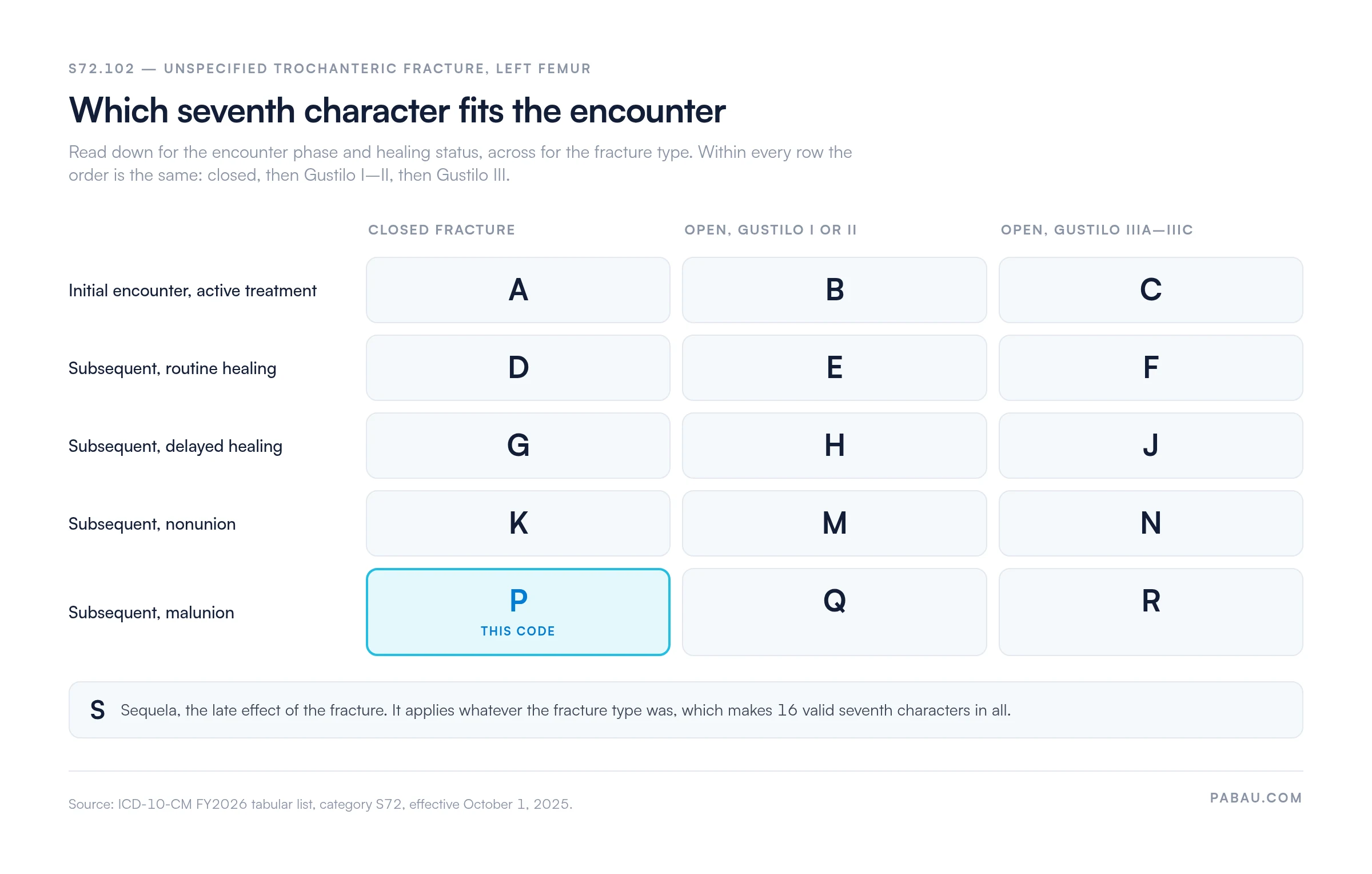
The table below carries the full description behind each of those characters.
Read the table in columns and the logic holds. Within each healing group, the first letter belongs to closed fractures, while the second covers Gustilo type I or II open fractures, and the third covers type IIIA, IIIB or IIIC. So, malunion is the P, Q, R trio, and P is the closed-fracture member.
P applies when two conditions are true at the same time: the fracture was closed, with no break in the skin, and it healed in the wrong position. Both facts, therefore, must be documented.
If the fracture was open, the malunion character is Q for Gustilo type I or II, and R for type IIIA to IIIC. Additionally, confusing P with K, the nonunion character, is the other frequent error, since both follow long treatment courses and look similar in a claim queue.
The trochanteric region sits in the proximal femur, between the femoral neck and the femoral shaft, and two bony prominences define it. Specifically, the greater trochanter is the lateral prominence where the hip abductor muscles attach, while the lesser trochanter is the posteromedial prominence where the iliopsoas inserts.
Trochanteric fractures are different from femoral neck fractures, which sit inside the hip joint capsule and carry a higher risk of avascular necrosis. Instead, trochanteric fractures are extracapsular, and that distinction matters for coding: femoral neck fractures sit in the S72.0 subcategory, while trochanteric fractures fall under S72.1.
The trochanteric region also has a lower boundary that changes the code family. A fracture that sits below the lesser trochanter on the same left femur codes to the subtrochanteric group instead, which includes S72.22XG.
The sixth character of S72.102P encodes laterality. Here, the digit “2” marks the left femur, while the right femur equivalent is S72.101P. So, never apply S72.102P when the documented fracture is on the right side.
Every ICD-10-CM code sits within a nested hierarchy. So, understanding where S72.102P falls helps coders find sibling codes and check correct category placement.
Category S72 (Fracture of femur) is not itself billable. Instead, only the fully extended, seventh-character codes at the bottom of the hierarchy are billable, and S72.102P meets that requirement. The AAPC’s ICD-10-CM code reference confirms both the hierarchy and the code’s billable status.
Clinical documentation rarely uses the exact ICD-10-CM description word for word. Instead, coders meet synonyms and variant wording in physician notes, operative reports, and radiology findings. So, the following terms all map to ICD-10 Code S72.102P.
When any of these terms appear alongside left laterality, a closed fracture, and a subsequent encounter, S72.102P is the correct code. So, work the ICD-10-CM index the same way you would for any fracture: first the main term (“fracture”), then the anatomical site, then the qualifier.
S72.102P sits within a family of closely related codes, and picking the wrong sibling is a common, auditable error. So, this table covers the codes most often confused with it.
The two siblings worth double-checking every time are S72.101P and S72.102Q: one flips the side, while the other flips the fracture type, and both are a single character away from the code you meant.
The three most commonly confused variants of S72.102 correspond to three separate phases of fracture management. So, using the wrong code for the encounter type is a compliance risk, not just a billing inconvenience.
The ICD-10-CM Official Guidelines specify that “subsequent encounter” applies to encounters after the patient has received active or definitive treatment. For example, take a patient who fractures a hip in January, has ORIF in February, and attends physical therapy in April.
From the physical therapy visit onward, that patient is in the subsequent phase. So, if the April X-ray shows malunion of a closed fracture, S72.102P is the code for that visit. In short, encounter type follows the purpose of the visit, not the time elapsed since injury.
Flag S72.102A (initial encounter) codes that appear more than 30 days after a fracture. That pattern usually signals a coding error, where the coder never transitioned to subsequent encounter codes. Auditors treat it as a compliance red flag.
S72.102P is a diagnosis code, so it justifies the service rather than describing it. For instance, at a malunion follow-up, it usually supports an evaluation, imaging, rehabilitation, or a corrective procedure. Below are the codes orthopedic and physical therapy practices pair with it most often.
Treat this list as a starting point, not a fee schedule. Instead, the operative note decides which repair code fits, and payer policy decides what is covered. So, check current CPT descriptors and National Correct Coding Initiative edits before you submit any surgical pairing.
Site of service changes the pairing as well. A federally qualified health center, rural health clinic or community health center reports the same follow-up visit with T1015 alongside the E/M code.
Practices running legacy reports, appealing older claims, or matching historical records may need to map S72.102P back to its ICD-9-CM predecessor codes. For this, the General Equivalency Mappings (GEMs) published by CMS provide the official crosswalk.
ICD-9-CM never offered ICD-10-CM’s level of detail for laterality, encounter type, and healing status at the same time. So, the two approximate equivalents above capture different aspects of S72.102P.
Code 733.81 captures the malunion complication, while 820.21 captures the anatomical location and the closed fracture. So, neither alone is a perfect equivalent, which is normal for GEMs crosswalks on codes this specific.
Missing one documentation element can make S72.102P hard to defend on audit. So, coders must check that all five components appear in the clinical record before assigning this code. Clean claim submission, after all, depends on catching them before the encounter closes.
Practices running audit-ready claims management software can build these five checks into the pre-submission workflow. That way, a missing element gets caught at the point of coding rather than the point of denial, since rebuilding the record afterward is far harder than capturing it up front.
Four error patterns account for most ICD-10 Code S72.102P denials and audit findings. Each one, however, has a specific documentation or selection fix.
An orthopedic denial-management workflow should include an audit trigger for S72 codes carrying a malunion character, checking that the record supports both the fracture type and the radiology-confirmed malunion. When a claim comes back, reading the denial codes in billing alongside the checklist above pinpoints the missing element.
Run a quarterly audit of all S72 family claims carrying a nonunion character (K, M, N) or a malunion character (P, Q, R). Compare each claim against the clinical documentation for that encounter. A mismatch between the coder’s selection and the physician’s documented healing status is the most common trigger for an orthopedic claim audit.
Coding S72.102P usually spans two systems: the clinical note and the follow-up imaging live in one place, while the claim gets built somewhere else. As a result, that split is where laterality slips, seventh characters go stale, and denials start.
Pabau, our practice management software, keeps the encounter record and the billing workflow in one system. In this setup, notes, imaging results, coded diagnoses, and invoices sit against the same patient timeline. So the person building the claim can see what the clinician recorded at that visit.
For submission, Pabau integrates with the Claim.MD clearinghouse, which generates professional CMS-1500 claims from your invoices and sends them electronically to US payers. In addition, it runs real-time eligibility checks (270/271) before the visit.
Claim statuses and electronic remittance advice flow back into Pabau, so each payer payment ties to the claim it settles. Meanwhile, coding decisions stay with your coder. What changes, instead, is that the submission and the chase stop living in a spreadsheet.

Pabau integrates with Claim.MD to send CMS-1500 claims electronically to US payers. Run real-time eligibility checks (270/271), then track claim status and ERA remittances in one place.

The five documentation elements behind S72.102P are worth capturing during the encounter rather than at the claim stage. After all, left laterality, the trochanteric region, the subsequent encounter, the closed fracture, and the confirmed malunion all come from the same visit. So, a coder who has to chase one of them afterward has already lost more time than the claim is worth.
The trade-off worth remembering is that the seventh character is cheap to get right and expensive to get wrong. For instance, Q and R describe an open fracture, while K describes a bone that never healed. In short, each one tells the payer a different story about the same patient.
Pabau keeps the documentation and the billing side by side, and the Claim.MD integration handles submission, eligibility checks, and remittance tracking. So, book a demo to see how that works on orthopedic follow-up claims in your practice.

Need to see how a coded diagnosis actually reaches the payer? The 837 electronic claim file explains how ICD-10-CM diagnosis codes are carried in the standard EDI claim format.
Want fewer fracture claims coming back for coverage reasons? Insurance eligibility verification covers the pre-visit checks that catch coverage problems before a claim is submitted.
Already sitting on a queue of denied orthopedic claims? Denial management in healthcare sets out how to work an appeal and stop the same denial repeating.
Not sure how long an initial encounter code can stay on a claim? Medical billing compliance covers the documentation rules auditors apply to encounter-type selection.
ICD-10 Code S72.102P is a billable ICD-10-CM diagnosis code. Specifically, it describes an unspecified trochanteric fracture of the left femur at a subsequent, follow-up encounter. At that visit, the closed fracture has healed in the wrong position, a complication called malunion. In short, the code breaks down as S72 (fracture of femur), .1 (pertrochanteric region), .10 (unspecified type) and 2 (left femur), and the seventh character P adds subsequent encounter for closed fracture with malunion.
Yes. S72.102P is a specific, billable ICD-10-CM code, valid for reimbursement submission as of the FY2026 edition, effective October 1, 2025. So, US payers, including Medicare and Medicaid, accept it when the clinical documentation supports every element of the code.
S72.102A is used during active treatment, such as the injury visit, the surgical encounter, or a fracture reduction. Meanwhile, S72.102D is used at follow-up when the closed fracture is healing normally, and S72.102P is used at follow-up when imaging confirms the closed fracture has healed in the wrong position. In short, the purpose of the encounter, not the time elapsed, determines the correct seventh character.
Five documentation elements must be present. Specifically, the record needs left laterality, the trochanteric region, a confirmed subsequent encounter, and a closed fracture classification. It also needs malunion shown by a radiology report or a physician note describing the abnormal healing position. So, missing any one of them makes the code hard to defend on audit.



