ICD-10 Code S42.444P: Medial epicondyle fracture, right humerus
ICD-10 Code S42.444P: full descriptor and code validity ICD-10 Code S42.444P car...

Last Updated: Oct 13, 2026
Billable Code Specific Code
S72.021R is the billable ICD-10-CM code for displaced fracture of epiphysis (separation) (upper) of right femur, subsequent encounter for open fracture type IIIA, IIIB, or IIIC with malunion.
Let Pabau's smart automation suggest the right codes, reduce claim denials, and keep your practice compliant—effortlessly.
Automate repetitive tasks and focus on what matters most—your patients.
Reduce coding errors and ensure compliance with the latest regulations.
Clean claims, fewer denials, and faster reimbursements.
Powerful insights and reporting to help your practice thrive.
HIPAA compliant SOC 2 certified GDPR-compliant Trusted by 4,000+ clinics worldwide

S72.021R covers a displaced fracture of the epiphysis (separation) (upper) of the right femur. It applies at a subsequent encounter for an open fracture type IIIA, IIIB, or IIIC with malunion.
The 7th character R carries three facts at once: subsequent encounter, open fracture graded Gustilo type IIIA, IIIB, or IIIC, and malunion.
R is not the closed-fracture character. Closed malunion takes P, open type I or II malunion takes Q, and only the type III grades take R.
Malunion means the bone united in a poor position. Nonunion means it never united, and those encounters take K, M, or N instead.
Practice management software like Pabau helps orthopedic teams submit and track subsequent-encounter claims for fracture follow-up care.
S72.021R is the ICD-10 Code for a displaced fracture of the epiphysis (separation) (upper) of the right femur. It is the subsequent-encounter character for an open fracture type IIIA, IIIB, or IIIC that has healed with malunion. In other words, the R is an open-fracture character, not a closed-fracture one.
Three mistakes drive most denials on this code. Specifically, coders reach for R when the fracture was closed, apply it at an initial encounter, or leave the Gustilo grade out of the note. This reference covers every element coders need to apply ICD-10 Code S72.021R correctly, from the 7th character system through documentation requirements and sibling codes. Getting each character right determines whether the claim pays first time.
The 7th character is the most consequential part of the S72.021x code. It encodes the encounter type and healing status. As a result, an incorrect character produces a denial.
For S72.021R, the character R means three things at once: subsequent encounter, open fracture, and malunion, all graded type IIIA, IIIB, or IIIC on the Gustilo-Anderson scale.
ICD-10-CM splits malunion across three characters by wound severity: P for a closed fracture, Q for an open type I or II fracture, and R for the type III grades. Treating R as the general malunion character is, in fact, the single most common error on this code. The grid below maps each character’s wound grade.
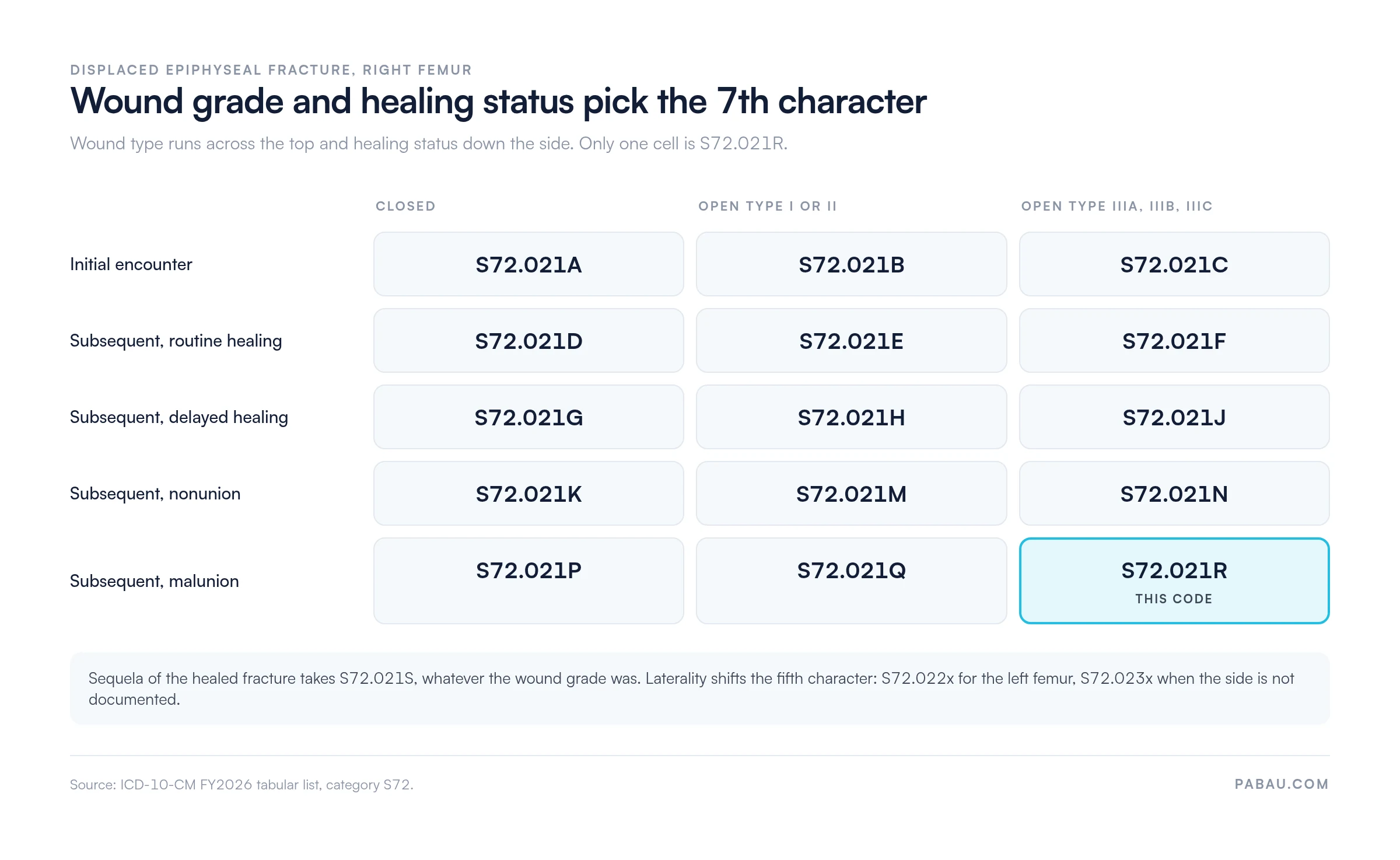
Malunion means the fracture has healed, but in an incorrect anatomical position. In other words, the bone consolidates, but not where it should. That’s the key clinical distinction coders must understand before applying ICD-10 Code S72.021R.
First, two closely related terms cause repeated coding errors. Understanding the difference, in turn, protects both claim accuracy and audit defensibility.
Malunion requires a very different clinical note than nonunion. The physician must document bony healing in a malposition, not just persistent symptoms or slow callus formation. Without that explicit statement, in other words, a payer reviewing the claim has no clinical basis for approving 7th character R over F, J, or N.
S72.021R applies only to an open fracture graded type IIIA, IIIB, or IIIC, at a subsequent encounter. Consequently, that rules out the emergency visit, debridement, and the first clinic appointment.
Using R on a closed fracture, or at an initial encounter, is a common audit finding. Denial management starts with catching these errors during the chart review.
The table below maps each Gustilo-Anderson grade to its malunion character.
Each element of the code must be supported in the record. Indeed, a single missing element can trigger a denial or an audit finding. Strong workflows build this into the chart review.
The same documentation habit applies across the ICD-10-CM code set, where a 7th character often depends on a detail only the clinician can record.
Document malunion at the visit where imaging confirms it, not at a later visit. Payers date the malunion finding to the encounter where the physician recorded it. Backdating or inferring malunion from a prior X-ray referenced at a later visit is a common audit flag.
Understanding where S72.021R sits in the ICD-10-CM hierarchy helps coders navigate the tabular list and cross-check code selection. Practices managing orthopedic billing at scale use claims management software to submit the coded claim. The software then tracks its progress once the coder has confirmed the selection.

Every code in the S72.021x family shares one anatomical location, the displaced epiphysis fracture of the upper femur. They differ only by laterality and by the 7th character, which carries encounter type and healing status. Coders also cross-reference nearby codes within S72.0 for neck-of-femur fractures.
Malunion coding errors on this code cluster around a small number of common patterns. Fortunately, each one is avoidable with a structured pre-submission review. Practices that cut denials on subsequent encounter codes tend to run that review at note sign-off rather than at the billing desk.
Epiphyseal fractures of the upper femur are injuries to the growth plate region at the upper end of the femur. Notably, the Salter-Harris classification system defines the severity of growth plate involvement. These fractures are most common in the pediatric and adolescent population, typically following high-energy trauma such as motor vehicle accidents or significant falls from height. Overall, open type III injuries at the upper femur are rare. The femur sits under thick muscle, so a wound that reaches it implies a very high-energy mechanism.
Displacement matters both clinically and for coding accuracy. Specifically, a displaced fracture means the bone fragments have shifted position relative to each other. Clinically, this raises the risk of avascular necrosis of the femoral head, growth disturbance, and, as captured by ICD-10 Code S72.021R, malunion. Practices managing orthopedic follow-up for this population depend on precise subsequent encounter coding.
Malunion in this anatomical location typically presents as limb length discrepancy, hip joint malalignment, or altered gait mechanics. Long-term outcomes depend a great deal on how quickly the malunion is identified and whether corrective osteotomy or other intervention is warranted. An open type III injury adds soft tissue loss and infection risk to that picture. Accordingly, the coding system mirrors that difference. ICD-10 Code S72.021R captures follow-up care for a complication whose management and reimbursement differ from routine fracture healing.
Review imaging reports at every follow-up visit for any S72.021 patient. The 7th character should be updated to reflect the current healing status, not carried forward from the previous visit. Switching from J (delayed healing) to R (malunion) requires a new X-ray finding documented in the current encounter note.
An orthopedic practice usually assembles a subsequent-encounter claim from three separate places. Typically, the Gustilo grade sits in the operative note, while the malunion finding sits in a radiology report. The diagnosis code then gets picked at the billing desk, often by someone who has read neither document.
Practice management software like Pabau keeps those records on one patient timeline. Clinical notes, uploaded imaging reports, and the coded diagnosis sit on the same chart. As a result, the person preparing the claim can see what the surgeon actually wrote about the wound.
From there, Pabau’s claims management tools submit the claim online and track its status through to remittance. Pabau does not pick the diagnosis code for you, so the coding decision stays with the clinician and the coder who reviewed the chart.
The result is fewer rebills on fracture follow-up claims, because each denial reason comes back attached to the record the coder worked from.

Pabau’s claims management tools help orthopedic practices submit cleaner claims, track subsequent-encounter claims through to remittance, and review denial reasons against the original record.

Coding ICD-10 Code S72.021R accurately means four facts have to line up in the record. The fracture is displaced, the original injury was an open type IIIA, IIIB, or IIIC, the encounter is subsequent, and imaging confirms malunion. Miss one and a clean claim turns into a denial or an audit finding.
In practice, the quickest way to get this wrong is to reach for R whenever the record says malunion. Instead, closed fractures take P, and open type I or II fractures take Q.
Pabau’s claims management tools help orthopedic practices submit and track subsequent-encounter claims across the fracture follow-up lifecycle. To see how they fit your workflow, book a demo.

Need to understand clean claim requirements for orthopedic billing? Clean claim best practices covers the documentation and submission standards that prevent first-pass denials.
Want to understand how remittance data identifies denial patterns? Electronic remittance advice explains how ERA files surface denial reasons and support appeal workflows.
Looking for a reference on medical billing fundamentals? What is medical billing covers the end-to-end revenue cycle process for healthcare practices.
ICD-10 Code S72.021R is the diagnosis code for a displaced fracture of the epiphysis (separation) (upper) of the right femur. Specifically, it applies at a subsequent encounter for an open fracture type IIIA, IIIB, or IIIC that has healed with malunion. Every element carries coding weight: displaced rather than nondisplaced, right femur rather than left, and epiphysis rather than neck or shaft. In short, the encounter must be subsequent, and the original injury must have been an open type III fracture.
The 7th character R indicates a subsequent encounter for an open fracture type IIIA, IIIB, or IIIC with malunion. Specifically, it is one of three malunion characters. P covers closed fractures, Q covers open type I or II fractures, and R covers the type III grades. Notably, R applies only when the bone has united in an anatomically incorrect position, confirmed by imaging.
Yes. In fact, S72.021R is valid for FY2025 and FY2026. It has been a billable code since ICD-10-CM took effect on October 1, 2015. Accordingly, the FY2026 edition carried it forward unchanged on October 1, 2025. Even so, coders should still verify against the CDC/NCHS ICD-10-CM web tool each year.
Specifically, the closest siblings are S72.021P for a closed fracture with malunion and S72.021Q for an open type I or II fracture with malunion. Across laterality, S72.022R codes the left femur and S72.023R codes unspecified laterality. Neck of femur fractures (S72.001x through S72.009x) are anatomically adjacent but code a different location. For this reason, do not substitute them when an epiphyseal fracture is documented.