ICD-10 Code S82.242H: Displaced spiral tibial shaft fracture, delayed healing
ICD-10 Code S82.242H: Definition and code details ICD-10 Code S82.242H designate...

Last Updated: Oct 15, 2026
Billable Code Specific Code
S68.522D is the billable ICD-10-CM code for partial traumatic transphalangeal amputation of left thumb, subsequent encounter.
Let Pabau's smart automation suggest the right codes, reduce claim denials, and keep your practice compliant—effortlessly.
Automate repetitive tasks and focus on what matters most—your patients.
Reduce coding errors and ensure compliance with the latest regulations.
Clean claims, fewer denials, and faster reimbursements.
Powerful insights and reporting to help your practice thrive.
HIPAA compliant SOC 2 certified GDPR-compliant Trusted by 4,000+ clinics worldwide

S68.522D describes a partial traumatic transphalangeal amputation of the left thumb at a subsequent encounter, not a finger injury
S68.5 is a thumb-only subcategory, so index, middle, ring and little finger amputations are coded under S68.6
Within S68.5 the 5th character sets complete versus partial and the 6th sets laterality, with no character for the digit
Category S68 defaults an amputation that is not identified as partial or complete to complete, so the note must say partial
S68.522D is POA exempt on inpatient claims and unchanged across the FY2025, FY2026 and FY2027 CMS code files
Practice management software like Pabau connects to Claim.MD for electronic claim submission, eligibility checks and remittance tracking
ICD-10 Code S68.522D is a valid, billable ICD-10-CM diagnosis code. Its full official description is: Partial traumatic transphalangeal amputation of left thumb, subsequent encounter. So every word in that description carries coding weight.
One tabular instruction deserves attention before you assign the code. Category S68 carries the note that an amputation not marked as partial or complete should be coded to complete. If the record never uses the word partial, S68.522D is the wrong choice and S68.512D applies instead.
The code is valid for submission on HIPAA-covered transactions, including CMS-1500 paper claims and 837P electronic claims.
This table sums up the billing facts coders and billers need before submitting a claim with S68.522D.
The 7th character is where coders most often go wrong on traumatic injury codes. Three 7th characters are valid for the S68.522 family. Each one describes the phase of care rather than the severity of the injury. Choosing the wrong one does not change the clinical story, but it does change whether the claim pays.
The ICD-10-CM Official Guidelines for FY2026 are explicit in Section I.C.19.a. Assignment of the 7th character rests on whether the patient is undergoing active treatment.
It does not rest on whether the provider is seeing the patient for the first time. A hand surgeon running a day 14 wound check uses D, even after performing the first repair.
In addition, the same section closes off a popular shortcut. Aftercare Z codes should not be used for injury aftercare where a 7th character exists. For routine follow-up on this amputation, report S68.522D rather than a general orthopedic aftercare code.
The practical test is simple. Ask whether the provider is actively treating the injury or managing its aftermath. Use character A for wound debridement, stump revision and replantation. Character D covers dressing changes, thumb range-of-motion work and suture removal. Reserve character S for a patient who returns years later with a painful neuroma traced to the amputation.
Sequela coding has one extra rule. When you use the 7th character S, report the specific late effect first and the injury code second. The S goes only on the injury code, which shows what caused the sequela.
For example, a common error appears when a patient transfers care. The second provider is not automatically in an initial encounter just because the patient is new to them. The 7th character reflects the phase of treatment, never the length of the clinical relationship.
Knowing where S68.522D sits in the hierarchy is what stops the finger-versus-thumb mistake. The table below traces the full parent chain from chapter down to the billable code. Similarly, other injury codes in our diagnostic code library follow the same path.
Read the characters in order and the code stops being confusing. S68.5 has already fixed the digit as the thumb. The 5th character then sets completeness, with 1 for complete and 2 for partial. Laterality comes from the 6th character, with 1 for right, 2 for left and 9 for unspecified. The map below gives each character the decision it owns.
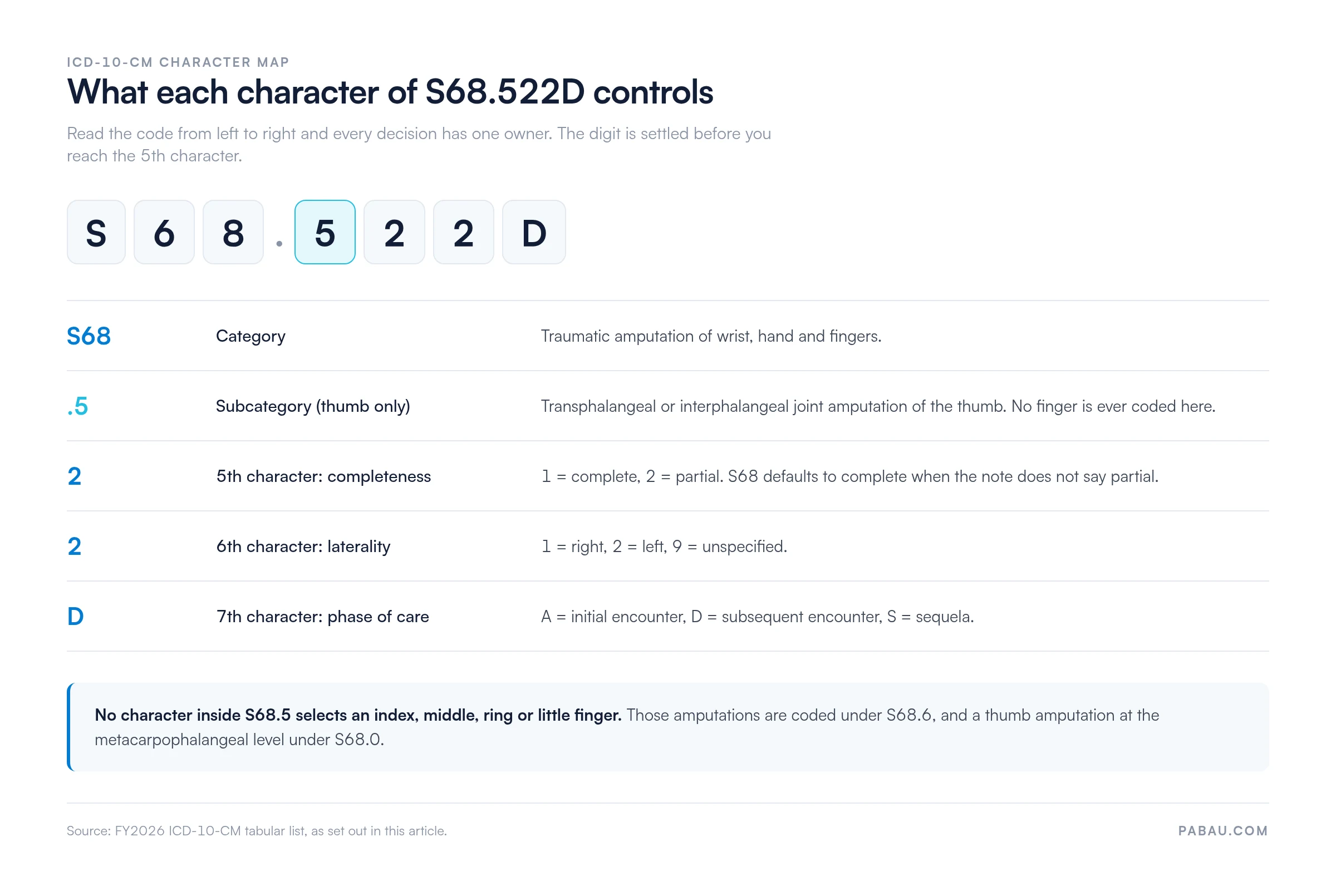
No character inside S68.5 selects an index, middle, ring or little finger. Those digits live in a separate subcategory, S68.6, Traumatic transphalangeal amputation of other and unspecified finger. Any crosswalk that maps S68.53 or S68.54 to a finger is wrong, because neither code exists.
Codes carrying 9 in the 6th position belong only in records that genuinely do not state a side. Payers increasingly treat missing laterality as an incomplete claim, especially on professional submissions. When the amputation is complete and no side appears in the record, the subsequent encounter code is S68.519D.
The thumb is built differently from the other digits, and that difference drives the code. It carries two phalanges, proximal and distal, joined by a single interphalangeal joint. By contrast, the other four digits each have three phalanges and two interphalangeal joints. A transphalangeal amputation of the thumb therefore happens at one of only two bone levels.
ICD-10-CM widens S68.5 slightly. The subcategory carries the inclusion term traumatic interphalangeal joint amputation of thumb, so a loss through the IP joint files here too. Amputation at the metacarpophalangeal level is a different subcategory and belongs to S68.0.
Partial versus complete is the next fork, and both options sit inside S68.5. Specifically, S68.51 covers complete transphalangeal amputation of the thumb and S68.52 covers partial.
A partial amputation leaves residual tissue at the amputation site, whether that is a remnant of phalanx, a soft tissue flap, or an attached tendon. The record should state what remains, since that detail supports the code and guides reconstruction planning.
At the subsequent encounter captured by S68.522D, active treatment is finished. The patient returns for wound care, hand therapy, prosthetic or orthotic assessment, or routine monitoring. Accordingly, notes for that visit should record healing status, any complication, and the current plan of care.
Record the amputation level and the state of the thumb interphalangeal joint in every follow-up note. S68.5 accepts both transphalangeal and IP joint amputations, so the level alone does not always separate S68.5 from S68.0 at the metacarpophalangeal level. Auditors reviewing amputation follow-up claims routinely compare the operative note against the subsequent encounter code. Vague anatomy is a frequent trigger for a documentation request.
S68.522D attracts more mis-assignments than most injury codes, because several neighboring codes read almost identically. The table below sets the usual suspects side by side.
The Alphabetic Index adds one more trap. Under Amputation, traumatic, thumb, the nonessential modifiers are complete and metacarpophalangeal, which point to S68.01-. A note reading only traumatic amputation of the left thumb therefore indexes to S68.012-, not to S68.522D. In short, documented level and documented completeness are both prerequisites for this code.
The S68.52 family covers partial traumatic transphalangeal amputations of the thumb across all lateralities and encounter types. Accuracy depends on picking the sibling that matches the documented side and phase of care.
Complete amputations at the same level move one subcategory up to S68.51x, where S68.512D covers the left thumb. Amputations of the index, middle, ring or little finger at the transphalangeal level are coded under S68.61x when complete and S68.62x when partial. Amputations at the thumb metacarpophalangeal level are coded under S68.01x and S68.02x.
Coding software and electronic medical record search fields rarely echo the official wording. Generally, the phrasings below all describe S68.522D and turn up regularly in clinical notes and lookup tools.
Treat these as documentation paraphrases rather than official index entries. When a note reads partial amputation of the left thumb through the proximal phalanx, subsequent visit, S68.522D is the code.
Verify every mapping against the current CMS code descriptions file rather than a memorized crosswalk. In fact, thumb and finger amputation codes are unusually easy to transpose.
Traumatic amputation codes follow ICD-10-CM Official Guidelines Section I.C.19, which governs injury coding across the S00-T88 chapter. Applying it properly prevents the errors that dominate hand surgery and orthopedic follow-up billing. The rules below apply to any traumatic injury encounter.
A follow-up template that prompts for digit, side, amputation level and encounter phase captures all four fields at the visit. As a result, structured forms wired into the clinical record are the most reliable way to do that consistently. A clean claim submission for amputation follow-up care needs all four present before the claim leaves the practice.
S68.522D pairs with CPT procedure codes that reflect the services usually delivered at a subsequent encounter for a traumatic thumb amputation. The code you select depends on the service the provider delivers during the visit.
CPT selection at a subsequent encounter follows the service performed. The evaluation and management level must be supported by the documented complexity of that visit, not by the severity of the first injury. A five-minute wound check with minimal decision making does not support 99214 just because the patient lost part of a thumb.
Subsequent encounter injury codes carry billing rules that differ from initial encounter codes. Consequently, getting these right reduces front-end rejections and post-payment audit exposure.
Electronic submission shortens the feedback loop on these rules. Practice management software like Pabau supports cleaner claims management by sending CMS-1500 and 837P claims through its Claim.MD integration. The same connection verifies eligibility, tracks claim status, and posts electronic remittance advice. A rejection tied to the 7th character then reaches the biller in days, not weeks.
Coding errors on amputation follow-up claims are rarely random. They cluster around a few recurring workflow breakdowns. Clinicians describe the digit and level in free text that the coder never sees. Billers reuse the 7th character from the previous visit. Nobody re-reads the operative note before the claim goes out. Ultimately, each one is a process problem that better workflow design can prevent.
Pabau closes the distance between the note and the code by keeping both in one record. When the follow-up template prompts for digit, side, amputation level and encounter phase, the coder sees all four fields. That happens before anyone chooses between S68.522D and its neighbors. Internal audits get faster too, because the supporting detail sits in a field rather than buried in narrative.
The Claim.MD integration then handles the submission side. Claims go out as CMS-1500 or 837P files, with eligibility verified against the payer beforehand. Each claim’s status comes back into the same record, and electronic remittance advice posts against the invoice. A denial on a 7th character therefore surfaces where the coder can act on it.

Pabau integrates with Claim.MD to submit CMS-1500 and 837P claims, verify eligibility and track every remittance. See how structured follow-up notes support accurate billing for subsequent encounter codes like S68.522D.

The subcategory does more damage on this code than the 7th character. Read S68.5 as a general finger group and the code lands on the wrong digit, with documentation that will not support it. Confirm three details before you submit: the thumb, the partial amputation, and the healing phase.
Pabau’s Claim.MD integration sends those claims electronically, then tracks each one through eligibility, status and remittance. For teams billing orthopedic and hand surgery follow-up, that shortens the loop between a rejected 7th character and a corrected claim. Finally, Book a demo to see how the follow-up note and the claim stay in one record.

Losing revenue to denied injury claims? Denial management in healthcare covers how to work a denial back to payment and stop the same rejection recurring.
Dealing with denials on follow-up visits? Medical billing denial codes breaks down the most common denial reasons and how to address them before resubmission.
Not sure what a clearinghouse adds to the process? Medical claims clearinghouse overview explains how an electronic claim travels between the practice, the clearinghouse, and the payer.
Looking for a broader billing compliance reference? Medical billing workflows explained covers the full revenue cycle from coding through remittance for healthcare practices.
ICD-10 Code S68.522D is a billable ICD-10-CM diagnosis code for a partial traumatic transphalangeal amputation of the left thumb at a subsequent encounter. It applies once active treatment has ended. At that point the patient is receiving routine, recovery, or follow-up care for the thumb injury.
Yes, S68.522D is a valid, billable ICD-10-CM diagnosis code accepted for HIPAA-covered transactions. It appears unchanged in the CMS code files for FY2025, FY2026 and FY2027. It is valid on CMS-1500 paper claims and 837P electronic claims.
The thumb only. Subcategory S68.5 is titled Traumatic transphalangeal amputation of thumb, so every code beneath it describes a thumb. Amputations of the index, middle, ring or little finger at the same level are coded under S68.6 instead. The equivalent left middle finger code is S68.623D.
The record must name the thumb rather than a finger and state the left side. It also has to describe the amputation as partial, and place the level at a phalanx or the thumb interphalangeal joint. The note must show that the visit is follow-up or recovery care. A secondary external cause code from Chapter 20 should be reported for the mechanism of injury.
Common pairings include 99213 or 99214 for office follow-up visits and 97110 for therapeutic exercise. Add 97530 for functional activity training and 97760 for thumb orthosis fitting. The CPT code must reflect the service actually provided. The evaluation and management level is supported by visit complexity, not by the severity of the first injury.
Yes. S68.522D appears on the CMS FY2026 POA exempt code list, together with the sequela code S68.522S. No present on admission indicator is assigned on an inpatient claim. The initial encounter code S68.522A is not exempt and still requires one.