ICD code S68.519D – Complete traumatic transphalangeal amputation of unspecified thumb
Billable Code•Specific Code
Code Definition
S68.519D is the billable ICD-10-CM code for complete traumatic transphalangeal amputation of unspecified thumb, subsequent encounter.
It applies when the thumb was fully severed through a phalanx, the record does not state right or left, and active treatment has ended. Post-amputation wound checks, therapy visits, and prosthetic fittings are typical subsequent encounters for this code.
Related Information
Chapter
S00-T88 Injury, poisoning and certain other consequences of external causes
Category
S68 Traumatic amputation of wrist, hand and fingers
Group
S68.519 Complete traumatic transphalangeal amputation of unspecified thumb
Billable
Yes
Code also known as
traumatic thumb amputation, complete digital amputation, traumatic transphalangeal amputation
Save time. Improve accuracy. Get paid faster.
Automate coding with Pabau
Let Pabau's smart automation suggest the right codes, reduce claim denials, and keep your practice compliant—effortlessly.
Complete traumatic transphalangeal amputation of unspecified thumb
Codes
Suggested by Pabau AI
S68.519DComplete traumatic transphalangeal amputation of unspecified thumb
ICD Code Suggestion
AI
Suggested code
S68.519DComplete traumatic transphalangeal amputation of unspecified thumbHigh match
Confidence score
98%
Why this code?
Matches patient diagnosis
Supported by clinical notes
Commonly used for this condition
Why practices choose Pabau
Save hours every week
Automate repetitive tasks and focus on what matters most—your patients.
Improve accuracy
Reduce coding errors and ensure compliance with the latest regulations.
Get paid faster
Clean claims, fewer denials, and faster reimbursements.
Grow with confidence
Powerful insights and reporting to help your practice thrive.
HIPAA compliant•SOC 2 certified•GDPR-compliant•Trusted by 4,000+ clinics worldwide
Key takeaways
S68.519D covers a complete traumatic amputation through the phalanges of the thumb at a subsequent encounter, when the record does not state which thumb.
The D suffix applies once active treatment has ended and the patient returns for routine care, such as a wound check, therapy, or prosthetic fitting.
When the note names the side, code S68.511D for the right thumb or S68.512D for the left thumb instead of the unspecified code.
Finger amputations through the phalanges use the separate S68.6 family, and thumb amputations at the metacarpophalangeal joint use S68.0.
Billing S68.519A for a follow-up visit is a 7th-character error that gives the payer grounds to deny the claim.
ICD-10 code S68.519D: Code overview and quick reference
S68.519D is a valid, billable ICD-10-CM code, and it remains valid in the FY2026 code set that took effect on October 1, 2025.
It sits in category S68 (traumatic amputation of wrist, hand, and fingers) within chapter 19 of ICD-10-CM, codes S00-T88.
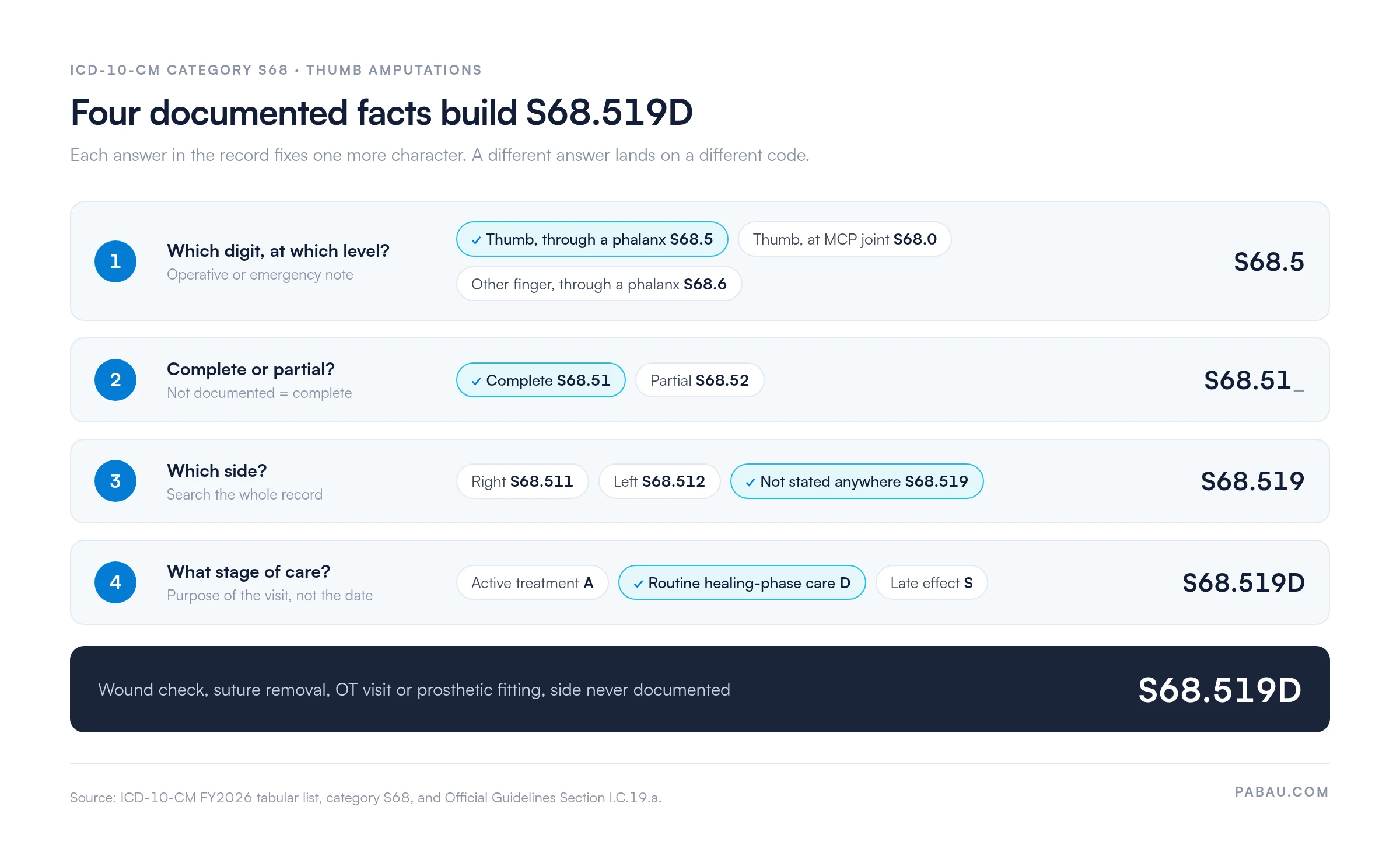
Within S68, subcategory S68.5 holds transphalangeal amputations of the thumb. S68.51 covers complete amputations and S68.52 covers partial ones. The sixth character then sets the side: 1 for right, 2 for left, and 9 for unspecified.
Field
Detail
Code
S68.519D
Official descriptor
Complete traumatic transphalangeal amputation of unspecified thumb, subsequent encounter
Billable
Yes, valid for claims to Medicare and commercial payers
ICD-10-CM chapter
19: Injury, poisoning, and certain other consequences of external causes (S00-T88)
Parent category
S68: Traumatic amputation of wrist, hand, and fingers
Subcategory
S68.51: Complete traumatic transphalangeal amputation of thumb
Laterality
Unspecified (the record does not state right or left)
7th character
D: subsequent encounter
Applicable care settings
Outpatient office, wound care, occupational therapy, hand surgery follow-up, prosthetic fitting
What S68.519D covers: Clinical scope and inclusions
S68.519D applies only when five conditions hold at the time of the visit. Each element of the descriptor is a coding criterion, and the record must support every one of them.
Complete amputation: The thumb was fully severed through the phalanges. A partial amputation, where soft tissue still connects the distal part, uses the S68.52_ codes. Under the S68 category note, an amputation documented as neither partial nor complete is coded as complete.
Traumatic mechanism: An external force caused the loss, such as a saw, crush, or machinery injury. A planned surgical amputation is not coded here.
Transphalangeal level: The amputation passed through the proximal or distal phalanx of the thumb. The thumb has only two phalanges, so there is no middle-phalanx level to document. An amputation at the metacarpophalangeal joint uses the S68.01_ codes instead.
Thumb with unspecified laterality: The record confirms the injured digit is the thumb but does not state right or left. When the side is documented, S68.511D (right) or S68.512D (left) applies.
Subsequent encounter: The patient is receiving routine care during healing, after active treatment has ended. This includes wound checks, dressing changes, suture removal, occupational therapy, and prosthetic fitting visits.
What S68.519D doesn’t cover: Exclusions and limits
Billing S68.519D when a more specific or different code applies is a specificity error that payers audit. Check these boundaries before you assign it.
Documented laterality: S68.511D (right thumb) and S68.512D (left thumb) are more specific. The CMS ICD-10-CM guidelines require the most specific code the documentation supports.
Partial amputations: S68.521D, S68.522D, and S68.529D cover partial transphalangeal amputation of the right, left, and unspecified thumb. Complete and partial codes are not interchangeable.
Fingers other than the thumb: Transphalangeal amputations of the index, middle, ring, and little fingers sit in the separate S68.6 family. For example, S68.610D is the right index finger. A thumb injury never takes an S68.6 code.
Metacarpophalangeal-level amputations: A thumb amputated at the metacarpophalangeal joint uses the S68.0_ family, such as S68.019D for an unspecified thumb. The S68.1_ codes cover the other fingers at that level.
Initial encounter: S68.519A applies while the patient is receiving active treatment. Using D for an active-treatment visit is as wrong as using A for a follow-up.
Sequela: S68.519S applies when the visit treats a late effect of the amputation, such as a painful neuroma or a joint contracture. Code the late effect first, then add S68.519S.
Understanding the 7th character D: Subsequent encounter rules
The 7th character D marks a subsequent encounter. Section I.C.19.a of the ICD-10-CM Official Guidelines applies it after active treatment, while the patient receives routine care during healing or recovery. The same rule runs through every injury code in chapter 19. D applies while the injury heals and the care is routine.
The three 7th characters for S68.519 each mark a distinct stage of care. Using A when D is correct invites a denial. Using D when A is correct misstates the visit and exposes the practice to audit.
7th character
Code
When it applies
Typical visit type
A (initial)
S68.519A
Patient is receiving active treatment for the injury
Emergency department visit, surgical treatment, evaluation and continuing treatment by a new provider
D (subsequent)
S68.519D
Routine care during healing, after active treatment
Wound check, dressing change, suture removal, OT visit, prosthetic fitting
S (sequela)
S68.519S
Treatment of a late effect of the original injury
Painful neuroma, joint contracture, scar revision
D applies to every routine visit in the healing phase, not only the first follow-up. The guidelines also bar aftercare Z codes for injuries, so post-amputation aftercare is reported with S68.519D itself. If a complication develops, code the complication and choose the 7th character that fits that encounter.
S68.519D vs adjacent codes: Choosing the right code
S68.519D sits among thumb amputation codes that differ by side, completeness, amputation level, and encounter type. The guidelines call for the most granular code the documentation supports, and each documented fact narrows the choice by one character.
Only the side and the stage of care separate S68.519D from its siblings, so those are the two facts to confirm before billing. Built from the ICD-10-CM FY2026 tabular list, category S68.
When any note in the record names the right or left thumb, move to S68.511D or S68.512D. Billing S68.519D when the side is clearly documented is a specificity downgrade that some payers flag. Confirm the full hierarchy in the CDC/NCHS ICD-10-CM web tool before you select a sibling code.
Code
Descriptor (abbreviated)
Key difference from S68.519D
S68.519A
Complete traumatic transphalangeal amputation of unspecified thumb, initial encounter
7th character A: active treatment, not follow-up care
S68.519S
Complete traumatic transphalangeal amputation of unspecified thumb, sequela
7th character S: late effect, not routine healing-phase care
S68.511D
Complete traumatic transphalangeal amputation of right thumb, subsequent encounter
Right thumb documented, so it is more specific than S68.519D
S68.512D
Complete traumatic transphalangeal amputation of left thumb, subsequent encounter
Left thumb documented, so it is more specific than S68.519D
S68.521D
Partial traumatic transphalangeal amputation of right thumb, subsequent encounter
Partial amputation of the right thumb
S68.522D
Partial traumatic transphalangeal amputation of left thumb, subsequent encounter
Partial amputation of the left thumb
S68.529D
Partial traumatic transphalangeal amputation of unspecified thumb, subsequent encounter
Partial amputation, side not documented
S68.0_D
Traumatic metacarpophalangeal amputation of thumb, subsequent encounter
Metacarpophalangeal joint level, not transphalangeal
S68.61_D
Complete traumatic transphalangeal amputation of other and unspecified finger(s), subsequent encounter
A finger other than the thumb, coded in a separate family
Documentation requirements for S68.519D
The medical record must support each element of the descriptor. A missing element gives the payer a technical basis for denial. A supportable S68.519D claim needs these minimum elements.
Traumatic mechanism: The note references the external cause, such as a table saw, press, or crush injury. A note that describes only the wound, with no mechanism, leaves the traumatic element unsupported.
Transphalangeal level: The original emergency note or operative report confirms the amputation passed through a phalanx of the thumb. Follow-up notes should reference that history or carry it on the problem list.
Completeness: The record distinguishes complete loss from a partial amputation. A phrase such as “complete traumatic amputation of thumb through the proximal phalanx” is supportable, while “thumb injury” is not.
Subsequent visit type: The note reflects routine healing-phase care rather than active treatment. Terms such as “wound check,” “suture removal,” or “post-amputation OT evaluation” signal a subsequent encounter.
Laterality: Search the whole encounter record for right or left. Use S68.519D only when no document states the side, and query the provider whenever the side can be confirmed.
Good billing documentation links each follow-up note to the original injury record. Post-amputation follow-up templates that carry forward the mechanism, level, and side spare clinicians from re-documenting them at every visit.
Payer requirements and S68.519D Medicare billing
Medicare and commercial payers accept S68.519D for the services below. Medical necessity and prior authorization policies attach to the CPT or HCPCS code billed, not to the ICD-10 code. Check current local coverage determinations (LCDs) with your Medicare Administrative Contractor (MAC) before assuming coverage.
Wound care visits: Pair the code with the wound care CPT code performed. Examples are 97597 or 97598 for selective debridement and 97602 for non-selective debridement. The diagnosis must link directly to the service billed.
Occupational therapy: S68.519D supports OT evaluations (97165-97167) and treatment codes such as 97530 and 97110 after a traumatic thumb amputation. Some plans require prior authorization after a set number of visits.
Prosthetic fitting visits: S68.519D can serve as the supporting diagnosis for a thumb prosthesis fitting or check. The HCPCS code for the device governs coverage separately.
Prior authorization: Requirements depend on the CPT code billed, so debridement, OT, and prosthetics may each carry separate thresholds. Check each payer’s policy rather than assuming a universal rule. Whatever CPT code you pair it with, S68.519D has to establish medical necessity for that service.
Pro Tip
Before billing S68.519D for an occupational therapy visit, confirm the OT note names the traumatic thumb amputation as the reason for treatment. A note that lists pinch or grip deficits without linking them to the amputation weakens medical necessity and raises denial risk.
Common claim denial reasons for S68.519D and how to fix them
Most S68.519D denials fit one of six patterns. Each has a corrective action, but the fix must address the documentation or coding habit behind it, not only the single claim.
Denial reason
Root cause
Corrective action
Wrong 7th character
S68.519A submitted for a follow-up visit
Change to S68.519D, and update coding templates to flag visits after active treatment
Specificity downgrade
Unspecified code billed when a note names the right or left thumb
Review the emergency or operative note for the side, query the provider if needed, and recode to S68.511D or S68.512D
Wrong digit family
A finger code from S68.6 billed for a thumb amputation, or the reverse
Confirm the injured digit in the operative note. Thumb codes sit in S68.5 and finger codes in S68.6.
Code-to-service mismatch
ICD-10 code does not support the billed CPT procedure
Confirm the CPT code relates to post-amputation care, and add a supporting diagnosis if needed, such as a wound complication code
Missing medical necessity
Visit note does not justify continued wound care or therapy
Document wound status, functional deficits, and measurable progress goals at each visit
Partial instead of complete
Complete amputation code billed when the record describes a partial amputation
Review the original injury documentation, and recode to S68.521D, S68.522D, or S68.529D if the amputation was partial
The claim denial codes on the explanation of benefits (EOB) point you to the pattern behind each denial. CARC 11 means the diagnosis is inconsistent with the procedure, which usually signals a code-to-service mismatch. CARC 4 means the procedure code is inconsistent with the modifier used, or a required modifier is missing.
CARC 197 means precertification, notification, or authorization was absent, so the fix is an authorization request, not a code change. Read each denial on the electronic remittance advice (ERA) before you resubmit, so the correction targets the cause.
Pro Tip
Run a monthly audit of S68.519D claims by date of service. D-coded claims dated within days of the injury deserve a second look, and so do claims where a later note records the side. Correct the encounter type or laterality at the source in your EHR workflow.
Coding scenarios: When to use S68.519D
Encounters do not always map cleanly to a descriptor. These four scenarios show the decision logic for S68.519D across post-amputation care settings. Each follows the same guideline principle: D applies once active treatment has ended and care is routine.
Scenario 1: Wound care follow-up. A patient returns to the hand surgery practice on day 10 after a table-saw injury that completely amputated the thumb through the proximal phalanx. The surgeon changes the dressing and checks healing. Neither the emergency record nor the operative note states which hand. Code: S68.519D. A query to confirm the side is still worth sending, because a documented side moves the claim to S68.511D or S68.512D.
Scenario 2: Occupational therapy evaluation. Four weeks after the injury, the patient is referred to OT for pinch and grip retraining. The referral reads “post-traumatic thumb amputation, side not documented.” Code: S68.519D. OT after the acute surgical phase is a subsequent encounter, even at the first OT visit.
Scenario 3: Prosthetic fitting. Six weeks after the amputation, the patient attends a fitting for a custom thumb prosthesis. The fitting is not active treatment, so S68.519D is the supporting diagnosis. The HCPCS code for the device drives coverage separately.
Scenario 4: Reconstruction consult. Two days after initial management at another facility, a hand surgeon evaluates the patient for thumb reconstruction. The guidelines treat evaluation and continuing treatment by a different physician as active treatment. Code: S68.519A for this visit. Apply D only when no active treatment is planned or performed at the visit.
The ICD-10-CM Official Guidelines for Coding and Reporting, Section I.C.19, govern the 7th character rules for S68.519D. These provisions apply to this code family.
Active treatment: Surgical treatment and an emergency department encounter are guideline examples of an initial encounter (7th character A). Evaluation and continuing treatment by the same or a different physician also counts.
Subsequent encounter scope: D applies after active treatment, while the patient receives routine care during healing or recovery. The guidelines list examples such as cast change or removal, medication adjustment, and other aftercare and follow-up visits.
No aftercare Z codes for injuries: Injury aftercare is reported with the injury code and 7th character D, never with an aftercare Z code.
External cause codes: The guidelines encourage reporting an external cause code alongside injury codes such as S68.519D. Codes from chapter 20 (V00-Y99) describe how the amputation happened and support medical necessity.
The AAPC Codify ICD-10-CM lookup reflects the current code set and shows guideline notes with each code. That makes it a useful check before claim submission. CMS publishes each annual tabular list release and the matching guidelines, so check there when a new fiscal year starts.
How claims management software prevents S68.519D denials
Most errors on this code start in the record, long before the clearinghouse sees the claim. A follow-up note that drops the side, or a template that defaults to 7th character A, turns a routine visit into a denial.
Practice management software like Pabau keeps the injury history, the visit notes, and the claim in one patient record. Its error-checking claims management software runs validation checks each time a claim is sent, so your team sees problems before the payer does.
US claims go through the Claim.MD clearinghouse, with real-time eligibility checks and a status on every claim from submission to payment or denial. Electronic remittance advice flows back into Pabau and ties each payment to the claim it settles.
Reduce denials on post-amputation claims
Pabau runs validation checks before every claim is sent and tracks each one through Claim.MD. Your team catches coding problems before the payer does.
S68.519D asks for two precise choices, and each one carries its own denial risk. The 7th character tells the payer where the patient is in care. The unspecified laterality tells them the record never named the side.
Treat the unspecified code as a fallback, and query for right or left whenever the operative note allows it. Let the purpose of the visit, not the calendar, set the 7th character.
A practice that fixes both at the template level stops reworking the same denial every month. Pabau supports submitting a clean claim by running validation checks before each claim goes to Claim.MD. Book a demo to see how Pabau helps hand surgery and wound care practices get S68.519D claims paid the first time.
Continue your research
Need to understand how clearinghouse claim submission works?Medical claims clearinghouse guide explains the end-to-end path from practice to payer and where ICD-10 validation happens.
Want to track denial patterns across your practice?Revenue cycle management overview covers how to build a denial trend dashboard and close revenue leaks systematically.
Stuck on the same denial every month?Denial management in healthcare sets out how to track, appeal, and prevent recurring denials across a practice.
ICD-10 code S68.519D is the billable diagnosis code for complete traumatic transphalangeal amputation of an unspecified thumb, subsequent encounter. It applies when a patient returns for routine care after active treatment of a traumatic thumb amputation has ended. Unspecified means the record does not state the right or left thumb.
Is S68.519D a billable ICD-10 code?
Yes. S68.519D is a valid, billable ICD-10-CM code, and it remains valid in the FY2026 code set that took effect on October 1, 2025. It can be submitted to Medicare and commercial payers for eligible subsequent encounter services after a traumatic thumb amputation.
What is the difference between S68.519A, S68.519D, and S68.519S?
The 7th character is the only difference. S68.519A is for encounters where the patient is receiving active treatment for the injury. S68.519D is for subsequent encounters involving routine care after active treatment. S68.519S applies to sequela visits for a late effect of the original amputation, such as a painful neuroma or a joint contracture.
When should I use the D suffix instead of the A suffix for a thumb amputation?
Use D when active treatment has ended and the patient returns for routine healing-phase care. Use A while the patient is receiving active treatment, including surgery, the emergency department visit, and evaluation by a new provider. A wound check on day 10 after surgery takes D, and the original emergency visit takes A.
Why would a claim with S68.519D be denied?
The most frequent reason is a wrong 7th character, such as A billed for a follow-up visit. Another is a specificity downgrade, where the unspecified code is billed although a note names the right or left thumb. A code-to-service mismatch, a finger code billed for a thumb injury, and thin medical necessity documentation also trigger denials.
Can S68.519D be used for a finger amputation?
No. S68.519D covers the thumb only. Complete transphalangeal amputations of the other fingers use the S68.61_ codes, such as S68.610D for the right index finger at a subsequent encounter.
Can S68.519D be used for occupational therapy or physical therapy visits?
Yes. S68.519D is appropriate for OT and PT visits after the acute treatment phase, because the guidelines assign D to routine care during healing or recovery. Some payers require prior authorization for therapy episodes, so verify coverage before starting an extended therapy plan.