ICD-10 code S61.201A: Open wound of left index finger without nail damage
ICD-10 code S61.201A covers a left index finger wound of unstated type ICD-10 co...

Last Updated: Oct 16, 2026
Billable Code Specific Code
S63.618A is the billable ICD-10-CM code for unspecified sprain of other finger, initial encounter.
The index, middle, ring, and little fingers each carry their own codes, S63.610 through S63.617. S63.618A picks up only what those cannot. Pick it too early and the claim meets a specificity edit.
Let Pabau's smart automation suggest the right codes, reduce claim denials, and keep your practice compliant—effortlessly.
Automate repetitive tasks and focus on what matters most—your patients.
Reduce coding errors and ensure compliance with the latest regulations.
Clean claims, fewer denials, and faster reimbursements.
Powerful insights and reporting to help your practice thrive.
HIPAA compliant SOC 2 certified GDPR-compliant Trusted by 4,000+ clinics worldwide

S63.618A is billable under the 2026 edition, and it means unspecified sprain of other finger, initial encounter.
The parent code S63.618 is not billable on its own, so the claim needs a 7th character of A, D, or S.
The index, middle, ring, and little fingers carry their own codes, S63.610 through S63.617. Reach for those first.
Use S63.618A when the note names a non-thumb finger but omits the side. Use S63.619A when no finger is named at all.
Thumb sprains never map here. They sit in S63.60, S63.62, S63.64, or S63.68, depending on the joint documented.
Practice management software like Pabau attaches the code to the encounter record, so the side documented at the visit reaches the payer.
S63.618A is a billable, specific ICD-10-CM diagnosis code, so it can stand alone as the reason for the visit. Here is the reference data the tabular list carries for it.
Every character carries a meaning, either anatomical or about the encounter. Reading them in order is the quickest way to confirm you have the right code rather than a sibling.
The CMS ICD-10-CM coding resources set out the chapter and category hierarchy that structure follows.
The unspecified sprain designation applies when the record names no injured structure. That covers notes that skip the collateral ligament, the volar plate, and any other named tissue.
Capture whatever ligament detail the provider did record before you default to unspecified, because the S63.6 block excludes documented ruptures.
S63.618 without a 7th character is not billable. The choice between A, D, and S is no formality either, because payers reject claims where the character conflicts with the encounter documented.
The CDC/NCHS ICD-10-CM web tool confirms all three are valid for the 2026 edition.
One audit finding turns up again and again. Physical therapy encounters get billed with the A suffix long after the first visit. Once active treatment has been delivered, the patient has moved into routine follow-up.
At that point the suffix has to change from A to D, per the ICD-10-CM Official Guidelines. That rule holds across every traumatic injury code in the S00-T88 chapter.
Check the 7th character against the encounter note before submitting. If the provider documents “follow-up for finger sprain” or “routine rehab visit,” that is a subsequent encounter (D), not an initial one (A). Mismatched suffixes are a leading cause of claim edits for musculoskeletal injury codes.
S63.618 is the non-billable parent. Walk down the hierarchy and each level narrows the injury a little further.
The four levels above the last one are headings in the tabular list, not claim codes. A claim carrying S63.618 on its own gets rejected at the front door, before a human reviewer ever sees it.
S63.618A covers a finger sprain that no more specific code in the S63.61 series will take. Each named non-thumb finger already has its own pair of codes, one per hand.
The tabular list gives S63.618 a single inclusion term, “unspecified sprain of specified finger with unspecified laterality.” That is the situation coders meet most often.
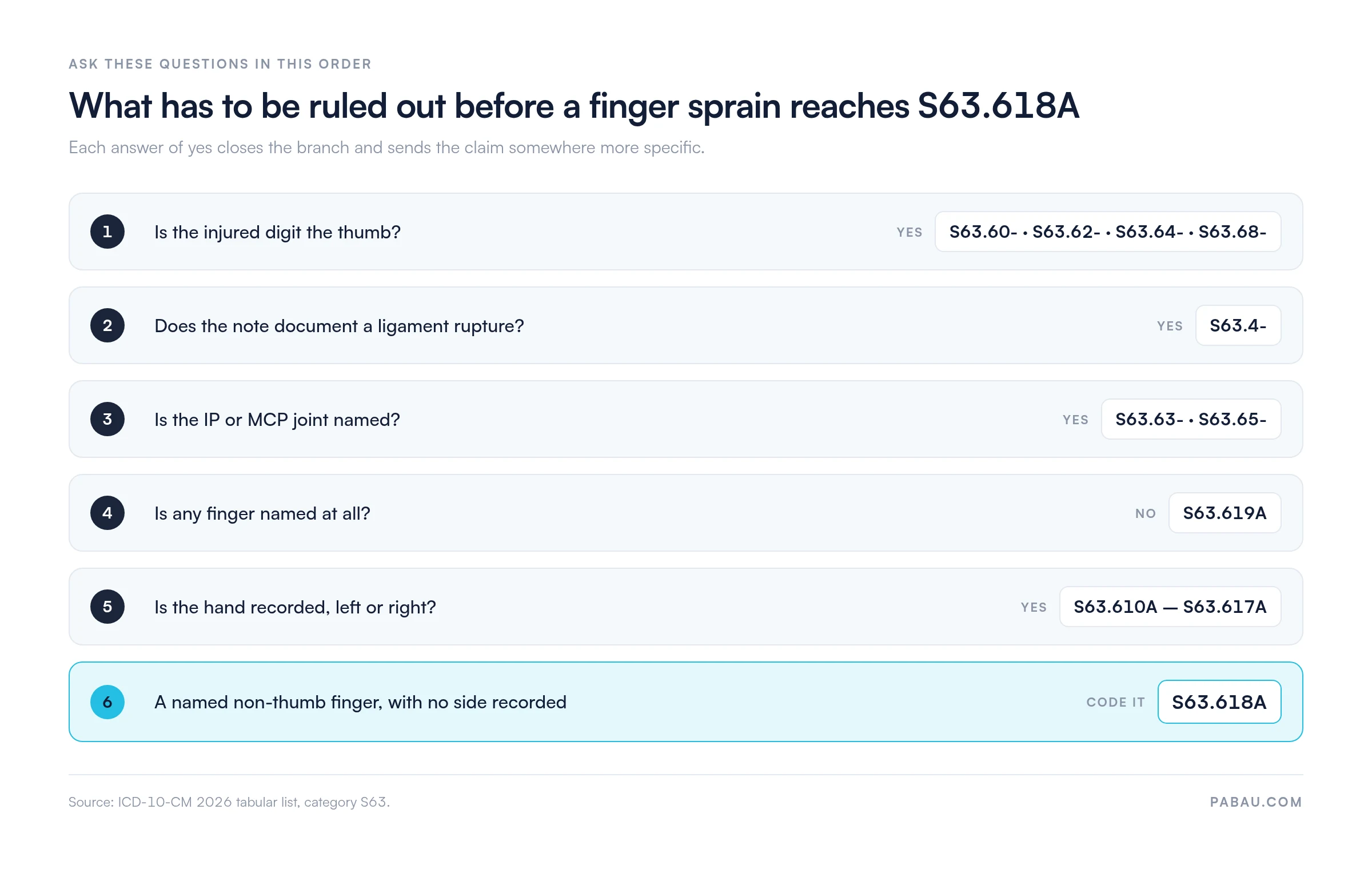
The order of that table is the order of preference. ICD-10-CM guidelines require the most specific code the record supports, so a documented right ring finger sprain belongs in S63.614A. S63.618A becomes correct only once the eight laterality-specific options are ruled out.
Treating it as the default for every finger except the thumb undercuts the notes, and specificity edits exist to catch that. Read the preference order as a short sequence of questions instead. Each yes closes a branch and sends the claim somewhere tighter.
These two codes are not interchangeable, and one detail separates them. S63.618A needs the finger named in the record, with the side left out. S63.619A applies when the note says “finger sprain” and never identifies which finger was hurt.
Reading S63.618A as the general fallback quietly overwrites that distinction, and it puts a specified-finger code on an unspecified-finger note.
If the note names the finger but not the hand, S63.618A is correct as written. It is still worth a documentation query. Adding “right” or “left” moves the claim to a code between S63.610 and S63.617, which removes the specificity flag before a payer raises it.
The thumb sits outside the S63.61 series entirely. It has four families of its own, and the joint documented decides which one applies. Sending a thumb sprain to S63.618A is a coding error rather than a shortcut.
S63.64- carries the thumb sprain that practices bill most often. The ulnar collateral ligament sits at the thumb metacarpophalangeal joint, and that injury is what clinicians call skier’s thumb.
There is a second reason to know these families well. The Excludes1 note at S63.6 redirects documented finger ligament ruptures to S63.4-, and that family contains no thumb codes at all. A documented thumb ligament rupture therefore stays inside the S63.6 thumb families.
The table above lists initial encounter codes, and the 7th character changes at follow-up. A right thumb interphalangeal sprain seen again later is S63.621D.
Provider notes rarely use tabular language. The phrase in the chart decides the code, so it helps to see the common wordings beside what each one actually supports.
The pattern is consistent. Every extra detail in the note moves the claim out of S63.618A. Naming the hand, the joint, or the torn structure points to a code that survives review.
Thin documentation is the main reason payers flag or deny finger sprain claims. The record has to support the initial encounter suffix and the unspecified sprain designation together. Structured encounter notes, with prompts for the side and the mechanism, head off most of these edits.
S63.618A is the diagnosis. The procedure codes billed beside it come from the work done at that first visit, and payers read the pair together. A splint applied at that visit is coded by its type. A fixed-position finger splint is 29130, and one allowing controlled motion is 29131.
Add an external cause code from the W, X, or Y range to show how the injury happened. Category S63 also carries a code also instruction for any associated open wound, which is easy to overlook on splinting claims.
Several adjacent codes share clinical territory with S63.618A. The right pick depends on the joint named, the digit involved, and whether the record describes a rupture rather than a sprain. A documented dislocation moves the claim out of S63.6- altogether. A left little finger dislocation with no joint named is S63.257A.
Full descriptions for each of these sit in the AAPC ICD-10-CM code lookup, which mirrors the tabular list.
Practices migrating older records have to map legacy ICD-9-CM codes to their ICD-10-CM equivalents. The General Equivalence Mappings run in both directions, and the two directions do not always agree.
The ResDAC guide to ICD codes in Medicare files explains how GEMs are used in claims research and where they break down.
That asymmetry is the point worth carrying away. A GEM crosswalk is a research tool rather than a coding instruction, and it does not round-trip. For retrospective record review, verify against the original clinical documentation instead of trusting a conversion table.
Follow one finger sprain claim out of the exam room and the stalls become obvious. The clinician documents the injury, the coder picks S63.618A, and the scrubber checks that diagnosis against the CPT lines. From there the claim goes to the clearinghouse, then to the payer, then back as a remittance.
Three stalls account for most of the rework. One happens in the note, when nobody records the side. Another shows up at the scrubber, which flags an unspecified code sitting beside a splint or X-ray line. Last comes the payer’s specificity edit.
When a claim does come back, the remittance names a reason rather than a fix. Read it against the standard denial codes and you learn which path to take. Some cases need a laterality query, others only need a corrected claim.
Run these five checks before the claim leaves the building. Each one maps to a rejection reason payers actually use, and together they cover most of what makes a clean claim on a finger sprain.
Two mistakes survive that checklist more often than any other. Billers submit the parent code S63.618 with no 7th character, and they leave the A suffix on the third therapy visit. Both are quick to catch at the scrubber, and both are cheaper to prevent at the note.
In most practices the diagnosis gets chosen twice. A clinician writes “sprained index finger” in the note. Hours later a coder rebuilds that phrase into a code, working from memory or a paper superbill. The side goes missing in the handoff, and the claim lands on S63.618A when the exam supported S63.610A.
Pabau, a practice management software platform, closes that handoff. Our single-screen claims management attaches the ICD-10-CM code to the encounter record itself. The code assigned during the visit is the code that travels to the payer, and coders work in the same screen as the note.
For US practices submitting electronically, our Claim.MD clearinghouse integration reaches thousands of US payers and validates ICD-10-CM codes before submission. Teams can then read each remittance against their finger sprain claims and spot payer patterns early. The same specificity edit stops repeating every month.

Pabau links ICD-10-CM diagnosis codes directly to clinical notes and routes claims through the Claim.MD clearinghouse. That way, 7th character errors and unspecified-code denials get caught before they reach the payer.

S63.618A is a clean, billable code in the one situation it was written for. The note names a non-thumb finger, the record does not say which hand, and no joint or ligament is named. Step outside that and a more specific code almost always exists.
Two habits keep these claims moving. Confirm the encounter type before you pick the 7th character, and confirm the side before you settle on the sixth. Both details live in the clinical note, which is exactly where practices lose them.
If you want the note and the claim to stay attached, book a demo. We will show you how Pabau keeps the code you assigned at the visit on the claim that reaches the payer.

Need to see where diagnosis coding sits in the wider billing cycle? What is revenue cycle management follows the money from code assignment through to payment posting.
Getting unspecified-code denials back from payers? Denial management in healthcare sets out how to appeal and prevent the patterns behind injury-code rejections.
Wondering how electronic claim submission validates a code? Pabau’s Claim.MD clearinghouse guide walks through the checks a claim passes before it reaches the payer.
For as long as the patient is receiving active treatment for the injury. The calendar does not decide it. Once care becomes routine healing, such as splint checks or therapy, the claim moves to S63.618D.
Yes. A sprain injures a ligament, so it sits in S63.6-. A strain injures muscle or tendon, and those injuries sit in the S66 block for the wrist and hand. Read the note before assuming.
The claim is valid without one. Many payers and trauma registries still expect one anyway. Add a code from the W, X, or Y range describing how the injury happened.
Yes. When the sprain is the reason for the visit, it leads the claim. List any associated open wound code after it, then the external cause code.
Often, yes. Jammed finger is patient language, and it usually describes a sprain. Check first whether the note names the digit and the side, because either detail moves the code.
No. Modifiers attach to procedure codes, not to diagnosis codes. The finger modifiers, FA and F1 through F9, identify the digit on the CPT line, such as a splint application.
No. A dislocated finger joint has its own codes in the S63 dislocation block. Use a sprain code only when the joint stayed in place.