ICD-10 Code S62.622A: Displaced fracture of middle phalanx of right middle finger
ICD-10 code S62.622A is the billable code for a displaced fracture of the middle...

Last Updated: Nov 4, 2026
Billable Code Specific Code
S63.208D is the billable ICD-10-CM code for unspecified subluxation of other finger, subsequent encounter. Other finger means the record names the finger, such as the ring finger, but not whether it is on the right or left hand.
The D marks a visit in the healing phase, after active treatment has ended. Follow-up checks, splint changes and physical therapy visits typically take it. If the note names the side, a side-specific code from S63.200 to S63.207 applies instead.
Let Pabau's smart automation suggest the right codes, reduce claim denials, and keep your practice compliant—effortlessly.
Automate repetitive tasks and focus on what matters most—your patients.
Reduce coding errors and ensure compliance with the latest regulations.
Clean claims, fewer denials, and faster reimbursements.
Powerful insights and reporting to help your practice thrive.
HIPAA compliant SOC 2 certified GDPR-compliant Trusted by 4,000+ clinics worldwide

S63.208D covers an unspecified subluxation of a finger the record names, such as the middle finger, when the note does not say which hand.
The 7th character D applies once active treatment has ended, so follow-up checks, splint changes and physical therapy visits take it.
When the note gives the side, use the side-specific code instead: S63.200 to S63.207 cover the right and left index, middle, ring and little fingers.
A documented joint moves the code out of S63.20- and into the MCP or interphalangeal subcategories, S63.21- to S63.24-.
Pabau’s claims management software validates each claim for missing or invalid details before it goes to the clearinghouse.
ICD-10 Code S63.208D is the billable code for a follow-up visit after an unspecified subluxation of a named finger, when the side is not documented. Check the facts below before the claim goes out, and confirm external cause rules against your payer’s policy.
The CDC/NCHS ICD-10-CM web tool is the authoritative US lookup, and CMS publishes annual ICD-10 update files covering additions, deletions and revisions.
In medical billing workflows that handle injury codes at volume, check two details on every claim: the 7th character and the finger’s side.
Each segment of S63.208D narrows the diagnosis. Read from left to right, the segments are:
In plain terms, S63.208D describes a follow-up visit for a partly displaced finger joint. The note names the finger but not the hand, and it doesn’t name the joint. Document the joint, and the code moves to the MCP or interphalangeal subcategories, S63.21- through S63.24-.
S63.208D covers any of the four fingers when the record names it but leaves out the side. It is not a slot for a fifth digit. The table maps each S63.20- code so you can confirm the right one.
Thumb subluxations sit in S63.1-, not S63.20-, so S63.208D on a thumb injury is a coding error. Before you settle on S63.208D, check the referral and imaging notes for the side.
A side recorded anywhere in the encounter supports the more specific code. When the note doesn’t name the finger at all, the S63.209 codes apply, starting with S63.209A at the first treatment visit.
The chart below puts both decisions in one place: the code the note supports, and the 7th character the visit takes.
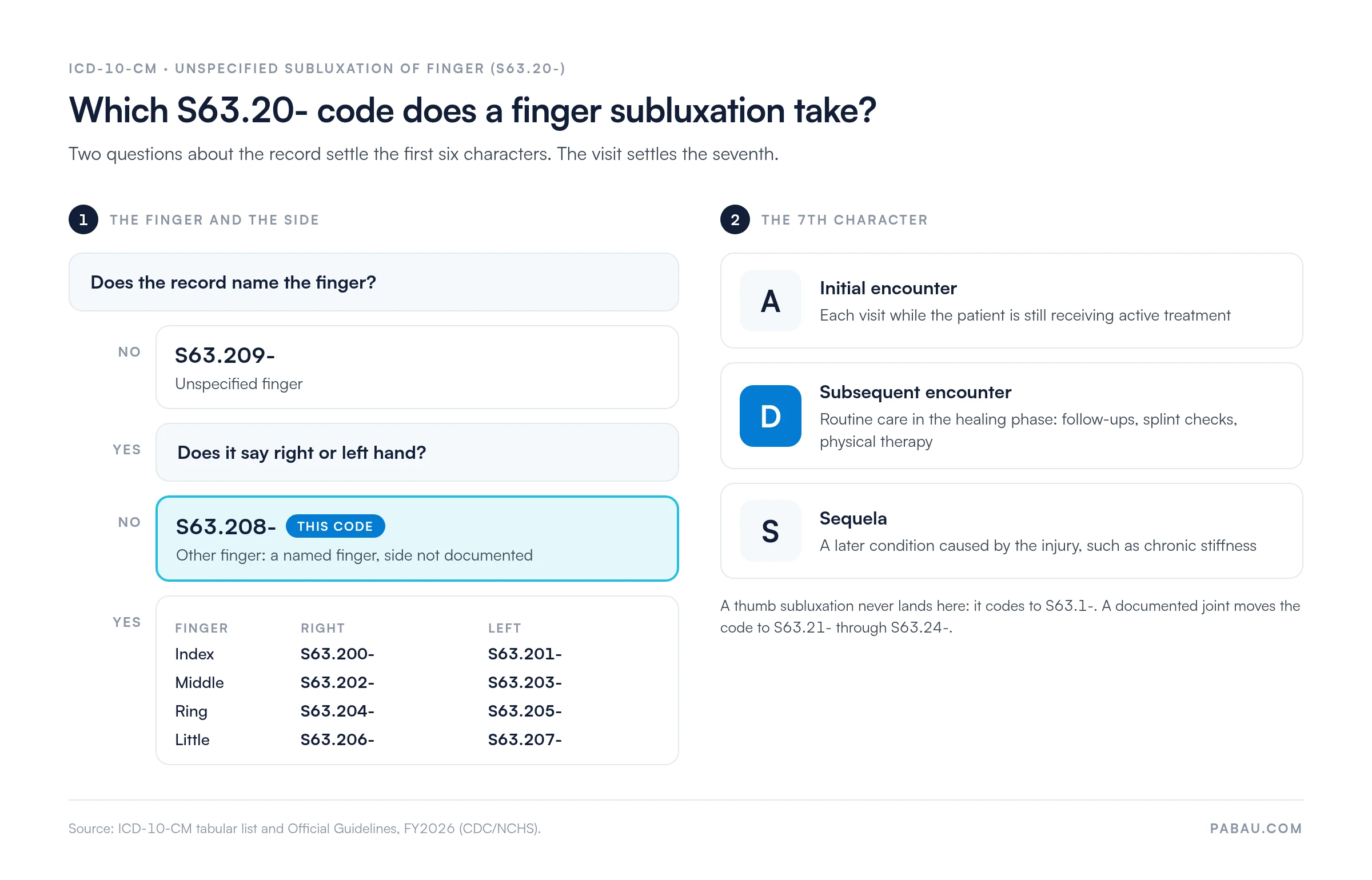
The 7th character D marks a subsequent encounter. The patient has finished active treatment and now receives routine care while the injury heals. Under the ICD-10-CM Official Guidelines (Section I.C.19.a), the choice rests on the phase of treatment, not on calendar time.
Physical therapy after the reduction is usually coded D, because the therapist supports recovery from an injury that has already been treated. The 7th character follows the treatment phase, not the provider, so a therapist’s first visit can still carry the D character. On a sequela claim, the condition itself, such as stiffness, is coded first and S63.208S follows it.
S63.208D sits in a dense cluster of subluxation and sprain codes. The wrong digit, encounter type or injury category is both a specificity error and a denial risk. The AAPC Codify ICD-10-CM lookup lets you move through the S63 hierarchy one level at a time.
Subluxation (S63.20-) means a partial displacement of the joint. A sprain (S63.6-) means a stretched or torn ligament without displacement. Code from what the provider documents. A note that says “jammed finger” with no mention of displacement points to the sprain codes. If the provider records a partial displacement, the subluxation code is correct.
Documentation for S63.208D has to support the diagnosis, the healing phase and the visit itself. Auditors look for the original injury, evidence that active treatment has ended, and a reason for this visit. Clean claim submission starts with a record that holds each of them before the claim goes out.
Before you submit an S63.208D claim, confirm three things in the chart. Look for a note showing the injury was treated, a current note with objective findings, and the mechanism of injury. Then check the referral and imaging notes for the hand. A side recorded anywhere changes the code.
Physical therapists report S63.208D for outpatient rehabilitation of a finger subluxation once active treatment has ended. The ED or orthopedist treating the injury reports S63.208A. Therapy visits during recovery then carry S63.208D for the whole episode, as long as the side stays undocumented.
The usual CPT pairings are therapeutic exercise (97110), manual therapy (97140) and therapeutic activities (97530). Medicare ended functional limitation reporting with G-codes on January 1, 2019. It still expects a certified plan of care with measurable goals, and a progress report at least once every 10 treatment days.
Document the specific deficit on every visit, such as reduced grip strength or limited range of motion. That one line is what ties each therapy code back to S63.208D.
External cause codes record how, where and during what activity the finger injury happened. No national rule makes them mandatory, but some commercial plans and workers’ compensation carriers ask for them. Where they’re reported, they give your revenue cycle management team the mechanism of injury without a trip back to the chart.
The 7th character carries over to W-series codes on later visits. If the first claim used W21.09XA, the follow-up claim carries W21.09XD. A mismatch between the injury code and its external cause code can get the claim rejected.
Denials on S63.208D usually come from a handful of coding and documentation errors. Reporting A after treatment has ended, or D while it is still under way, invites both coding and medical necessity denials.
Structured denial management workflows and a clear list of medical billing denial codes help you trace each rejection to its cause. That beats resubmitting the same error.
Most S63.208D errors start between the clinical note and the claim form. The note names the finger, but the side sits in an imaging report. Or the 7th character gets copied from the last claim instead of read from the treatment phase.
Pabau, the practice management platform we build, keeps the treatment note, the invoice and the claim in one patient record. Its claims management software opens each claim pre-filled from the invoice. Claim validation then scrubs it for missing or invalid details before it leaves Pabau.
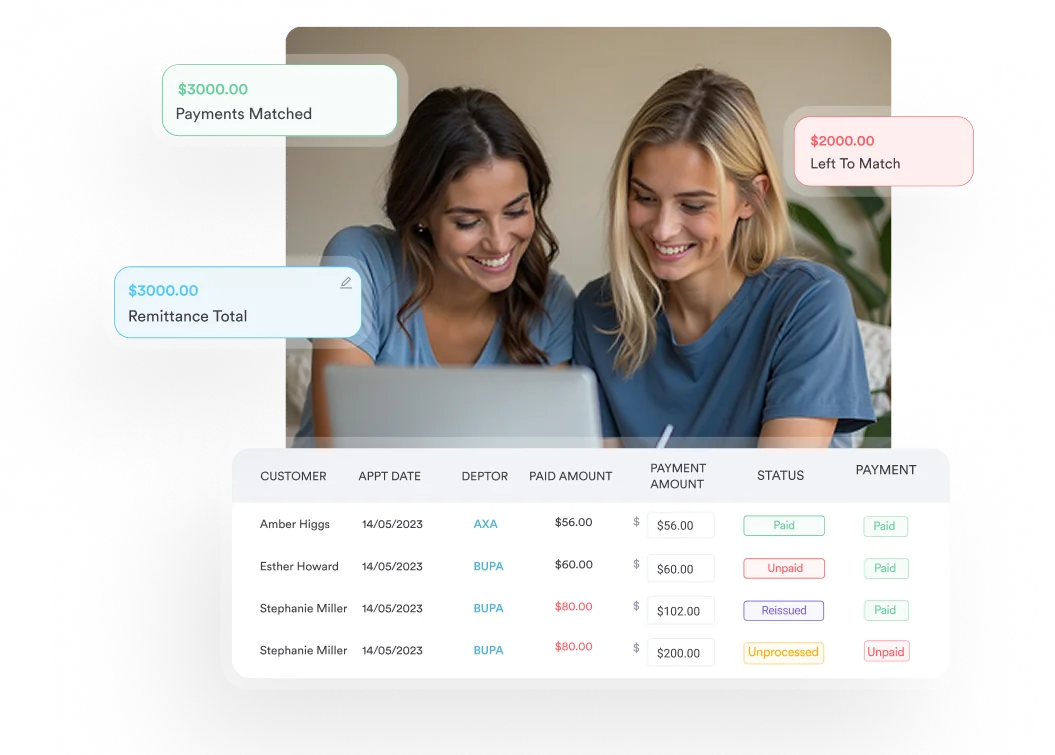
US claims go to payers as CMS-1500 claims through the Claim.MD clearinghouse. You can check eligibility before the visit and settle payments from electronic remittance advice. If a claim comes back rejected, Pabau flags it Needs action and shows the reason, so the fix happens the same day.

Pabau builds each claim from the invoice, validates it for missing or invalid details, and sends it through Claim.MD. Rejected claims show the reason, so your team fixes them the same day.

S63.208D is the right code in a narrow situation. The note names the finger and leaves out the hand, and the visit falls in the healing phase. Each of those facts lives in the documentation, and a coder can’t infer any of them.
The cheapest fix sits upstream. Ask providers to record the side and the joint on the first note, and S63.208D shrinks to the rare case it was built for. The more specific code that replaces it is also the one auditors expect to see.
Book a demo to see how Pabau builds injury claims from the visit note and validates them before they reach the payer.

Need to understand how clearinghouse claim validation works? Pabau’s Claim.MD clearinghouse guide explains how real-time eligibility checks and claim scrubbing reduce denials before submission.
Want to reduce claim denials at the source? Clean claim submission best practices outlines the documentation and coding steps that prevent denials before a claim leaves the practice.
ICD-10 Code S63.208D is the billable code for an unspecified subluxation of other finger at a subsequent encounter. Other finger means the record names the finger but not the hand. The D covers routine care after active treatment, such as follow-up visits and physical therapy.
Yes, S63.208D is a billable ICD-10-CM code. The parent code S63.208 is not billable on its own. A claim that omits the 7th character is rejected as an invalid code.
The 7th character sets the phase of care. A covers each visit while the patient receives active treatment. D covers routine care in the healing phase, including physical therapy. S applies to a later condition caused by the injury, coded after that condition. The diagnosis is the same across all three.
Yes. Physical therapists report S63.208D for rehabilitation visits once active treatment of the subluxation has ended. Each visit needs objective findings and progress toward the measurable goals in the plan of care.
The usual causes are a 7th character that doesn’t match the treatment phase, and S63.208D used when the chart states the side. Missing external cause codes and thin visit notes follow. Checking the note for the side and the treatment phase before submission prevents most of them.
Use S63.209D only when the record doesn’t name the finger at all. If the note names the finger but not the hand, S63.208D is correct. If it names both, use the side-specific code from S63.200D to S63.207D.