ICD-10 code S92.321K: Right second metatarsal nonunion
S92.321K means a broken right second metatarsal has stopped healing ICD-10 code ...

Last Updated: Oct 21, 2026
Billable Code Specific Code
S63.034A is the billable ICD-10-CM code for dislocation of midcarpal joint of right wrist, initial encounter. It covers a complete separation between the proximal and distal rows of carpal bones while the patient receives active treatment.
Claims for this code are commonly returned when the note omits the joint, the side or the treatment phase. Document the midcarpal joint, the right wrist and a complete dislocation rather than a sprain or subluxation.
Let Pabau's smart automation suggest the right codes, reduce claim denials, and keep your practice compliant—effortlessly.
Automate repetitive tasks and focus on what matters most—your patients.
Reduce coding errors and ensure compliance with the latest regulations.
Clean claims, fewer denials, and faster reimbursements.
Powerful insights and reporting to help your practice thrive.
HIPAA compliant SOC 2 certified GDPR-compliant Trusted by 4,000+ clinics worldwide

S63.034A reports a complete dislocation of the midcarpal joint of the right wrist at an encounter for active treatment.
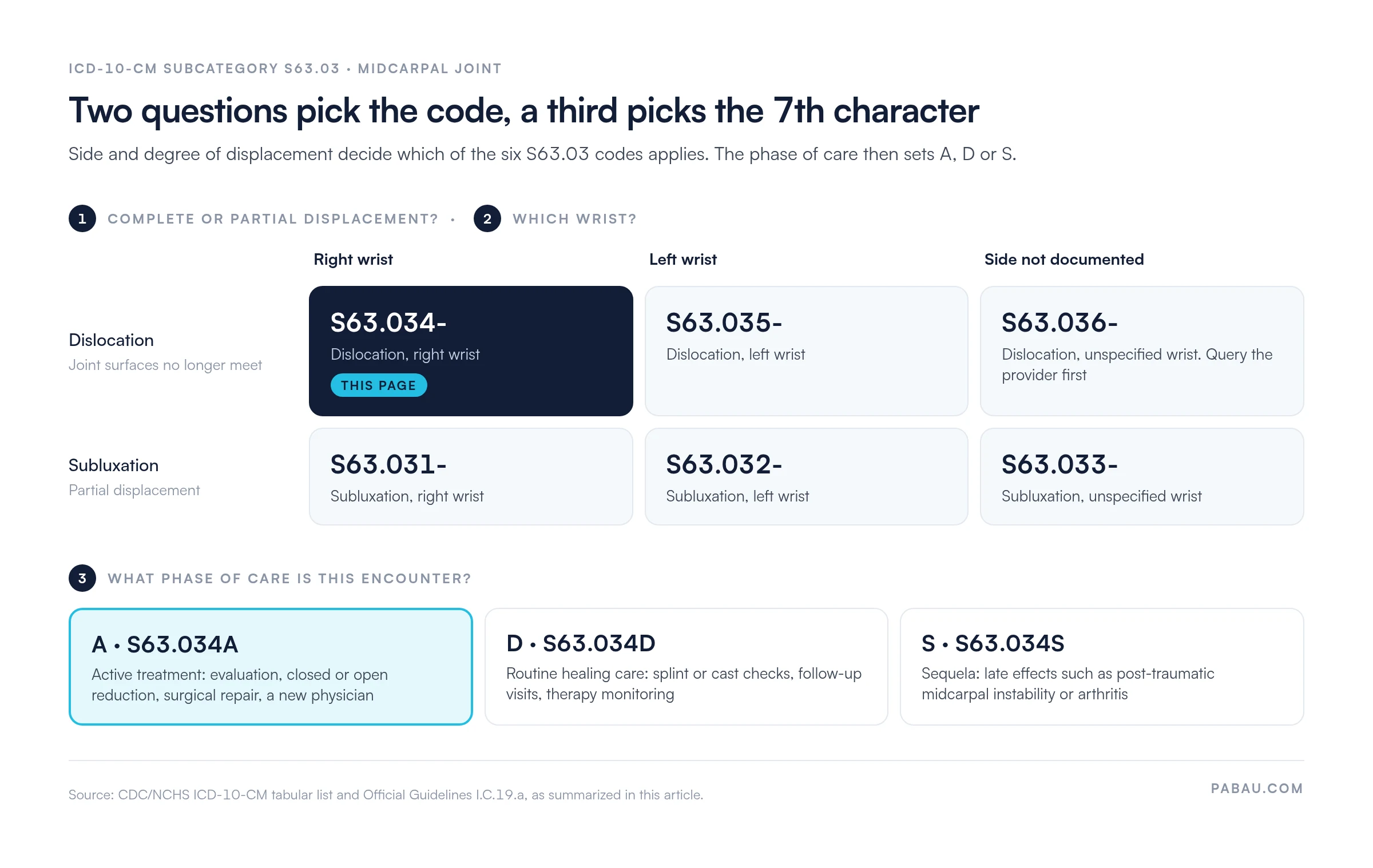
A left-sided injury takes S63.035A, and a partial displacement of the right midcarpal joint takes S63.031A instead.
Use 7th character A during active treatment, D for routine healing visits, and S for late effects of the dislocation.
Code also any associated open wound, and add a separate fracture code when imaging shows a carpal or radius fracture.
Denials commonly trace back to a note that omits the side, the joint or the treatment phase.
ICD-10 Code S63.034A is the billable ICD-10-CM code for dislocation of the midcarpal joint of the right wrist, initial encounter. It covers a complete separation between the two rows of carpal bones in the right wrist. The 7th character A means the patient is receiving active treatment for the injury.
Use the CDC/NCHS ICD-10-CM web tool to confirm the current descriptor and instructional notes before you submit. NCHS releases code updates each October 1, so recheck the code at every annual release.
The midcarpal joint is the articulation between the proximal and distal rows of carpal bones. In a dislocation, the distal row loses contact with the proximal row and the joint surfaces no longer meet. S63.034A applies only when that happens in the right wrist.
These injuries usually follow a high-energy load on an extended wrist, such as a fall on an outstretched hand or a motor vehicle crash. They are uncommon and can be subtle on a first radiograph. A carpal fracture, most often of the scaphoid, can accompany the dislocation.
Joint identity decides the code. The radiocarpal joint, the thumb carpometacarpal joint and the other carpometacarpal joints each have their own subcategory in S63.0. An intake form that records the joint, side and mechanism keeps that detail in the chart for the coder.
The 7th character describes the phase of care, not the visit count. Under ICD-10-CM Official Guidelines Section I.C.19.a, character A applies to each encounter where the patient receives active treatment for the injury.
The move from A to D is a clinical decision recorded in the note. A line such as “reduction stable, routine follow-up in two weeks” signals the shift. Without it, the coder has no basis to change the character.
State the treatment phase in every note. A line confirming a reduction performed today supports the A character. A line recording a routine splint check supports the D character. When the note says neither, expect a 7th-character query from the coder.
S63.034A belongs to Chapter 19, block S60-S69, category S63 and subcategory S63.03. That subcategory holds six codes split by subluxation or dislocation and by side. Each one takes A, D or S as the 7th character, and the grid below shows how three questions narrow the choice to one code.
As a principal diagnosis, the initial-encounter (A) and sequela (S) codes, including S63.034A, group to MDC 8 and MS-DRG 562-563. Subsequent-encounter (D) codes group to aftercare in MDC 23. In legacy ICD-9-CM terms, the closest equivalent is 833.03, closed dislocation of the midcarpal joint. ICD-9-CM had no laterality, so the crosswalk loses the right-wrist detail.
The S63.03 subcategory covers the midcarpal joint only. Side and the degree of displacement complete the code, so check both before you pick a sibling.
See the AAPC ICD-10-CM code lookup to browse the full S63 range before you make a final selection.
The instructional notes for S63.034A sit at category level. S63 includes avulsion, laceration, sprain, traumatic hemarthrosis, rupture, subluxation and tear of joints or ligaments at wrist and hand level.
Missing these codes rarely invalidates S63.034A on its own. They still cause clearinghouse edits and payer denials for incomplete claim data.
Three mix-ups are the usual sources of miscoding here. Coders report a sprain when imaging shows a dislocation, pick the wrong joint, or miss a concurrent fracture. The table below resolves each scenario.
When the provider documents a lunate or perilunate pattern, code from the exact wording through the Alphabetic Index. Do not assume midcarpal.
A claim for ICD-10 Code S63.034A holds up on audit when the note answers five questions. Strong medical billing documentation habits catch these before the claim is submitted.
Medicare expects the record to support both the diagnosis and the procedure billed with it. When the claim pairs S63.034A with a reduction code, the note must show why the reduction was needed.
No National Coverage Determination targets S63.034A specifically, so general trauma and surgical billing rules apply. Local Coverage Determinations from your Medicare Administrative Contractor can add regional requirements, especially for surgery.
CPT 25660 (closed treatment of radiocarpal or intercarpal dislocation, with manipulation) and 25670 (open treatment) are the usual procedure pairings. Confirm current descriptors and NCCI edits through the CMS ICD-10 codes page and your MAC before billing.
Denials for ICD-10 Code S63.034A follow a predictable set of triggers. Denial management workflows applied before the claim leaves the practice catch these triggers early. The denial codes in medical billing guide explains the reason codes that come back.
Clean claim submission habits built around the five documentation elements above stop these triggers at the source. Pairing those habits with denial-reducing claims management software adds an automated check before the claim reaches the payer.
S63.034A is sometimes a secondary diagnosis when a patient has several wrist or hand injuries. Sequencing follows the principal diagnosis rule. The condition chiefly responsible for the encounter is coded first.
Practices with high trauma volumes should review remittance data regularly. The electronic remittance advice on each payment shows which claims were adjusted and why.
Run a quarterly audit of S63.034A claims against your remittance data. Look for CARC 11 (diagnosis inconsistent with the procedure) and CARC 97 (service included in another service already paid). The first points to a joint or side error, and the second to a global-period visit billed separately.
Wrist trauma coding breaks down when the joint, side or treatment phase never reaches the note. The coder then has to query the provider, and the claim waits.
Pabau, the practice management platform we build, holds intake forms, treatment notes and imaging files in one patient record. Note templates can prompt for the joint, the side, the reduction performed and the treatment phase. Pabau Scribe, our AI scribe, drafts the note from the consultation so those details are captured while the visit is fresh.
The result is a record that supports S63.034A on first read, with fewer provider queries and fewer claims sent back for missing detail.

Pabau puts intake forms, structured treatment notes and imaging in one record, so your coders confirm the joint, side and treatment phase before billing.

S63.034A is narrow by design: one joint, one side, one phase of care. Errors commonly come from coding the wrong joint, the wrong side or the wrong 7th character, and each of those starts in the note.
Fix the note template once and the coding follows. A record that names the midcarpal joint, the right wrist, the displacement and the treatment phase leaves the coder little to guess. Book a demo to see how Pabau keeps wrist trauma documentation complete before the claim goes out.

Need a framework for managing claim rejections systematically? Denial management in healthcare covers the end-to-end workflow for tracking, appealing, and preventing billing denials across all ICD-10 categories.
Want to understand what clearinghouses check before a claim reaches the payer? Clean claim submission explains the data elements payers validate and the most common failure points in musculoskeletal trauma claims.
Looking for a reference on the denial reason codes that accompany rejected wrist dislocation claims? Denial codes in medical billing maps CARC and RARC codes to their root causes and corrective actions.
ICD-10 code S63.034A is the billable diagnosis code for dislocation of the midcarpal joint of the right wrist, initial encounter. It applies while the patient receives active treatment. It sits in category S63 within Chapter 19 of ICD-10-CM.
Yes, S63.034A is a valid, billable ICD-10-CM code. Check the CDC/NCHS release each October 1 to confirm its descriptor and instructional notes are unchanged.
S63.034A covers encounters for active treatment, such as evaluation and reduction. S63.034D covers routine care during healing, such as splint checks and follow-up visits. The choice depends on the phase of care, not the number of visits.
A midcarpal dislocation of the left wrist is coded S63.035A at the initial encounter. A partial displacement takes S63.031A on the right and S63.032A on the left.
The note must name the midcarpal joint, confirm the right wrist, and state a complete dislocation. It should also record the mechanism and date of injury and show that active treatment is under way. An imaging report confirming the dislocation should be in the record.
Closed reduction of an intercarpal dislocation, CPT 25660, is the usual pairing, and 25670 covers open treatment. Confirm current descriptors and NCCI edits before billing, because payer policies change each year.
Use S63.034S only for a late effect of the dislocation, such as post-traumatic instability or arthritis. Code the late effect first, then S63.034S. During active treatment, S63.034A applies.