

HCPCS Code E0272: Foam rubber mattress billing guide
HCPCS Code E0272: official descriptor and code overview HCPCS Code E0272 is the ...

Last Updated: Nov 6, 2026
25320 is the CPT code for open capsulorrhaphy or reconstruction of the wrist for carpal instability. It covers capsulodesis, ligament repair, and tendon transfer or graft, and it includes synovectomy, capsulotomy and open reduction.
It sits in the 25000-25999 forearm and wrist subsection of the CPT surgery section, maintained by the American Medical Association (AMA). Clean claims depend on an op note that confirms an open approach, a laterality modifier, and a diagnosis that supports open repair.
Let Pabau's smart automation suggest the right codes, reduce claim denials, and keep your practice compliant—effortlessly.
Automate repetitive tasks and focus on what matters most—your patients.
Reduce coding errors and ensure compliance with the latest regulations.
Clean claims, fewer denials, and faster reimbursements.
Powerful insights and reporting to help your practice thrive.
HIPAA compliant SOC 2 certified GDPR-compliant Trusted by 4,000+ clinics worldwide

CPT code 25320 covers open capsulorrhaphy or reconstruction of the wrist for carpal instability, while arthroscopic wrist work takes codes 29840-29847.
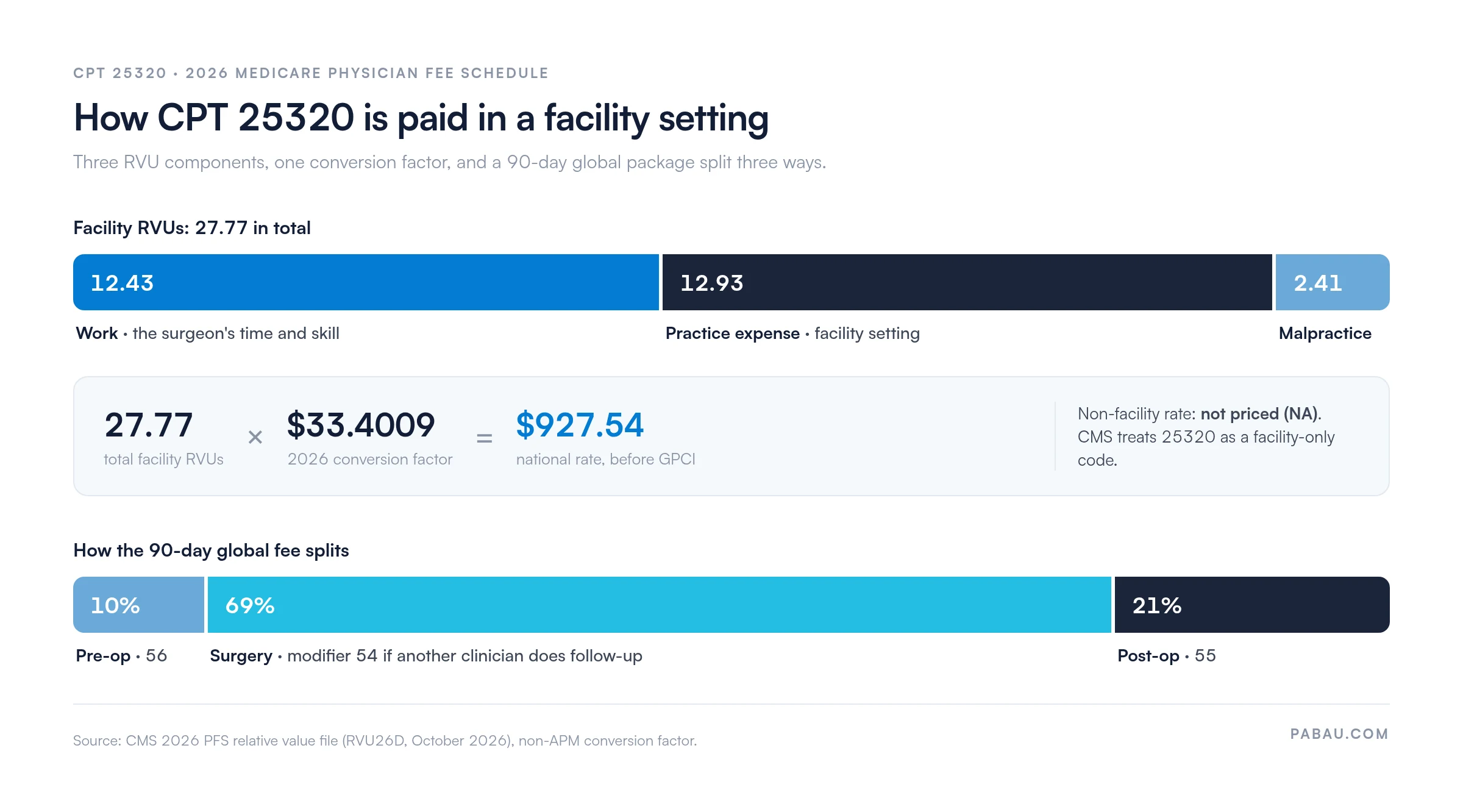
The 2026 Medicare fee schedule gives 25320 a total of 27.77 facility RVUs and no non-facility rate, about $928 nationally.
The 90-day global period bundles routine post-op care, and modifiers 24, 57, 58, 78 and 79 cover the exceptions.
Payers expect LT or RT on every 25320 line, and a missing laterality modifier is a common reason for rejection.
Pabau, our practice management software, sends 25320 claims to thousands of US payers through Claim.MD after a real-time eligibility check.
CPT code 25320 is the code for open capsulorrhaphy or reconstruction of the wrist to treat carpal instability. The official AMA descriptor reads as follows.
Capsulorrhaphy or reconstruction, wrist, open (eg, capsulodesis, ligament repair, tendon transfer or graft) (includes synovectomy, capsulotomy and open reduction) for carpal instability.
In plain terms, the surgeon opens the wrist and tightens, repairs or rebuilds the soft tissue that keeps the carpal bones aligned. The code sits in the 25000-25999 forearm and wrist subsection of the CPT surgery section, and it covers the wrist only.
The surgeon reaches the damaged structure through a dorsal or palmar incision. Common techniques include:
The code applies to intrinsic ligament repairs, such as the scapholunate and lunotriquetral interosseous ligaments, and to extrinsic capsular procedures.
25320 is an open procedure only. Arthroscopic wrist procedures take their own codes, 29840-29847. Billing 25320 for a procedure the surgeon documented as arthroscopic is a coding error and a common denial trigger.
Knowing where 25320 stops prevents unbundling errors. The table below shows what the code already pays for and what goes on its own claim line.
The 25000-25999 range holds several neighboring wrist procedures. Coders mis-select from the codes below when the operative note is unclear about the approach (open or arthroscopic) or the main structure repaired.
When the operative report documents an open capsule repair and a separate arthroscopic procedure, the arthroscopic code may be reportable. Check the NCCI edits for the current quarter before billing both codes together.
The diagnosis code has to show why open ligament or capsule repair was needed. ICD-10-CM has no code that names the scapholunate ligament, so a scapholunate tear is coded to other ligament of wrist (S63.39-).
Use the A (initial encounter) seventh character for the surgical episode on injury codes. Check every code against the current ICD-10-CM tabular list before billing. The diagnosis must justify open repair over conservative care or arthroscopy.
Relative value units (RVUs) from the CMS Medicare Physician Fee Schedule (MPFS) set Medicare’s payment for 25320. Most commercial contracts benchmark against them too. The values below come from the CMS 2026 relative value file (October release). You can confirm them in the CMS Physician Fee Schedule lookup tool.
The NA flag marks 25320 as a facility-only code. CMS sets no non-facility rate because the procedure is rarely or never performed outside a hospital or surgical center.
Multiply 27.77 RVUs by the 2026 conversion factor of $33.4009, and the national facility rate comes to $927.54. Clinicians in a qualifying alternative payment model (APM) use the $33.5675 factor, which gives about $932. The chart below shows how the three components build that figure, and how the global fee splits.
Check the NA flag before you quote an office-based fee for 25320. CMS sets no non-facility rate for this code, so an estimate built on non-facility RVUs overstates what Medicare pays.
Medicare pays 25320 under the MPFS, using the RVU calculation above adjusted by the geographic practice cost index (GPCI) for your locality. Nationally, that starts from about $928 per case. RVUs change with each annual MPFS final rule, so check the current year’s rate before you quote a fee.
Commercial payers usually pay a percentage of the MPFS or a separately negotiated fee schedule. For hospital outpatient cases, the surgeon bills 25320 for the professional service and the facility bills its own service codes.
CPT code 25320 carries a 90-day global period, which makes it a major surgery under CMS rules. The window opens the day before surgery and closes 90 days after it.
Knowing the global package is one of the medical billing fundamentals that prevents overbilling. It covers the preoperative visit the day before surgery, the procedure itself, and routine follow-up care for 90 days.
CMS splits the global fee 10% preoperative, 69% intraoperative and 21% postoperative. Those shares set the payment when care is split between clinicians. Modifier 54 marks surgical care only, 55 postoperative management only, and 56 preoperative management only.
Services you can bill separately during the global period:
Correct modifiers are one of the clearest signs of documentation accuracy on a 25320 claim. The table below covers the ones coders apply most often.
Traditional Medicare (Parts A and B) doesn’t include CPT code 25320 on its prior authorization list for hospital outpatient services. Medicare Advantage plans set their own rules, so check with the specific plan before scheduling.
Many commercial payers and Medicare Advantage plans require prior authorization for 25320 as an elective wrist procedure. When they do, the request usually includes:
A vague or templated operative report is a frequent cause of medical necessity denials for 25320. Payers check whether the documented procedure matches the open-repair descriptor, and an op note that reads like an arthroscopy report won’t pass review. Meeting medical billing compliance standards takes an operative record with these elements:
Complete documentation is the first item on any list of clean claim requirements. When the op note and the 25320 descriptor don’t match, the payer can deny on medical necessity or code accuracy.
Denials for CPT code 25320 cluster around seven recurring issues. Good denial management workflows track each denial by its claim adjustment reason code (CARC), so patterns show up across the practice. Our guide to medical billing denial codes explains each code and its usual fix.
The National Correct Coding Initiative (NCCI), run by CMS, defines which codes bundle with CPT code 25320 and whether a modifier can override the edit. The NCCI Policy Manual is the authoritative reference.
Use the AAPC code lookup for a quick edit check, and confirm it in the CMS NCCI resources for the current quarterly edit table.
Key bundling scenarios for 25320:
Many practices send a 25320 claim through several hands. The surgeon dictates the op note, a coder picks the codes and modifiers, and someone keys the claim into a clearinghouse portal. Each handoff is a chance to lose the LT modifier or the authorization number.
Pabau, the practice management platform we build, keeps the operative note, the invoice and the claim in one patient record. Its claims management software checks each claim for missing or invalid details before it leaves. The claim then goes through Claim.MD to thousands of US payers, after a real-time eligibility check that surfaces coverage problems before surgery.
Claim statuses and electronic remittance advice (ERA) flow back into Pabau’s claims dashboard. Your billing team sees which 25320 claims are paid, pending or denied without logging in to each payer’s portal.

Pabau keeps the operative note, claim validation and remittance tracking in one workflow. Send CPT 25320 claims to thousands of US payers through Claim.MD and follow each one to payment.

CPT code 25320 pays well for an open wrist reconstruction, but only when the op note, the diagnosis and the modifiers tell the same story. Before you submit, read the op note against the descriptor and confirm the approach was open.
After a clean surgical claim, the 90-day global period is where revenue slips away. Review every post-op visit, and bill unrelated care with modifier 24 rather than writing it off.
Pabau keeps the operative note, the claim and its remittance in one record, so those checks happen before submission rather than after a denial. Book a demo to see how it handles surgical claims like 25320 from op note to payment.

Need to understand how clearinghouse submission works for surgical codes? How a medical claims clearinghouse routes claims explains the electronic submission pathway from practice to payer.
Tracking denial patterns across your orthopedic caseload? Revenue cycle management fundamentals covers how to build denial tracking into your billing workflow.
Submitting 837P files for wrist surgery claims? 837P electronic claim file guide breaks down the EDI transaction set used for professional claims including CPT 25320.
CPT code 25320 covers open capsulorrhaphy or reconstruction of the wrist for carpal instability. That includes capsulodesis, ligament repair, and reconstruction with a tendon transfer or graft. Synovectomy, capsulotomy and open reduction are part of the code. Arthroscopic wrist procedures are coded from the 29840-29847 range instead.
CPT code 25320 has a 90-day (090) global period, which makes it a major surgical procedure. The package covers the day before surgery, the day of surgery, and 90 days of routine post-op care. Unrelated E/M visits, the decision for surgery, staged procedures and complications can be billed with modifiers 24, 57, 58, 78 or 79.
LT or RT for laterality is the one most payers insist on. Modifier 59 overrides an NCCI edit when a second procedure is clinically distinct, and modifier 50 reports a bilateral procedure. Modifier 22 flags unusual complexity, and modifier 51 applies when 25320 is a secondary procedure on the claim. Confirm each payer’s modifier rules before billing.
Traditional Medicare does not require prior authorization for CPT 25320. Many commercial payers and Medicare Advantage plans do require it for this elective procedure, though rules vary by plan. Check with the payer before scheduling surgery. Submit imaging, proof of failed conservative treatment, and clinical notes that support open repair.
CPT 25310 covers tendon transplantation or transfer in the forearm and wrist, while CPT 25320 covers repair or reconstruction of the wrist capsule and ligaments. A tendon transfer done as part of the 25320 reconstruction is included in 25320. Billing 25310 alongside it needs a separate clinical reason and an NCCI edit check.
Not routinely. Payers generally bundle a diagnostic arthroscopy (29840) done in the same session as an open repair. Surgical arthroscopy codes such as 29846 may be reportable when the two procedures treat distinct structures. That needs modifier 59 and documentation that clearly separates the two procedures. Confirm against the current NCCI edit table first.




