ICD code S62.664D – Nondisplaced ring finger fracture
Billable Code•Specific Code
Code Definition
S62.664D is the billable ICD-10-CM code for nondisplaced fracture of distal phalanx of right ring finger, subsequent encounter for fracture with routine healing. It applies to follow-up visits where active treatment has ended and the fingertip fracture is healing as expected.
Two selection errors come up most often. The first is reporting seventh character A at a routine follow-up visit, where D belongs. The second is confusing this nondisplaced fracture with its displaced counterpart, S62.634D. The note must confirm laterality, digit, displacement, bone and encounter stage before the code is assigned.
Related Information
Chapter
S00-T88 Injury, poisoning and certain other consequences of external causes
Category
S62 Fracture at wrist and hand level
Group
S62.66 Nondisplaced fracture of distal phalanx of finger
Billable
Yes
Code also known as
ring finger tip fracture, fourth finger fracture, fingertip bone fracture, right ring finger fracture
Save time. Improve accuracy. Get paid faster.
Automate coding with Pabau
Let Pabau's smart automation suggest the right codes, reduce claim denials, and keep your practice compliant—effortlessly.
S62.664DNondisplaced ring finger fractureHigh match
Confidence score
98%
Why this code?
Matches patient diagnosis
Supported by clinical notes
Commonly used for this condition
Why practices choose Pabau
Save hours every week
Automate repetitive tasks and focus on what matters most—your patients.
Improve accuracy
Reduce coding errors and ensure compliance with the latest regulations.
Get paid faster
Clean claims, fewer denials, and faster reimbursements.
Grow with confidence
Powerful insights and reporting to help your practice thrive.
HIPAA compliant•SOC 2 certified•GDPR-compliant•Trusted by 4,000+ clinics worldwide
Key takeaways
S62.664D is a valid, billable ICD-10-CM code for the right ring finger only, not the left (S62.665D) or an unspecified finger.
The seventh character D applies only to subsequent encounters with routine healing. In contrast, delayed healing, nonunion and malunion each take a different character.
Coders must code a fracture as displaced when the note says neither, so S62.664D needs the word nondisplaced in the record.
Missing laterality and reporting S62.664A at a follow-up visit are the two most common denial triggers for this code.
Pabau, the practice management platform we build, keeps the fracture note and the claim in one record, so coders check documentation before submission.
ICD-10 Code S62.664D: quick reference
ICD-10 Code S62.664D reports a follow-up visit for a nondisplaced fracture of the distal phalanx of the right ring finger that is healing as expected. The table below lists its official details for FY2027.
Field
Value
Code
S62.664D
Full descriptor
Nondisplaced fracture of distal phalanx of right ring finger, subsequent encounter for fracture with routine healing
Billable
Yes, valid for claim submission
Category
S62 Fracture at wrist and hand level (block S60-S69, injuries to the wrist, hand and fingers)
Parent codes
S62.6 Fracture of other and unspecified finger(s) > S62.66 Nondisplaced fracture of distal phalanx of finger
Seventh character
D, subsequent encounter for fracture with routine healing
Valid FY
Valid for FY2027 (effective Oct 1, 2026) per CDC/NCHS
ICD-10-CM chapter
Chapter 19, injury, poisoning and certain other consequences of external causes (S00-T88)
What S62.664D covers: nondisplaced fracture of the distal phalanx of the right ring finger
S62.664D describes a specific combination of anatomy, displacement status, laterality, and encounter type. Therefore, the note must confirm each element before you assign this code.
Distal phalanx: the fingertip bone, the most distal of the three phalanges in each finger. It sits beyond the distal interphalangeal (DIP) joint. However, coders sometimes use this code in error when the fracture is at the middle or proximal phalanx.
Right ring finger: the fourth digit of the right hand. Laterality is explicit in the code, so a left ring finger fracture requires S62.665D instead.
Nondisplaced: the fracture fragments remain in normal alignment. The provider’s documentation or radiology report must state “nondisplaced” or equivalent clinical language. The S62 tabular note tells you to code a fracture as displaced when the record states neither, so treatment method alone does not support this code.
Subsequent encounter (D): the patient is receiving care after the acute treatment phase. The seventh-character section below gives the full definition.
The code sits within S62.66-, which covers nondisplaced distal phalanx fractures of every finger except the thumb. In short, the family spans the index, middle, ring and little fingers on both hands, plus other and unspecified fingers, across every seventh character. Then confirm the correct sub-code using the CDC/NCHS ICD-10-CM web tool, which reflects the official annual tabular list.
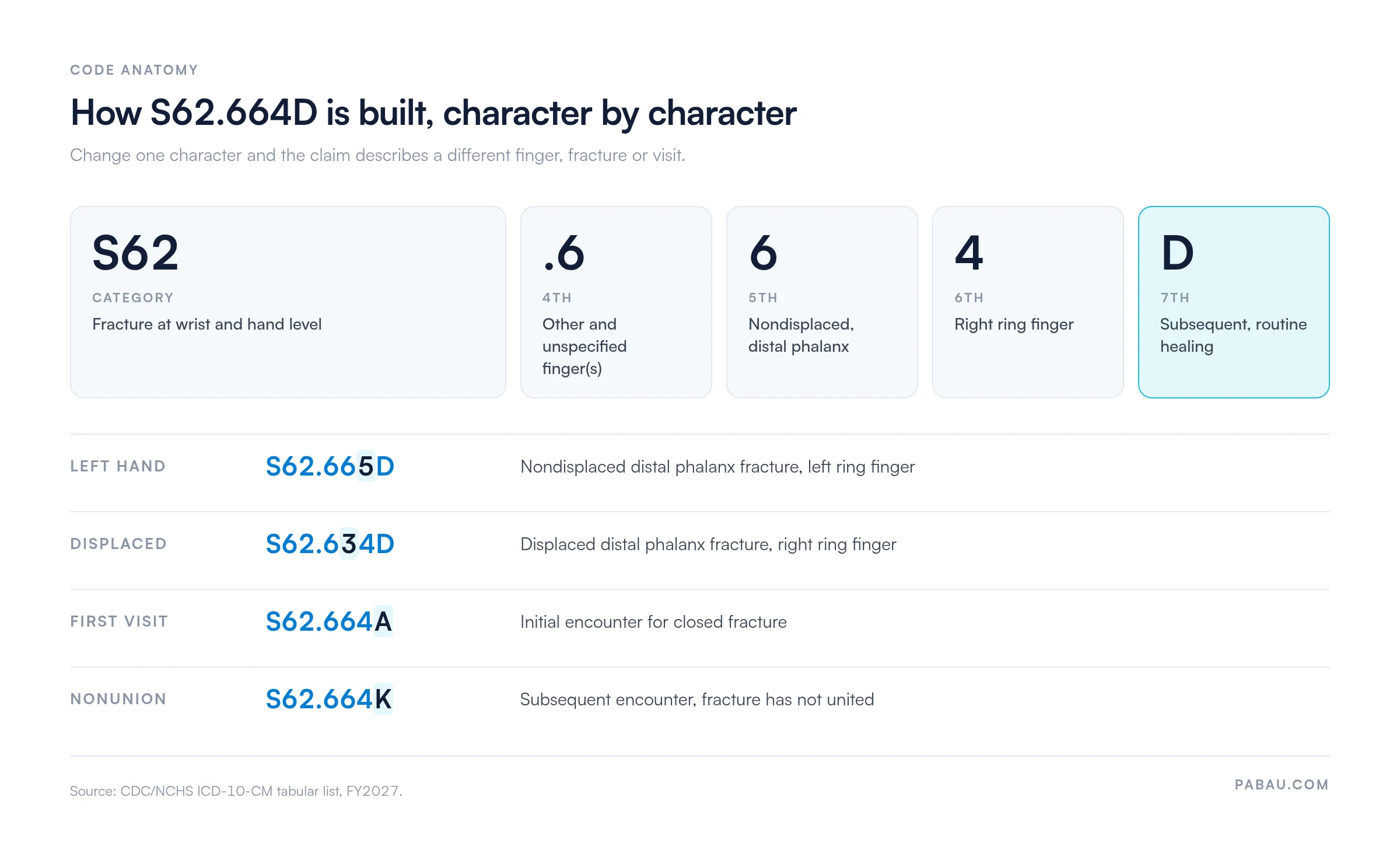
Each character of the code records one fact from the note. As a result, one swapped character gives a different neighboring code, as the diagram below shows. For other fracture and injury codes, browse our ICD-10-CM code guides.
One changed character turns S62.664D into a different finger, fracture type or visit stage, so each character needs support in the note. Source: CDC/NCHS ICD-10-CM tabular list, FY2027.
Understanding the seventh character D: subsequent encounter explained
The seventh character in S62 fracture codes determines the encounter stage and is the most common source of coding error. Overall, seven characters apply to S62.664: A and B for initial encounters, D, G, K and P for subsequent ones, and S for sequela.
7th character
Code
When to use
A – Initial encounter
S62.664A
Patient is receiving active treatment for a closed fracture, such as a first ED visit, urgent care splinting or initial outpatient evaluation
B – Initial encounter, open fracture
S62.664B
Patient is receiving active treatment for an open fracture, where the skin over the break is broken
D – Subsequent encounter
S62.664D
Patient is in the healing phase receiving routine follow-up care, such as cast or splint checks, X-ray surveillance and suture removal. Healing is progressing as expected.
G – Subsequent, delayed healing
S62.664G
Healing is slower than expected but nonunion has not been confirmed
K – Subsequent, nonunion
S62.664K
Fracture has failed to heal; nonunion is documented radiographically or clinically
P – Subsequent, malunion
S62.664P
Fracture healed in an abnormal position; malunion is confirmed in documentation
S – Sequela
S62.664S
Fracture is fully healed; patient presents with a late effect of the original injury (such as stiffness, deformity or chronic pain). The sequela code is listed second, after the condition code.
Therefore, the care delivered decides between A and D, whatever the time since injury, under the ICD-10-CM Official Guidelines for Coding and Reporting (Chapter 19).
For example, a patient who returns to the same provider two days after injury for a formal cast application is still at initial encounter. In contrast, a patient who comes in three weeks later for a routine X-ray check with no change in treatment is at subsequent encounter.
Pro Tip
Document the encounter type clearly in the plan or assessment section. Notes that state only ‘fracture follow-up’ without clinical progression details leave the seventh character impossible to verify during audit. For example, a single sentence such as ‘Fracture healing well, no malunion, continue splinting for 2 weeks’ supports D and prevents a query.
S62.664D vs adjacent codes: choosing the right code
S62.664A vs S62.664D is the most common selection error on follow-up visits. In addition, coders need to separate this code from its displaced equivalent and the left-hand version. The table below covers the codes that coders most often confuse with ICD-10 Code S62.664D.
Code
Descriptor
Key distinction
S62.664A
Same anatomical site – initial encounter
Active/definitive treatment phase only
S62.664D
Nondisplaced, right ring finger, distal phalanx – subsequent, routine healing
Follow-up with expected healing progress
S62.664K
Same site – subsequent, nonunion
Nonunion confirmed in documentation; never assume from time alone
S62.664S
Same site – sequela
Fracture is healed; patient has a residual late effect; code the sequela condition first
S62.634D
Displaced fracture, distal phalanx, right ring finger – subsequent
Displaced vs nondisplaced – must be confirmed in radiology or clinical notes
S62.665D
Nondisplaced, left ring finger, distal phalanx – subsequent
Laterality error – right vs left must match the clinical note exactly
Verify adjacent codes against the AAPC ICD-10-CM lookup or cross-check using Check ICD-10. Check ICD-10 mirrors official CMS/NCHS data, so it shows the full S62.66- family with descriptors.
Tabular notes and excludes for S62.664D
These notations govern what you can and cannot code alongside S62.664D and apply at the S62 category level or higher. Then review the CMS ICD-10 codes page for the current tabular list with all category-level notes.
Note (S62): code a fracture as displaced when the note says neither displaced nor nondisplaced. Likewise, code one as closed when the note says neither open nor closed. For this reason, the record must say nondisplaced.
Excludes1 (S62): traumatic amputation of wrist and hand (S68.-). If the injury resulted in amputation, report S68.- instead, because S62 cannot apply to the same injury.
Excludes2 (S62): fracture of distal parts of ulna and radius (S52.-). You code a concurrent distal radius fracture as its own line under S52, so these two fractures can coexist on the same claim.
Open wounds (S61): category S61 carries an Excludes1 note for open fractures of the wrist, hand and finger. Instead, report an open fracture with seventh character B at the initial encounter, without a separate S61 wound code.
External cause (Chapter 19 note): Chapter 19 directs coders to add secondary codes from Chapter 20 (V00-Y99) to show the cause of injury. They matter most on workers’ compensation and liability claims, because those payers require mechanism documentation.
Documentation requirements for ICD-10 Code S62.664D
Clear language in the provider note or radiology report must support every element of the code. Otherwise, the claim faces a denial for lack of detail.
Laterality – right hand: the note must state “right ring finger” or “right fourth finger/digit.” Do not infer laterality from operative site markings, photos, or history alone.
Digit – ring (fourth) finger: “fourth digit” and “ring finger” are both acceptable. However, “finger fracture” without a named digit does not support this code.
Fracture type – nondisplaced: the radiology report or clinical examination note must use “nondisplaced,” “non-displaced,” or equivalent. Indeed, an absence of language is not the same as nondisplaced.
Bone location – distal phalanx: the provider must identify the distal (fingertip) phalanx. “Finger fracture” or “phalanx fracture” without specifying distal is insufficient for S62.664D.
Encounter type – subsequent/follow-up: the note should reference the prior treatment episode and describe the current clinical status. For example, language such as “2-week fracture check,” “healing well on X-ray,” or “follow-up for ring finger fracture splint” all support D.
Therefore, practices using structured clinical notes or digital intake workflows can build these five elements into follow-up visit templates, which cuts audit exposure sharply.
CPT codes commonly paired with S62.664D
For subsequent encounter visits, the CPT codes you bill alongside ICD-10 Code S62.664D depend on the service you render at that visit. For instance, the following pairings are common in orthopedic and urgent care settings. Verify against your payer’s LCD before submitting, because payer policies vary. If you take a follow-up X-ray, CPT code 73140 has its own view and modifier rules.
CPT code
Description
Pairing notes
99212-99215
Office/outpatient E/M, established patient
Most common pairing; level depends on medical decision making and time documented
73140
Radiologic exam, finger(s), minimum 2 views
Billed when follow-up X-ray is performed at the visit; modifier may apply if same provider reads the film
29130
Application of finger splint (static)
Billed when a new or replacement finger splint is applied at the follow-up visit. Payers may bundle it with the E/M, so check the policy.
29085
Application of hand and lower forearm cast
Used when cast is applied or changed at a subsequent visit; document clinical rationale for cast change
97110
Therapeutic exercises
If physical or occupational therapy is ordered and rendered; requires prior authorization with many payers
Payers often edit claims that carry CPT casting or splinting codes (29085, 29130) alongside an E/M on the same date. For example, some payers bundle the minor procedure into the E/M payment. In contrast, others allow both with a modifier.
First, review the payer’s policy. Then append modifier 25 to the E/M only when a separately identifiable evaluation went beyond the fracture management service. In addition, a clearinghouse such as Claim.MD runs real-time eligibility checks and payer-specific edits before each submission.
Common claim denial reasons for S62.664D
Most denials on ICD-10 Code S62.664D fall into one of five patterns, so structured denial management workflows catch these before they become write-offs.
Wrong encounter character: billing S62.664A at a follow-up visit is the most common denial trigger. Payers compare the claim date with prior encounter dates on file, and repeated use of A suggests the provider never moved to subsequent care. Therefore, switch to D at the first follow-up visit after active treatment ends.
Missing laterality in documentation: if the coder cannot find “right” in the note, they may fall back to an unspecified finger code. The payer may also reject the claim for lack of detail. For this reason, providers should state laterality on every note, not only the initial visit.
Nondisplaced not documented: coding nondisplaced when the note lacks that language creates a discrepancy payers may audit later. If the radiology report says only “fracture” without specifying displacement, then query the provider before you assign S62.664D.
Healing complication not coded: billing S62.664D (routine healing) for a patient whose note documents nonunion or malunion fails medical necessity review. Move to S62.664K or S62.664P instead.
Bundling edits on splinting plus E/M: payers often bundle 29130 into the E/M, as the CPT section explains. Submitting both without modifier 25 on the E/M triggers an edit. Therefore, review clean claim submission requirements for each payer before billing casting or splinting services.
Prior authorization and payer considerations
Most subsequent encounter office visits for a routine distal phalanx fracture do not require prior authorization. However, certain services billed alongside S62.664D commonly trigger authorization requirements.
Physical and occupational therapy: payers often require prior authorization for therapy services, including therapeutic exercise (97110) and manual therapy (97140). Authorization usually attaches to the therapy CPT codes, not the ICD-10 diagnosis, but the diagnosis must support medical necessity for approval.
Surgical intervention: if delayed healing or nonunion progresses to surgical fixation, prior authorization is standard. Then the diagnosis changes to S62.664K for nonunion, and the surgical CPT codes go through their own authorization review.
Medicare and Medicaid: Medicare generally covers subsequent fracture follow-up visits under Part B when the note documents medical necessity. In contrast, Medicaid policies vary a lot by state, so verify through your state fee schedule before you assume coverage.
Workers’ compensation: workers’ comp claims require mechanism-of-injury documentation (external cause code) and often involve a separate authorization pathway than commercial insurance. S62.664D is valid on workers’ comp claims, but the payer relationship and authorization process differ from commercial insurance.
Pro Tip
Run an eligibility check at every subsequent fracture encounter, as well as the initial visit. Coverage, deductible status and authorization requirements can change between the injury date and the follow-up date. Patients on employer-sponsored plans with January 1 benefit resets are the usual case.
How Pabau keeps S62.664D follow-up claims clean
Most S62.664D denials trace back to the visit note. When the note and the billing screen live in separate systems, the coder retypes laterality, digit and encounter stage. As a result, each retype is a chance to slip.
Pabau holds the follow-up note, the diagnosis and the invoice in one patient record. Its claims management software sends the claim through Claim.MD and tracks its status, so a rejection comes back to the record that produced it.
The coder still chooses the code. However, the X-ray finding and the healing status sit one click from the claim. As a result, it is quick to check the seventh character against the note before submission.
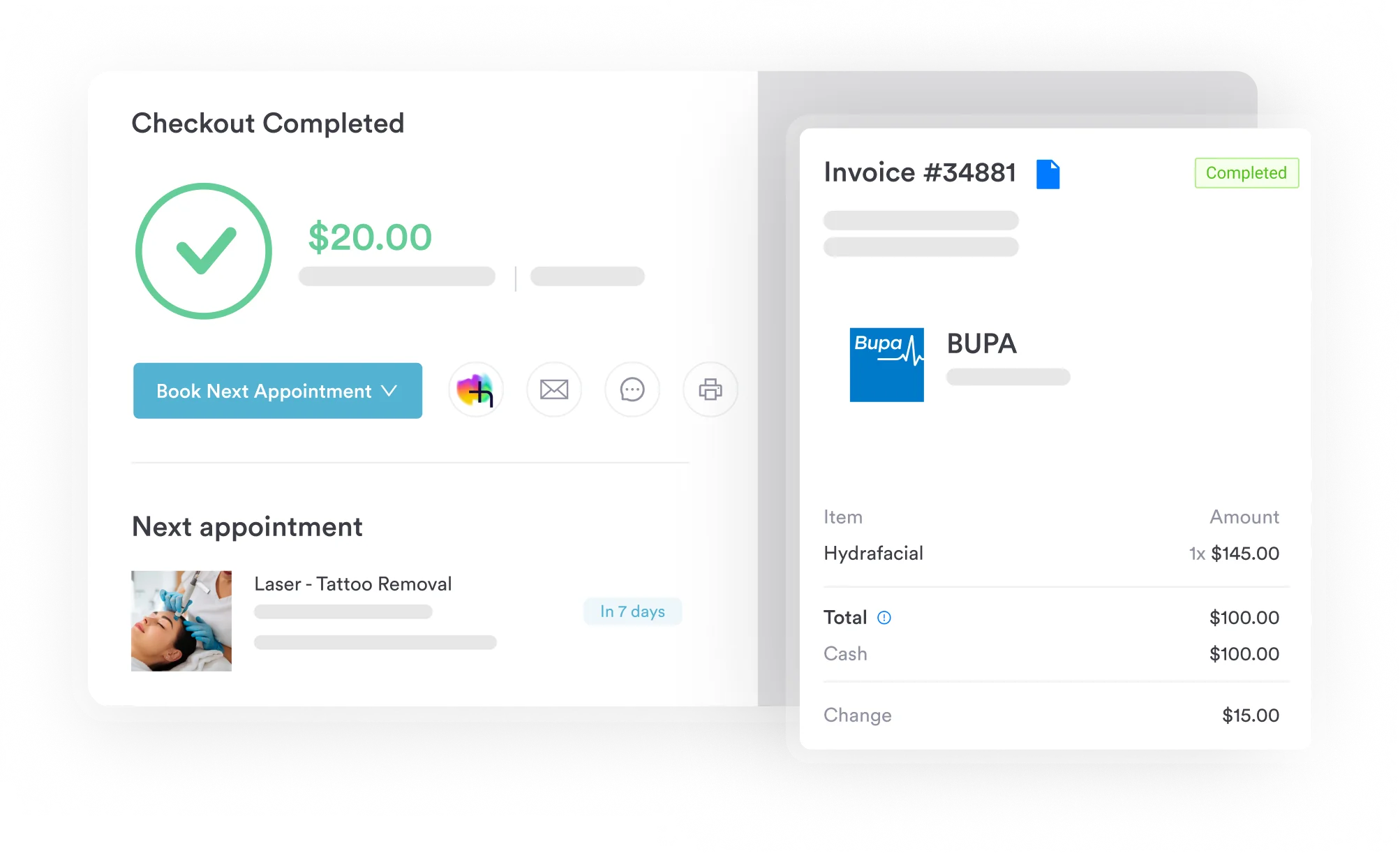
Pabau’s checkout books the next appointment as the visit is invoiced, so the patient’s fracture follow-up is scheduled before they leave.
Cut S62.664D denials before they reach the payer
Pabau keeps the fracture note, the diagnosis and the claim in one record and sends claims through Claim.MD. Coders check the documentation before submission, not after a denial.
The decision that matters most on this code is the seventh character. Before you assign D, confirm that active treatment has ended and the note says healing is on track. If it describes delayed healing, nonunion or malunion, move to G, K or P instead.
The other four elements rarely change between visits: right hand, ring finger, nondisplaced and distal phalanx. So build them into the follow-up template once, and spend review time on the encounter stage, where most of the denials on this code start.
Book a demo to see how Pabau keeps fracture notes and follow-up claims in one record for orthopedic and urgent care practices.
Continue your research
Need to understand how denied claims get resolved?Denial management in healthcare walks through how to build an effective denial workflow for fracture and orthopedic claims.
Looking for clearinghouse options for your practice?Medical claims clearinghouse guide explains how clearinghouses handle claim editing, 837P submissions, and ERA processing.
Want to reduce billing errors before submission?What is a clean claim? covers the payer-specific requirements that prevent most orthopedic claim rejections.
Billing the follow-up X-ray too?CPT code 73140 covers finger X-ray views, modifiers and the documentation each one needs.
Decoding a denial on a fracture claim?Denial codes in medical billing explains what each common denial code means and how to correct the claim.
Frequently asked questions
What does ICD-10 Code S62.664D mean?
ICD-10 Code S62.664D is the billable code for a nondisplaced right ring finger distal phalanx fracture at a subsequent encounter with routine healing. The code belongs to category S62 (fracture at wrist and hand level) in Chapter 19 of ICD-10-CM.
Is S62.664D a billable ICD-10 code?
Yes. S62.664D is a valid, fully specified billable ICD-10-CM code confirmed by the ICD List and active through the current fiscal year per CDC/NCHS data. It is assignable at the highest level of specificity and valid for claim submission.
What is the difference between S62.664A and S62.664D?
S62.664A is used while the patient is receiving active treatment for the fracture. S62.664D is used for routine follow-up visits where healing is progressing as expected. The distinction is based on the nature of care delivered, not the number of days since injury. Submitting A on a follow-up visit is the most common denial reason for this code family.
Can S62.664D be used for a nondisplaced fracture of the left ring finger?
No. S62.664D is laterality-specific to the right ring finger. A nondisplaced distal phalanx fracture of the left ring finger at subsequent encounter is coded S62.665D. Using S62.664D for a left-hand injury constitutes a laterality error and may generate a claim denial if the payer cross-references clinical records.