ICD-10 Code Y76.0: Diagnostic obstetric and gynecological devices
ICD-10 Code Y76.0: Definition and billable status ICD-10 Code Y76.0 is a valid, ...

Last Updated: Oct 23, 2026
Billable Code Specific Code
S62.233B is the billable ICD-10-CM code for other displaced fracture of base of first metacarpal bone, unspecified hand, initial encounter for open fracture.
A fully specified fracture paired with an unspecified side is what makes this code awkward to bill. Payers see a note detailed enough to describe displacement and an open wound, yet silent on which hand. The guidance below follows the 2026 ICD-10-CM edition, effective October 1, 2025.
Let Pabau's smart automation suggest the right codes, reduce claim denials, and keep your practice compliant—effortlessly.
Automate repetitive tasks and focus on what matters most—your patients.
Reduce coding errors and ensure compliance with the latest regulations.
Clean claims, fewer denials, and faster reimbursements.
Powerful insights and reporting to help your practice thrive.
HIPAA compliant SOC 2 certified GDPR-compliant Trusted by 4,000+ clinics worldwide

ICD-10 Code S62.233B describes other displaced fracture of base of first metacarpal bone, unspecified hand, initial encounter for open fracture. It is billable in the 2026 ICD-10-CM edition.
Unspecified hand is the defining feature of this code. It applies when the record does not name the injured side, and never as shorthand for both hands.
Laterality-specific codes exist for the same fracture and encounter: S62.231B for the right hand and S62.232B for the left hand. Query the physician whenever the side can be confirmed.
Other displaced is a catch-all category. Bennett’s fracture sits in S62.21- and Rolando’s fracture in S62.22-, so neither is coded here.
The seventh character B carries two facts at once. The encounter is initial, and the fracture is open.
Pabau’s claims management software connects to the Claim.MD clearinghouse. It checks code pairings and claim formatting against payer rules before a fracture claim goes out.
ICD-10 Code S62.233B is a billable, specific ICD-10-CM code valid for reimbursement under HIPAA-covered transactions. In fact, its full official description is: Other displaced fracture of base of first metacarpal bone, unspecified hand, initial encounter for open fracture.
Unspecified hand means the documentation does not name a side. In other words, it does not mean both hands are injured, and it is not a laterality of last resort for a record that names the hand elsewhere.
According to the Centers for Medicare and Medicaid Services (CMS), ICD-10-CM is the required diagnosis coding system for all covered entities under HIPAA. As a result, S62.233B is specific enough to submit directly, and no extra code is required to make it billable.
The first metacarpal is the thumb’s foundation. Its base sits at the carpometacarpal (CMC) joint, where it connects to the trapezium bone of the wrist. This joint bears a lot of force during gripping and pinching. As a result, base fractures are a common finding in emergency and orthopedic settings.
Other displaced in the code description marks a catch-all category. Bennett’s fracture is an intra-articular fracture-dislocation of the first metacarpal base, and Rolando’s fracture is its comminuted variant. Both hold their own ICD-10-CM subcategories. S62.23- therefore covers base fractures that are displaced but fall outside those two named patterns.
Clinically, open metacarpal base fractures usually result from crush injuries, falls on an outstretched hand, or direct blows. As a result, they require urgent evaluation given the risk of neurovascular involvement and infection that comes with open injury patterns.
S62.233B sits at the bottom of a five-level chain, and reading that chain is how coders catch a truncated code before submission. The wider ICD-10-CM code library follows the same parent-child structure, from chapter down to the billable seven-character code.
The CDC/NCHS ICD-10-CM web tool provides the official tabular list for verifying hierarchy and effective dates. S62, S62.2, S62.23, and the six-character S62.233 are all too general to submit. In the end, only the fully specified seven-character code S62.233B belongs on a claim.
The seventh character is where most fracture coding errors occur. For S62.233B, the seventh character is B, which means two things at once. The encounter is initial, and the fracture is open. In short, both conditions must be true, or the code is wrong.
Across injury categories, the seventh character drives adjudication, DRG assignment, and compliance audits. In turn, the ICD-10-CM Official Guidelines for Coding and Reporting, Section I.C.19, define the encounter-type framework for fracture codes.
Key rule: initial encounter refers to the patient receiving active treatment for the fracture, not to the first time they see a provider. For example, a patient transferred between facilities for surgical management is still in initial encounter status while active treatment continues. This is a common misunderstanding in inpatient coding.
Record the injured hand and the open or closed status in the same note. A line that reads displaced fracture of the first metacarpal base, with no side stated, leaves two options. The coder raises a physician query, or falls back to the unspecified code S62.233B. Write left or right, and write either open fracture with skin disruption or closed fracture, skin intact, at the time of the encounter.
Use S62.233B only when the clinical record does not name the injured hand. ICD-10-CM publishes a code for each side, so an unspecified laterality code works as a documentation fallback rather than a first choice.
Coders often need to tell S62.233B apart from closely related sibling codes. The differences hinge on laterality, displacement, fracture pattern, and encounter type. See AAPC’s ICD-10-CM code lookup and the CMS tabular list when selecting between codes in the S62.2 group.
The WHO ICD-10 browser gives useful context on how the international classification structures hand fracture categories. Even so, US coders must work from the ICD-10-CM tabular list, not the international version.
Most S62.233B errors come from misreading the sixth digit or from picking a neighboring family. In fact, six patterns account for the bulk of them.
The subcategory reads more easily as a grid than as a list. Laid out on its two axes, the sixth digit stops being a guess.
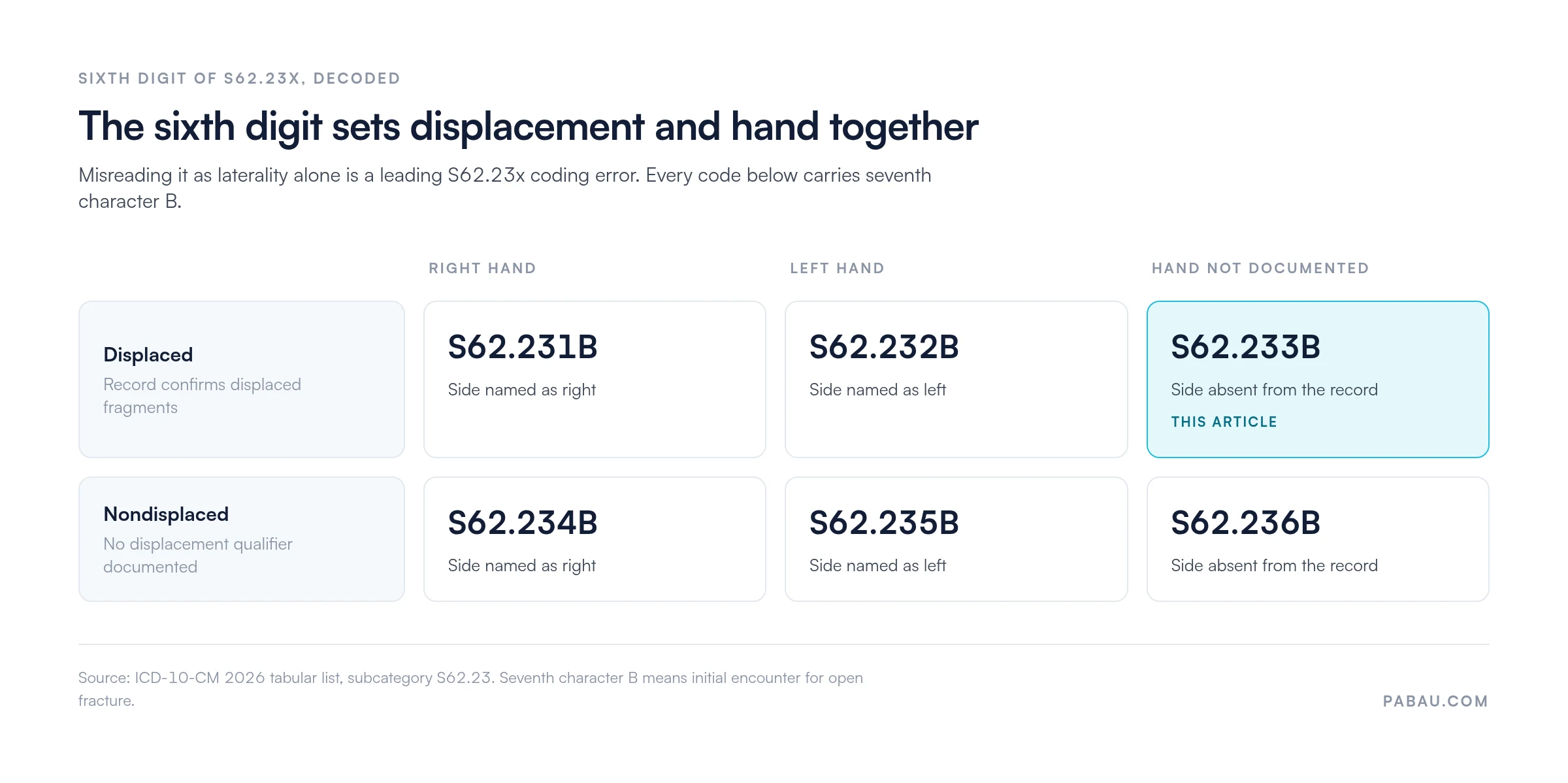
Claim denials for S62.233B almost always trace back to incomplete notes. Four elements decide the code, and the payer’s clinical edit engine checks each one before adjudication. In short, meeting medical billing compliance requirements for orthopedic fracture coding means capturing all four clearly in the clinical record.
Missing laterality is a common trigger for orthopedic pre-payment edits. A physician query can add days or weeks to the claim cycle, so catching the gap at the point of care pays for itself.
Build a fracture documentation checklist into your orthopedic SOAP note template: laterality, open versus closed, displacement status, and encounter purpose. A structured note, reviewed at the point of care, catches the omissions that push a claim onto an unspecified laterality code. It does that before the record ever reaches the coding team.
S62.233B is a billable ICD-10-CM diagnosis code that can be submitted for reimbursement on HIPAA-covered transactions. Successful submission requires an appropriate procedure code and a medical record that supports every element of the diagnosis. Even so, use of the code does not guarantee reimbursement, and payer policies on medical necessity and procedure pairing vary.
An unspecified laterality code can also draw closer review, since a named side would have produced a more specific code. Confirm the record truly omits the hand before you submit. The same pressure appears on orthotic claims, where HCPCS code L2030 needs an RT or LT modifier to establish the side billed.
The procedure code depends on the surgical approach. Because the fracture is open, closed reduction alone is usually not enough. Verify each pairing below against AMA guidelines and payer policy.
Practices can route S62.233B claims through Claim.MD, connected to Pabau’s claims management software, which checks code pairings against payer rules before submission. A mismatched pair then surfaces there instead of coming back as a denial, keeping coders in one workflow.
S62.233B denials cluster at one point: pre-payment clinical-edit failures from thin notes, not post-payment recoveries. Fixing the note at the point of care beats chasing after-the-fact physician queries and lifts the first-pass rate more than any billing-side change.
When an S62.233B claim is denied, sort it by denial reason code first. Orthopedic fracture denials usually fall into three buckets.
Tracking those patterns by code gives billers something to act on. The remittance advice on a denied claim carries the CARC reason, showing whether the fix is a documentation query or a CPT correction.
Getting S62.233B right depends on two things. The first is structured clinical documentation that covers every axis of the code. The second is a billing system that catches code-level errors before submission. Yet practices often have one without the other.
For orthopedic and physical therapy practices managing post-fracture care, practice management software like Pabau supports structured note capture. Your note template can prompt for laterality, fracture type, and encounter purpose while the patient is still in the room. As a result, that removes most of the after-the-fact query burden from the billing team.
On the billing side, the Claim.MD integration checks code pairings and claim formatting against payer-specific rules before the 837P file goes out. An unsupported diagnosis and procedure pair surfaces in the workflow dashboard rather than in a denial report. Whether the note supports an open fracture stays a coder’s judgment call, not a clearinghouse edit.
Pabau’s reporting monitors first-pass claim rates by ICD-10 code range. That shows whether S62.2xx fracture codes generate more denials than other injury categories. In turn, it closes the loop between documentation behavior and billing outcomes.
Clean claim standards for open fracture trauma vary by Medicare Administrative Contractor region and by commercial payer. The clearinghouse connection handles payer enrollment and eligibility verification. The front desk then knows, before the appointment, whether the coverage will accept the planned code pairing.

Pabau connects to the Claim.MD clearinghouse to check ICD-10 and CPT code pairings and claim formatting against payer rules before submission. See how orthopedic practices use Pabau to lift their first-pass rate on fracture claims.

S62.233B is the unspecified-hand member of the S62.23 family, and that one detail drives most of its billing problems. Even so, the code still demands clear proof of displacement, open-fracture status, and initial encounter. Add the side to the record and a more specific code, S62.231B or S62.232B, becomes available.
Practices that build fracture documentation prompts into the clinical workflow settle most S62.233B billing issues early. In turn, pairing those prompts with pre-submission claim validation stops the rest from hardening into denial patterns. Book a demo to walk through your own fracture coding setup with the Pabau team.

Need to understand how claim denials are categorized and resolved? Denial management in healthcare covers the full process for tracking, appealing, and preventing claim rejections on fracture and injury codes.
Want to verify your claim is structured correctly before submission? Submitting a clean claim outlines the specific formatting, coding, and documentation elements payers check during pre-payment edits.
Looking for guidance on the clearinghouse submission process for US practices? How medical claims clearinghouses work explains 837P file transmission, ERA reconciliation, and payer enrollment requirements.
ICD-10 Code S62.233B is a billable ICD-10-CM code for other displaced fracture of base of first metacarpal bone, unspecified hand, initial encounter for open fracture. It applies when a patient receives active treatment for a displaced, open fracture at the base of the thumb metacarpal. In addition, the record must not name the injured hand, and the pattern must be neither a Bennett nor a Rolando fracture.
Yes. S62.233B is a fully specified, billable ICD-10-CM code valid for HIPAA-covered transactions in the 2026 edition, effective October 1, 2025. As a result, it can be submitted directly as a diagnosis code, and it needs no more specific child code.
Use seventh character B for an initial encounter with an open fracture, and A for an initial encounter with a closed fracture. D, G, K, and P cover subsequent encounters with routine healing, delayed healing, nonunion, and malunion. S covers sequela. In short, initial versus subsequent turns on whether active treatment is being provided, not on whether it is the first visit.
S62.233B is valid in the 2026 ICD-10-CM edition, which became effective October 1, 2025. For dates of service from October 1, 2025 onward, use the 2026 edition. Otherwise, for earlier dates of service, apply the 2025 edition. Verify the fiscal year edition against the CMS ICD-10-CM update files when coding past claims.