

ICD-10 Code S42.444P: Medial epicondyle fracture, right humerus
ICD-10 Code S42.444P: full descriptor and code validity ICD-10 Code S42.444P car...

Last Updated: Oct 13, 2026
Billable Code Specific Code
S62.337B is the billable ICD-10-CM code for displaced fracture of neck of fifth metacarpal bone, left hand, initial encounter for open fracture.
Two elements decide whether the code survives claim review. So the note has to identify the left hand, and it has to document that the fracture was open. From there, the rest of the descriptor follows from the fracture site itself, which is where most of the confusion with nearby codes starts.
Let Pabau's smart automation suggest the right codes, reduce claim denials, and keep your practice compliant—effortlessly.
Automate repetitive tasks and focus on what matters most—your patients.
Reduce coding errors and ensure compliance with the latest regulations.
Clean claims, fewer denials, and faster reimbursements.
Powerful insights and reporting to help your practice thrive.
HIPAA compliant SOC 2 certified GDPR-compliant Trusted by 4,000+ clinics worldwide

S62.337B is a billable ICD-10-CM code for a displaced fracture of the neck of the fifth metacarpal bone, left hand.
The 7th character B marks an initial encounter for an open fracture, and confusing it with A, which means closed, causes denials.
Clinicians call this injury a boxer fracture, but ICD-10-CM does not list that term as an inclusion note for S62.337.
On an inpatient claim, S62.337B groups to MS-DRG 562 with a major complication or comorbidity, and to 563 without one.
Pabau’s claims management software submits and tracks these claims through Claim.MD, so coders see payer responses without leaving the record.
ICD-10 Code S62.337B is a billable, specific ICD-10-CM diagnosis code valid for use on medical claims for payment purposes. The full official description is: Displaced fracture of neck of fifth metacarpal bone, left hand, initial encounter for open fracture. Also, the 2026 edition started on October 1, 2025, per the annual CMS update cycle managed by the Centers for Medicare and Medicaid Services.
A boxer fracture is a fracture of the neck of the fifth metacarpal bone. Also, that bone runs through the palm and connects the wrist to the little finger. The injury often results from impact against a hard surface with a clenched fist. Thus, the fracture neck is the narrowest part of the metacarpal, making it the weakest point under stress.
Boxer fracture is clinical shorthand rather than an ICD-10-CM term. The tabular list carries no inclusion note for it under S62.337, so the code is selected from the documented anatomy instead. So three details in the note must line up before submission:
Also, the CDC/NCHS ICD-10-CM web tool carries the current tabular entry for S62.337, maintained by the National Center for Health Statistics. It also shows the full descriptor and the Type 2 Excludes notes that sit above the code.
The 7th character is the most often misapplied element in fracture coding. For the S62.3 group, it encodes both the encounter type and the fracture type. So using the wrong one on an open fracture claim is a common reason claims come back denied. Next, the table below maps what each character signals to the payer.
The 7th character B in S62.337B confirms this is the first visit for an open fracture. Later visits for the same open fracture use character D (routine healing), G (delayed healing), K (nonunion), or P (malunion). In other words, character B never appears on a follow-up claim for the same episode of care.
S62.337B sits within the injury chapter of ICD-10-CM. Understanding the parent hierarchy helps coders navigate related codes when the documentation is ambiguous about fracture site or laterality. For example, the AAPC ICD-10-CM code lookup reflects this same structure for the S62 category.
The hierarchy also shows where a note tends to fall short. So if it says “metacarpal fracture” without naming the fifth metacarpal or the left hand, the coder cannot reach S62.337B. In short, the record has to confirm fifth metacarpal, left hand, displaced, and open before this code applies. Also, nearby subcategories in the ICD-10-CM code reference cover the base and shaft fractures that documentation is most often mistaken for.
Laterality and encounter type are what separate the sibling codes. As a result, coders working hand fracture claims need the full S62.337 family in front of them to avoid a laterality mismatch. So the right-hand counterpart to S62.337B is S62.336B.
Two errors dominate this code family. The first is reaching for the right-hand code, S62.336B, when the fracture is left-sided. The second is picking character A for a fracture the note describes as open. Next, the grid below shows how those two decisions land on one of four codes.
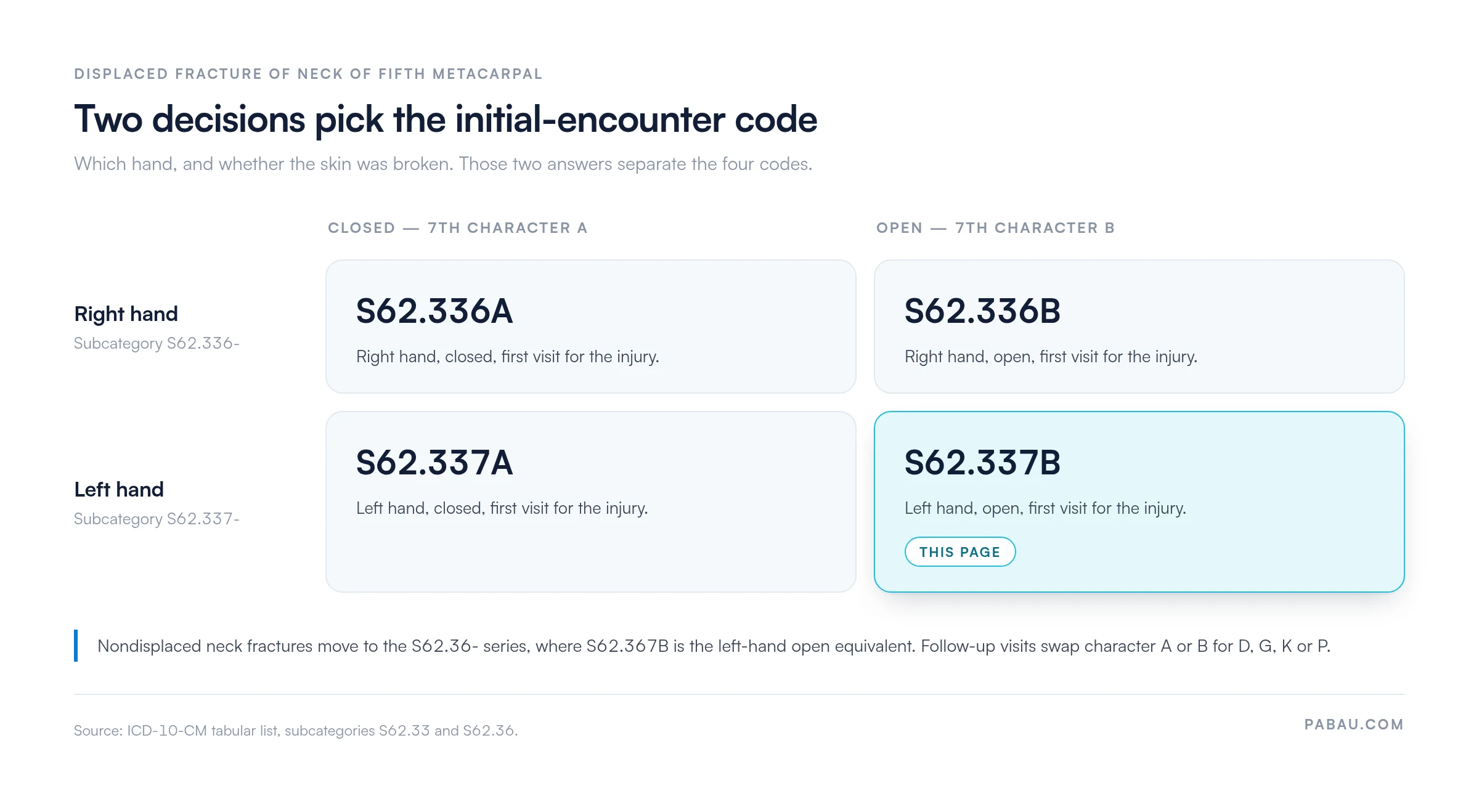
When S62.337B is submitted on an inpatient claim, CMS assigns it to a Medicare Severity Diagnosis Related Group (MS-DRG) under the current definitions manual. So the MS-DRG drives the facility payment amount. Still, coders should note that specific MS-DRG dollar amounts change with each CMS annual update; the groupings below reflect the current CMS MS-DRG definitions.
This family splits on one question, and it is not a three-way choice. First, a stay that carries a major complication or comorbidity groups to DRG 562, which pays a higher base rate. Otherwise, a stay without one groups to 563. An open fracture needing surgical debridement often qualifies once the comorbidities are coded alongside S62.337B.
Document all comorbidities at the time of the open fracture visit. Wound infection, diabetes, or anticoagulant use recorded in the same encounter can shift the MS-DRG from 563 to 562, a meaningful difference in facility payment. Capturing them at the point of care avoids queries after the fact.
Claim denials for this code trace back to the same short list of documentation problems. Closing them lifts first-pass acceptance and shortens the denial management in healthcare cycle for orthopedic and urgent care practices.
So consistent documentation at the point of care reduces the query burden on treating providers and keeps audit risk low. It matters most when a patient moves from emergency care to outpatient orthopedic follow-up, where the second coder inherits the first one’s note.
HIPAA names ICD-10-CM as the standard diagnosis code set for electronic claims. Thus, any practice billing hand fracture encounters has to use codes from the current edition, not old ICD-9 codes.
Older systems, past chart reviews, and payers still processing older claims may reference matching ICD-9-CM codes. The General Equivalence Mappings (GEMs) maintained by CMS and NCHS provide a rough crosswalk, though they are not exact matches.
ICD-9-CM did not encode laterality as precisely as ICD-10-CM. As a result, older claims coded under 815.14 could represent left or right hand, displaced or nondisplaced. For this reason, GEMs crosswalks are presented as rough mappings only and should never be used as the basis for coding a current claim. Always use the current ICD-10-CM edition code when submitting new claims.
Open fracture coding errors start at documentation, not at the coder’s desk. When a note says “boxer fracture” without naming the side, or leaves open versus closed unstated, the coder has to query the provider. In short, that query is what delays the claim.
Practice management software like Pabau keeps the clinical note and the claim in one record, so the biller works from what the clinician wrote. Pabau’s claims software for practices then sends the CMS-1500 claim to the payer through our Claim.MD clearinghouse connection.
That connection also runs real-time eligibility checks before the visit, tracks each claim’s status after submission, and posts electronic remittance advice back into the record. Also, coverage reaches thousands of US payers. Code selection stays with your coder, since Pabau does not assign the diagnosis code or check the 7th character for you.
For orthopedic and urgent care practices with a high volume of hand fracture claims, that removes the swivel between two systems. Coding and claim submission happen in the same platform, so fewer transcription steps sit between the note and the payer.
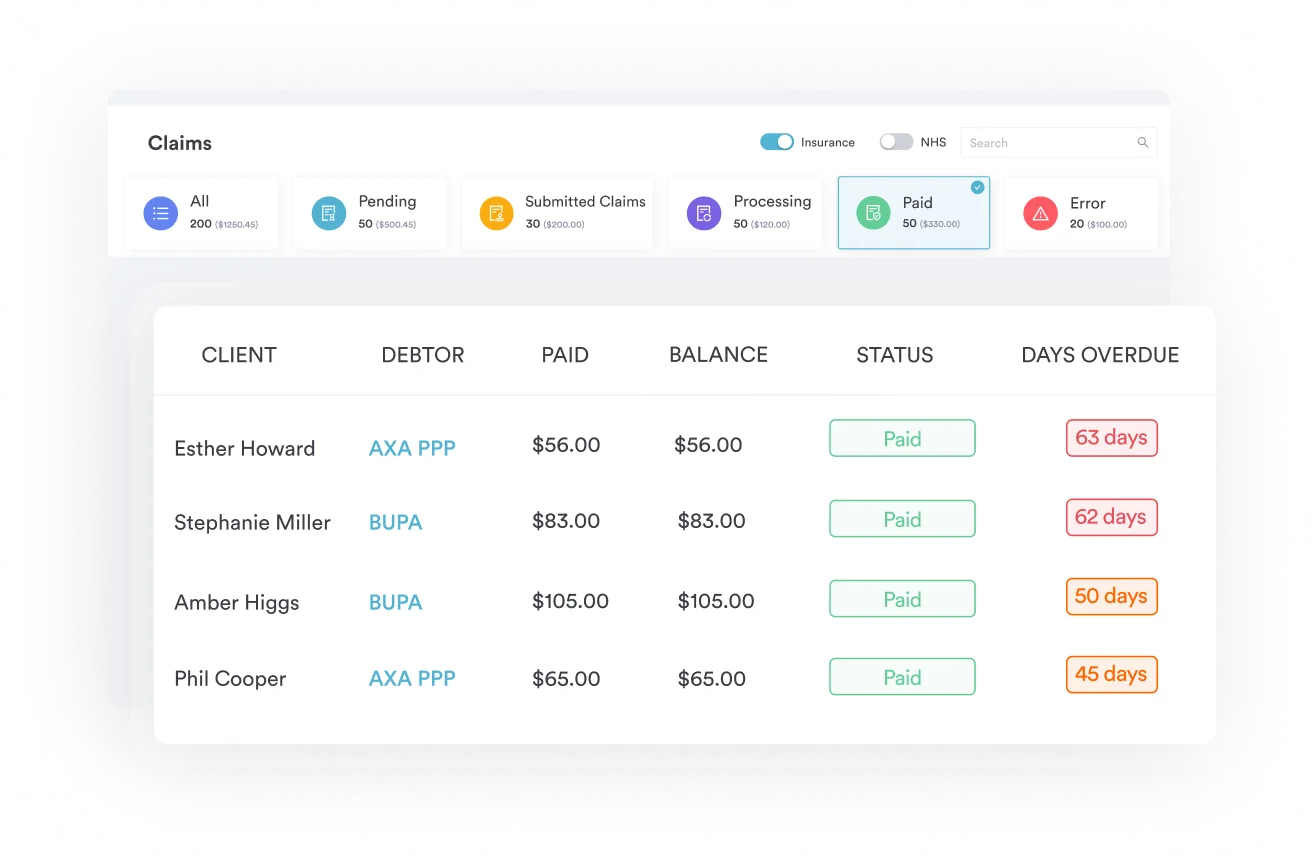

Pabau keeps the clinical note and the claim in one record, then submits and tracks it through Claim.MD. See how orthopedic and urgent care practices cut rework on hand fracture claims.

Open fracture claims turn on three decisions. Then, the fracture site, the laterality, and the encounter type each have to match what the note says. For a displaced boxer fracture of the left hand treated as an open injury on the first visit, S62.337B is the correct billable code.
So, the useful move is upstream of the coder. Ask clinicians to state the side and the skin status in the note itself, and the coder has no query to raise. Book a demo to see how Pabau keeps hand fracture documentation and claim submission in one record.

Need to understand how medical claims flow from code to payment? What is medical billing explains the full billing cycle from ICD-10 code assignment through payment.
Seeing denials on hand fracture claims? Denial management in healthcare covers the most common reasons claims return and how to resolve them systematically.
Curious how ICD-10-CM integrates with electronic claim submission? Medical billing compliance covers HIPAA code set requirements and electronic transaction standards for diagnosis codes.
ICD-10 Code S62.337B is a billable ICD-10-CM diagnosis code for a displaced fracture of the neck of the fifth metacarpal bone, left hand. In fact, it applies on the initial encounter for an open fracture, which clinicians often describe as a boxer fracture with an accompanying wound.
Yes. S62.337B is a specific, billable ICD-10-CM code valid for submission on medical claims for the 2025 and 2026 billing years. The 2026 edition started October 1, 2025, per the CMS annual update cycle. It can be used as a standalone diagnosis code to indicate the reason for the encounter.
S62.337B groups to MS-DRG 562 when the stay carries a major complication or comorbidity (MCC), and to MS-DRG 563 when it does not. Also, both sit under MDC 08, diseases and disorders of the musculoskeletal system and connective tissue. So accurate comorbidity documentation alongside S62.337B decides which of the two applies.
Yes. S62.337B is valid for both the 2025 and 2026 ICD-10-CM editions. The 2026 edition started October 1, 2025, and S62.337B remains an active, billable code with no change to its descriptor between editions. Still, always confirm code validity against the current CMS ICD-10-CM update files for any given billing year.




