ICD-10 Code V78.7XXD: Person on outside of bus in noncollision traffic accident, subsequent encounter
ICD-10 Code V78.7XXD: Definition and billable status ICD-10 Code V78.7XXD is a b...

Last Updated: Oct 20, 2026
Billable Code Specific Code
S56.929S is the billable ICD-10-CM code for laceration of unspecified muscles, fascia and tendons at forearm level, unspecified arm, sequela.
It is reported for a condition that remains after a forearm muscle or tendon laceration has healed, such as a scar or contracture. Code that residual condition first and list S56.929S after it.
Let Pabau's smart automation suggest the right codes, reduce claim denials, and keep your practice compliant—effortlessly.
Automate repetitive tasks and focus on what matters most—your patients.
Reduce coding errors and ensure compliance with the latest regulations.
Clean claims, fewer denials, and faster reimbursements.
Powerful insights and reporting to help your practice thrive.
HIPAA compliant SOC 2 certified GDPR-compliant Trusted by 4,000+ clinics worldwide

S56.929S is a billable ICD-10-CM code for the late effects of a forearm muscle, fascia or tendon laceration when the arm is not documented.
The 7th character S (sequela) marks a condition left after the laceration has healed, such as a scar, a contracture or reduced grip strength.
Use S56.921S (right arm) or S56.922S (left arm) when the record names the side, and S56.909S or S56.919S when the injury was not a laceration.
Code the residual condition first and list S56.929S after it, as the ICD-10-CM guidelines require for every sequela.
ICD-10 Code S56.929S reports the late effects of a forearm muscle or tendon laceration when the record names neither the muscle nor the arm. Its full descriptor is Laceration of unspecified muscles, fascia and tendons at forearm level, unspecified arm, sequela. It is listed after the code for the residual condition being treated, such as a scar or contracture.
The code sits at the end of a five-level hierarchy within the S56 category. The injury type is known, while the muscle group and the side are not.
“Unspecified” appears twice in the descriptor. The record does not name which forearm muscle or tendon was cut, and it does not say which arm was injured. The injury type is documented as a laceration. The ICD-10-CM guidelines reserve unspecified codes for records that lack the detail, so coders query the treating provider first.
Injury codes in ICD-10-CM require a 7th character that defines the type of encounter. Three options exist, and selecting the wrong one is a common cause of sequela claim denials.
Sequela coding takes two codes under ICD-10-CM Official Guidelines Section I.C.19.a. The first code describes the residual condition, for example M62.439 for contracture of muscle, unspecified forearm. S56.929S follows it and identifies the laceration that caused the problem. The S is added only to the injury code, never to the residual-condition code.
The practical test is whether the laceration itself is still being treated. Use D while the patient is still recovering from the repair. Once the wound has healed and a scar, contracture or weakness is the focus of care, the S character applies. The three choices below run in that order, ending with how the two codes sit on the claim.
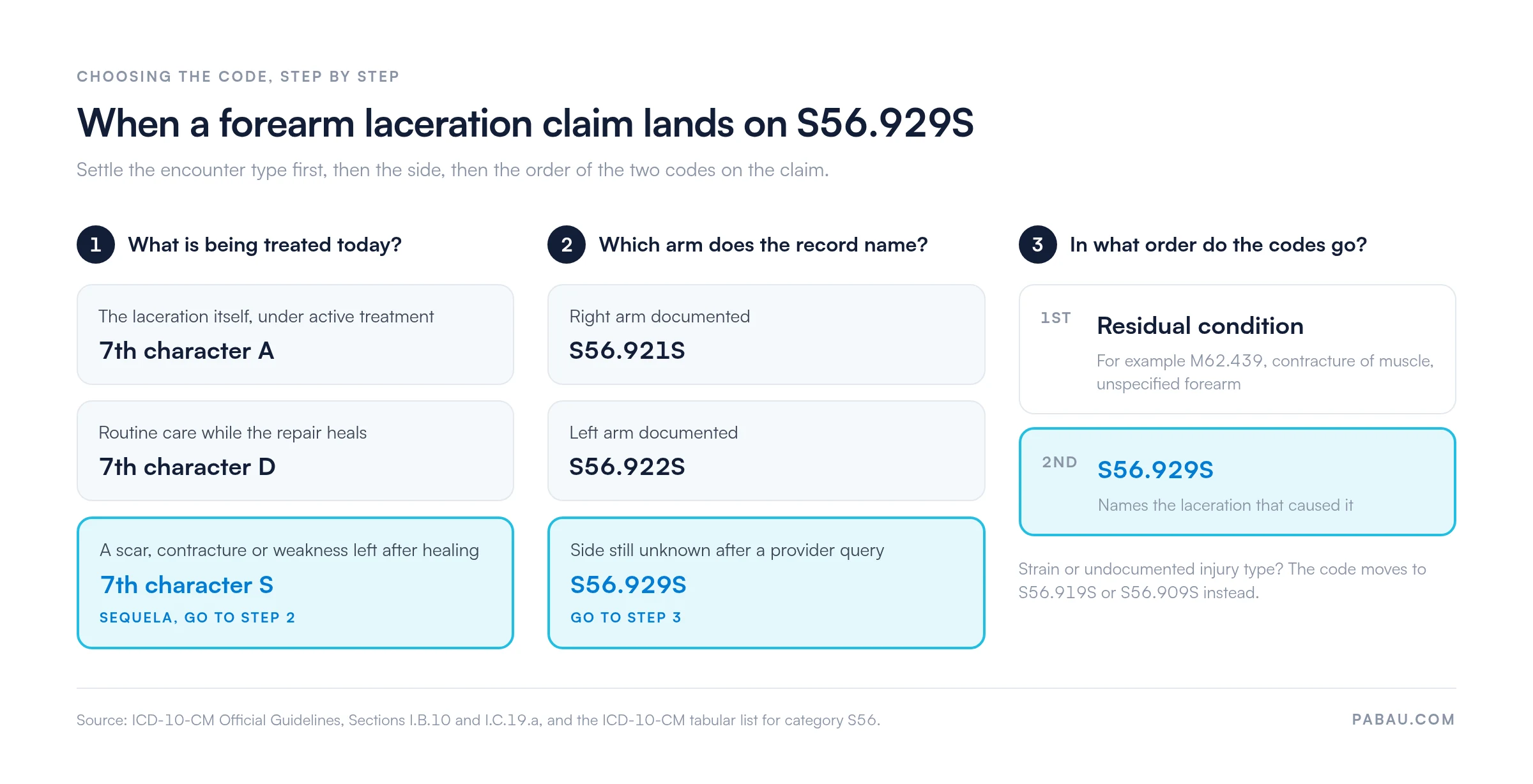
Record the date of the original laceration in every note where you bill S56.929S. Payers reviewing sequela claims look for that date to confirm the acute injury has passed.
The S56 category covers injuries of muscle, fascia and tendon at the forearm level, the region between the elbow joint and the wrist joint. This boundary decides which category a laceration belongs to.
The S56 category carries two Excludes2 notes and one code-also note. Excludes2 means the excluded condition is not part of S56, but both codes may be reported together when the patient has both.
Verify against the current fiscal year tabular list using the CDC/NCHS ICD-10-CM web tool before submitting. Excludes notes can change with each October update.
ICD-10-CM Official Guidelines require the most specific code the record supports. Reach for S56.929S only after the side and the injury type have been checked. When the note names the muscle group, the code moves to its own subcategory, such as S56.529S for a laceration of another extensor muscle.
You can verify the complete S56 code family and their current billable status using the AAPC Codify ICD-10-CM lookup.
The S character tells the payer that the original injury has healed, so reviewers look for proof of that in the note. Without it, medical necessity is hard to establish and the claim is likely to deny.
In Pabau, the practice management software we build, the claims management software pulls the diagnosis codes already on the patient record into a pre-filled claim. The codes charted in the note are the codes that reach the payer.
Medicare Local Coverage Determinations (LCDs) for physical therapy may add criteria when a sequela code supports the visit. LCDs vary by Medicare Administrative Contractor (MAC) jurisdiction, so check the one for your region. Commercial payers set their own authorization rules for sequela episodes. A sequela claim billed against an authorization issued for the acute laceration is a preventable cause of denial.
The denial patterns below are the ones most closely tied to sequela coding on ICD-10 Code S56.929S. Each one is fixed in the note or on the claim before submission, which keeps it out of the appeals queue.
For a broader overview of denial patterns and appeal workflows, the denial management guide covers CARC codes and corrected-claim submission steps in detail. Checking the components of a clean claim before submission helps keep S56.929S denials from reaching the appeals stage.
S56.929S turns up often in physical therapy and rehabilitation billing. A patient may finish acute care for a forearm muscle or tendon laceration and later return with restricted grip, weakness or limited movement. By then the laceration itself has healed. That is the sequela scenario.
Practices billing therapy visits with sequela codes can use the denial codes reference to read CARC and RARC codes when a claim comes back unpaid.
As of the current fiscal year, CMS has not mandated ICD-11 for US clinical billing. ICD-10-CM remains the required diagnostic code system for HIPAA-covered transactions, and S56.929S is valid under the current CMS code set. The WHO ICD-11 browser is publicly available for reference, but no US compliance date has been announced. Practices should continue using ICD-10-CM until CMS publishes a mandatory transition timeline.
Check the CMS ICD-10-CM annual update files each October 1. New codes and revised Excludes notes take effect at the start of each fiscal year, so check the notes for S56 each year.
Sequela claims often fail on details recorded weeks apart. The laceration date sits in an old note and the residual condition sits in today’s note. The claim is then keyed by hand in a separate billing system.
Pabau keeps the clinical notes and the claim in one record. Its claims screen pulls the diagnosis codes already charted into a pre-filled claim. The Claim.MD clearinghouse connection then submits it to US payers and tracks its status.
Your team sees each claim’s status in Pabau beside the note that supports it. When a sequela claim stalls, the laceration date and the residual condition are one click away.

Pabau pulls the codes on the patient record into a pre-filled claim, submits it through Claim.MD and tracks its status with the payer.

ICD-10 Code S56.929S belongs on a claim only when three facts line up. The original injury was a laceration of forearm muscle or tendon, and the record cannot name the muscle or the arm. The care is for a condition the healed laceration left behind.
When the side is known, the code changes to S56.921S or S56.922S. When the injury was a strain or its type is undocumented, the right code comes from a different S56 subcategory. Charting the laceration date and the residual condition in every note makes the sequela pair hold up when a payer reviews it. Getting those details right in the record is part of sound medical billing. To see how Pabau carries them from note to claim, book a demo.

Need to understand denial code patterns on sequela claims? Electronic remittance advice explains how to read ERA files and match CARC codes to specific claim issues.
Submitting forearm injury claims through a clearinghouse? 837 file guide covers the transaction format used to submit ICD-10-CM diagnosis codes to payers electronically.
Want to verify insurance coverage before the PT visit? Insurance eligibility verification walks through the real-time eligibility check process that reduces sequela authorization mismatches.
ICD-10 Code S56.929S is the billable diagnosis code for laceration of unspecified muscles, fascia and tendons at forearm level, unspecified arm, sequela. It applies once a forearm muscle or tendon laceration has healed. The patient is then treated for a condition it left behind, such as a scar or contracture.
Yes, S56.929S is fully billable under ICD-10-CM and valid for HIPAA-covered transactions. It is a 7-character code, which makes it a complete, reportable diagnosis code for claims submission.
The 7th character D (subsequent encounter) applies while the patient receives routine care as the laceration heals. The 7th character S (sequela) applies after the acute phase has ended. The patient is then treated for a condition the laceration caused, such as a scar or contracture.
Use S56.929S only when the record does not show which arm was lacerated, even after a provider query. S56.921S is the laceration sequela code for the right arm and S56.922S is the code for the left arm. If the injury was a strain rather than a laceration, use the strain codes such as S56.919S instead.
The most common reasons are using D when S applies and leaving the laceration date out of the note. Others are an undocumented provider query about the side, listing S56.929S before the residual condition, and therapy notes without objective measures.
No. Under the ICD-10-CM sequela guideline, the residual condition being treated is sequenced first and S56.929S follows it. The visit notes should also include objective functional measures and show the original laceration has healed.