ICD-10 code S61.201A: Open wound of left index finger without nail damage
ICD-10 code S61.201A covers a left index finger wound of unstated type ICD-10 co...

Last Updated: Oct 16, 2026
Billable Code Specific Code
M42.9 is the billable ICD-10-CM code for spinal osteochondrosis, unspecified.
Coders reach for it when the encounter note records neither the age group nor the vertebral level. Every other M42 code carries at least one of those two facts. Payers therefore treat M42.9 as the option of last resort and flag it for review. Orthopedic, chiropractic, and physical therapy practices meet it most often when degenerative spinal changes are documented without a named vertebral level.
Let Pabau's smart automation suggest the right codes, reduce claim denials, and keep your practice compliant—effortlessly.
Automate repetitive tasks and focus on what matters most—your patients.
Reduce coding errors and ensure compliance with the latest regulations.
Clean claims, fewer denials, and faster reimbursements.
Powerful insights and reporting to help your practice thrive.
HIPAA compliant SOC 2 certified GDPR-compliant Trusted by 4,000+ clinics worldwide

M42.9 applies only when the note records neither the age group nor the vertebral level.
The code is billable and valid for all HIPAA-covered transactions in the FY 2026 edition, effective October 1, 2025.
A Scheuermann or Calvé diagnosis establishes juvenile onset, so the unspecified-site fallback is M42.00 rather than M42.9.
No ICD-9-CM code maps forward to M42.9 under the CMS General Equivalence Mappings.
Pabau embeds ICD-10 code search in clinical notes, so coders assign M42.9 without leaving the patient record.
ICD-10 code M42.9 is a valid, billable ICD-10-CM diagnosis code representing spinal osteochondrosis, unspecified. It sits within the M42 category (Spinal osteochondrosis), which belongs to the M40-M43 block of deforming dorsopathies.
That block falls under Chapter XIII of ICD-10-CM, covering diseases of the musculoskeletal system and connective tissue (M00-M99).
The Centers for Medicare and Medicaid Services (CMS) co-maintains ICD-10-CM with the National Center for Health Statistics (NCHS) and publishes annual updates each October. M42.9 has remained a valid, billable code across multiple annual editions with no structural revision in the FY 2026 release.
Spinal osteochondrosis is a group of conditions involving disrupted endochondral ossification of the vertebral growth plates. Bone and cartilage in the vertebral column degenerate as a result.
The process primarily affects the vertebral body endplates and intervertebral disc interfaces. Two distinct age-group presentations drive the ICD-10-CM subcategory structure.
Common clinical presentations include localized spinal pain, stiffness, and postural changes. Imaging typically shows endplate irregularities, Schmorl nodes (vertical disc herniations through the endplate), or vertebral wedging.
The WHO’s ICD-10 international classification groups these under dorsopathies because the degenerative process directly affects spinal structure and mechanics.
Several clinical terms resolve to M42.9 in practice. Knowing the synonym list reduces miscoding when a referring provider uses a term that differs from the official ICD-10-CM descriptor. Each of the following resolves to M42.9 only while both the age group and the vertebral level are absent from the record.
Scheuermann disease and Calvé disease are not synonyms for M42.9, and this is where the code is most often misapplied. Both diagnoses establish juvenile onset on their own, which routes the encounter into the M42.0x series. A Scheuermann note naming the thoracic region maps to M42.04. A Scheuermann note with no region recorded still maps to M42.00, because the age group is documented even where the site is not.
Before assigning M42.9, scan the encounter note and any attached imaging report for vertebral level references. Radiologists routinely note T5-T10 involvement in Scheuermann disease, which enables site-specific coding even when the physician note lacks that detail. Imaging reports embedded in the clinical record count as supporting documentation under ICD-10-CM Official Guidelines.
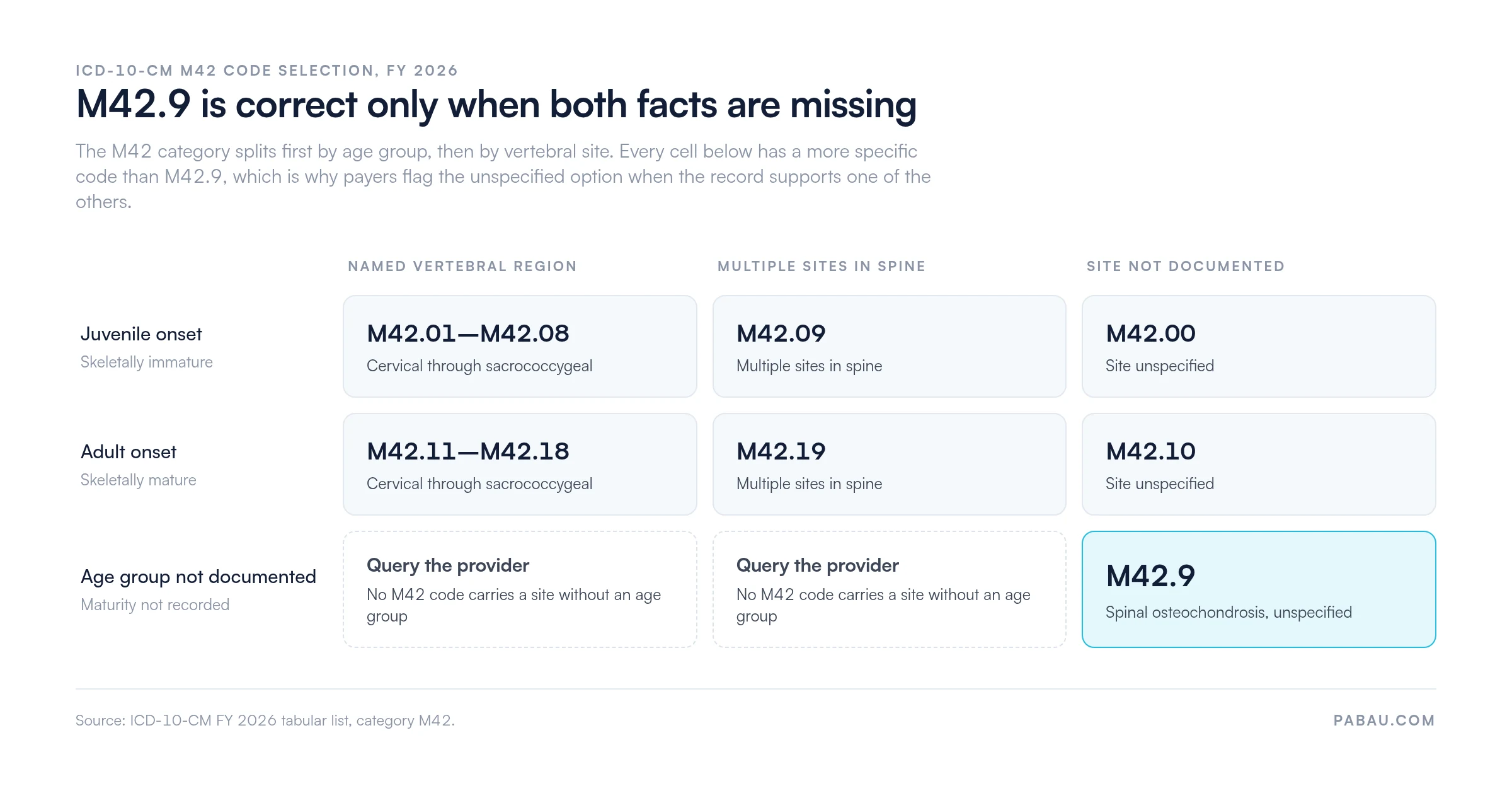
Understanding where M42.9 sits in the code tree helps coders choose the most specific code available. The M42 category branches into three subcategories. M42.0 and M42.1 carry site-specific child codes, and M42.9 carries none. It is the residual code, assigned only after every more specific option has been ruled out.
The M42.0x series covers juvenile-onset spinal osteochondrosis, including Scheuermann disease and Calvé disease. Eight of the ten codes name a vertebral region. M42.00 covers an unspecified site, and M42.09 covers multiple sites in the spine.
Juvenile osteochondrosis outside the spine falls outside M42 entirely. A pelvic ossification center, for example, codes to M91.0 instead of any M42.0x code.
The M42.1x series mirrors the M42.0x structure for skeletally mature patients. M42.10 and M42.19 hold the same two positions there, covering an unspecified site and multiple sites.
M42.9 is appropriate only when the clinical record supports no M42.0x or M42.1x code. Before assigning it, work through a short decision sequence. The grid below shows what each combination of documented facts actually resolves to.
Payers can and do flag claims coded with “unspecified” codes for additional review, particularly when imaging is attached to the claim. A thoracic MRI in the claim packet alongside an M42.9 code signals to a reviewer that site-specific coding should have been possible. Good denial management workflows start with specificity at the coding stage rather than appeals after the fact.
Sufficient documentation for M42.9 must establish the diagnosis without identifying age group or site. Three elements are generally expected in the clinical record to support the code.
Practices with repeated M42.9 denials usually find the cause in the encounter template itself. The form captures the diagnosis but carries no field for the spinal region. Adding one, and reviewing it with the clinicians who fill it in, is the fastest fix available.
M42.9 is a billable code valid for submission on HIPAA-covered transactions. Because ICD-10-CM diagnosis codes drive medical necessity, M42.9 has to pair with a procedure code the payer accepts alongside it.
In practice that means evaluation and management codes (99202-99215), physical medicine codes (97000 series), or chiropractic manipulation codes (98940-98942).
When M42.9 is rejected, the remittance commonly cites “diagnosis code not specific enough” or “medical necessity not established”. Mapping that reason back to the original note is the fastest route to a clean corrected claim.
A validation step before submission catches the problem earlier than an appeal does. Faster claims management means fewer M42.9 claims leaving the practice when the record already supported M42.10.
Practices with legacy data, payer reconciliation requirements, or workers’ compensation cases still reference ICD-9-CM codes. The General Equivalence Mappings (GEMs) maintained by CMS provide the official conversion. Running M42.9 backward through them produces a result worth knowing: no ICD-9-CM code maps forward to M42.9 at all.
The three legacy codes coders most often assume map to M42.9 each land somewhere else. Their official GEM targets are below.
GEM mappings are approximate rather than exact across the osteochondrosis codes, because ICD-10-CM introduced age-group and site specificity that ICD-9-CM never carried. Any M42.9 that arrived in your data through a conversion script deserves a second look against the original note.
M42.9 is often coded alongside or confused with adjacent spinal diagnosis codes. The table below covers codes from the M40-M54 range that appear in similar clinical scenarios, along with notes to prevent miscoding. Where a referral names a condition outside the M42 family, browse ICD-10-CM codes by chapter before assigning anything.
M42.9 appears across several practice types. Chiropractors are among the most frequent users, because spinal osteochondrosis is a common presenting diagnosis in their patient populations.
The initial encounter note rarely records a vertebral level. An intake form that asks for the spinal region moves most of those encounters into the M42.1x range before the note is finalized.
Flag M42.9 in your practice’s coding audit queue. Run a monthly report of claims submitted with M42.9 and cross-reference them against attached imaging. When a radiology report shows a specific vertebral region, file a corrected claim with the appropriate M42.0x or M42.1x code. Most payers accept corrected claims within 90 days of original submission, and the site-specific code reduces the risk of a future audit flag.
M42.9 carries forward into the FY 2026 ICD-10-CM edition without modification. The code’s descriptor, billability status, and hierarchical position are unchanged from prior editions. The 2026 edition became effective October 1, 2025 and remains valid through September 30, 2026.
The CDC/NCHS ICD-10-CM web tool confirms M42.9 as active for FY 2026, with no addenda or editorial revisions applied to the M42 category. No new child codes were added under M42, and no existing codes were retired. Coders working from FY 2025 resources can continue using M42.9 under the same guidance.
Most practices assign the diagnosis code after the visit, from a note somebody else wrote. The coder reads “osteochondrosis” with no vertebral level and has no quick way to ask the clinician. M42.9 goes on the claim to keep it moving.
Practice management software like Pabau puts ICD-10-CM code search inside the treatment record itself. The clinician picks the code while the imaging report is still open, so the vertebral level is captured at source. Diagnosis codes then feed claim generation directly, without a second person retyping them.
The result for a musculoskeletal practice is fewer unspecified codes reaching the payer. An M42.9 assigned because the clinician never recorded a region becomes an M42.14 assigned because they did. That single change removes the most common reason these claims come back.


Pabau embeds ICD-10-CM code search directly in the treatment record and feeds the selected diagnosis straight into claim generation. Coders stop guessing at specificity a week after the encounter.

M42.9 is valid, billable, and almost always the wrong answer. The code survives adjudication, but it tells the payer that the record established neither the patient’s skeletal maturity nor the vertebral level.
Two corrections cut most M42.9 usage on their own. Route any Scheuermann or Calvé diagnosis to the M42.0x series, since both establish juvenile onset. Read the radiology report before coding, because it names a region the physician note often leaves out.
Specificity has to be captured during the encounter, because reconstructing it from a finished note rarely works. A coder can only report what the clinician wrote down. Book a demo to see how Pabau puts ICD-10 code selection inside the treatment record.

Need to understand how clearinghouses validate ICD-10 codes before submission? How medical claims clearinghouses work explains the pre-submission validation process that catches coding errors before they reach the payer.
Dealing with M42.9 denials from payers? Clean claim requirements in medical billing covers the documentation and coding criteria that help musculoskeletal claims pass first-pass adjudication.
Tracking whether an M42.9 claim actually paid? Electronic remittance advice processing explains how to read the payer response and spot specificity denials early.
ICD-10 code M42.9 is the billable diagnosis code for spinal osteochondrosis, unspecified. It applies when spinal osteochondrosis is documented but the record names neither the patient’s age group nor the affected vertebral level.
Yes. M42.9 is a billable, specific ICD-10-CM code valid for all HIPAA-covered transactions in the FY 2026 edition. That edition runs from October 1, 2025 through September 30, 2026. It can be used as a standalone diagnosis code on claims without a more specific child code.
M42.0x codes specify juvenile osteochondrosis of the spine by vertebral region, and M42.1x codes specify adult osteochondrosis by region. M42.9 is used only when documentation establishes neither the patient’s age group nor the spinal site. That makes it the least specific option in the M42 category.
Use M42.9 only after confirming two absences in the record. The clinical note must not state the patient’s skeletal maturity, and neither the note nor any attached imaging report may identify the vertebral region. If a provider query has been attempted and remains unanswered, M42.9 is an acceptable placeholder pending clarification.
No ICD-9-CM code maps forward to M42.9 under the CMS General Equivalence Mappings. The closest legacy code is 732.0 (juvenile osteochondrosis of spine), which maps to M42.00 because juvenile onset is already established. Legacy data converted to M42.9 by a script should be checked against the original note.
Yes, M42.9 is valid for FY 2026 billing with no changes from prior editions. The code became effective October 1, 2025 and remains active through September 30, 2026 with no revisions to its descriptor, hierarchy, or coding guidance.