ICD-10 code S61.201A: Open wound of left index finger without nail damage
ICD-10 code S61.201A covers a left index finger wound of unstated type ICD-10 co...

Last Updated: Oct 16, 2026
Billable Code Specific Code
S54.92XA is the billable ICD-10-CM code for injury of unspecified nerve at forearm level, left arm, initial encounter.
Get the laterality, the encounter type, and that reasoning into the note, and the claim moves. Miss one, and it comes back as a documentation query.
Let Pabau's smart automation suggest the right codes, reduce claim denials, and keep your practice compliant—effortlessly.
Automate repetitive tasks and focus on what matters most—your patients.
Reduce coding errors and ensure compliance with the latest regulations.
Clean claims, fewer denials, and faster reimbursements.
Powerful insights and reporting to help your practice thrive.
HIPAA compliant SOC 2 certified GDPR-compliant Trusted by 4,000+ clinics worldwide

ICD-10 code S54.92XA covers injury of an unspecified nerve at forearm level, left arm, initial encounter, and it is billable through FY2026.
The 7th character ‘A’ means initial encounter, so use S54.92XD for follow-up care and S54.92XS for sequela.
Reach for S54.92XA only when the record cannot name the injured nerve, because a confirmed ulnar, median or radial injury outranks it.
Payers query these claims when the note leaves out laterality, the mechanism of injury, or the reason the nerve stayed unspecified.
Practice management software like Pabau pre-fills codes from the client record and adds ICD-10 code lookup libraries for coders.
S54.92XA is a valid, billable ICD-10-CM code for every HIPAA-covered transaction in FY2026. It needs no more specific companion to be accepted.
The table below holds the data points a coder checks first.
The FY2026 edition took effect on October 1, 2025, according to the CMS ICD-10 codes page. It stays usable through September 30, 2026. No addendum since release has touched the description or the billable status.
Reading the code from the outside in shows how much detail the tabular list expects. S54 covers nerve injuries at forearm level, S54.9 narrows to an unspecified nerve, and S54.92 adds the left arm.
The X in the sixth position is a required placeholder, not a typo. ICD-10-CM uses it wherever a code does not yet fill that character. Drop it and you have an invalid code, which payers reject on sight.
The CDC/NCHS ICD-10-CM web tool carries the official tabular list if you want to check the structure yourself.
Use “A” while the patient is under active treatment for the injury. That covers surgery, splinting, casting, and every emergency department visit. Put “D” or “S” on a first presentation and you have handed an auditor an easy finding.
Does a second provider treating the same acute injury still use “A”? Yes. The character tracks the phase of care, not the visit number. The switch to “D” happens once the injury moves into healing or maintenance.
ICD-10-CM’s Official Coding Guidelines, Section I, Part C, govern how these rules apply in the US.
Category S54 sorts forearm nerve injuries by nerve first, then by side. So a documented ulnar, median, radial or cutaneous sensory injury replaces S54.92XA outright.
The crosswalk below covers the siblings coders reach for most.
Before you settle on this code, confirm the note genuinely leaves the nerve unnamed. A quick diagnostic code lookup makes that check faster when several siblings are in play. A named radial nerve injury at forearm level on the left side moves to ICD-10 code S54.22XD once care becomes routine follow-up.
For the rest of the category, the AAPC ICD-10-CM lookup tool mirrors the current CMS tabular list.
Pick the most specific code the record supports. That one rule from ICD-10-CM’s Official Coding Guidelines settles most of these claims.
The chart below walks the two questions in the order a coder meets them.
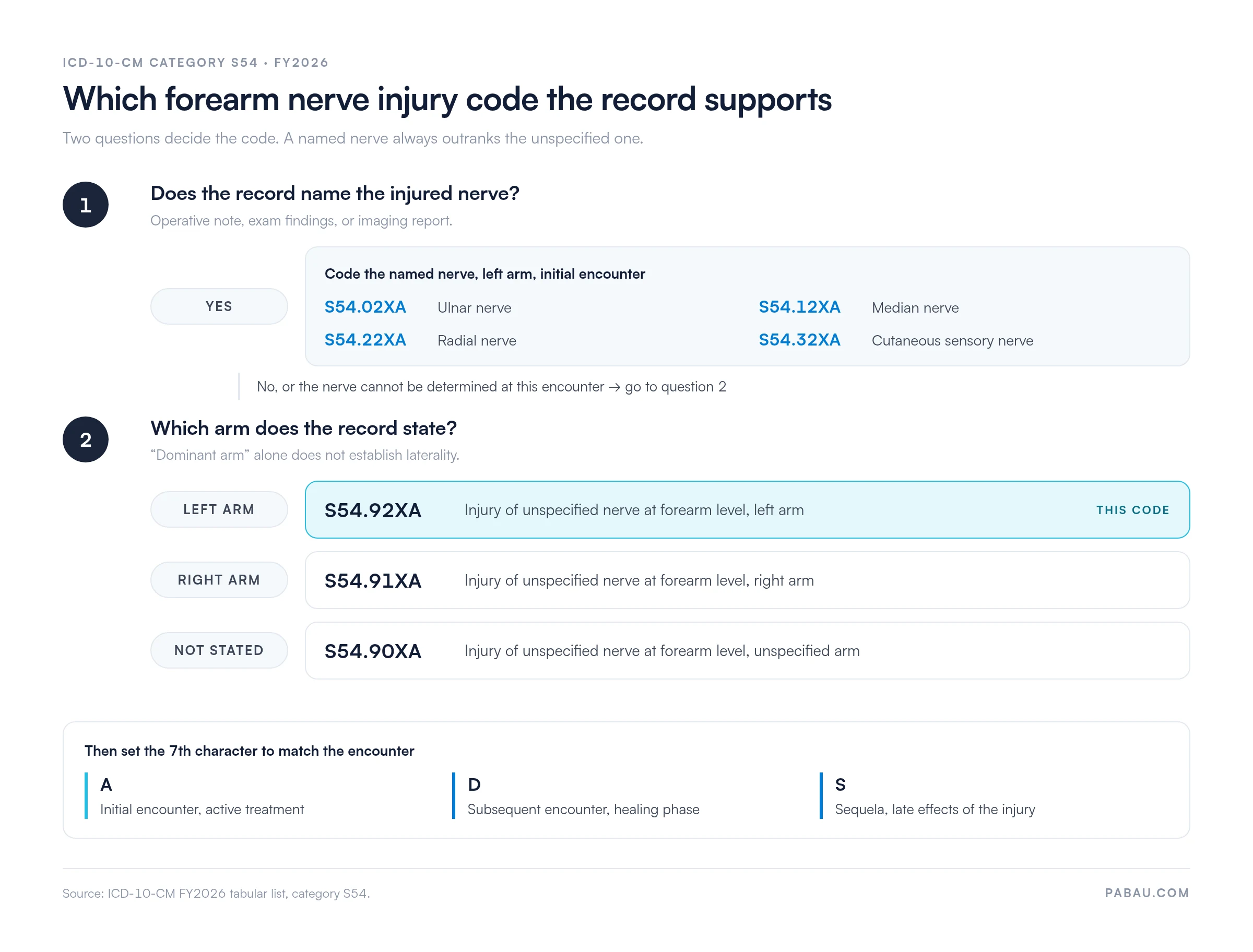
Applied the same way every time, these rules keep the diagnosis stable across a whole episode of care. They also tell you what the note has to say, which is the next thing worth checking.
Three conditions carry this claim. The record has to establish the diagnosis, support the left-arm laterality, and explain why the nerve stayed unspecified. Miss one and a query follows, usually a week after the claim went out.
Run a clinical documentation integrity query, known as a CDI query, whenever an operative or emergency note describes forearm nerve symptoms without naming the nerve. Most denials on S54.9x codes trace back to functional language in the note, such as ‘weakness in wrist extension’. Nobody named the structure involved. One sentence resolved before billing saves a long appeal.
Forearm nerve injuries rarely arrive alone. Knowing the usual companions in advance speeds up claim preparation and heads off a “diagnosis does not support procedure” denial.
The table lists the codes that pair with S54.92XA most often, plus the sequencing note for each.
Pain codes in the G89 range are not routine additions to a traumatic injury claim. Add one only when pain management is documented and addressed as its own clinical focus at that encounter.
External cause codes in the W, X and Y blocks deserve a look at payer policy. Some commercial plans make them mandatory on injury claims.
Fracture codes such as S52.202A change the shape of the claim. Sequence the structural injury first, then add the nerve injury as the secondary diagnosis that completes the clinical picture.
Build a charge capture template for forearm nerve injury encounters. Put S54.92XA on it as the working diagnosis, next to the external cause codes your patient population generates. In orthopedic and urgent care settings that usually means W19.XXXA for an unspecified fall. Pre-populating the pair cuts keystrokes and keeps the claim complete on first submission.
Most rejections on this code are mechanical rather than clinical. The diagnosis holds up fine, and a field on the claim does not. So it helps to know the route the claim takes before you press send.
The provider documents the encounter, then the coder assigns S54.92XA and any companion codes. The charge line picks up the procedure code for the treatment rendered, whether that is nerve exploration, fracture management or an evaluation visit.
From there the claim leaves as an 837P transaction or a CMS-1500 form, passes through the clearinghouse, and lands with the payer.
The diagnosis has to support medical necessity for every procedure code on the claim. Run these five checks before it goes:
Two mistakes account for most repeat denials here: a missing procedure code, and an encounter-type mismatch after the patient moves into follow-up care. Both are cheap to prevent.
Keeping a clean claim checklist at the coder’s desk catches them before the batch goes out.
In a lot of practices the diagnosis gets written once in the note and typed again into the billing system. Retyping is where the 7th character slips and the laterality quietly drops off.
Practice management software like Pabau closes that hand-off. The codes already attached to the visit land on the claim form, so what the clinician recorded is what the payer receives.
Its ICD-10-CM and procedure code lookup libraries sit behind a search icon on the same screen, which saves a trip to a separate code book.
Pabau also checks that claim-required fields are complete, such as membership and authorization numbers, before the send button unlocks. Those are field checks rather than coding advice, so the 7th character stays the coder’s call.
From there Pabau submits electronically through Claim.MD, its US clearinghouse partner, which reaches more than 4,000 US payers. Real-time eligibility checks, claim-status tracking and remittance posting all sit in the same place.
For an orthopedic or urgent care front office, faster claims management means fewer forearm injury claims parked in a rework queue.
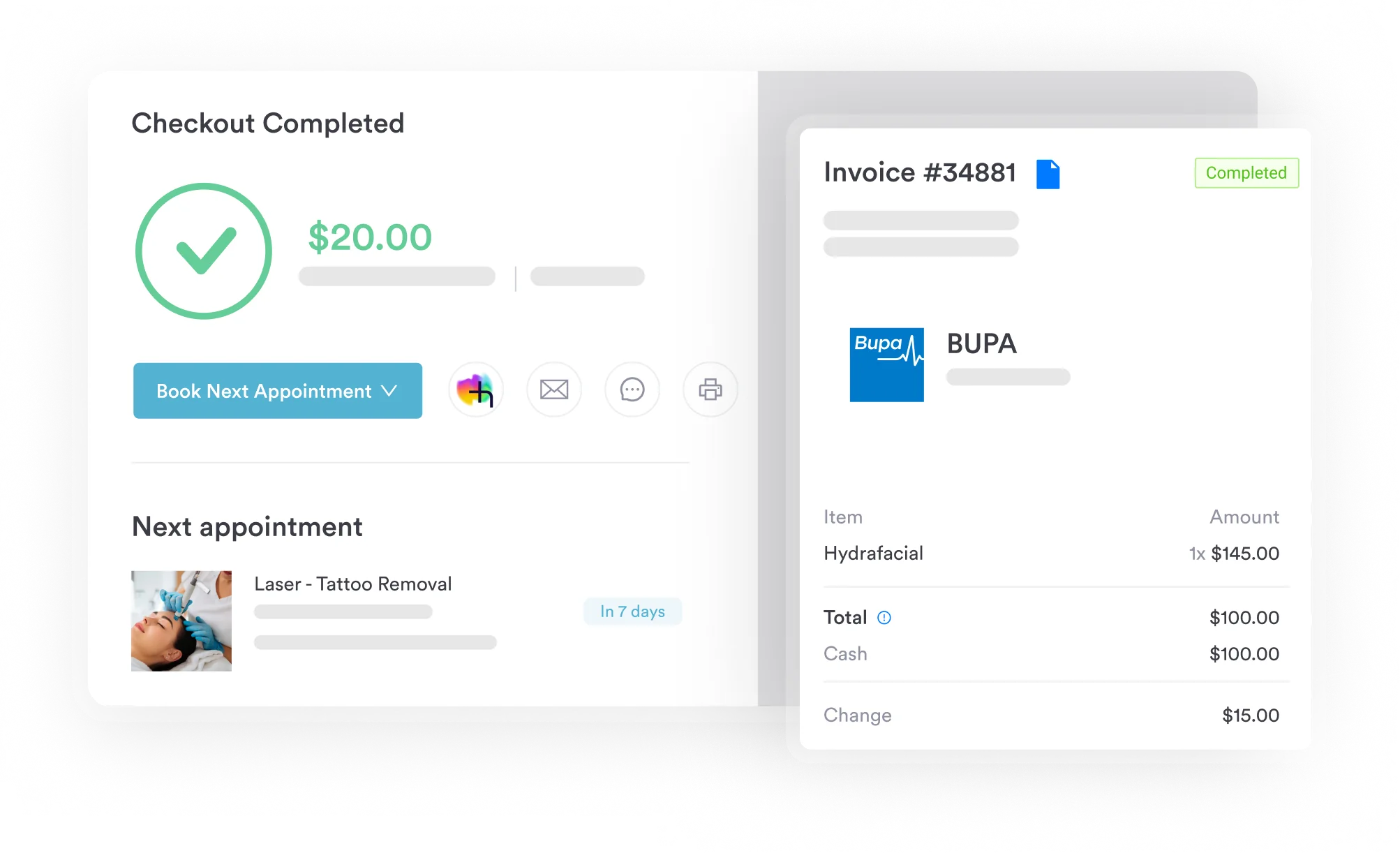

Pabau pre-fills the claim from the client record and adds ICD-10 and procedure code lookup libraries. It also checks that required fields are complete before you submit.

S54.92XA is the honest code when the record cannot name the nerve, and it pays like any other billable diagnosis. What it will not do is cover for a thin note. The word unspecified has to read as a finding, not a shortcut.
So the work sits upstream of the claim. Query the provider while the chart is still fresh, keep the laterality and the encounter type explicit, and submission stops being the hard part.
Software helps by carrying the codes from the record onto the claim form and checking that required fields are complete. Book a demo to see how Pabau handles traumatic injury claims like this one, from the note through to the payer.

Coding a nerve injury higher up the arm? ICD-10 code S44.42XA covers the musculocutaneous nerve at upper arm level on the left side, under the same 7th character rules.
Need the forearm flexor code instead? ICD-10 code S56.109A handles an unspecified flexor muscle or tendon injury at forearm level.
Not sure what a payer counts as clean? What makes a clean claim walks through the fields checked before a claim is accepted.
Working through denials on injury codes? Denial codes in medical billing breaks down the common CARC reasons and how to clear them.
Want the wider billing picture? Revenue cycle management explained follows each stage from diagnosis capture to payment posting.
No. S54.92XA is a traumatic injury code. Compression and entrapment conditions such as carpal tunnel syndrome sit in the G56 range, and those codes carry no 7th character.
Then S54 is the wrong category. Nerve injuries at wrist and hand level belong to S64. The tabular list treats forearm level as elbow to wrist, so the anatomy in the note decides which category applies.
There is no day count. ‘A’ applies for as long as the patient receives active treatment for the injury, which might be one visit or several. Once care becomes routine follow-up, switch to S54.92XD.
Yes, though the 7th character is usually wrong by then. Therapy for a healing nerve injury counts as subsequent care, so S54.92XD normally fits. Keep ‘A’ only where the therapist is delivering active treatment.
Code each side separately. S54.92XA covers the left arm and S54.91XA covers the right, so a bilateral injury takes both codes on the claim. S54.9 offers no combined bilateral option.