ICD-10 code S61.201A: Open wound of left index finger without nail damage
ICD-10 code S61.201A covers a left index finger wound of unstated type ICD-10 co...

Last Updated: Oct 16, 2026
Billable Code Specific Code
S52.591C is the billable ICD-10-CM code for other fractures of lower end of right radius, initial encounter for open fracture type IIIA, IIIB, or IIIC.
Get the grade wrong and the letter on the end of the code changes, which is why open wrist claims bounce back so often.
Let Pabau's smart automation suggest the right codes, reduce claim denials, and keep your practice compliant—effortlessly.
Automate repetitive tasks and focus on what matters most—your patients.
Reduce coding errors and ensure compliance with the latest regulations.
Clean claims, fewer denials, and faster reimbursements.
Powerful insights and reporting to help your practice thrive.
HIPAA compliant SOC 2 certified GDPR-compliant Trusted by 4,000+ clinics worldwide

S52.591C covers an other fracture of the lower end of the right radius, graded Gustilo IIIA, IIIB, or IIIC. It applies at the initial encounter only.
The code sits in S52.5, fracture of lower end of radius. S52.291C sits in S52.2 and describes the ulna shaft instead.
The 7th character C is exclusive to open fractures graded Gustilo type IIIA, IIIB, or IIIC. All three subtypes share that one character.
Coders never assign the Gustilo grade themselves. Where the record states an open wound but no grade, ICD-10-CM sends you to B, not C.
Practice management software like Pabau keeps the coded chart and the outgoing claim in one system, so the biller never re-keys the codes.
Start with the lookup. The reasoning behind each row follows underneath.
Read the code left to right and each segment narrows the injury a little further. Misread one segment and you have described a different fracture.
The “other fracture” designation at the 5th character means the pattern does not meet the criteria for any named distal radius subcategory.
It is not a Colles’ fracture (S52.53-), a Smith’s fracture (S52.54-), a Barton’s fracture (S52.56-), or a radial styloid fracture (S52.51-). Coders in orthopedic and trauma settings meet this when the surgeon describes the morphology in detail but never names it.
Distal radius fractures are among the most common fractures seen in adults, according to the American Academy of Orthopaedic Surgeons (AAOS).
Most are closed injuries. S52.591C represents the subset that presents as an open wound, meaning bone has breached the skin or the wound communicates directly with the fracture site.
A worked example. Someone comes off a bike at speed and lands on the right wrist. Imaging shows a distal radius fracture that is not a Colles’, Barton’s, Smith’s, or styloid pattern. The surgeon documents an open wound and grades it Gustilo IIIB. Surgery happens the same day, so this is the initial encounter. That record supports S52.591C, and only that record does.
The 7th character carries two facts in a single letter. It records whether the fracture is open or closed, and it records the phase of care. C means an open fracture of Gustilo grade IIIA, IIIB, or IIIC, seen at an initial encounter.
So you need both facts before you can choose a letter, and both have to come off the record. That logic runs through the whole S52 family, and through every traumatic fracture chapter in the code set.
Gustilo and Anderson published this classification in the Journal of Bone and Joint Surgery in 1976. It grades open fractures by wound size, soft tissue injury, contamination, and bone involvement.
ICD-10-CM does not separate types IIIA, IIIB, and IIIC at the 7th character level, so all three map to character C.
Important: an open type I or II fracture takes 7th character B instead. Only types IIIA, IIIB, and IIIC take character C, and assigning it to a type I wound will not survive a documentation audit.
ICD-10-CM also tells you what to do when the grade is missing. Where the record documents an open fracture but no Gustilo type, the guidelines send you to the type I or II character. At an initial encounter that letter is B rather than C, because the default runs down and never up.
Put those rules end to end and the whole choice comes down to three questions about the record.
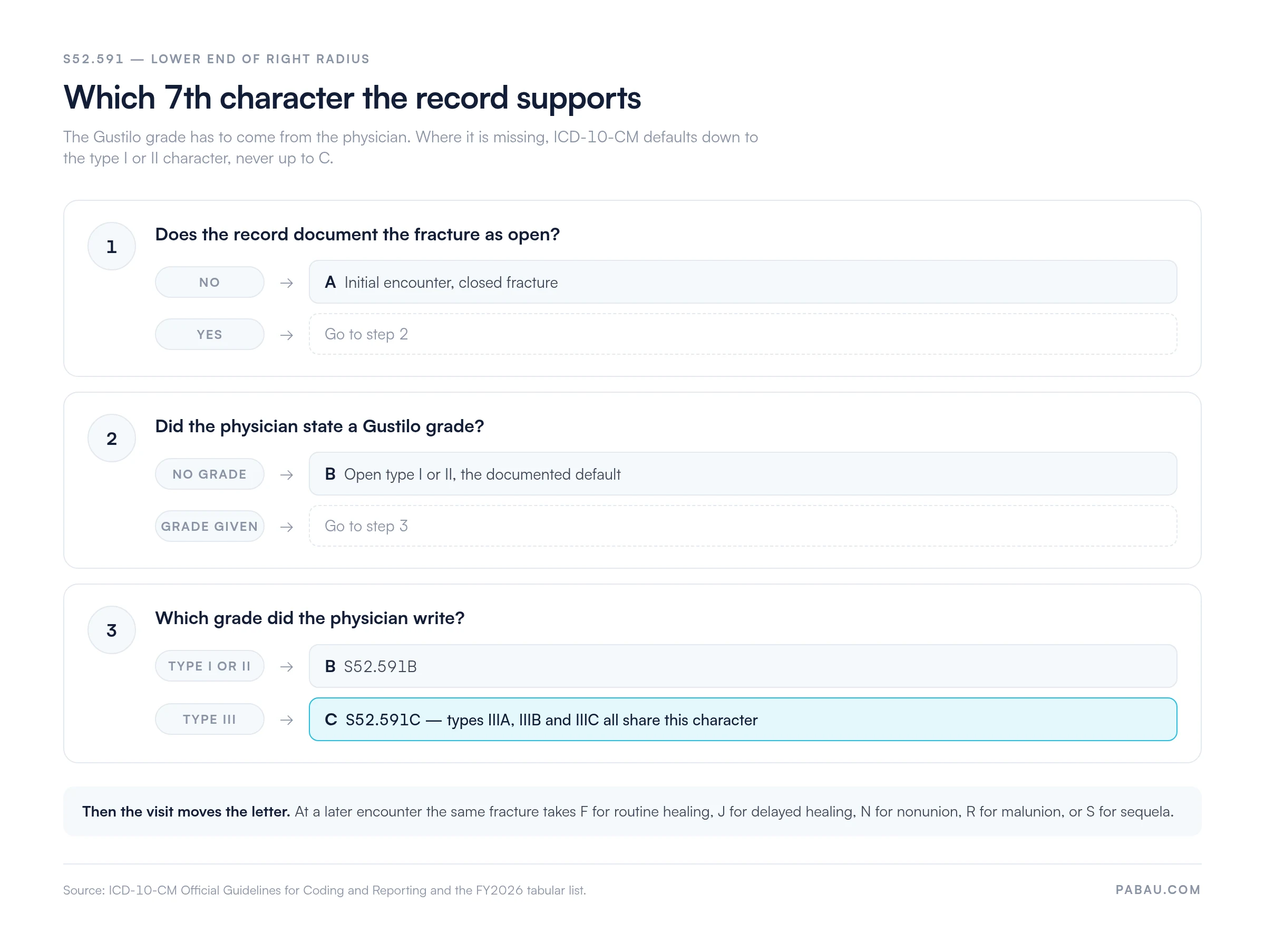
The table below covers the whole treatment continuum. It runs from initial active treatment through healing complications and late effects.
Choosing the right letter means knowing the care phase the physician documented at that visit.
Document the 7th character decision in your coding notes for every S52.591C claim. If a payer audit queries the Gustilo grade, you need the physician’s documented wound classification available immediately. Relying on retrospective chart review after a denial adds weeks to resolution time.
Laterality and fracture specificity decide which sibling code applies. When documentation does not state right or left, use the unspecified code. Never guess, and never default to right.
Category S52 carries two exclusion notes that matter on trauma claims. Traumatic amputation of the forearm is an Excludes1 note, so S58.- never appears alongside a code from S52.
Fracture at wrist and hand level is an Excludes2 note, so a carpal or metacarpal fracture from the same accident is coded separately with S62.-.
These two codes share a 7th character and look almost identical on a claim line, but they describe different bones. The 4th character is the whole difference, and payers read it.
If the operative note describes a wrist injury and distal radius fixation, S52.591C is the code. S52.291C belongs to subcategory S52.2, fracture of shaft of ulna, and describes an ulna shaft injury in the middle of the forearm.
Sending an ulna shaft diagnosis with a distal radius procedure code invites a medical necessity denial on the first pass.
CMS and the National Center for Health Statistics maintain the ICD-10-CM Official Guidelines for Coding and Reporting.
Five of those rules bear directly on this code:
Those five rules collapse into one habit at the desk. Confirm wound type, Gustilo grade, laterality, and care phase before the claim goes out, not after a denial arrives.
Five elements have to appear in the physician’s own words before this code is defensible. If any one is missing, the correct move is a physician query, not an assumption.
These five turn up again and again on S52 remittances. Each one is cheap to catch beforehand and expensive to fix afterwards.
Each of these comes back on the remittance as a specific rejection, and the denial codes tell you which one you hit. Flag S52 claims for a documentation review before they leave the practice, and most of these never reach a payer at all.
S52.591C is a diagnostic code only. You report the surgical work separately with CPT codes. The pairings below reflect the open nature of the injury, because closed reduction alone rarely suits a Gustilo type III wound.
The split between 25607 and 25608-25609 is the one coders get wrong most often. 25607 covers an extra-articular fracture. 25608 and 25609 need the fracture to enter the radiocarpal or distal radioulnar joint, and the number of fragments fixed then chooses between them.
Check payer-specific National Correct Coding Initiative edits before these combinations go out.
Debridement is the other common trap. Because an open fracture is present, the 11010-11012 family applies rather than the 11042-11047 wound debridement codes.
Depth decides which one. Code 11010 covers skin and subcutaneous tissue, 11011 adds muscle and fascia, and 11012 goes through bone. Some payers still bundle the debridement into the fracture repair, so confirm the edit before billing both on the same date of service.
If soft-tissue coverage later calls for a skin substitute, that product bills on its own line. HCPCS code Q4104 is reported per square centimeter of the applied wound area. The claim also needs an application code from 15271-15278, or the product line triggers a technical denial.
Verify NCCI bundling rules before pairing 11010-11012 with 25607-25609 on the same claim. Some payers bundle open fracture debridement into the fracture repair code, and an unbundled claim triggers an automatic edit that adds weeks to payment.
A Gustilo type III wrist fracture is almost always a high-energy injury, so Chapter 20 external cause codes usually belong on the claim. They are always secondary. An external cause code is never the first-listed diagnosis.
These codes carry weight on trauma claims. Workers’ compensation and auto carriers often route the file on the status and place codes alone. A missing Y99 can therefore send a payable claim to the wrong payer.
S52.591C is a one-visit code. Once the patient moves out of active treatment, the 7th character has to move with them. The rest of the code stays exactly the same.
Those five all keep the S52.591 stem because the fracture pattern has not changed. A right-sided Colles’ fracture with the same open type III wound and a nonunion takes S52.531N instead.
Sequela coding has one rule that catches people out. List the condition resulting from the injury first, then S52.591S second. Never put the residual condition and the acute injury code on the same claim line.
The code is one stop on a longer route, and most of the trouble happens at the hand-offs. Here is the path a single open wrist fracture takes:
Two hand-offs cause most rejections. One is the move from the operative note to the coding sheet, where laterality and the Gustilo grade get dropped. The other is the move from coding to charge entry, where the diagnosis says right and the modifier says left.
Seven lines, and each takes seconds against the chart. Work down them before the claim leaves the practice.
Codes in the S52 family stay stable across recent fiscal years, but confirm the annual update before you bill. Three sources settle almost every question.
In a typical practice the side of the injury and the wound grade are written once, in the operative note. Then someone types them again by hand at billing.
That second keystroke is where a distal radius code quietly becomes an ulna shaft code, and the denial turns up three weeks later.
Practice management software like Pabau keeps the clinical record and the claim in one system. The operative note, the imaging report, and the codes stay attached to the same encounter. Your biller then works from the chart instead of a summary sheet.
Pabau’s claims management software then sends the claim electronically through a regional clearinghouse and runs eligibility checks before the visit. It does not grade wounds or crosswalk codes for you, and no software should.
What it removes is the re-keying and the chase, so the codes your surgeon documented are the codes the payer receives.
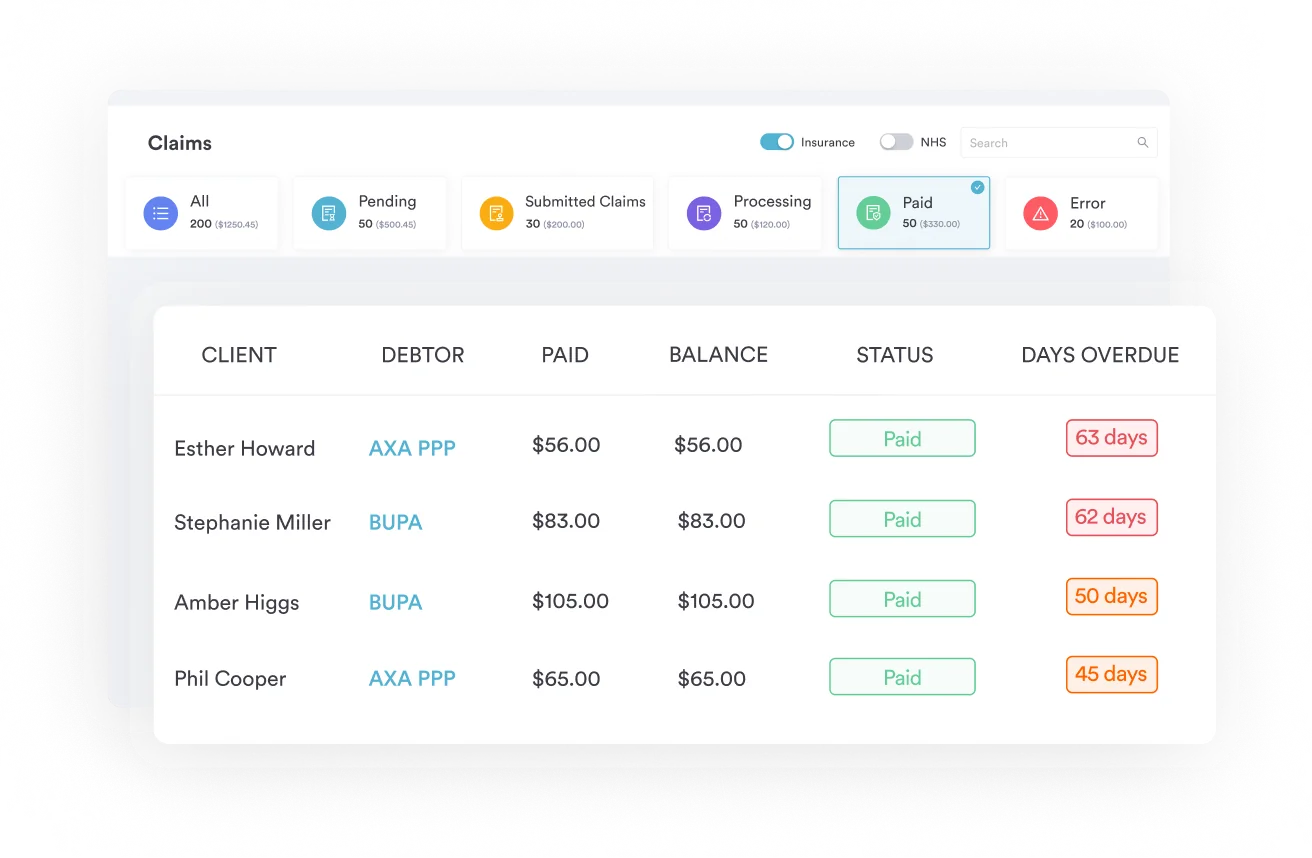

Pabau holds the operative note, the codes, and the claim on one encounter, submits electronically, and checks eligibility before the visit. See how it handles your fracture billing in a live demo.

S52.591C is not a hard code to assign. It is a hard code to defend, because four of its five elements live in someone else’s handwriting. The site, the side, the pattern, and the grade all come from the surgeon, and you own only the sequencing.
So the work moves upstream. Query the grade while the patient is still in the building, rather than three weeks later against a denial. A query costs an hour. Reworking a denied type III claim costs far more, plus the days it adds in accounts receivable.
The near miss is the one to watch. S52.291C sits one digit away and describes an ulna shaft, and a payer reads that as a different injury. If your fracture claims keep coming back for documentation, book a demo. You will see how Pabau keeps the operative note and the claim on one record.

Coding a different distal radius pattern? S52.355C covers the nondisplaced comminuted fracture of the lower end of the radius.
Looking at a buckle fracture instead? S52.529D covers a torus fracture of the lower end of the radius at a follow-up visit.
Billing debridement alongside the fixation? CPT code 11011 covers open fracture debridement that reaches muscle and fascia.
Chasing a rejection on a fracture claim? Denial management in healthcare walks through resolving ICD-10 rejections and stopping the repeats.
Preparing for a payer audit? Medical billing compliance sets out the documentation standards that hold up under review.
The initial encounter is not a date range. It covers every visit where the patient receives active treatment, including surgery, emergency care, and evaluation by a new physician. A staged washout two days later is still active treatment, so the 7th character stays at C.
Yes. The injury code is sequenced first when it is the reason for the encounter. External cause codes from Chapter 20 are always secondary and never lead the claim.
Code each fracture separately. S52.591C reports the radius, and a code from S52.2- reports the ulna shaft. Sequence the more severe injury first, or the one that drove the encounter.
No. A physeal fracture of the lower end of the radius belongs in S59.2-, not S52.5-. Check whether the surgeon described a Salter-Harris injury before you reach for this code.
Correct the claim rather than leave it. A late-documented Gustilo grade supports a corrected claim carrying the right 7th character. Payers accept the change far more readily before a denial than after one.