

ICD-10 code S61.201A: Open wound of left index finger without nail damage
ICD-10 code S61.201A covers a left index finger wound of unstated type ICD-10 co...

Last Updated: Oct 16, 2026
Billable Code Specific Code
S52.531N is the billable ICD-10-CM code for Colles' fracture of right radius, subsequent encounter for open fracture type IIIA, IIIB, or IIIC with nonunion.
It applies at a follow-up visit once imaging confirms the fracture has failed to heal. The original injury must be an open Colles fracture of the right radius, Gustilo type IIIA, IIIB, or IIIC. A closed fracture with nonunion takes S52.531K, and an open type I or II fracture takes S52.531M.
Let Pabau's smart automation suggest the right codes, reduce claim denials, and keep your practice compliant—effortlessly.
Automate repetitive tasks and focus on what matters most—your patients.
Reduce coding errors and ensure compliance with the latest regulations.
Clean claims, fewer denials, and faster reimbursements.
Powerful insights and reporting to help your practice thrive.
HIPAA compliant SOC 2 certified GDPR-compliant Trusted by 4,000+ clinics worldwide

ICD-10 Code S52.531N reports a subsequent encounter for an open Colles fracture of the right radius, Gustilo type IIIA, IIIB, or IIIC, with confirmed nonunion.
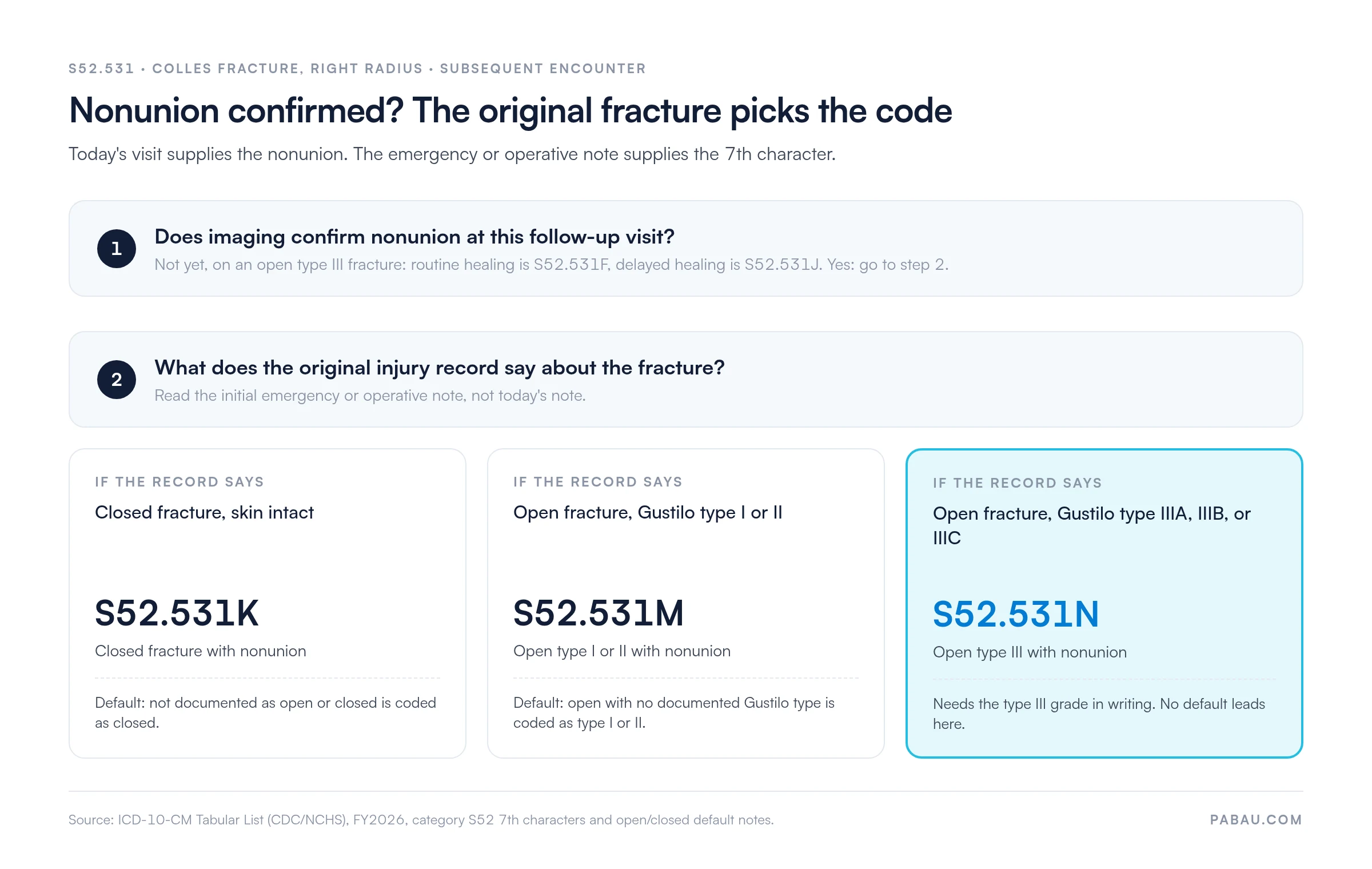
The 7th character N applies only to open type III fractures with nonunion. A closed fracture takes K, and an open type I or II fracture takes M.
Slow healing of an open type III fracture without documented nonunion is coded S52.531J, not S52.531N.
Imaging (X-ray or CT) must support the nonunion diagnosis, because clinical suspicion alone does not meet payer documentation standards.
Practice management software like Pabau runs validation checks on each claim, submits it directly through Claim.MD, and tracks it through to payment.
ICD-10 Code S52.531N reports a follow-up visit for an open Colles fracture of the right radius that has gone on to nonunion.
The original fracture must be Gustilo type IIIA, IIIB, or IIIC. The table below collects the reference data to check before submission.
Confirm the current-year valid status annually using the CDC/NCHS ICD-10-CM web tool, which publishes the official tabular list each fiscal year.
S52.531N breaks down into five components, and each one carries clinical and billing meaning.
The combination of laterality and 7th character is what makes this code billable at the highest level of specificity. Dropping either results in an unspecified code that many payers will reject or down-code.
A Colles fracture is a dorsally displaced and dorsally angulated fracture of the distal radius. It is most often sustained when a patient extends the wrist to break a fall. The classic radiographic appearance is a “dinner fork” deformity caused by dorsal displacement of the distal fragment.
Nonunion means the fracture has failed to achieve bony consolidation within the expected healing window. For distal radius fractures, most orthopedic authorities consider nonunion confirmed when imaging shows no bridging callus 6 months or more after injury.
Some payers apply a 3–6 month threshold based on their Local Coverage Determination (LCD). Nonunion is pathologically distinct from delayed union, which implies healing is still progressing slowly.
For coding purposes, the distinction matters because delayed union of an open type III fracture maps to the “J” 7th character, not “N.” Documenting “slow healing” or “delayed consolidation” without explicitly stating nonunion will lead a coder to the wrong extension and a denied claim.
ICD-10-CM bases its open fracture designations on the Gustilo-Anderson classification. It grades an open fracture by wound size, soft tissue damage, and vascular involvement. S52.531N covers only the three most severe grades.
Two default rules decide the code when the record is vague. A fracture not documented as open or closed is coded as closed, which points to S52.531K. An open fracture with no documented Gustilo type is coded as type I or II, which points to S52.531M. S52.531N needs the type III grade in writing, as the decision path below shows.
The 7th character is the most error-prone element of S52.531N. The table below maps every valid 7th character for S52.531 to its clinical scenario.
The critical distinction for ICD-10 Code S52.531N is the original fracture type. “N” applies only when the Colles fracture was open and graded Gustilo type IIIA, IIIB, or IIIC. A closed fracture with nonunion maps to “K,” and an open type I or II fracture maps to “M.” Always cross-reference the original injury record before assigning the 7th character.
Code selection errors cluster around three confusion points: encounter type, healing status, and laterality. The table below compares S52.531N with the codes most often confused with it.
Using S52.531A on a return visit where nonunion is documented is a hard audit trigger. Payers cross-reference the date of service against the expected encounter type. An “A” code months after the injury date will generate an automated edit.
Payer auditors review five documentation elements to validate ICD-10 Code S52.531N. Missing any one of them is sufficient grounds for denial or post-payment recoupment.
Practices should create a nonunion fracture documentation checklist embedded in their orthopedic note templates. Each of the five elements above should appear as a structured field or free-text requirement before the note is closed.
S52.531N pairs with a range of CPT codes, depending on whether the encounter covers evaluation, conservative management, or surgical nonunion repair. Matching each pairing to the documented service reduces unbundling risk.
Always verify modifier requirements when billing surgical CPT codes alongside S52.531N. Payers often require modifier 58 (staged procedure) or modifier 78 (unplanned return to operating room). This applies when nonunion repair follows initial fracture treatment billed to the same global period. Confirm pairing rules with each payer’s policy before submitting.
Medicare and commercial payers handle S52.531N claims differently depending on whether the encounter involves evaluation only or surgical nonunion repair. For straightforward follow-up visits coded with an E/M CPT, prior authorization is generally not required.
Surgical nonunion repair is a different matter: most payers require prior authorization before bone grafting, open reduction, or internal fixation for fracture nonunion. Many also require documented evidence of failed conservative management.
Eligibility is worth checking before the surgical visit as well. Practice management software like Pabau connects to Claim.MD, so coverage can be verified in real time before the patient arrives.
Medicare follows Local Coverage Determinations (LCDs) issued by each Medicare Administrative Contractor (MAC). LCDs for fracture nonunion treatment typically require proof that the fracture has not healed after a set period of conservative management, often 3–6 months. They also require imaging evidence of persistent nonunion.
The relevant LCD varies by MAC jurisdiction. Verify the applicable LCD for your area using the CMS ICD-10 codes page, which links to the Medicare Coverage Database.
On the electronic remittance advice for a nonunion repair claim, watch for CARC (Claim Adjustment Reason Code) 197. It means precertification, authorization, or notification was absent, so the payer found no approved authorization for the service. Confirm the authorization number was captured before surgery, then check whether the payer accepts a retroactive request.
Review medical billing compliance standards for fracture aftercare before submitting nonunion repair claims, particularly when bone grafting CPT codes are included. Payers audit these combinations closely because bone graft billing is a known high-risk area.
Denials on S52.531N claims fall into five categories. Each one comes back with a claim adjustment reason code, and our guide to medical billing denial codes explains how to read them.
Audit denied S52.531N claims for the 7th character first. A frequent cause is an extension copied forward from the previous visit and never updated to ‘N’ after imaging confirmed nonunion.
The approximate ICD-9-CM equivalent for S52.531N is 813.51 (Colles fracture, open). The crosswalk is approximate because ICD-9 did not encode encounter type or healing status at the same level of specificity as ICD-10-CM. One ICD-9 code covered every encounter type and healing outcome that ICD-10 now splits into separate 7th characters.
Crosswalk tools are useful for legacy system conversions and retrospective data analysis. The mapping is directional, because 813.51 converts to several ICD-10 codes depending on encounter context.
ICD-9 codes are not valid on US claims for dates of service from October 1, 2015. Use the crosswalk for legacy data only, never to choose the code for a current claim.
For additional lookup and validation, the AAPC ICD-10-CM code search provides descriptor, hierarchy, and crosswalk data for the full S52 block.
Coders must review the instructional notes at the S52 block level before finalizing any code in this family. These notes apply to S52.531N by inheritance from its parent categories.
A nonunion claim often passes through several hands before it reaches the payer. Each retyping is a chance for a “K” to become an “N,” or for a routine-healing extension to carry over from the last visit. A missing authorization number on a repair claim comes back weeks later as a CARC 197.
Pabau’s claims management software runs validation checks every time you send a claim. It confirms required details, such as membership numbers and authorization codes, are present. Invoice details pre-fill the submission, and US practices send it directly through Claim.MD.
After submission, the Claims dashboard shows each claim as pending, submitted, processing, paid, or error. Your billing team spots a rejected S52.531N claim early and records the payment against the right invoice once it clears.

Pabau checks each claim for missing details before it goes out, submits it directly through Claim.MD, and tracks it to payment. Orthopedic practices spend less time reworking denied nonunion claims.

S52.531N depends on the original injury record as much as on today’s visit. A follow-up note can confirm nonunion, but only the emergency or operative note proves the fracture was open and graded type III.
Before you submit, check three facts against the record: the fracture was open type III, imaging confirms nonunion, and the encounter is subsequent. If the Gustilo grade is missing, query the provider before the claim defaults to S52.531M.
To see how Pabau checks and tracks orthopedic claims from submission to payment, book a demo.

Want fewer rejections on the first pass? What is a clean claim covers the checks a claim needs before it reaches the payer.
Need to understand denial workflows? Denial codes in medical billing explains the CARC and RARC codes that come back on denied claims.
Reading remittance advice line by line? Electronic remittance advice shows how to read the adjustment codes behind a short payment.
Building a denial prevention process? Denial management in healthcare walks through tracking, appealing, and preventing denied claims.
Submitting claims through a clearinghouse? Medical claims clearinghouse guide walks through how clearinghouse validation catches code errors before they reach the payer.
ICD-10 Code S52.531N is a billable diagnosis code for an open Colles fracture of the right radius with confirmed nonunion, at a subsequent encounter. The open fracture is Gustilo type IIIA, IIIB, or IIIC. S52 is the forearm fracture block and .531 is a Colles fracture of the right radius. The 7th character N means subsequent encounter, open type III fracture, nonunion.
Yes, S52.531N is a fully billable ICD-10-CM code valid for claim submission in FY2026. It is a terminal code (no further subdivision exists), which means it can be reported directly on a claim without a more specific code. Verify current-year status annually using the CDC/NCHS ICD-10-CM tool, because CMS and NCHS publish additions and deletions each October.
S52.531A is the initial encounter code for a closed Colles fracture of the right radius. S52.531N is a subsequent encounter code for an open type IIIA, IIIB, or IIIC fracture once nonunion is confirmed on imaging. The initial encounter for that same open fracture is S52.531C, not S52.531A. Using an initial encounter code on a follow-up visit is the most common denial trigger for this code family.
S52.531D applies to a closed fracture that is healing as expected. S52.531N applies to an open type III fracture that has failed to heal, meaning imaging shows no bridging callus and the provider has documented nonunion. For the same open type III fracture, routine healing uses S52.531F and delayed healing uses S52.531J.
The approximate ICD-9-CM equivalent is 813.51 (Colles fracture, open), sometimes supplemented by 733.82 (nonunion of fracture) as a secondary code. The mapping is approximate because ICD-9 did not capture encounter type, Gustilo grade, or healing status. A single ICD-9 code therefore corresponds to several ICD-10 7th-character extensions.
Yes, imaging confirmation is required for nonunion coding from a payer documentation standpoint. X-ray or CT evidence of absent bridging callus, combined with a provider or radiologist attestation of nonunion, is the standard. Clinical suspicion alone, without supportive imaging, does not satisfy most payer LCD requirements and will not withstand post-payment audit scrutiny.



