

ICD-10 code S61.201A: Open wound of left index finger without nail damage
ICD-10 code S61.201A covers a left index finger wound of unstated type ICD-10 co...

Last Updated: Oct 16, 2026
Billable Code Specific Code
S52.236N is the billable ICD-10-CM code for nondisplaced oblique fracture of shaft of unspecified ulna, subsequent encounter for open fracture type IIIA, IIIB, or IIIC with nonunion.
Three facts have to sit in the record before you use it. The physician must name the ulna, state the Gustilo type, and document the nonunion.
Let Pabau's smart automation suggest the right codes, reduce claim denials, and keep your practice compliant—effortlessly.
Automate repetitive tasks and focus on what matters most—your patients.
Reduce coding errors and ensure compliance with the latest regulations.
Clean claims, fewer denials, and faster reimbursements.
Powerful insights and reporting to help your practice thrive.
HIPAA compliant SOC 2 certified GDPR-compliant Trusted by 4,000+ clinics worldwide

S52.236N reports a nondisplaced oblique fracture of the ulna shaft, side unspecified. It applies at a subsequent encounter for an open Gustilo III fracture with nonunion.
The 7th character N carries three facts at once. The visit is a follow-up, the fracture was graded Gustilo IIIA, IIIB, or IIIC, and it has not united.
S52.2 is the ulna shaft category. Radius shaft fractures sit under S52.3, so the radius twin of this code is S52.336N.
Only the treating physician can state the Gustilo type and the nonunion diagnosis. A coder cannot read either one off the wound size or the imaging.
Reach for the unspecified side only when the record genuinely lacks it. Query the physician first, because payers read a default as thin documentation.
S52.236N is a valid, billable ICD-10-CM diagnosis code. It is not a header or a placeholder, so it needs no companion code to reach the specificity payers want. Here is the code in full.
Three clinical conditions have to be true at the same time before the code fits. The record needs a nondisplaced oblique fracture pattern, an open wound graded Gustilo IIIA, IIIB, or IIIC, and a confirmed nonunion at that visit.
All three come from the treating physician. That combination is what makes S52.236N one of the harder fracture codes to assign.
Read the official description as seven separate decisions rather than one long phrase. Each one points at a different digit, and each one is a place the code can go wrong.
Chapter 19 runs on the CMS ICD-10-CM guidelines. They tell you to pick the encounter type from the purpose of the visit, not the calendar. A patient seen 18 months after the injury for nonunion care is still at a subsequent encounter.
Most S52.236 errors land on the final digit. Open fractures in the S52 category use an extended set of 7th characters, so the shorter closed-fracture options do not apply here.
Two questions settle the character at any follow-up visit. How was the fracture graded, and how is it healing? The grid below crosses the two.
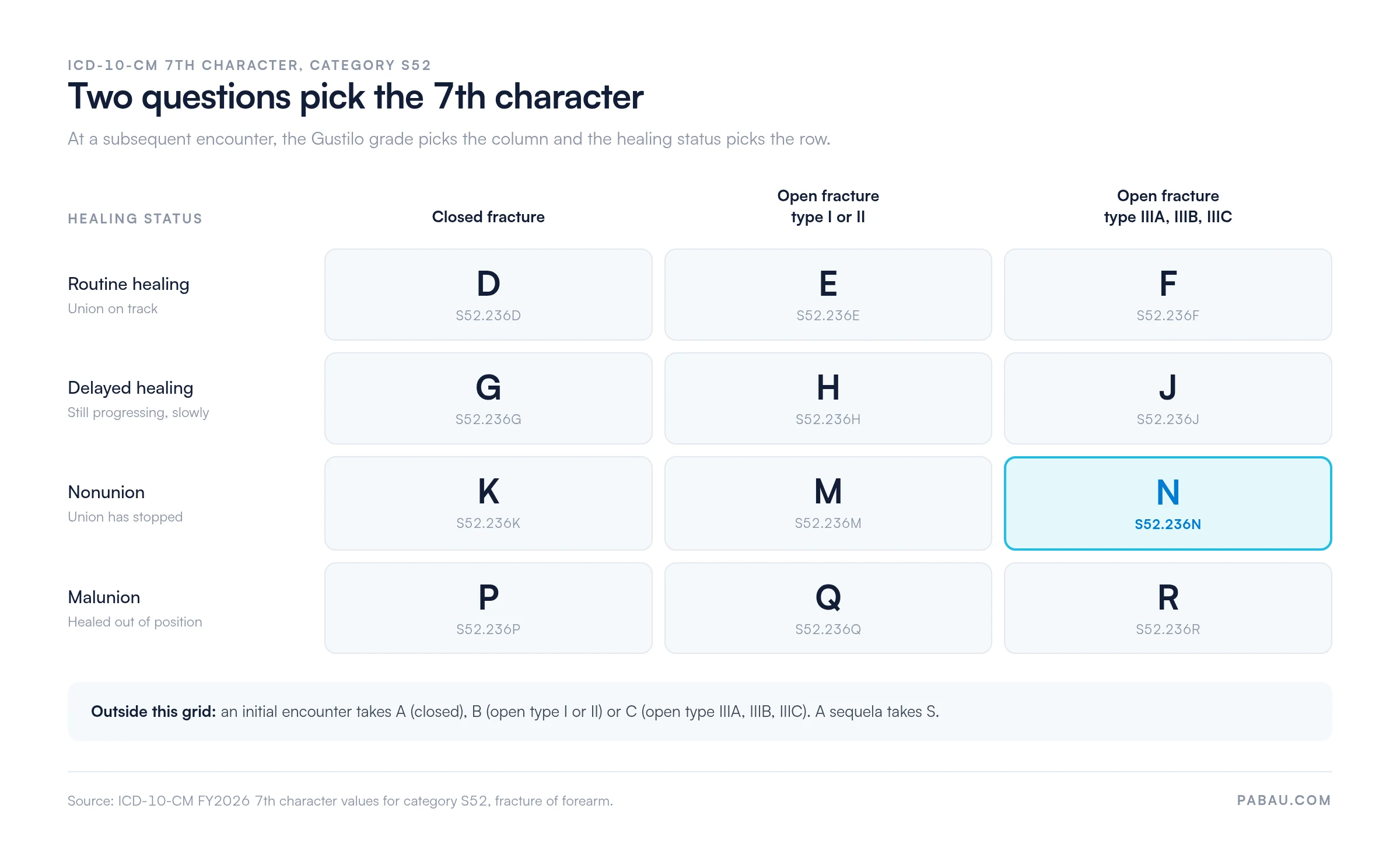
Take a patient seen 11 months after a Gustilo IIIB ulna shaft fracture. Imaging shows no union, and the surgeon documents nonunion at that visit. The pattern was oblique and nondisplaced, and the note never names the arm. That set of facts lands on S52.236N.
Swap any one of those facts and the character moves. K means a closed-fracture nonunion. M means an open type I or II nonunion. Choose either one for this patient and the code contradicts the operative note, which is exactly what a payer looks for on review.
The Gustilo-Anderson grade comes from the surgeon, never from the coder. It is the standard system for scoring how severe an open fracture is, and the type has to appear in the operative or clinical note. A wound description on its own will not support the N character.
Type I wounds measure under 1 cm and type II wounds fall between 1 cm and 10 cm, both with limited soft tissue damage. The type III grades cover the high-energy injuries most likely to end in nonunion, through lost blood supply, contamination, and stripped periosteum.
The StatPearls open fracture management review sets out how surgeons separate the grades at debridement.
Document the Gustilo type at the first operative encounter, then repeat it in every note that discusses nonunion. Payers auditing these claims look for the same grade across the whole episode of care. One operative note carrying it is not enough.
S52.236N belongs to the S52.23 oblique ulna shaft group, and its neighbors differ by a single character. Knowing which one moves where saves a query later.
S52.236N is an ulna code. The matching radius code is S52.336N, since radius shaft fractures sit in the separate S52.3 subcategory. Put the ulna code on a radius fracture and the claim names the wrong bone.
Delayed healing means the fracture is still moving toward union. Nonunion means it has stopped and will not heal without intervention. The physician has to say which one applies, because a coder cannot make that call.
The S52 block carries instructional notes that govern when you can report S52.236N. Reading them first heads off the rejections that follow a bundling error.
S52.236N sits seven levels down the tree. Reading it from the top shows you which digit to change when you need to move sideways.
Each level adds one qualifier: the bone, the site within it, the pattern, the displacement status, then the side. The 7th character layers encounter type and healing status on top. Our ICD-10-CM code library indexes the neighboring entries if you need to work across the family.
Codes change every October, so check validity in the CDC/NCHS ICD-10-CM web tool at the start of each fiscal year.
Legacy claims, audits, and older records sometimes still need an ICD-9-CM equivalent.
The CMS General Equivalence Mapping files map S52.236N approximately to ICD-9-CM code 733.82, nonunion of fracture. Treat that mapping as a starting point rather than a conversion.
Payers reviewing an S52.236N claim look for seven specific elements. Miss one and you get a medical necessity denial or a request for records. These claims draw more scrutiny than routine fracture follow-up, because the care runs long and costs more.
Auditors read those elements against each other. A note that states nonunion but never names a Gustilo type will not support the N character, however complete the rest of the record looks.
Rejected S52.236N claims usually fail on one of six checks. Run them in order, before the claim leaves the practice.
Clear all six and the claim travels the ordinary route. It leaves the practice, passes the clearinghouse edits, and reaches the payer with the supporting documentation already lined up behind it. Fail one, and the work moves to the back end, where an appeal costs far more than a query would have.
The 7th character settles the diagnosis line, not the rest of the claim. A drug line proves itself separately: HCPCS code Q0138 pays per milligram, so one 510 mg vial bills 510 units. That line also needs an 11-digit NDC plus a JZ or JW modifier reporting single-dose vial wastage.
S52.236N carries a high rate of avoidable claim errors. Five patterns account for most of the denials and physician queries on these claims.
A quarterly review of S52.23x denials shows which of the five is happening in your practice. Good denial management turns that pattern into a workflow fix rather than a standing rework queue.
Once a month, pull every S52.23x claim that carries K, M, or N as its 7th character. Compare the documented Gustilo type against the character on each denied claim. K on an open fracture, or M on a Gustilo III, points at a broken workflow rather than one careless claim. Fix the template and the query process, not just the claims in front of you.
In most orthopedic and trauma practices, nonunion claims get coded from free-text operative notes. A coder reads the note, hunts for the Gustilo type, and raises a query when it is missing. That loop adds days to the claim, and it leaves the 7th character exposed at audit.
Practice management software like Pabau moves those details into the note itself. Structured clinical templates prompt the physician at the point of care. The note asks for the bone, the pattern, the displacement status, the side, the Gustilo type, and the union status. The coder then works from a complete record instead of chasing one.
Pabau’s claims management software then checks the claim before it leaves the practice. Eligibility and clean-claim validation run against the Claim.MD clearinghouse, so payer-level problems surface while you can still fix them. Fewer resubmissions on complex fracture claims means the money arrives sooner.

Pabau prompts clinicians for the Gustilo type, laterality and union status while they write the note, then validates the claim before it reaches the payer. Orthopedic and trauma practices use it to cut rework on nonunion and open fracture cases.

Start with the bone. S52.236N is an ulna shaft code, and its radius twin is S52.336N. From there, the code only holds up if the physician’s own words carry the Gustilo grade and the nonunion. N is not interchangeable with K or M, and an unspecified side is a last resort rather than a shortcut.
Practices that stop losing money on these claims are the ones that fix the note, not the ones that appeal faster. Book a demo to see how Pabau prompts for the Gustilo type and validates the claim before it reaches the payer.

Coding the displaced version of this fracture? ICD-10 code S52.233F covers the displaced oblique ulna shaft fracture at a subsequent encounter.
Need the documentation rules behind fracture coding? Medical billing compliance guidance covers the standards that keep complex diagnosis codes out of the denial pile.
Seeing the same denials on fracture claims every month? Denial management in healthcare sets out the workflow fixes that address systemic rejection patterns.
Wondering how a clearinghouse checks a diagnosis code? Medical claims clearinghouse overview explains how pre-submission scrubbing catches errors before they reach the payer.
Looking for a repeatable clean claim process? Clean claim submission requirements details what payers check at adjudication and how to meet it consistently.
ICD-10-CM does not require one, but many payers and state reporting programs do. If you report an external cause code, match the encounter type. Subsequent-encounter external cause codes take 7th character D. They are never the first-listed diagnosis on the claim.
ICD-10-CM sets no timeframe, so the physician’s statement decides it. Many surgeons follow the FDA definition of nine months since the injury with no healing progress on imaging for three straight months. Code from the words in the note, not the calendar.
Yes. The 7th character reflects the phase of care, not which practice delivers it. A surgeon taking over nonunion management from another provider still reports a subsequent encounter. The initial encounter character belongs to the active treatment phase, wherever that happened.
No. ICD-10-CM guidelines cover fracture aftercare with the acute fracture code plus the right 7th character. Aftercare Z codes do not apply to injuries. S52.236N already says the visit is follow-up care, so a Z47 code alongside it duplicates that information.



