ICD-10 code S61.201A: Open wound of left index finger without nail damage
ICD-10 code S61.201A covers a left index finger wound of unstated type ICD-10 co...

Last Updated: Oct 16, 2026
Billable Code Specific Code
S52.231J is the billable ICD-10-CM code for displaced oblique fracture of shaft of right ulna, subsequent encounter for open fracture type IIIA, IIIB, or IIIC with delayed healing.
Let Pabau's smart automation suggest the right codes, reduce claim denials, and keep your practice compliant—effortlessly.
Automate repetitive tasks and focus on what matters most—your patients.
Reduce coding errors and ensure compliance with the latest regulations.
Clean claims, fewer denials, and faster reimbursements.
Powerful insights and reporting to help your practice thrive.
HIPAA compliant SOC 2 certified GDPR-compliant Trusted by 4,000+ clinics worldwide

S52.231J covers a displaced oblique fracture of the right ulnar shaft at a subsequent encounter. In other words, the original injury was an open fracture of type IIIA, IIIB, or IIIC, and healing is delayed.
Delayed healing is not nonunion. Rather, J means union is slow but has not been declared failed. A documented nonunion of the same open type III fracture takes N instead.
S52.231 accepts 16 valid 7th characters. Specifically, they run from A to S, and the letters I, L, and O are skipped so they cannot be misread as digits.
The 7th character reports two facts at once. Namely, it carries the Gustilo grade recorded at the injury and the healing status recorded at today’s visit.
Practice management software like Pabau keeps ICD-10 selection inside the encounter note, so the character is chosen where the healing status is written.
ICD-10 code S52.231J reports a displaced oblique fracture of the shaft of the right ulna at a subsequent encounter. In other words, the original injury was an open fracture of type IIIA, IIIB, or IIIC, and healing is now delayed. Specifically, two separate facts have to be in the record before this code is correct. First, the injury was graded as a severe open fracture, and second, the bone is healing slowly rather than failing to heal.
J is often mistaken for a nonunion character, and that is in fact the most common error on this code. Specifically, nonunion has three characters of its own, chosen by how the fracture was graded:
In short, the character J belongs to delayed healing only.
In fact, S52.231J is a billable and specific ICD-10-CM code, valid for FY2026 submission. It sits under the S52 category for fractures of the forearm, and it carries every specificity element CMS looks for on a clean claim. Namely, those elements are fracture morphology, anatomical site, laterality, open fracture grade, and encounter type with healing status.
Indeed, every character in S52.231J carries a distinct clinical meaning. However, misread one segment, particularly the 7th character, and the claim goes out describing a different patient.
Oblique means the fracture line runs diagonally across the shaft, rather than straight across (transverse) or around the bone (spiral). In other words, displaced means the fragments have shifted out of anatomical alignment. Together, those two descriptors pin the code to one clinical picture, so a coder should confirm both against the original imaging report.
Where the imaging report names no fracture pattern, coding on the right ulnar shaft falls back to the unspecified S52.201 group. ICD-10 code S52.201B then covers an initial encounter with an open type I or II wound.
Fracture coding errors concentrate in the 7th character. S52.231 accepts 16 valid 7th characters, spanning the letters A through S in the tabular list. Three letters never appear, because I, L, and O read too easily as the digits 1 and 0. Therefore, selecting J means knowing the encounter type, the Gustilo grade from the injury, and the healing status documented today.
These 16 characters are usually printed as a flat list, which hides the pattern. In fact, they are really a grid: each row is an encounter type and healing status, while each column is how the fracture was graded at the injury. Read across the row to find the right letter.
J sits in the bottom-right of the delayed healing row. Slide one row down, for instance, and you get N, which is nonunion. Similarly, slide one column left and you get H, which is an open type I or II fracture. As a result, those two neighbors account for most of the miscoding on this family.
Specifically, J applies only where the original injury was graded as a Gustilo-Anderson type III open fracture. That grading, however, is a clinical judgment made at the time of injury, not at the follow-up visit. Indeed, the ICD-10-CM tabular list states directly that the open fracture designations follow the Gustilo classification.
Notably, the grade has to appear in the injury documentation, which usually means the emergency department note or the first operative report. Where the record grades the fracture as type I or II, delayed healing takes the character H instead. Where the record states no grade at all, however, the fracture defaults to closed, which points to the character G for delayed healing.
In essence, delayed healing means the fracture is uniting more slowly than expected, and the treating physician has not declared that union has failed. That is, in short, the whole of what J reports. Nonunion, in contrast, is a separate finding, and it moves the code to a different character.
Namely, for an open type IIIA, IIIB, or IIIC fracture of the right ulnar shaft, the four subsequent encounter outcomes read like this:
ICD-10-CM Official Guidelines set no fixed number of weeks for any of these. Orthopedic literature often cites six to nine months before nonunion is considered, but the code follows the physician wording at that encounter. Where the note says slow, delayed, or behind expected progress, J is the character; conversely, where it says nonunion, N is.
Notably, knowing where S52.231J sits in the hierarchy makes it faster to move sideways when the clinical picture changes. Indeed, each level adds a layer of specificity that a payer’s edits check before the claim clears. Additionally, our ICD-10 library for coders carries the same breakdown for neighboring fracture codes.
In particular, the S52.231 parent code generates 16 billable child codes, one for each 7th character. Accordingly, coders move between these siblings visit by visit as the healing trajectory becomes clear.
Notably, laterality shifts the same 7th character onto a different parent code. For example, delayed healing of an open type III fracture on the other side uses S52.232J instead. Where the record never states a side, however, S52.239J applies, and many payers will question it.
Re-read the 7th character at every visit instead of copying it forward. One patient can legitimately move through several characters. For example, C applies at the injury, F while healing is on track, J when progress stalls, and N if union finally fails. The character reports that encounter only, so a carried-forward letter is a documentation mismatch waiting to be audited.
Indeed, J applies to a narrow set of circumstances. In fact, encounter type matters as much as fracture morphology here. The four checks below, accordingly, run in the order a coder should work through them.
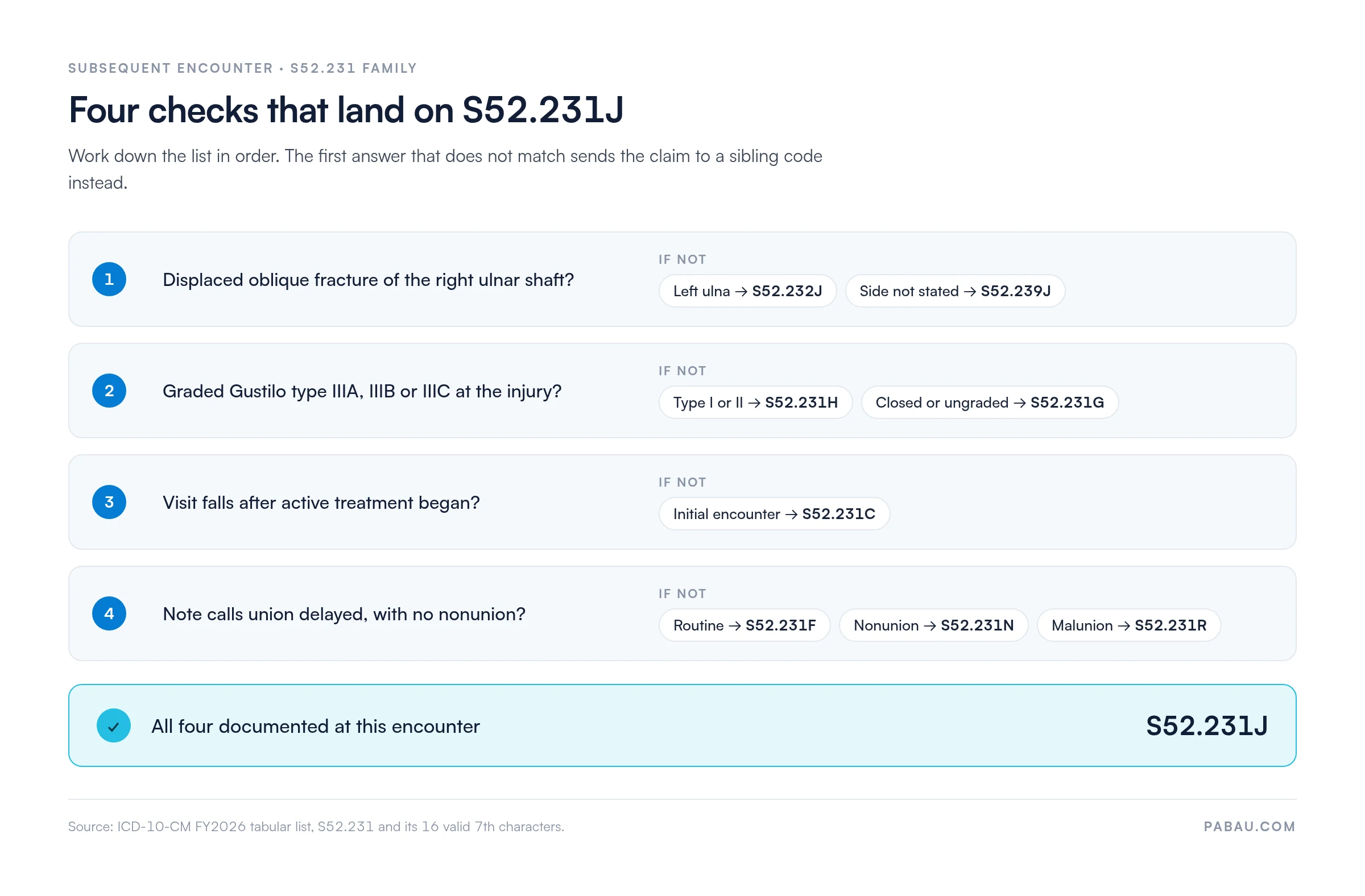
Use S52.231J when all of the following are documented:
Do not use S52.231J when:
Notably, the ICD-10-CM Official Guidelines for Coding and Reporting, Section I.C.19, govern all injury and fracture coding. In particular, several rules bear directly on S52.231J.
Specifically, two tabular notes are worth checking before submission. S52 carries an Excludes1 note for traumatic amputation of forearm, which routes to S58 instead. It also carries an Excludes2 note for fracture at wrist and hand level, which routes to S62. In other words, an Excludes2 note means the two conditions can be reported together when both are present.
Indeed, beyond the guidelines, the practical failure point is the note itself. Indeed, claims rejected for a mismatched encounter type or an unsupported healing status trace back to the documentation, not the billing department. Consequently, correcting one means going back to the physician for wording, which costs more than settling the character at the visit.
Notably, every element of S52.231J has to be traceable to a specific entry in the chart. The question a descriptor never answers is what the physician has to write for the code to survive a payer review. Specifically, the table below maps each element to the note that carries it.
For example, a follow-up note that supports every element might read like this. Patient returns for review of a displaced oblique fracture of the right ulnar shaft, first treated on the injury date. Notably, the injury was documented as a Gustilo type IIIA open fracture.
Notably, radiographs today show callus formation behind the expected timeline. Specifically, union is delayed, with no radiographic or clinical evidence of nonunion, and protected immobilization continues. Ultimately, a clean claim rests on exactly that level of specificity.
Notably, S52.231J reports the diagnosis, and the procedure side of the claim depends on what happens at the visit. Delayed healing is usually managed without surgery, so most of these encounters bill as an office visit plus imaging rather than a revision procedure. That differs from a nonunion claim, where bone grafting and revision fixation are common. In addition, rates for each of these codes come from the CMS Physician Fee Schedule.
Blood product codes price from a different schedule. A unit of transfused red blood cells bills as HCPCS code P9021, one line per unit, on a CMS rate that varies by MAC locality.
Notably, one coverage rule trips practices up here. Medicare and most commercial payers restrict noninvasive bone growth stimulators to a documented nonunion of a long bone fracture. Billing 20974 or 20979 against a delayed healing diagnosis will often be denied, so check the applicable policy first. Therefore, confirm the S52 descriptors in the AAPC ICD-10 code index before submission.
Accordingly, practices running practice management software like Pabau can keep the diagnosis and the procedure codes on the same encounter record. Pabau’s claims tools for practices submit and track what the record already holds. The pairing on the 837P claim then reflects the note rather than a retyped charge sheet.
Ask the treating physician to state the healing assessment in words, not just in imaging findings. However, a radiology report noting limited callus does not by itself support J, and it does not support N either. Instead, one line in the assessment settles the 7th character. Wording such as union delayed with no evidence of nonunion answers the payer question before it is asked.
Notably, no single ICD-9-CM code carried the information S52.231J carries. Indeed, ICD-9 had no laterality, no Gustilo grade, and no way to record healing status on the diagnosis itself. As a result, a coder had to assemble the picture from separate codes, which is why fracture follow-up claims were harder to adjudicate before October 2015.
Indeed, that older set is instructive. ICD-9 gave a coder aftercare or nonunion and no middle option, so a slow-healing fracture looked identical to a routine one on the claim. Consequently, the 7th character now reports that middle state directly, which is precisely the job J does.
Typically, the follow-up note and the code selection often happen in two different places. The surgeon writes the assessment, and a coder later opens a separate lookup tool to pick a character. By then the wording that decides between F, J, and N sits on another screen. Meanwhile, the last visit’s code is still in the record, waiting to be reused as a default.
Consequently, Pabau closes that distance. ICD-10 search sits inside the clinical encounter record, so the clinician selects the code in the same note that carries the healing assessment. The selection and the supporting wording travel together into billing. However, Pabau does not decide the character for you, and it should not. What it removes is the retyping step where characters get dropped or carried forward.
In short, the outcome is fewer denials from the two mismatches this code family produces most often. Specifically, one is an encounter type that contradicts the visit history, while the other is a healing status the note does not support. For an orthopedic practice running high follow-up volume, ultimately, that is time back on every appeal you no longer have to write.

Pabau puts ICD-10 search in the encounter record, so the clinician picks the code beside the healing assessment that justifies it. As a result, the note and the code reach billing together, which keeps follow-up fracture claims matching the chart.

S52.231J is billable and valid for FY2026, but it is easy to reach for the wrong reason. The code says the original injury was a severe open fracture and that healing is now slow. However, it does not say the fracture has failed to unite. If the note declares nonunion, the claim belongs on S52.231N, and submitting J instead misstates the patient’s status.
In short, the practical fix is small. Get the Gustilo grade recorded once at the injury, then get one line of healing assessment into every follow-up note. As a result, those two habits settle the 7th character without a lookup argument, and they hold up when a payer asks. Book a demo to see how Pabau keeps fracture coding tied to the documentation that supports it.

Need guidance on what denial codes mean on your remittance? Denial codes in medical billing in turn explains the most common CARC and RARC denial reasons and how to respond to each.
Want to understand the clearinghouse that connects your claims to payers? How Claim.MD clearinghouse works covers, in detail, how 837P electronic claims are validated, scrubbed, and transmitted to over 4,000 US payers.
Looking for a structured approach to clean billing workflows? What is revenue cycle management specifically walks through the end-to-end process from patient registration to payment posting.
ICD-10 code S52.231J is a billable ICD-10-CM diagnosis code. Specifically, it reports a displaced oblique fracture of the shaft of the right ulna. The encounter is a subsequent one, for an open fracture of type IIIA, IIIB, or IIIC with delayed healing. In particular, displaced describes fragment alignment, oblique describes the fracture line, shaft identifies the diaphysis, and right sets the laterality. In short, the J character says the visit is a follow-up after a severe open fracture, and that union is behind schedule.
Yes. S52.231J is a billable and specific ICD-10-CM code, valid for FY2026 and effective October 1, 2025. However, its parent code S52.231 is not billable on its own, because a 7th character is always required.
No, and the distinction changes the code. Delayed healing means union is slower than expected but has not been declared to have failed. Nonunion, in contrast, means the physician has documented that the fracture will not unite. Therefore, for an open type IIIA, IIIB, or IIIC fracture of the right ulnar shaft, delayed healing takes J and nonunion takes N.
S52.231A is used at the first encounter for active treatment when the fracture was closed. In contrast, S52.231J is used at a follow-up encounter after an open fracture of type IIIA, IIIB, or IIIC, where healing is delayed. Indeed, only the 7th character differs. The displaced, oblique, shaft, and right ulna elements are, in fact, identical in both codes.
Use J at a subsequent encounter, where the original injury was documented as a Gustilo type IIIA, IIIB, or IIIC open fracture. In addition, the physician has to record healing as delayed at that visit. Do not use J for initial encounters. Instead, for a closed fracture with delayed healing use G, and for an open type I or II fracture with delayed healing use H.
Delayed healing is usually managed conservatively, so the common pairings are 99213 to 99215 for the established patient office visit and 73090 for forearm radiographs. In addition, cast application codes 29075 and 29065 apply where immobilization continues. However, bone growth stimulation codes 20974 and 20979 are often restricted by payers to documented nonunion. Therefore, verify every descriptor before submission.
The parent code is S52.231, a displaced oblique fracture of the shaft of the right ulna, which is not billable on its own. Specifically, S52.231 generates 16 billable child codes, one per valid 7th character. Namely, those characters run A, B, C, D, E, F, G, H, J, K, M, N, P, Q, R, and S.