ICD-10 Code S46.999A: Other injury, unspecified shoulder muscle
ICD-10 code S46.999A: Quick reference card ICD-10 code S46.999A is the billable ...

Last Updated: Oct 27, 2026
Billable Code Specific Code
S45.201A is the billable ICD-10-CM code for unspecified injury of axillary or brachial vein, right side, initial encounter. It applies when a right-sided axillary or brachial vein injury is documented but the injury type, such as a laceration, is not.
The code sits in category S45, injury of blood vessels at shoulder and upper arm level. Assignment turns on three details: The injury type, the side, and whether active treatment is still underway. Naming the axillary or the brachial vein does not change the code.
Let Pabau's smart automation suggest the right codes, reduce claim denials, and keep your practice compliant—effortlessly.
Automate repetitive tasks and focus on what matters most—your patients.
Reduce coding errors and ensure compliance with the latest regulations.
Clean claims, fewer denials, and faster reimbursements.
Powerful insights and reporting to help your practice thrive.
HIPAA compliant SOC 2 certified GDPR-compliant Trusted by 4,000+ clinics worldwide

S45.201A is a billable 7-character ICD-10-CM code, while its parent codes S45.201 and S45.20 are non-billable headers.
The 7th character A means active treatment, not first visit. Keep A for every visit where active treatment continues, even the third or fourth.
“Unspecified” refers to the injury type, not the vessel. Naming the axillary or brachial vein does not change the code, but a documented laceration moves it to S45.211A.
Add an S41.- open wound code and an external cause code whenever the record supports them.
Pabau, practice software with built-in claims management, scrubs each claim for missing or invalid details and checks patient eligibility before submission.
ICD-10 code S45.201A is the billable ICD-10-CM code for an unspecified injury of the right axillary or brachial vein, initial encounter. Use it while the patient is in active treatment and the record does not yet state the injury type, such as a laceration.
The table below gives the coder-facing data points in a single view. Confirm billability against the current fiscal-year tabular before use, as codes are updated annually.
S45.201A is a 7-character ICD-10-CM code, and each character carries a distinct clinical meaning. Reading the segments correctly prevents the most common coding errors.
The laterality digit “1” locks this code to the right upper extremity. If the vein is on the left, the correct code is S45.202A. S45.209A exists for an undocumented side, but missing laterality should trigger a physician query rather than a default to “unspecified side.” The diagram below shows how the three documented facts set the last three characters.
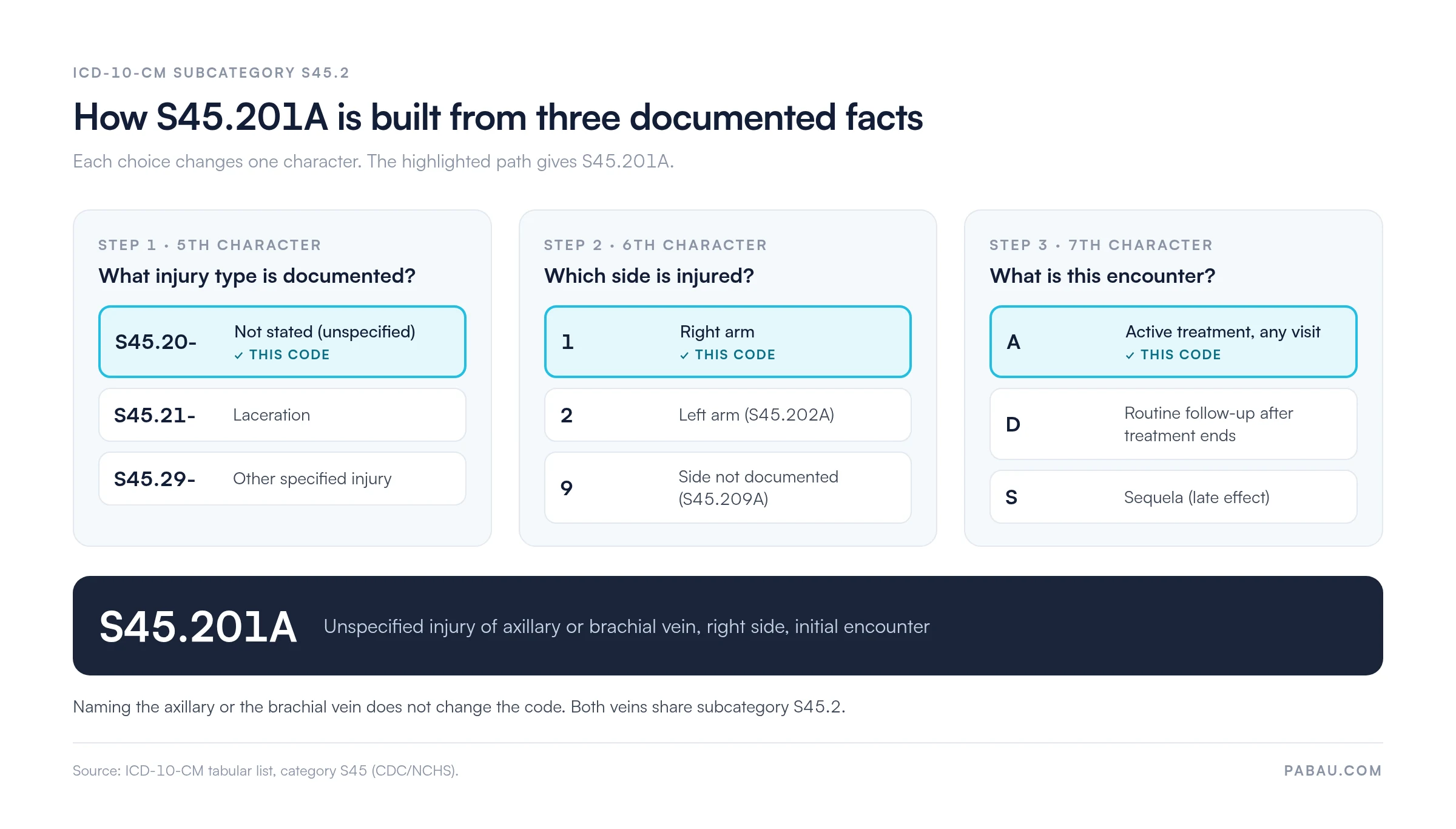
S45.201A covers injuries to either the axillary vein or the brachial vein on the right side. The two vessels are anatomically continuous, which is why they share a single ICD-10-CM subcategory, S45.2.
The “unspecified” in the descriptor refers to the injury type, not the vessel. Naming the axillary or the brachial vein does not change the code. Amend it only when operative notes, angiography, or duplex ultrasound document the injury type: S45.211A for a laceration, or S45.291A for another specified injury.
Only the 7-character code is billable. Each parent level exists as a navigation header in the tabular list, not a valid claim code. Submitting S45.201 (6 characters) or S45.20 (5 characters) will generate an invalid-code edit at the clearinghouse.
The 7th character is a frequent source of claim denials on S45.201A. The point to hold onto from the ICD-10-CM Official Guidelines for Coding and Reporting is that “A” does not mean “first visit.” It marks an encounter where the patient is receiving active treatment.
Here is a practical test. If the treating provider is still deciding how to manage the injury (debridement, repeat imaging, surgical planning), A is still correct. Once management is complete and the patient is in follow-up or rehab, D takes over. The ICD-10-CM Official Guidelines for Coding and Reporting come from CDC/NCHS and are posted by CMS. They assign A to each encounter where the patient receives active treatment.
If several providers see a vascular trauma patient during active treatment, confirm with your coding supervisor that all of them apply A consistently. A switch to D mid-treatment by one provider creates a coding mismatch that payers flag on audit.
Several codes in the S45 category are frequently confused with ICD-10 code S45.201A. The table below shows the critical distinctions. Getting the injury type or laterality wrong generates a denial or, worse, an audit flag for upcoding.
The most consequential distinction is S45.201A versus S45.211A. Billing S45.211A without operative or imaging confirmation of a laceration is upcoding. When the record describes how the injury happened but not what type of injury it is, S45.201A is the supportable choice.
The S45 category carries several coding notes that affect correct use of ICD-10 code S45.201A.
Payer audits for vascular trauma codes focus on four documentation elements. Missing even one can result in a medical necessity denial. The basics of medical billing fundamentals explain why clean documentation sits underneath every clean claim.
Query the surgeon before using S45.201A on a post-operative encounter. If the operative report describes a laceration, the injury type is no longer unspecified, and S45.211A is the correct code. Naming the axillary or brachial vein alone does not change the code.
Vascular trauma claims commonly pair S45.201A with procedure codes for repair, exploration, or diagnostic imaging. Billing teams using Pabau’s claims management software get each claim scrubbed for missing or invalid details before submission. The table below lists CPT codes typically billed alongside ICD-10 code S45.201A, with the relevant bundling note for each.
Practices submitting these pairings electronically can send them through the Claim.MD clearinghouse integration, which checks patient eligibility before the claim leaves the practice. Verify bundling against the current CMS NCCI tables, as the edits change with each quarterly update.
Two of the codes in the table have their own reference pages. CPT 93971 covers billing for the unilateral upper extremity duplex scan, and CPT 99285 covers the high-complexity ED visit, including modifier use.
Trauma codes like S45.201A generally bypass prior authorization in emergency settings. Retro-authorization requirements, however, vary significantly by payer and plan type. A clean claim submission from the outset remains the most reliable way to avoid later retro-auth denials.
According to the CDC/NCHS ICD-10-CM tool, the S45 category is updated as part of the annual fiscal-year cycle. Confirm that S45.201A remains unchanged in the current-year tabular before building it into a payer contract or charge description master.
Five denial patterns come up repeatedly on claims for ICD-10 code S45.201A. Effective denial management workflows catch most of them before submission rather than during the appeal cycle.
Reviewing the medical billing denial codes on your S45.201A claims can reveal patterns. A cluster of CO-4 (inconsistent modifier) denials points to the modifier 25 issue. CO-16 (missing information) typically signals missing laterality or mechanism documentation.
Experienced coders apply a few practical rules to vascular trauma coding that prevent the most avoidable errors with ICD-10 code S45.201A.
Without a validation step, a wrong 7th character or a missing open wound code is usually found when the payer rejects the claim. By then the encounter is weeks old, and the coder has to rebuild the context before correcting it.
Pabau’s claim validation scrubs every claim for missing or invalid details before it leaves the practice. Each error links straight to the field that needs correcting, so the fix takes seconds rather than an appeal.
For US practices, claims go out as electronic CMS-1500 claims through Claim.MD, with real-time eligibility checks before the visit. Claim statuses and remittances come back into Pabau, so a denied vascular trauma claim gets worked while the record is still fresh.
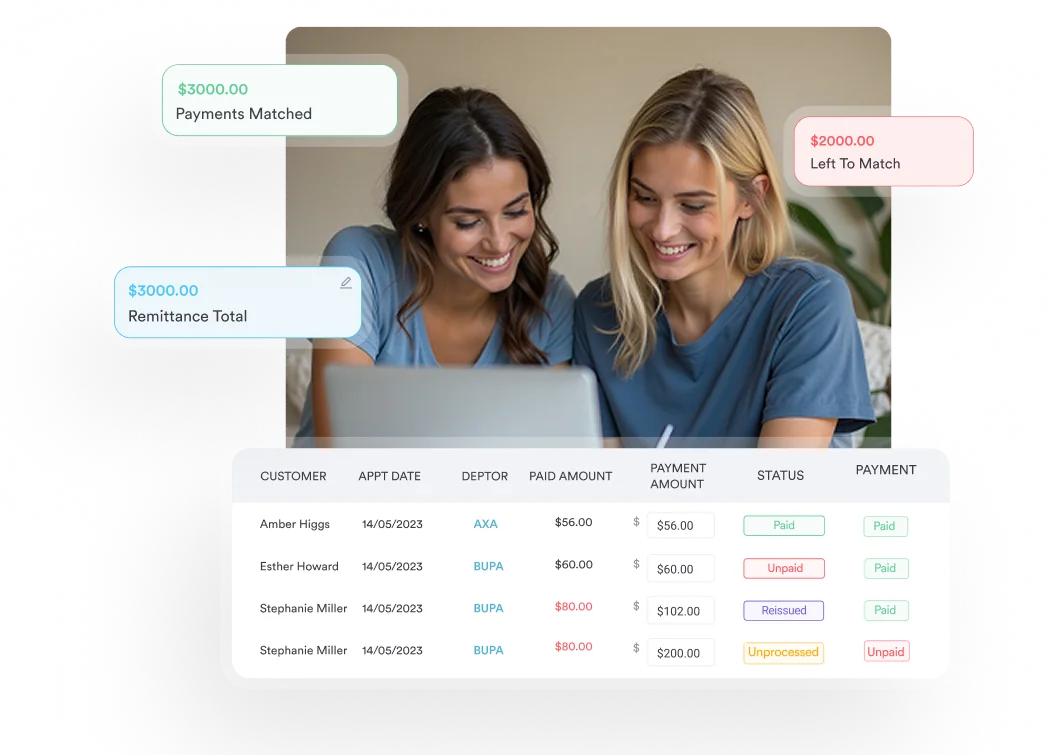

Pabau’s claim validation checks every claim for missing or invalid details before it leaves your practice. US claims go out through Claim.MD, with real-time eligibility checks and remittances matched back to each appointment.

S45.201A holds up on audit as long as the record supports each of its characters. Only the injury type moves it to a sibling code, and the choice of vein never does. Hold the code at S45.201A until a laceration or other injury is documented, and keep the 7th character at A while treatment is active.
The trade-off is speed against specificity. A surgeon query can delay the claim by a day or two. In return, it keeps an upcoded laceration or a wrong-side code out of an audit. Book a demo to see how Pabau validates vascular trauma claims before they reach the payer.

Need to understand denial codes on returned claims? Denial codes in medical billing explains the most common CARC and RARC codes and what each one requires from your billing team.
Want to improve your claims submission workflow? Claim.MD clearinghouse overview covers how the Pabau and Claim.MD integration handles electronic claims, remittances and real-time eligibility for US practices.
Coding an arterial injury instead? ICD-10 code S45.001A covers unspecified injury of the right axillary artery, the arterial counterpart of this vein code.
Billing the wound exploration? CPT code 20103 explains when exploration of a penetrating extremity wound is billed on its own and when it bundles into the repair.
ICD-10 code S45.201A is the billable ICD-10-CM diagnosis code for an unspecified injury of the right axillary or brachial vein, initial encounter. It belongs to category S45, injury of blood vessels at shoulder and upper arm level. Use it when documentation confirms a right-sided vein injury at that level but does not yet specify the injury type.
Yes. S45.201A is a valid, billable 7-character ICD-10-CM code. Its parent codes S45.201 (6 characters) and S45.20 (5 characters) are non-billable header codes and will generate an invalid-code edit if submitted on a claim.
S45.201A codes an injury whose type is not documented. S45.211A codes a confirmed laceration of the right axillary or brachial vein. Use S45.211A only when operative notes, imaging, or clinical documentation explicitly confirm a laceration. Using it without that confirmation is upcoding.
Use A for any encounter where active treatment is still occurring, regardless of visit number. Use D once active treatment is complete and the patient is in routine follow-up or rehabilitation. Use S for a late effect (sequela) of the original vein injury, pairing S45.201S with the code for the sequela condition.
Five reasons come up most often. The first three are a wrong 7th character (D on an active-treatment visit), missing laterality documentation, and upcoding to S45.211A without operative confirmation. The other two are a missing S41.- open wound code on a penetrating injury and a same-day E/M billed without modifier 25.
Use S45.201A when the injury is on the right side and S45.202A when it is on the left. If laterality is undocumented and a physician query cannot confirm it, S45.209A (unspecified side) is the fallback. Querying the provider is always preferable to defaulting to “unspecified side.”