ICD-10 code S62.635G: Left ring distal phalanx, delayed healing
ICD-10 code S62.635G at a glance ICD-10 code S62.635G covers a displaced fractur...

Last Updated: Oct 16, 2026
Billable Code Specific Code
S42.213P is the billable ICD-10-CM code for unspecified displaced fracture of surgical neck of unspecified humerus, subsequent encounter for fracture with malunion.
The seventh character P means the fracture has united in a faulty position after active treatment ended. It does not mean sequela. The sequela character for this code family is S, which gives S42.213S. Because P marks a subsequent encounter, S42.213P is normally the first-listed diagnosis for the visit rather than a secondary code.
Let Pabau's smart automation suggest the right codes, reduce claim denials, and keep your practice compliant—effortlessly.
Automate repetitive tasks and focus on what matters most—your patients.
Reduce coding errors and ensure compliance with the latest regulations.
Clean claims, fewer denials, and faster reimbursements.
Powerful insights and reporting to help your practice thrive.
HIPAA compliant SOC 2 certified GDPR-compliant Trusted by 4,000+ clinics worldwide

S42.213P is the billable ICD-10-CM code for an unspecified displaced surgical neck humerus fracture, subsequent encounter for fracture with malunion.
The seventh character P means malunion, not sequela. The sequela character for this code family is S, which gives S42.213S.
P is a subsequent-encounter character, so S42.213P is normally the first-listed diagnosis. No sequela-first sequencing rule applies to it.
S42.213 takes seven valid seventh characters: A, B, D, G, K, P and S. No other letter is valid for this code.
Practice management software like Pabau validates required claim fields before submission and tracks the denial reason codes that come back.
ICD-10 code S42.213P is a billable, valid ICD-10-CM diagnosis code confirmed active for FY2025 and FY2026. It sits in the S42 branch of the ICD-10-CM code set, which groups fractures of the shoulder and upper arm. The table below shows the full code path and the key reference data.
Per the CMS ICD-10 codes page, S42.213P carries no age or sex edit restrictions. The code is not a manifestation code, and the guidelines do not push it into a secondary position. On a malunion encounter it normally leads the claim.
The surgical neck of the humerus is the narrow region just below the greater and lesser tuberosities, where the shaft meets the humeral head. It is the most common site for proximal humerus fractures, particularly in older patients after low-energy falls. “Unspecified displaced” means the record confirms displacement but never states the direction.
S42.213P describes a later stage of that injury. Active treatment has finished, the bone has united, and the union sits in a faulty position. Malunion at the surgical neck usually shows up as one of the following:
The malunion itself needs no separate diagnosis code. The seventh character P carries it, so S42.213P states both the original fracture and its faulty union in one code. Conditions that sit on top of the malunion, such as post-traumatic arthritis or stiffness, are coded additionally.
The P seventh character marks a subsequent encounter for a fracture that united with malunion, not a sequela. That is a frequent misreading, and it changes claim sequencing.
Section I.C.19.c of the ICD-10-CM Official Guidelines has coders assign the acute fracture code with the correct seventh character for aftercare. S42.213P is normally the first-listed diagnosis. Section I.B.10’s sequela rule covers the S character instead: S42.213S, with the late effect coded first and the injury code second.
S42.213 supports seven valid seventh characters, shown below with their full meaning and typical sequencing.
Open and closed fractures are separated only at the A and B characters. From D onward the descriptor drops that distinction, so S42.213P covers a healed open fracture as well as a closed one. C, E, F, H, J, M, N, Q and R belong to the expanded Gustilo set, used on the forearm, femur and leg. None of those letters is valid on S42.213; a claim carrying one is rejected as invalid.
The most frequent error on S42.213 claims is picking the wrong subsequent-encounter character. D gets used out of habit for any follow-up visit, and S gets used whenever a visit feels like a late effect.
Two clinical facts settle it. Has the bone united, and is the fracture still being managed? The chart below runs both questions across every seventh character S42.213 takes.
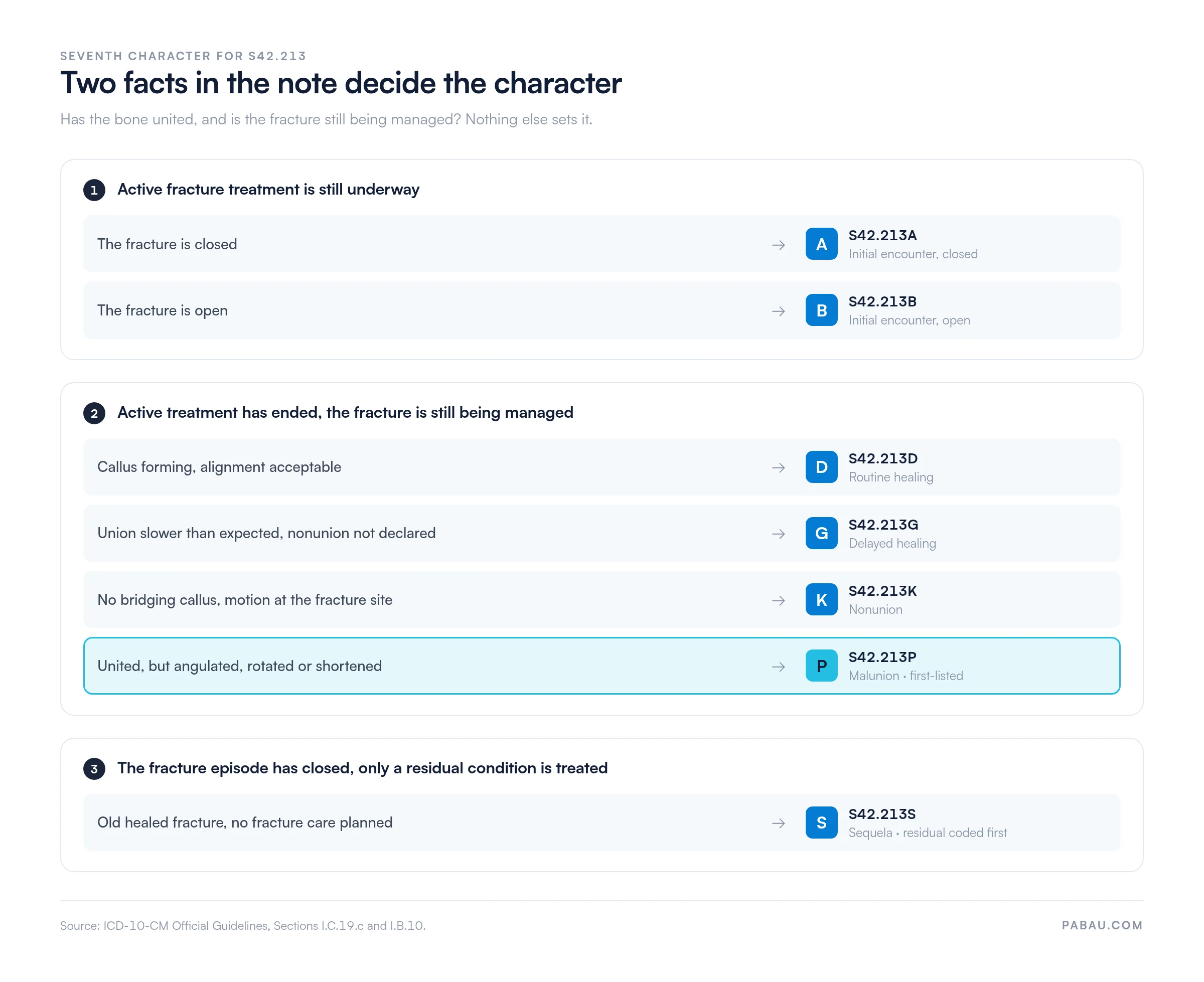
The practical difference is sequencing. S42.213P leads its claim, so the coder does not need a second diagnosis to make it valid. S42.213S cannot lead a claim, because Section I.B.10 requires the late effect first. Reversing that order on an S claim is a compliance problem. Applying the S rule to a P claim buries a sound primary diagnosis behind something else.
Malunion and nonunion drive most of the confusion between S42.213P and S42.213K. One clinical test separates them. A fracture site that is still mobile, with no bridging callus, is a nonunion and takes the K character. Bone that has consolidated but healed in poor alignment is a malunion and takes the P character. Put simply, K means the bone never finished healing, while P means it finished healing wrong.
Malunion and nonunion are among the most audited distinctions in orthopedic fracture coding. The two conditions carry different procedure implications, different medical necessity thresholds, and different CPT pairings.
Payer edit systems cross-reference the procedure code against the diagnosis code. Billing a bone-graft CPT against S42.213P usually triggers a medical necessity edit. So does a corrective osteotomy billed against S42.213K without supporting notes.
Several fracture types sit outside the S42.213P code family. Knowing which ones prevents miscoding and reduces claim-level compliance findings.
Open fractures are not excluded. S42.213 separates open from closed only at the initial encounter, with A for closed and B for open. From the subsequent-encounter characters onward the descriptor drops the distinction, so S42.213P covers a malunited open fracture too.
Conditions commonly reported alongside S42.213P are the problems the malunion is causing. The usual companions are post-traumatic osteoarthritis of the shoulder (M19.111, M19.112, M19.119) and osteonecrosis of the humerus due to previous trauma (M87.221, M87.222). Shoulder stiffness (M25.611, M25.612) and chronic pain due to trauma (G89.21) also appear often. Soft-tissue injuries from the original event may be reported too, such as rotator cuff strain (S46.01-) or axillary nerve injury (S44.31X-, S44.32X-).
Payer auditors reviewing an S42.213P claim look for five documentation elements. Missing any one of them creates grounds for denial or recoupment. The CDC/NCHS ICD-10-CM coding tool confirms the descriptor, but only the note can show that this patient has a malunited fracture.
The five elements auditors expect in the record are:
Documentation prompts that ask the physician for each element at the point of care reduce coder queries. They also stop claims leaving the practice without adequate support. When the record names the right humerus, S42.211P is the code to submit instead of S42.213P.
The seventh character is chosen from the state of the bone at that visit, not from how long ago the injury happened. These three scenarios show how the same patient history produces three different codes.
The third scenario is where most S42.213P errors start. A visit that feels like a late effect is not automatically a sequela encounter. The malunion character stays in play for as long as the malunited fracture is what the clinician is managing.
Medicare and commercial payers treat S42.213P as a subsequent-encounter fracture claim. Medical necessity review focuses on the deformity and the functional loss it causes. Prior authorization depends on the associated procedure. Corrective osteotomy for malunion and shoulder arthroplasty for end-stage post-traumatic arthritis both need prior authorization from most Medicare Advantage plans and commercial insurers.
Claim.MD, Pabau’s US clearinghouse partner, runs real-time eligibility checks before the visit. Claim status tracking then shows where each submitted claim sits with the payer, and electronic remittance advice reports what was paid. That matters on S42.213P claims, because payer edits commonly flag unspecified laterality and mismatched encounter characters before payment.
For Medicare fee-for-service claims, no Local Coverage Determination currently restricts S42.213P itself. Restrictions sit at the procedure level. Any surgery paired with S42.213P must meet the payer’s medical necessity criteria, with documented functional impairment, failed conservative management, and a described deformity.
S42.213P denials cluster around a small set of correctable errors. Most are either a wrong seventh character or a note that never states the malunion. Tracking these patterns lifts first-pass acceptance, and it starts with mapping each denial reason to its coding cause.
A clean S42.213P claim means confirming all six points above before it leaves the practice. A pre-submission checklist built into the workflow catches most of them at source rather than after the denial.
Before you submit an S42.213P claim, confirm three points in the note. Check that the fracture has united, that the union is described as malunited or deformed, and that the side is recorded. Where the side is documented, use S42.211P for the right humerus or S42.212P for the left. Keep S42.213P for records that do not state a side.
The CPT code submitted alongside S42.213P has to match a subsequent-encounter malunion visit, not an acute fracture event. Billing primary fracture fixation against a malunion diagnosis creates a medical necessity mismatch that payers flag on adjudication. Practices that also bill therapy alongside orthopedic care should check the therapy evaluation code just as carefully.
For practices billing shoulder arthroplasty or osteotomy against S42.213P, each step stays traceable from prior authorization through remittance posting. The AAPC ICD-10-CM code lookup provides further crosswalk data for checking CPT-to-ICD-10 pairing against payer policy.
In most orthopedic practices the seventh character is chosen at the end of the day, from a note the coder reads hours after the visit. If the physician wrote “healed, still deformed” rather than “united with malunion”, the coder either queries or guesses. Queries slow the claim down. Guesses show up later as denials on codes like S42.213P.
Practice management software like Pabau moves that decision to the point of care. Custom clinical forms prompt the surgeon for union status, deformity type and laterality while the patient is still in the room. Those answers land in the patient record as structured fields. The coder then opens a note that already carries the three facts an S42.213P claim needs.
From there, the claims management software in Pabau validates the required claim fields before submission and tracks what comes back. Denials are grouped by reason code, so a practice can see which reasons drive its S42.213P rejections. The result is fewer reworked claims and a shorter path from visit to payment.

Pabau’s claims management tools help orthopedic and sports medicine practices submit cleaner ICD-10 fracture claims. Track denial reason codes, and fix revenue leaks before they turn into write-offs.

S42.213P is straightforward once the seventh character is read correctly. P means the fracture united in a faulty position, which makes this a subsequent-encounter code and the first-listed diagnosis for that visit. The sequela code for the same fracture is S42.213S, and only on that claim does the late effect come first.
Three habits cause most of the trouble. A note stops at “healed” without saying how the bone united. A side is left unspecified even though the chart names it. An acute-care procedure code goes out against a malunion diagnosis. All three are fixed at the point of documentation, not in the appeals queue.
Pabau puts the union, deformity and laterality prompts in the note itself, then tracks the denial reason codes that come back on claims like these. To see how that fits your orthopedic workflow, book a demo.

Is the right side documented on your malunion claim? ICD-10 code S42.211P covers the same fracture and malunion on the right humerus.
Need to decode the denial that just came back? Denial codes in medical billing explains the reason codes payers return and what each one asks for.
Dealing with recurring denial patterns across your orthopedic claims? Denial management in healthcare explains how to build a systematic denial tracking and appeals workflow.
Want to understand how claim submission works end to end? Clean claim submission walks through the elements every claim must have before it leaves the practice.
S42.213P is the billable ICD-10-CM code for an unspecified displaced fracture of the surgical neck of the unspecified humerus, subsequent encounter for fracture with malunion. It applies once active treatment has ended and the fracture has united in a faulty position.
Yes. S42.213P is a valid, billable seven-character ICD-10-CM code, active for FY2025 and FY2026. It carries no age or sex edits. As a subsequent-encounter code it is normally the first-listed diagnosis for the malunion visit, not a secondary code.
Use S42.213P when the fracture has united but in a faulty position. Use S42.213K when the bone has not united at all. The test is union: motion at the fracture site points to nonunion, while solid bone in poor alignment points to malunion.
S42.213 takes seven valid seventh characters: A, B, D, G, K, P and S. A and B separate closed from open at the initial encounter. D, G, K and P cover subsequent encounters for routine healing, delayed healing, nonunion and malunion. S covers sequela.