ICD-10 code T87.52: Necrosis of amputation stump, left upper extremity
ICD-10 code T87.52 at a glance: Left arm, not left leg ICD-10 code T87.52 is the...

Last Updated: Oct 26, 2026
Billable Code Specific Code
S42.216G is the billable ICD-10-CM code for unspecified nondisplaced fracture of surgical neck of unspecified humerus, subsequent encounter for fracture with delayed healing.
Most denials on this code trace to the 7th character. Character G reports delayed healing and character D reports routine healing, so a note describing normal progress will not support the G character. Laterality is the second trap, because a record naming left or right belongs on S42.215G or S42.214G instead.
Let Pabau's smart automation suggest the right codes, reduce claim denials, and keep your practice compliant—effortlessly.
Automate repetitive tasks and focus on what matters most—your patients.
Reduce coding errors and ensure compliance with the latest regulations.
Clean claims, fewer denials, and faster reimbursements.
Powerful insights and reporting to help your practice thrive.
HIPAA compliant SOC 2 certified GDPR-compliant Trusted by 4,000+ clinics worldwide

S42.216G covers a nondisplaced surgical neck fracture of the humerus at a subsequent encounter, where healing is delayed and the record names no side.
The 7th character G means delayed healing. Character D means routine healing, and swapping the two is a frequent denial cause.
Use S42.216G only while the record stays silent on laterality. A documented side sends the claim to S42.215G (left) or S42.214G (right).
The chart must show the surgical neck site, nondisplaced status, a subsequent encounter, and clinical or imaging evidence that healing is running behind schedule.
Practice management software like Pabau pairs ICD-10 codes with CPT procedures automatically, so 7th character errors surface before the claim file is built.
ICD-10 Code S42.216G sits within the S42.2 subcategory covering fractures of the upper end of the humerus. The table below provides the at-a-glance reference coders need before building the full claim.
The surgical neck of the humerus is the constricted region just below the greater and lesser tubercles, roughly 2 cm distal to the humeral head. It is the most fracture-prone zone in the proximal humerus because cortical bone thins at that transition point.
That makes it vulnerable under axial loading or a fall on an outstretched arm. “Nondisplaced” means the fracture fragments have not shifted from their anatomical alignment, which typically permits conservative management rather than surgical fixation.
The descriptor carries the word “unspecified” twice, and each instance means something different. The first refers to the fracture pattern. The record does not identify a 2-part, 3-part, or 4-part configuration, which would route the claim to S42.22, S42.23, or S42.24 instead. The second refers to laterality. Nothing in the chart states whether the injury is on the left or the right, so the unspecified-humerus code carries the claim.
The 7th character G means the patient is presenting for a follow-up visit and the fracture is healing more slowly than expected. Delayed healing is not the same as nonunion. The bone is still consolidating, just behind the usual timeline for a nondisplaced surgical neck fracture. Character D, not G, is the one that reports routine healing, and confusing the two is among the most common errors in orthopedic coding.
According to the CMS ICD-10-CM Official Guidelines for Coding and Reporting, a subsequent-encounter character applies once the initial encounter has been reported. The patient must be receiving routine care during the healing phase. Choosing between D, G, K, and P then depends on what the provider records about healing progress.
The full 7th character set for S42.216 is shown below. Selecting the wrong character after the initial visit is the single largest cause of S42.216G claim denials.
Reading the note first and picking the character second is the fastest way to get this right. The chart below maps each healing description in the record to the code it supports.
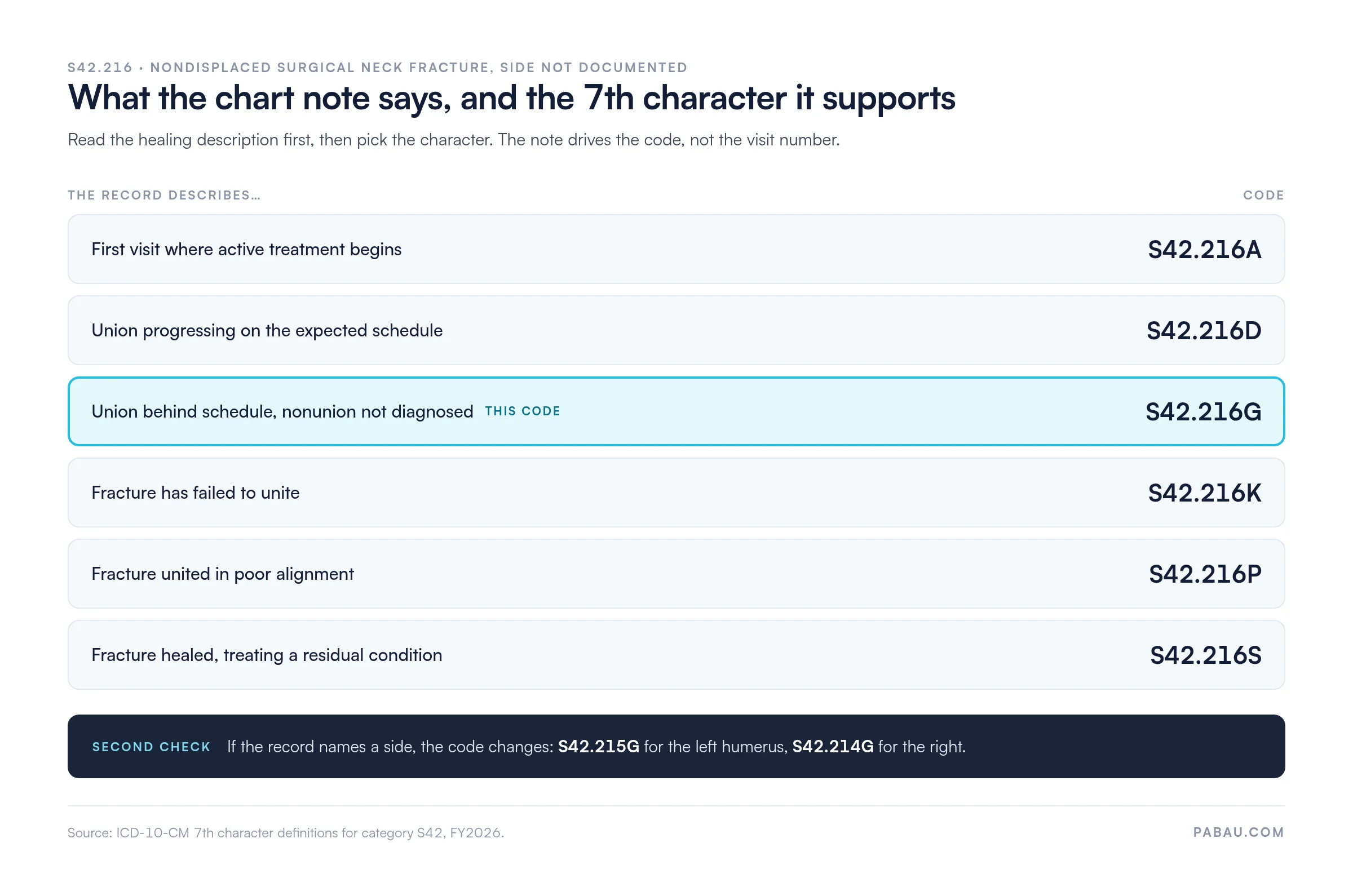
S42.216G is one of several closely related codes within the S42.21x surgical neck family. Choosing the wrong sibling code or the wrong character is the primary driver of payer edits on proximal humerus fracture claims. The AAPC ICD-10-CM code lookup remains a practical verification tool alongside the official tabular.
Sequela vs. subsequent encounter: S42.216S applies only after the fracture has completely healed. The patient must now be receiving treatment for a direct consequence of it, such as post-traumatic rotator cuff stiffness or axillary nerve dysfunction. Using S42.216G while the fracture is still uniting slowly is correct. Switching to S42.216S prematurely will trigger a payer edit, because the clinical timeline does not support a healed-fracture encounter.
Check the tabular list each fiscal year. ICD-10-CM codes update on October 1, and the S42.21x family has seen descriptor refinements in recent cycles. Running S42.216G against the current-year CDC tool before your billing cycle begins prevents filing with a retired or revised code.
Every subsequent-encounter claim for S42.216G rests on a medical record that demonstrates five coding dimensions. Those are laterality, displacement status, anatomical site, encounter type, and healing status. Missing any one of these in the chart note gives a payer a legitimate basis for denial.
Medicare and most commercial payers require imaging within the most recent 30-90 days to confirm healing status at subsequent fracture encounters. Exact intervals vary by payer local coverage determination (LCD). Providers should document the imaging date, modality, and findings in each encounter note.
Delayed healing usually extends the treatment episode, so frequency edits matter more on character G than on the routine-healing character. Three limits are worth checking before the visit count climbs.
Submitting S42.216G requires a paired CPT procedure code on the same claim. The pairing must reflect the service delivered at the subsequent encounter. Office visit codes, imaging codes and therapy codes each carry their own documentation demand. That makes the pairing a per-visit decision rather than a per-episode one.
Practice management software like Pabau validates the pairing at the point of claim creation. Its claims management software flags a CPT-ICD mismatch while the encounter record is still open. Billing teams fix it before the claim file is generated.
Claim denials on S42.216G follow predictable patterns. Most can be prevented with a pre-submission audit of the 7th character, the imaging documentation, and the CPT pairing. Reviewing denial codes alongside your remittances shows which CARC code maps to each root cause.
Physical and occupational therapists use S42.216G as the primary diagnosis during rehabilitation for a surgical neck humerus fracture. The orthopedic record must still describe union as delayed. Rehabilitation often runs longer on these patients, which is exactly why the character has to match the note. The code remains appropriate throughout the active healing phase, provided the treating physician has not yet designated the fracture as healed. A therapist who moves to the sequela character before that designation arrives will see the claim denied.
Rehabilitation claims also need a plan of care signed by the referring physician. Functional goals must tie back to the fracture diagnosis, and Medicare therapy thresholds need tracking where applicable. When the referring orthopedist’s notes indicate the fracture is fully healed, the therapist should move to a sequela pairing. The residual condition, such as adhesive capsulitis or post-traumatic stiffness, becomes the primary code, with S42.216S recorded as the sequela linkage.
The governing framework for S42.216G is Section I.C.19 of the ICD-10-CM Official Guidelines for Coding and Reporting, which covers injuries, poisoning, and external causes. The key provisions that coders should have on hand when working with this code are listed below. The Check ICD-10 database mirrors official CMS and NCHS data and can be used as a secondary verification source.
Excludes notes at the S42 category level affect which conditions can be reported alongside S42.216G. Violating an Excludes1 note is a hard coding error. An Excludes2 note indicates that the excluded condition may be reported separately when clinically warranted.
Run a pre-bill audit on every S42.216 claim. Confirm the 7th character matches the encounter phase and the documented healing status. Verify the CPT code reflects the actual service. Check that imaging documentation sits in the record, dated within the payer’s required window. Three minutes per claim prevents weeks of appeals.
In most orthopedic and therapy practices, the 7th character is chosen from memory at the end of a busy clinic. The coder reads a note written for clinical purposes, decides whether union counts as routine or delayed, and types a character. No step in that workflow compares the choice against the words the provider wrote. The mismatch surfaces weeks later on a remittance.
Pabau moves that check to the point of claim creation. Diagnosis codes sit on the encounter record next to the CPT codes for the visit. The pairing is built once and carried through to the claim file. Claims go out through the Claim.MD integration, which runs payer edits before submission rather than after.
The outcome is fewer corrected claims and faster payment after the visit. Billing teams spend their time on denials that need a clinical argument. They no longer re-key characters that should have been right the first time.

Pabau’s claims management workflow validates ICD-10 code and CPT pairings, flags 7th character mismatches, and submits clean claims through Claim.MD. See how orthopedic and physical therapy practices use Pabau to cut fracture claim denial rates.

S42.216G is a billable code that rewards precise documentation. Two details decide whether it survives a payer review: the fracture must be healing more slowly than expected, and the record must name no side. Where the chart says healing is on schedule, character D is the correct choice. Where the chart names left or right, S42.215G or S42.214G is.
Practices running high volumes of orthopedic and physical therapy claims benefit from a system that validates ICD-CPT pairings automatically. Read how our Claim.MD clearinghouse integration works, or book a demo to see a fracture claim move from encounter note to submission.

Need to understand how denials reach your remittance? Electronic remittance advice (ERA) explained covers how CARC and RARC codes map to specific denial reasons so you can action them faster.
Building a clean claim checklist for fracture encounters? What makes a clean claim outlines the pre-submission criteria that reduce payer edits on musculoskeletal diagnoses.
Managing insurance eligibility before each subsequent visit? Insurance eligibility verification explains real-time verification workflows that catch coverage problems before the patient arrives.
ICD-10 Code S42.216G is the billable diagnosis code for an unspecified nondisplaced fracture of the surgical neck of the unspecified humerus. It reports a subsequent encounter for fracture with delayed healing. Use it when the record names no side and union is running behind the expected timeline.
The 7th character G in ICD-10-CM fracture codes means subsequent encounter for fracture with delayed healing. It indicates the patient is past the initial treatment phase and the fracture is uniting more slowly than expected. It is distinct from D (routine healing), K (nonunion), P (malunion), and S (sequela).
S42.216D reports a follow-up visit where the fracture is healing on the expected schedule. S42.216G reports a follow-up visit where healing is delayed but the provider has not diagnosed nonunion. Billing G against a note that describes normal healing progress is a common and avoidable denial.
No. S42.216G reports an unspecified humerus, which means the medical record does not state which arm was injured. Use S42.215G when the documentation confirms the left humerus and S42.214G when it confirms the right. Many payers deny unspecified-laterality claims, so query the provider before filing.
S42.216A is the initial encounter code used when active treatment begins for the first time. S42.216G is a subsequent encounter code for follow-up visits where healing is delayed. Using S42.216A after the initial treatment phase is a frequent billing error on this code family.
Use S42.216G while the fracture is still uniting and the patient is receiving treatment directly for the fracture. Switch to S42.216S only after the treating physician documents that the fracture has healed. By then the patient is being treated for a residual complication, such as post-traumatic shoulder stiffness.
Yes. Physical and occupational therapists may report S42.216G as the primary diagnosis during rehabilitation, provided the orthopedic record still describes union as delayed. The code pairs with therapy CPT codes such as 97110 and 97530. If the physician later documents routine healing, move to S42.216D.
The record must document the anatomical site (surgical neck of humerus), displacement status (nondisplaced), encounter type (subsequent, not initial), and healing status (delayed). Laterality must be absent from the record, because a documented side moves the claim to S42.215G or S42.214G. Imaging confirming healing status is typically required.