

ICD-10 code S61.201A: Open wound of left index finger without nail damage
ICD-10 code S61.201A covers a left index finger wound of unstated type ICD-10 co...

Last Updated: Oct 16, 2026
Billable Code Specific Code
S42.294G is the billable ICD-10-CM code for other nondisplaced fracture of upper end of right humerus, subsequent encounter for fracture with delayed healing. It is used at follow-up visits after active treatment, when the provider documents that the fracture is healing more slowly than expected.
The code sits in S42.29, which holds upper-end fractures outside the named types, such as anatomical neck and articular head fractures. The 7th character G marks a follow-up visit where healing is delayed. Routine healing takes D, nonunion takes K, and residual effects after healing take S.
Let Pabau's smart automation suggest the right codes, reduce claim denials, and keep your practice compliant—effortlessly.
Automate repetitive tasks and focus on what matters most—your patients.
Reduce coding errors and ensure compliance with the latest regulations.
Clean claims, fewer denials, and faster reimbursements.
Powerful insights and reporting to help your practice thrive.
HIPAA compliant SOC 2 certified GDPR-compliant Trusted by 4,000+ clinics worldwide

S42.294G reports a follow-up visit for an other nondisplaced fracture of the upper end of the right humerus that is healing more slowly than expected.
The 7th character G means subsequent encounter with delayed healing, while sequela is S, nonunion is K and malunion is P.
The note has to support three facts: the right side, a nondisplaced fracture, and the provider’s statement of delayed healing.
S42.294G can be the first-listed diagnosis at a delayed-healing follow-up, because the fracture itself is the reason for the visit.
Fractures of the lower end of the humerus, near the elbow, belong in S42.4- and never in S42.29-.
ICD-10 Code S42.294G is the billable code for an other nondisplaced fracture of the right upper humerus with delayed healing, at a subsequent encounter. It is used after active treatment has ended, at follow-up visits where the provider documents that the fracture is healing more slowly than expected.
The code titles above match the CMS ICD-10-CM code tables for the S42.29 family. Every element has to be supported by the note, from the side of the body to the healing status.
The upper end of the humerus is the proximal part of the bone, at the shoulder. ICD-10-CM splits S42.2 into named fracture types, and S42.29 holds the upper-end fractures that fit none of them.
Several neighboring sites sit outside S42.29 entirely. Fractures of the shaft of the humerus are coded in S42.3-, and fractures of the lower end, near the elbow, are coded in S42.4-. Physeal fractures of the upper end, which involve the growth plate in children, are coded in S49.0-.
One default rule in the tabular list matters for this code. A fracture not documented as displaced or nondisplaced is coded as displaced. So S42.294G needs the word nondisplaced, or an equivalent description, in the record.
The 7th character G means subsequent encounter for fracture with delayed healing. It applies once active treatment has ended and the patient returns while the fracture is still healing, more slowly than expected.
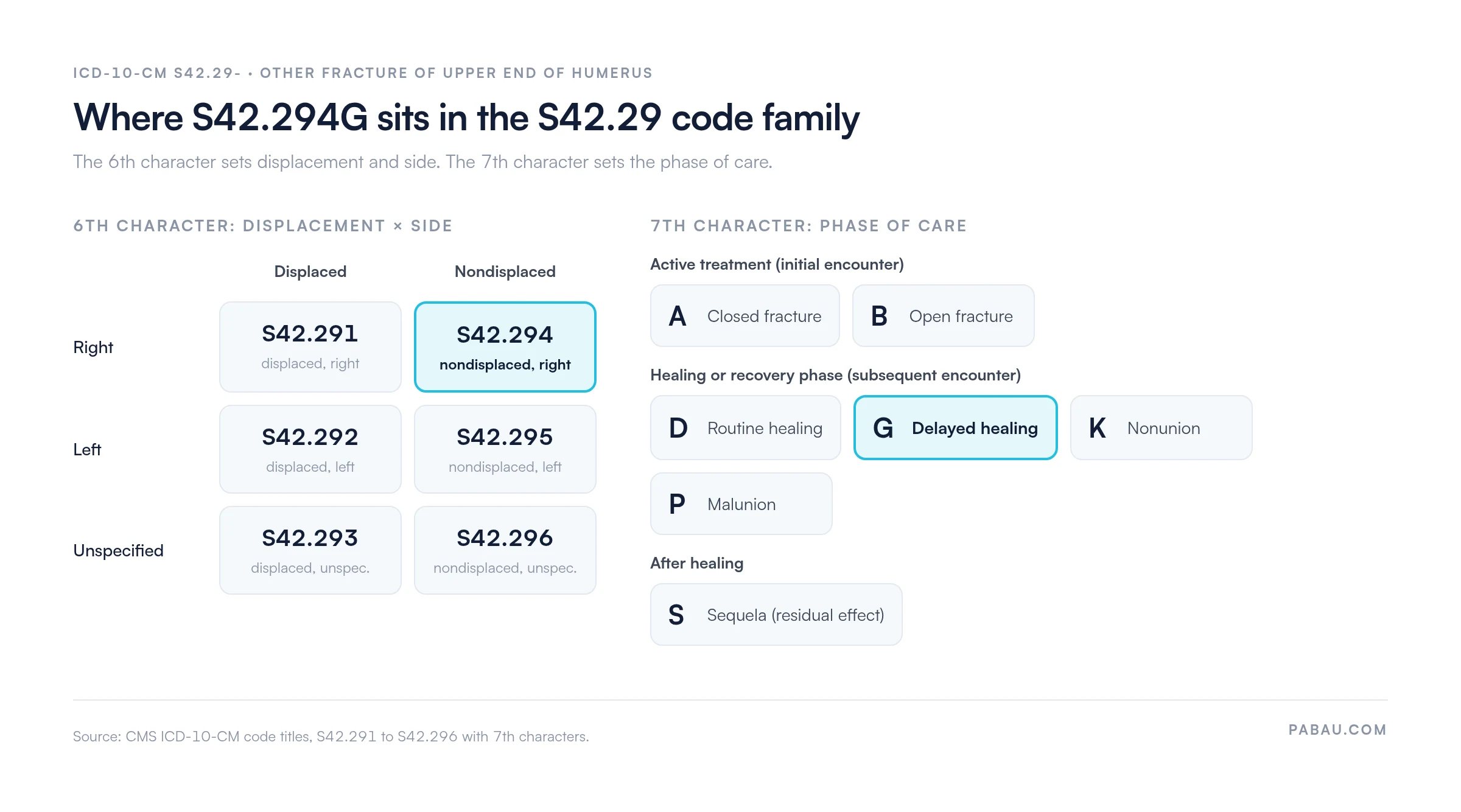
G sits between D and K on the same healing timeline. D says healing is on track, G says healing is slow, and K says healing has stopped. The grid below shows where S42.294G sits among its sibling codes and the seven characters.
A residual problem after the fracture has healed, such as shoulder stiffness, takes the sequela character. It is reported with S42.294S rather than with G.
Let the provider’s documentation decide the character. No ICD-10-CM rule turns a fracture into delayed healing after a set number of weeks, so G needs the provider to document it. Query the provider when imaging looks slow but the note is silent.
S42.294G fits when three conditions hold at the same visit. Active treatment has ended, the fracture is still healing, and the provider documents that healing is delayed.
Complications of surgical treatment, such as a failed fixation device, take complication codes instead of the G character. Those cases are rare for a nondisplaced fracture, but the distinction still applies.
The six S42.29 codes split on two facts: whether the fracture is displaced and which arm it involves. Each one takes the same seven 7th characters.
Check displacement against the imaging report before you check side. An imaging report that mentions any displacement moves the code to S42.291G, even when the office note calls the fracture minor.
The record has to support every character in the code. Payers look for four elements in the note for the visit being billed.
A note that says only “fracture follow-up, doing well” supports S42.294D rather than S42.294G. A note that describes slow healing without naming the side cannot support any right-sided code.
Most S42.294G denials trace back to a mismatch between the code and the note. Each one has a clear fix.
Strong denial management workflows catch most of these before submission. When a denial does arrive, attach the note that supports the corrected 7th character, side and displacement.
The guide to denial codes in billing explains the reason codes that come back with these rejections. It also helps to keep each correction in line with medical billing compliance requirements.
A delayed-healing visit usually involves an evaluation, repeat imaging and therapy. The pairings below are typical, and each one needs its own support in the note.
The last row is where G and K stop being interchangeable. Under Medicare NCD 150.2, ultrasonic bone stimulators stay noncovered for fresh fractures and delayed unions.
Medicare treats a long-bone fracture as a nonunion only after serial radiographs show healing has stopped for at least three months. Until then, a stimulator claim on S42.294G is likely to be denied.
The ICD-10-CM Official Guidelines for Coding and Reporting, Section I.C.19, set the rules for injury and fracture codes. Five of them shape how S42.294G is used.
The CDC/NCHS ICD-10-CM browser tool shows the current tabular list and index entries for S42.29. Coders who check it each October catch annual changes before they reach the revenue cycle.
When delayed healing becomes a nonunion, change the 7th character on the next claim, not the earlier ones. Each claim reflects what the provider documented at that visit, so the earlier G claims stay correct.
Delayed healing stretches a fracture episode across several follow-up visits, and each visit produces its own claim. When the note lives in one system and the claim in another, the claim can drift from the note.
Pabau, the practice management platform we build for medical practices, keeps the clinical note, the appointment and the claim in the same patient record. Your coder reads the delayed-healing statement and the imaging result in the record they bill from.
Our claims management software then submits the claim electronically through Claim.MD, our US clearinghouse partner. It tracks each claim status and remittance in the same place, while the code choice stays with your coder.

Pabau keeps the clinical note, the appointment and the claim together, then submits through Claim.MD and tracks each response. Your team follows every S42.294G visit from note to payment.

S42.294G is a narrow code. It describes a right-sided, nondisplaced upper-end humerus fracture that is still healing, only more slowly than it should. The 7th character carries most of the billing risk, because D, G and K describe three points on the same timeline.
Let the provider’s documented healing status pick the character, and recode as soon as that status changes. That habit keeps each claim aligned with its note and keeps stimulator claims off a delayed-union diagnosis. Book a demo to see how Pabau keeps fracture follow-up notes and claims in one record.

Need a reference for handling denied orthopedic claims? Denial management in healthcare walks through root-cause analysis and appeal workflows for common musculoskeletal billing denials.
Want to understand the clearinghouse that processes your fracture claims? How Claim.MD works as a clearinghouse explains real-time eligibility, ERA remittances, and CARC denial codes in plain language.
Looking to strengthen your overall billing accuracy? What is medical billing covers the end-to-end claim lifecycle from encounter to payment posting.
ICD-10 code S42.294G means other nondisplaced fracture of upper end of right humerus, subsequent encounter for fracture with delayed healing. It is reported at follow-up visits after active treatment, when the provider documents that the fracture is healing more slowly than expected.
The 7th character G means subsequent encounter for fracture with delayed healing. It applies after active treatment has ended, once the provider documents slower healing than expected. Routine healing takes D, nonunion takes K, and malunion takes P.
Use S42.294D when the fracture is healing on schedule at a follow-up visit. Switch to S42.294G only when the provider documents delayed healing, usually backed by imaging that shows less callus than expected. Without that statement in the note, D is the supported code.
Most denials come from a mismatch between the code and the note. Common causes are a G with no documented delayed healing and the wrong side or displacement. Another is a bone stimulator, which Medicare covers only for documented nonunion.
Yes. At a follow-up visit for delayed healing, the fracture is the reason for the encounter, so S42.294G can be listed first. The sequela rule that puts the residual condition first applies only to the 7th character S.



