ICD-10 Code Y76.0: Diagnostic obstetric and gynecological devices
ICD-10 Code Y76.0: Definition and billable status ICD-10 Code Y76.0 is a valid, ...

Last Updated: Oct 23, 2026
Billable Code Specific Code
S32.461G is the billable ICD-10-CM code for displaced associated transverse-posterior fracture of right acetabulum, subsequent encounter for fracture with delayed healing. It applies at a follow-up visit where the physician documents that this right-sided fracture is healing more slowly than expected.
The 7th character G separates this code from S32.461D, which covers routine healing, and mixing up the two is a frequent cause of denials. G signals that healing is delayed. Left-sided injuries use S32.462G, and unspecified laterality uses S32.463G.
Let Pabau's smart automation suggest the right codes, reduce claim denials, and keep your practice compliant—effortlessly.
Automate repetitive tasks and focus on what matters most—your patients.
Reduce coding errors and ensure compliance with the latest regulations.
Clean claims, fewer denials, and faster reimbursements.
Powerful insights and reporting to help your practice thrive.
HIPAA compliant SOC 2 certified GDPR-compliant Trusted by 4,000+ clinics worldwide

S32.461G is billable for a displaced transverse-posterior fracture of the right acetabulum at a follow-up visit where healing is delayed.
7th character G means delayed healing. Use D instead when the fracture is healing normally at a subsequent encounter.
The physician’s note must state that healing is delayed, for example citing inadequate callus on imaging, because coders cannot infer it from symptoms.
Pabau, the practice management platform we build, submits S32.461G claims electronically and tracks them, but the 7th character still comes from the physician’s note.
ICD-10 Code S32.461G is the billable ICD-10-CM code for a displaced associated transverse-posterior fracture of the right acetabulum with delayed healing at follow-up. It is valid for fiscal years 2025 and 2026, and the table below holds the reference data coders need before submission.
Verify current validity against the CMS ICD-10 codes page, which publishes the official annual code files each October. Codes in the S32 block have stayed stable across recent fiscal years. Checking before each October update still avoids rejected claims on revised descriptors.
The acetabulum is the cup-shaped socket in the pelvis that forms the hip joint with the femoral head. A displaced associated transverse-posterior fracture is a two-component injury. The Judet-Letournel classification calls it an “associated pattern” because it combines two elementary fracture types. One is a transverse fracture line crossing the acetabulum, and the other is a fracture of the posterior wall.
“Displaced” means the fracture fragments have shifted out of their anatomical position. This matters for coding because nondisplaced fractures of the same pattern take different codes, S32.464- to S32.466-.
This fracture pattern is typically caused by high-energy trauma, with motor vehicle collisions, falls from height, and dashboard injuries the most common mechanisms. Older patients may sustain it from lower-energy falls when bone quality is compromised. Two components make surgical fixation more technically demanding than either elementary type alone. That is why follow-up care is intensive and delayed healing is a recognized complication.
The 7th character G, as defined in the ICD-10-CM Official Guidelines (Section I.C.19.c), denotes a subsequent encounter at which the fracture is healing with delay. It sits between routine healing (D) and confirmed nonunion (K). The table below compares all six valid 7th characters for the S32.461 family: A, B, D, G, K and S.
A frequent coder error is using G when D applies, or the reverse. The physician’s note is the only basis for this choice. Coders must not infer healing status from symptoms, pain complaints, or the number of weeks since injury.
The note must state explicitly that healing is delayed. It should describe the clinical evidence, such as inadequate callus formation on radiographs or an assessment of stalled progress. It should also support the conclusion that nonunion has not been confirmed.
S32.461G is correct only when all five of the following conditions are met. Verify each against the physician note before submitting the claim.
When the documentation context is ambiguous, review the tabular Excludes notes for the S32 block alongside the Official Guidelines before you assign the code.
Choosing among the six valid S32.461 extensions hinges on the clinical status the physician documents. The table below compares the four that coders confuse most often at follow-up visits.
A practical test: if the physician’s note says anything equivalent to “healing well” or “on track,” the code is S32.461D, not S32.461G. If the note says “slower than expected” or “delayed,” G applies. If the note records nonunion as a confirmed diagnosis, switch to the nonunion extension. A visit treating avascular necrosis or post-traumatic arthritis caused by the fracture takes the S extension, with a separate code for the resulting condition. The guide below maps all six extensions to the two questions that decide them.
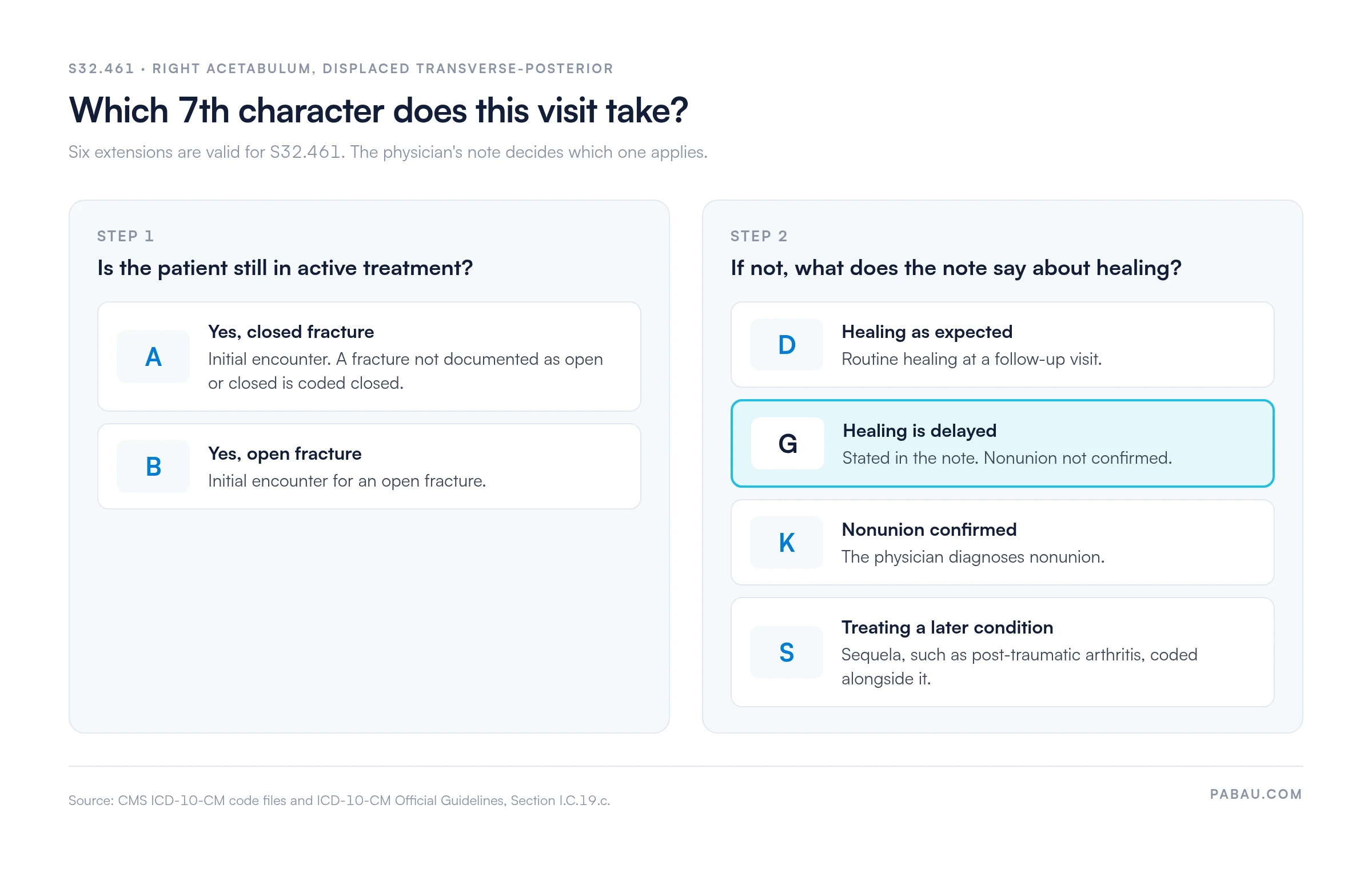
Flag the physician note for a query whenever it describes slow healing without explicitly stating ‘delayed healing.’ Payers and auditors require the exact clinical determination in the documentation. A note saying ‘patient has pain and limited ROM at 12 weeks post-op’ does not support 7th character G on its own. The physician must state the healing assessment, not leave it to be inferred.
At a subsequent encounter for delayed healing, the services billed alongside S32.461G depend on what the physician performs at that visit. The table below lists the CPT codes most commonly paired with S32.461G in orthopedic and rehabilitation settings.
Physical therapy services billed with S32.461G need documentation that ties the therapeutic goal to the delayed healing status. Payers may deny PT claims if the functional impairment is attributed only to the acute fracture rather than to the documented complication of delayed healing.
Prior authorization requirements for services coded with S32.461G vary by payer type and plan year. Always verify current requirements directly with the specific payer before the patient encounter.
Understanding the medical billing process for complex fracture follow-up helps billing teams anticipate which services need pre-authorization. They can then secure it before the encounter rather than scrambling after a denial arrives.
Denials on S32.461G cluster around a predictable set of documentation and coding failures. Good claims software for practices submits and tracks each claim, but it cannot judge whether the note supports a G extension. The table below maps the most common denial reasons to their root causes and fixes.
Denial management workflows that track which denial categories recur on fracture follow-up claims let you aim documentation education at the root cause. Practices that only fix individual denied claims see the same denial types return on the next billing cycle.
Claims carrying S32.461G go out on the CMS-1500 (professional) or UB-04 (facility) claim form. Submitting a clean claim for a delayed-healing fracture visit means checking four elements before the claim leaves the practice:
After adjudication, the payer returns an electronic remittance advice (ERA, or 835 file). It carries claim adjustment reason codes (CARCs) that map to the denial categories above. The medical billing denial codes reference explains how to read and act on each CARC returned on a rejected S32.461G claim. Reading them on receipt shortens the appeals cycle and gets the corrected claim back to the payer faster.
Official and third-party resources coders should bookmark when working with S32.461G and the broader S32 pelvic fracture block:
Once the physician’s note supports G, the remaining work is getting the claim out and watching what comes back. Without an integrated system, billing staff key each claim into a payer portal, then chase its status by phone, one claim at a time.
Pabau turns the visit invoice into an electronic CMS-1500 claim through its Claim.MD integration, which reaches thousands of US payers. It checks the patient’s coverage in real time before the visit and tracks each claim’s status after submission.
When the payer responds, the ERA comes back into Pabau and ties the payment to the claim it settles. Your team sees a denied S32.461G claim next to its reason code, so they can fix the note or the extension and resubmit. Pabau submits the codes your coders assign, and the choice between D and G still rests on the physician’s documentation.
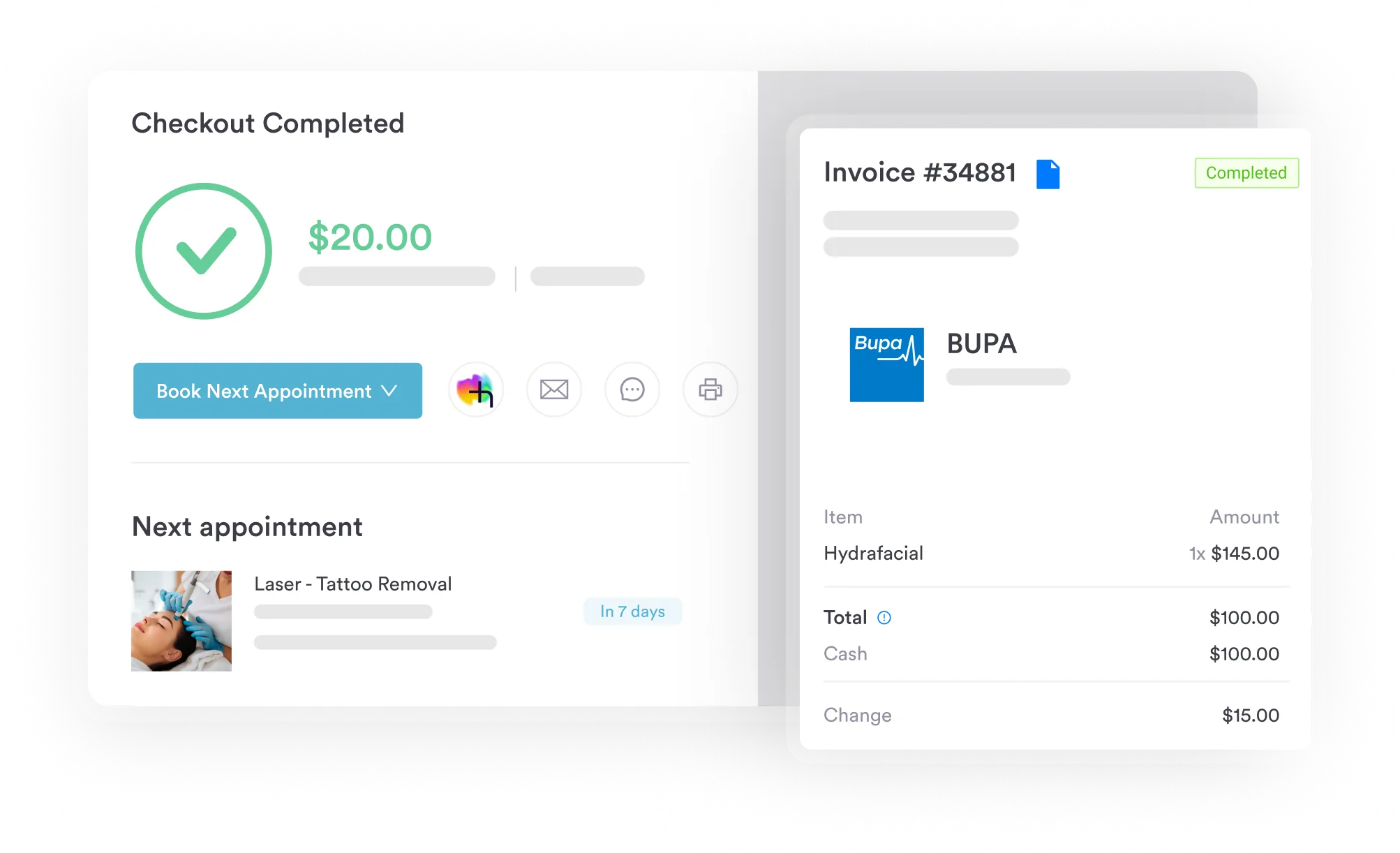

Pabau turns visit invoices into electronic claims, checks coverage in real time, and brings remittances back into your billing workflow. Your team sees each denied claim and its reason code without chasing payer portals.

Treat G as a documentation question before it is a coding one. If the note doesn’t state that healing is delayed, query the physician before the claim goes out. Coding from pain scores or elapsed weeks is what turns a defensible G into a denial.
Revisit the extension at every follow-up. A fracture coded G at one visit may be coded D at the next as healing catches up, or K once the physician confirms nonunion. Re-reading the note each time stops last visit’s extension from riding onto today’s claim.
To see how Pabau submits fracture follow-up claims and brings remittances back into one billing workflow, book a demo.

Need a framework for handling medical billing denials? Denial management in healthcare covers the workflows that reduce repeat denials across orthopedic and specialty billing.
Want to understand how electronic remittances work after a claim is adjudicated? Electronic remittance advice explains ERA/835 files and how to read CARC denial codes returned on fracture claims.
Looking for guidance on medical billing fundamentals before diving into ICD-10? Revenue cycle management explains the end-to-end billing process for practices managing complex injury claims.
ICD-10 Code S32.461G is the billable diagnosis code for a displaced associated transverse-posterior fracture of the right acetabulum. It applies at a follow-up visit where the physician documents delayed healing. The code sits in the S32 block (fractures of the lumbar spine and pelvis), and its 6th character, 1, specifies the right side. The 7th character, G, marks a subsequent encounter where healing is slower than expected but nonunion has not been confirmed.
Yes, S32.461G is a valid billable ICD-10-CM diagnosis code for HIPAA-compliant claim submission, confirmed valid for fiscal years 2025 and 2026. Check the annual CMS ICD-10-CM code file each October to verify that the code has not been revised or deleted for the upcoming fiscal year.
Denials on S32.461G usually trace back to one of four causes. The first is the wrong 7th character, such as coding G when the note supports routine healing. The others are notes that never state delayed healing, laterality errors, and missing prior authorization for imaging or surgery ordered at the visit. Each has a fixable root cause, so correct the documentation pattern rather than just re-filing the claim.
Traditional Medicare Part B does not generally require prior authorization for established-patient E/M visits. Imaging or surgery ordered at a delayed-healing follow-up may need documentation review or prior authorization, depending on your Medicare Administrative Contractor’s Local Coverage Determinations. Medicare Advantage plans apply their own, often stricter, requirements, so verify with the specific plan before the encounter.