ICD-10 code S31.125S: Laceration of abdominal wall with foreign body, sequela
ICD-10 code S31.125S covers what the healed wound left behind ICD-10 code S31.12...

Last Updated: Nov 2, 2026
Billable Code Specific Code
S32.436K is the billable ICD-10-CM code for a nondisplaced fracture of the anterior column [iliopubic] of an unspecified acetabulum, at a subsequent encounter for nonunion. Use it only when no document in the record names the injured side.
When the imaging report or note states the side, code S32.434K for the right acetabulum or S32.435K for the left. Many payers deny or pend unspecified-side codes, and the K character needs a documented, imaging-backed nonunion finding.
Let Pabau's smart automation suggest the right codes, reduce claim denials, and keep your practice compliant—effortlessly.
Automate repetitive tasks and focus on what matters most—your patients.
Reduce coding errors and ensure compliance with the latest regulations.
Clean claims, fewer denials, and faster reimbursements.
Powerful insights and reporting to help your practice thrive.
HIPAA compliant SOC 2 certified GDPR-compliant Trusted by 4,000+ clinics worldwide

S32.436K is the billable ICD-10-CM code for a nondisplaced anterior column acetabular fracture with nonunion, when the record does not name the side.
Document laterality wherever you can, so the claim carries S32.434K for the right acetabulum or S32.435K for the left.
Many payers treat an unspecified-side code as a denial trigger, so check the imaging report for the side before you submit.
The K character needs a clinician’s nonunion finding backed by imaging, while G covers healing that is slow but still expected.
Pabau, our practice management software, supports ICD-10-CM code entry, Claim.MD claim submission and denial tracking, while code choice stays with your coder.
ICD-10 code S32.436K reports a nondisplaced fracture of the anterior column [iliopubic] of an unspecified acetabulum that has failed to heal. It applies at a subsequent encounter, once the treating clinician documents nonunion.
The word that matters most is “unspecified.” The code tells the payer one hip is fractured without saying which. Charts seldom lack that detail, because the CT report almost always names the side.
S32.436K has been a valid, billable code since October 1, 2015, the start of FY 2016. It sits in Chapter 19 (S00-T88), category S32 (fracture of lumbar spine and pelvis), under subcategory S32.4 (fracture of acetabulum). Each character records one coding decision:
In the S32.43 subcategory, the sixth character combines two facts: whether the fragments moved, and which acetabulum broke. Six values cover every combination.
A one-digit slip changes one of those facts without warning. Typing 3 instead of 6 turns a nondisplaced fracture into a displaced one. Typing 6 instead of 4 or 5 turns a specific claim into an unspecified one.
Start with the radiology report, which almost always names the left or right acetabulum. The official ICD-10-CM coding guidelines allow laterality to come from other clinicians’ documentation when the treating provider omits it.
If two documents disagree on the side, query the attending provider before you assign a code. Keep S32.436K for the rare record where no document names the injured hip.
Anterior column fractures are often confused with anterior wall fractures, which carry their own codes. The anterior wall (S32.41-) is the thin front rim of the socket. The anterior column (S32.43-) is the load-bearing pillar that runs from the iliac crest to the pubic symphysis.
A report that only says “anterior acetabular fracture” needs a query before you choose between the two subcategories. If the answer is a nondisplaced wall fracture with no side, the initial-encounter code is S32.416A.
K marks a subsequent encounter for a fracture that has failed to unite. Time alone does not prove nonunion. The treating clinician has to state it, and imaging should support it, for example a persistent fracture line with no bridging callus.
S32.436 accepts six seventh characters, and each one tells the payer a different story about the fracture:
Payers often query the line between G and K. Use G when the clinician says healing is slow but has not ruled out union. Use K only when the clinician states nonunion and imaging supports it. If the note says “slow to heal” or “questionable healing,” query the clinician before you choose K.
S32.436K is a closed-fracture code by default, because ICD-10-CM codes a fracture as closed unless the record says it is open. The B character applies only to the initial encounter for an open fracture. At later visits, S32 has no open or closed split, so K here simply means nonunion.
A nonunion follow-up claim passes through seven steps, and the side or the 7th character can slip at any of them:
Take a patient who returns nine months after a fall. The surgeon’s note reads “anterior column acetabular fracture, nondisplaced, nonunion” with no side. The CT report from the same week describes the left acetabulum.
Coding from the note alone gives S32.436K, which leaves the claim exposed to an unspecified-site denial. Taking the side from the CT report gives S32.435K, which also matches the LT modifier on the procedure line.
A records request on this code checks four elements: the fracture site, displacement, side and the nonunion finding. Supporting all four is what makes a clean claim possible.
Reviews for medical billing compliance look for the same elements on orthopedic claims. Building them into your follow-up note template saves a query later.
S32.436K explains why care was needed, and a CPT code describes what was done. When a nonunion goes to surgery, the claim often pairs the diagnosis with one of these open treatment codes:
These codes describe open treatment of acetabular fractures. Confirm the CPT code for nonunion surgery against the operative note and payer policy.
Payer edits compare the diagnosis with the procedure, so both codes must tell the same story. An LT modifier on the procedure next to an unspecified-side diagnosis is a mismatch that edits can catch. Check each payer’s policy before you assume a pairing will pass.
Denials on this code commonly trace back to these five causes. The unspecified side comes first because it is the easiest one to prevent.
Systematic denial management catches these patterns before they repeat. Knowing the denial codes payers use helps your team trace each remittance reason back to its cause, instead of resubmitting the same claim.
Run each claim carrying this code through six quick questions:
The first four questions decide the code itself, and the path below shows how each answer moves the claim.
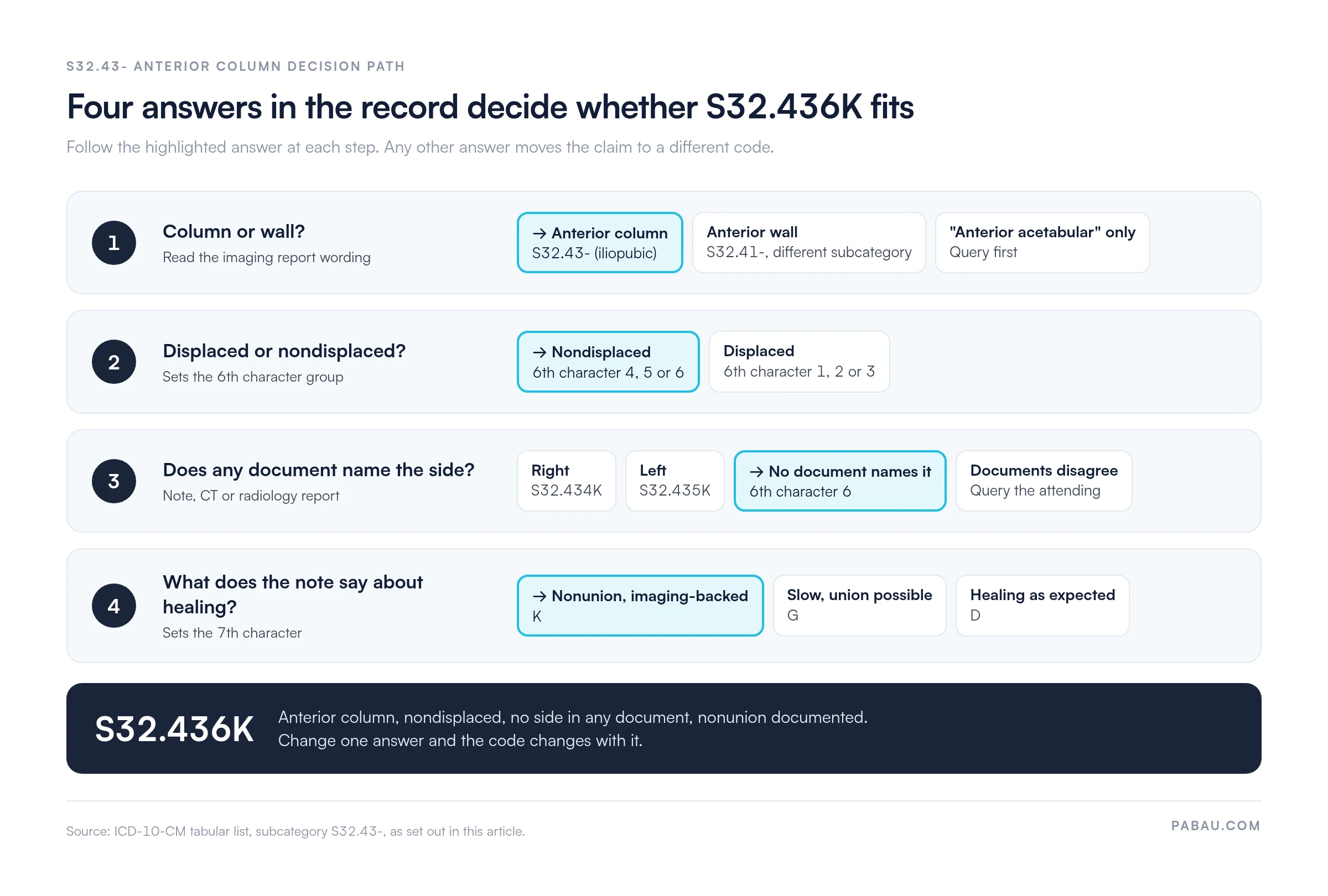
The steps above usually happen in separate places: the chart, a code reference, a payer portal and a clearinghouse. Each handoff gives the side or the 7th character another chance to slip.
Pabau, the practice management platform we build, puts code entry and billing next to the patient record. Your coder searches and adds ICD-10-CM codes from a built-in library, and US claims go out electronically through Claim.MD.
Once claims are sent, Pabau’s claims software for billing teams tracks their status and logs denials. Your team can see which codes keep coming back, while the choice between S32.434K, S32.435K and S32.436K stays with your coder.
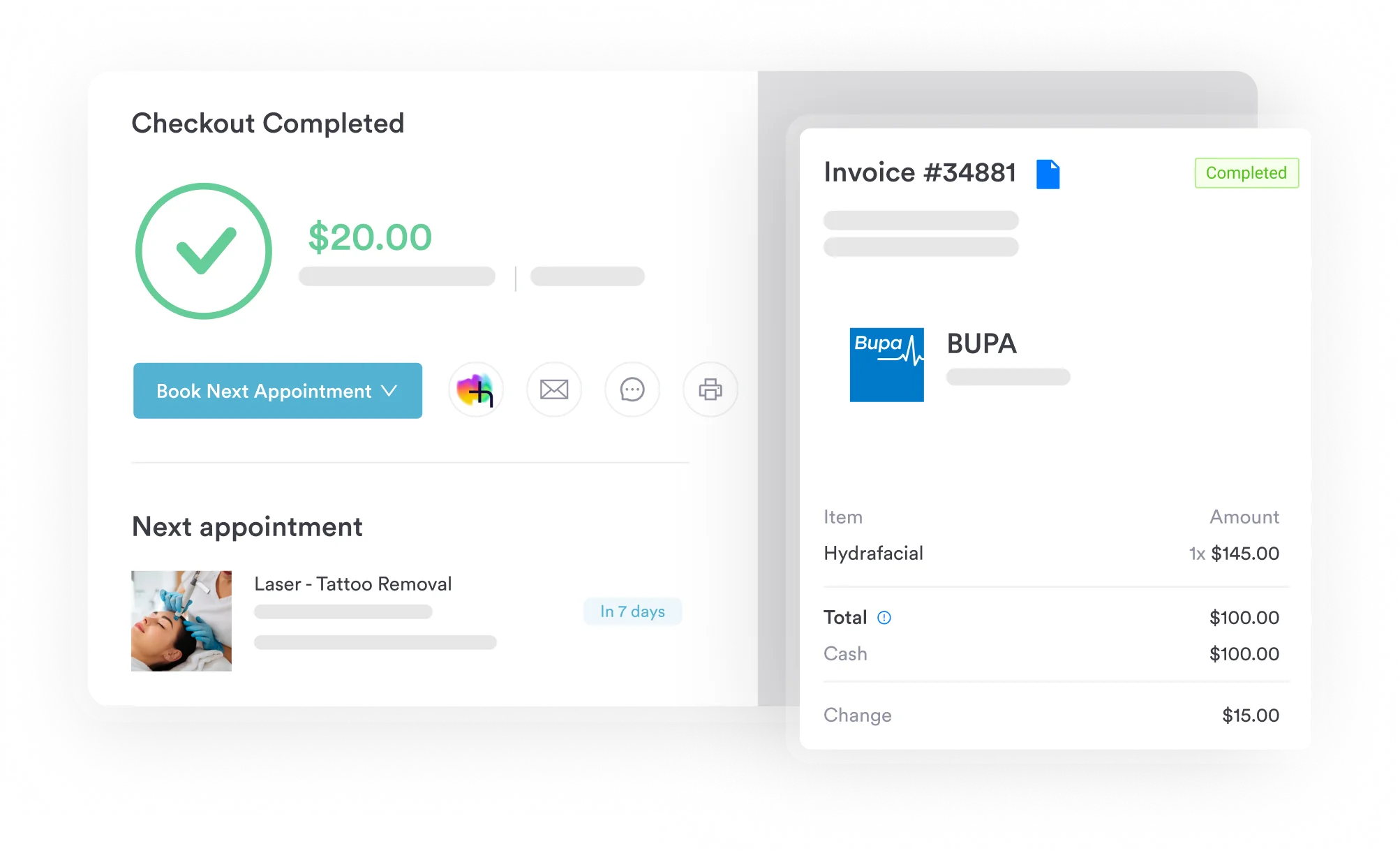

Pabau supports ICD-10-CM code entry, submits US claims through Claim.MD and tracks denials, so your team can spot and fix rejected nonunion claims sooner.

S32.436K is a code you should seldom need. When a nonunion claim arrives with no side recorded, go back to the imaging report before you submit.
A side-specific code with a clear nonunion statement survives payer edits and records requests. An unspecified code invites both, and every denial means rework. For the wider claim cycle, see what medical billing involves.
Book a demo to see how Pabau supports ICD-10-CM code entry, Claim.MD submission and denial tracking for your orthopedic practice.

Need to understand how denial codes map to S32.436K rejections? Denial codes in medical billing explains how to read remittance advice reason codes and trace each one to the missing documentation.
Want to improve claim acceptance rates across your orthopedic practice? Denial management in healthcare covers systematic approaches to reducing rework and tracking denial patterns by code family.
Looking for a clearinghouse that integrates with ICD-10 code submission? Claim.MD clearinghouse overview covers how Pabau’s US clearinghouse partner handles 837P claims, real-time eligibility, and ERA processing.
Not on every claim. External cause codes (V00-Y99) are optional unless a state mandate or payer policy requires them. When you report one, it can stay on the claim for the whole course of treatment. It uses 7th character A for active treatment, or D at subsequent encounters such as this K visit.
The general equivalence mappings link S32.436K to ICD-9-CM 733.82, nonunion of fracture. ICD-9 had no laterality or column detail, so the match is approximate. Use it only for historical data, never for current claims.
No. S32 covers traumatic fractures only. Stress fractures go to M84.3-, pathological fractures to M84.4- through M84.6-, and osteoporotic fractures to M80. The record should state the traumatic cause to keep the code in S32.
Yes. List it first when the nonunion is the main reason for the visit. Add separate codes for any other injuries or conditions treated at the same encounter.