ICD-10 Code S42.444P: Medial epicondyle fracture, right humerus
ICD-10 Code S42.444P: full descriptor and code validity ICD-10 Code S42.444P car...

Last Updated: Oct 13, 2026
Billable Code Specific Code
S32.008G is the billable ICD-10-CM code for other fracture of unspecified lumbar vertebra, subsequent encounter for fracture with delayed healing.
The most common mistake coders make with this code is applying the initial-encounter character A on follow-up visits. That is an auditable error, and it triggers claim denial and may flag the account for payer review. S32.008G applies only after active treatment has started and the provider has documented delayed healing. It is used when no specific lumbar level (L1 through L5) appears in the clinical record.
Missing or vague healing-status documentation is the top denial trigger for this code.
Let Pabau's smart automation suggest the right codes, reduce claim denials, and keep your practice compliant—effortlessly.
Automate repetitive tasks and focus on what matters most—your patients.
Reduce coding errors and ensure compliance with the latest regulations.
Clean claims, fewer denials, and faster reimbursements.
Powerful insights and reporting to help your practice thrive.
HIPAA compliant SOC 2 certified GDPR-compliant Trusted by 4,000+ clinics worldwide

S32.008G codes other fracture of an unspecified lumbar vertebra at a subsequent encounter, not at the first active treatment visit.
The 7th character G requires provider documentation that healing is delayed, and vague healing-status notes are the leading denial cause.
Using S32.008A on a follow-up visit is an auditable error, and S32.008D is the code when healing progresses routinely.
Pabau connects to Claim.MD for electronic claim submission and real-time eligibility checks before a follow-up visit.
ICD-10 Code S32.008G is a valid, billable code for fiscal years 2025 and 2026, per the CMS ICD-10-CM annual release. Confirm the at-a-glance details below before submitting a claim.
The full descriptor breaks into three parts, each carrying distinct clinical and coding weight. Getting any one of them wrong leads to the wrong code.
According to the CDC/NCHS ICD-10-CM web tool, S32.008 sits within the S32.0 subcategory covering fractures of lumbar vertebrae. That subcategory is nested under S32, which covers all fractures of the lumbar spine and pelvis in the S00-T88 injury chapter.
The 7th character in ICD-10-CM fracture codes signals the stage of care, not the chronological visit number. Under ICD-10-CM 7th character conventions, “subsequent encounter” means the patient has received definitive treatment and is now in the healing phase. Character G narrows that further, because the record must describe healing as delayed. The table below sets out every 7th character available for S32.008.
A key practical rule from the ICD-10-CM Official Guidelines (Section I.C.19.c): the subsequent-encounter characters apply to every visit once active treatment has started. Choose between D, G, and K on what the note says about healing, not on the calendar. The character does not reset between providers either. A physical therapist seeing the patient for rehabilitation uses a subsequent-encounter character, not A, even if it is their first encounter with this patient.
Using S32.008A on a follow-up visit is one of the most auditable fracture coding errors in AAPC education materials and AHA Coding Clinic guidance. The stage of care at that specific visit decides the character, not the time elapsed since the injury.
Use this clinical decision sequence before assigning a 7th character:
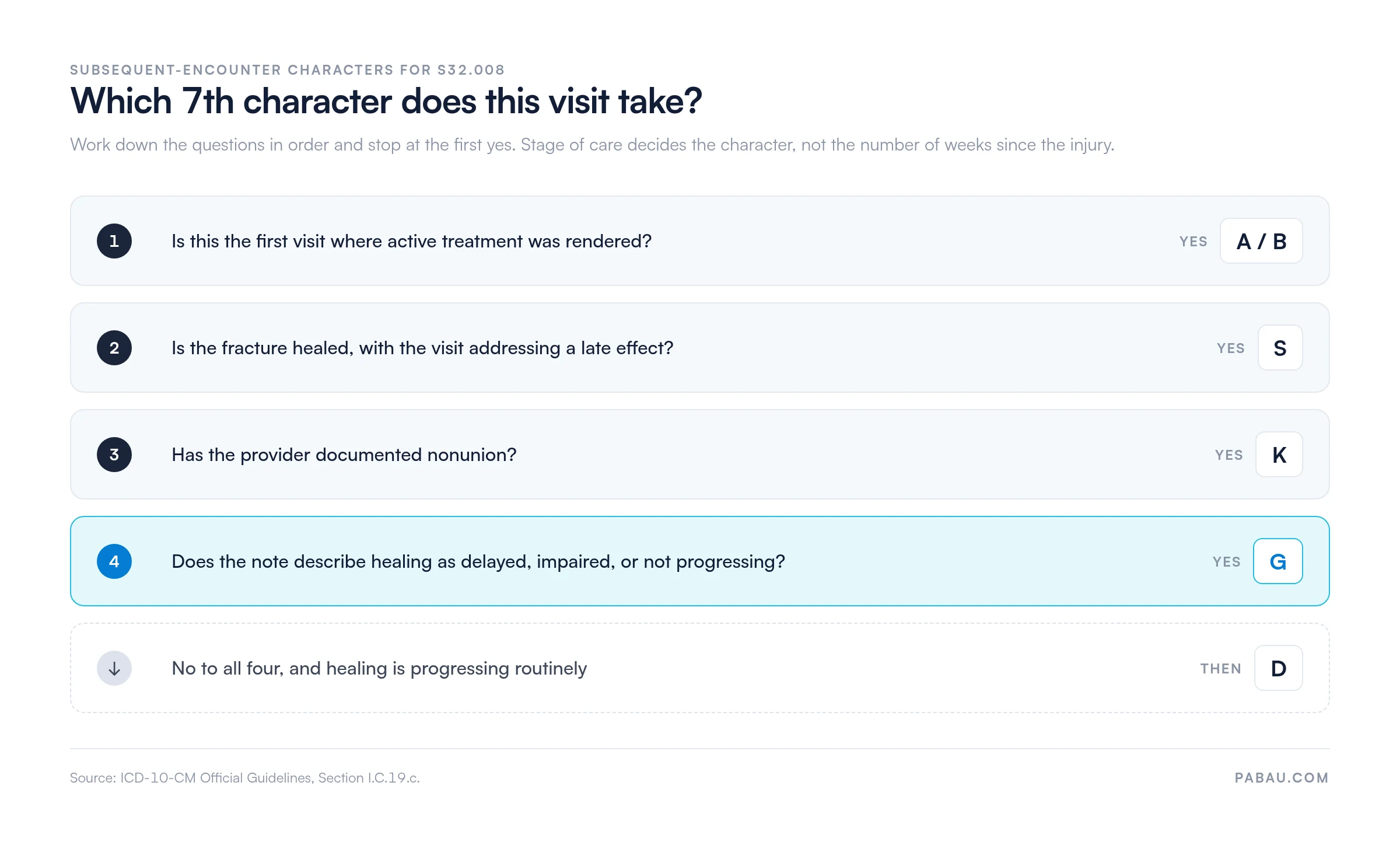
The split between D and G trips up many coders. Delayed healing (G) requires explicit provider documentation that healing is not occurring at the expected rate. A patient who is six weeks post-injury and still in a brace does not qualify on timing alone. If the note says “fracture healing well” or “progressing as expected,” S32.008D is correct regardless of the number of weeks elapsed.
The excludes notes at the S32 category level constrain which codes can appear alongside S32.008G. Misreading an Excludes1 as an Excludes2 is a coder error that can cause claim denials and compliance findings. The note type decides whether a condition is barred from the claim or may still be reported alongside it.
When a more specific vertebral level is documented, assign a level-specific code rather than S32.008G. The table below maps the key sibling codes within the S32.0 subcategory to help coders navigate to greater specificity.
Add the appropriate 7th character to each base code. Suppose the note documents L3 and describes the fracture as transverse, which is an other fracture type. S32.038G is then more specific than S32.008G, and it is the code to use.
Five documentation elements must be present in the provider’s note to support ICD-10 Code S32.008G without triggering a medical necessity review. Catch a missing element before submission and it is a quick fix. Find it after a denial and it becomes a revenue delay.
Run a pre-billing documentation check on every S32.008G claim before submission. Confirm the note carries the five elements above and that the provider has described healing as delayed rather than routine. Claims that leave healing status vague are a top target for Medicare ADR (Additional Documentation Request) letters.
S32.008G pairs with a range of CPT procedure codes, depending on the treating specialty and the services rendered at the visit. Physical therapy and orthopedic practices generate most of the rehabilitation CPT codes listed below. Always verify current NCCI edits before submitting combinations, because bundling rules change with each annual update.
CMS covers subsequent encounter visits for lumbar fracture under Medicare Part B when medical necessity is clearly documented. Understanding medical billing compliance at the payer level is essential before submitting S32.008G on a Medicare claim.
Key payer requirements to address before submission:
Practice management software like Pabau integrates with Claim.MD for electronic claims, supporting real-time eligibility verification before a subsequent encounter visit. That check confirms active coverage, so S32.008G claims are not submitted against a lapsed or changed benefit period. Pabau’s claims management software connects to Claim.MD’s network of 4,000+ US payers for CMS-1500 and 837P electronic submission.
S32.008G denials cluster around five root causes. Each maps to a specific documentation or coding error that can be caught before submission with a structured pre-billing review. See the medical billing denial codes reference for guidance on the adjustment reason codes that turn up on S32.008G remittances.
Remittance advice posts back through Pabau’s Claim.MD connection, so practices can track denial patterns by code and encounter type. That makes it easier to spot when S32.008G claims keep hitting the same CARC code, and to fix the root cause.
Set up a claim scrubbing rule that flags any claim where S32.008A appears more than 14 days after the documented injury date. That gap is a strong signal the visit is a follow-up. Review the subsequent-encounter characters instead: D when the note describes routine healing, G when it describes delayed healing.
Legacy billing systems, retroactive claim corrections, and research queries against older Medicare data often need an ICD-9-CM equivalent. The crosswalk below is approximate. ICD-9-CM had no encounter-type 7th character system, so the specificity of S32.008G cannot be reproduced in it.
Per the ResDAC coding transition guidance, note that loss of specificity whenever ICD-9 codes are used for comparative research or legacy claim work.
The CMS General Equivalence Mapping (GEM) files provide the official crosswalk methodology. The mapping from ICD-9 805.4 to S32.008 is an approximate forward map. Do not treat it as a precise one-to-one equivalent for clinical research.
In most practices, a wrong 7th character surfaces only after the remittance arrives. The healing-status phrase sits in a free-text note, and the coder works from memory or a printed cheat sheet. Nobody compares the note against the character on the claim until a denial forces the review.
Pabau keeps that check inside the visit. Clinical note templates can prompt the provider for an explicit healing-status statement at every follow-up. The diagnosis your coder assigns then stays attached to the encounter, instead of being retyped into a separate billing screen.
Claims then leave through Pabau’s Claim.MD integration, with eligibility confirmed before the visit and remittance advice posted back against the original encounter. Fewer S32.008G claims go out carrying a healing status the note does not support. The denials that do arrive are easier to trace back to a root cause.

Pabau connects to Claim.MD for real-time eligibility checks and electronic claim submission. Coders see the note and the claim in one record, so fewer S32.008G claims go out on the wrong 7th character.

Accurate use of ICD-10 Code S32.008G comes down to two disciplines. Choose the 7th character by stage of care rather than visit count, and state healing status explicitly in the note. Both are preventable failure points.
Remember which way round the two subsequent-encounter characters run. G is the delayed-healing character, so a note describing a fracture that is healing well belongs on S32.008D instead. If your billing workflow for lumbar fracture follow-up visits needs tightening, see how Pabau handles this.

Need a clean-claim checklist for musculoskeletal codes? Clean claim submission guidelines covers the documentation and coding elements payers check before paying a claim.
Working with insurance eligibility before each visit? Insurance eligibility verification workflows explains how to confirm active coverage and benefit details before submitting subsequent encounter claims.
Want the full picture from encounter coding to payment? Revenue cycle management for healthcare practices covers the end-to-end process from encounter coding through payment posting.
ICD-10 Code S32.008G is the billable ICD-10-CM diagnosis code for other fracture of unspecified lumbar vertebra, subsequent encounter for fracture with delayed healing. It applies to follow-up visits after active treatment has begun, when no specific vertebral level is documented and the provider records that healing is delayed.
Yes. Physical therapists and other non-physician practitioners may report S32.008G when they treat a patient for lumbar fracture rehabilitation at a subsequent encounter. Character A belongs to the visit where active treatment was first rendered, so later rehabilitation visits take a subsequent-encounter character. Use G only where the record documents delayed healing, and D where healing is routine.
Four causes account for most Medicare denials on S32.008G. The first is missing or vague healing-status documentation in the provider note. The second is the wrong 7th character, usually A, submitted on a follow-up visit. The third is medical necessity that the documented clinical findings do not support. The fourth is an Excludes1 violation, where S32.008G is reported alongside transection of abdomen (S38.3).
The approximate ICD-9-CM equivalent is 805.4 (closed fracture of lumbar vertebra without mention of spinal cord injury), per CMS General Equivalence Mapping files. This is an approximate forward map only. ICD-9-CM does not distinguish encounter type or healing status, so the specificity of S32.008G cannot be replicated.