

ICD-10 code S61.201A: Open wound of left index finger without nail damage
ICD-10 code S61.201A covers a left index finger wound of unstated type ICD-10 co...

Last Updated: Oct 16, 2026
Billable Code Specific Code
S14.5XXD is the billable ICD-10-CM code for injury of cervical sympathetic nerves, subsequent encounter. It applies when active treatment for a traumatic neck injury has ended and the patient returns for routine care while the nerves heal.
The injury usually shows as Horner-type signs on one side: a drooping eyelid, a small pupil and reduced facial sweating. The 7th character D separates it from S14.5XXA, used during active treatment, and S14.5XXS, used for lasting effects after healing.
Let Pabau's smart automation suggest the right codes, reduce claim denials, and keep your practice compliant—effortlessly.
Automate repetitive tasks and focus on what matters most—your patients.
Reduce coding errors and ensure compliance with the latest regulations.
Clean claims, fewer denials, and faster reimbursements.
Powerful insights and reporting to help your practice thrive.
HIPAA compliant SOC 2 certified GDPR-compliant Trusted by 4,000+ clinics worldwide

S14.5XXD is a billable ICD-10-CM code for a traumatic cervical sympathetic nerve injury at a follow-up visit.
It fits once active treatment has ended and the patient returns for routine care while the nerve heals.
The usual clinical picture is Horner-type: ptosis, miosis and reduced sweating on the injured side after neck trauma.
Cervical cord lesions code to S14.1-, brachial plexus injuries to S14.3- and peripheral neck nerve injuries to S14.4-.
A clean claim names the original injury, its date and mechanism, and states that healing is still underway.
ICD-10 code S14.5XXD reports an injury of the cervical sympathetic nerves at a subsequent encounter. You use it once active treatment is complete and the patient comes back for routine care while the nerve heals. The official descriptor reads: Injury of cervical sympathetic nerves, subsequent encounter.
Each part of the seven-character string has a role, so check the full string before the claim leaves your system.
Both placeholders are required. Without them, the code is invalid and the claim rejects at the clearinghouse before a payer ever sees it.
S14.5 covers traumatic damage to the sympathetic nerves that run through the neck. These nerves control the pupil, part of the upper eyelid and facial sweating on the same side. When they are injured, the record usually describes a Horner-type picture:
Typical causes include blunt or penetrating neck trauma, such as a motor vehicle accident, a fall or a stab wound. The S14 category also has a code-also note. It covers any associated cervical vertebra fracture (S12.0- to S12.6-), open wound of the neck (S11.-) or transient paralysis (R29.5).
If imaging also shows a carotid artery injury, that injury takes its own code from S15.0-. Horner syndrome with no documented injury is a different diagnosis altogether, coded to G90.2 in the nervous system chapter.
Character D applies when the patient has finished active treatment and now gets routine care during healing or recovery. Section I.C.19.a of the ICD-10-CM Official Guidelines sets this rule for injury codes. The type of care decides the character, not the number of visits.
Character A, by contrast, follows the patient through every encounter with active treatment. That includes emergency evaluation, surgical repair, and evaluation and continuing treatment by the same or a different physician. D starts afterward, when visits shift to checking progress and adjusting the plan.
The flow below shows where each character starts and stops.
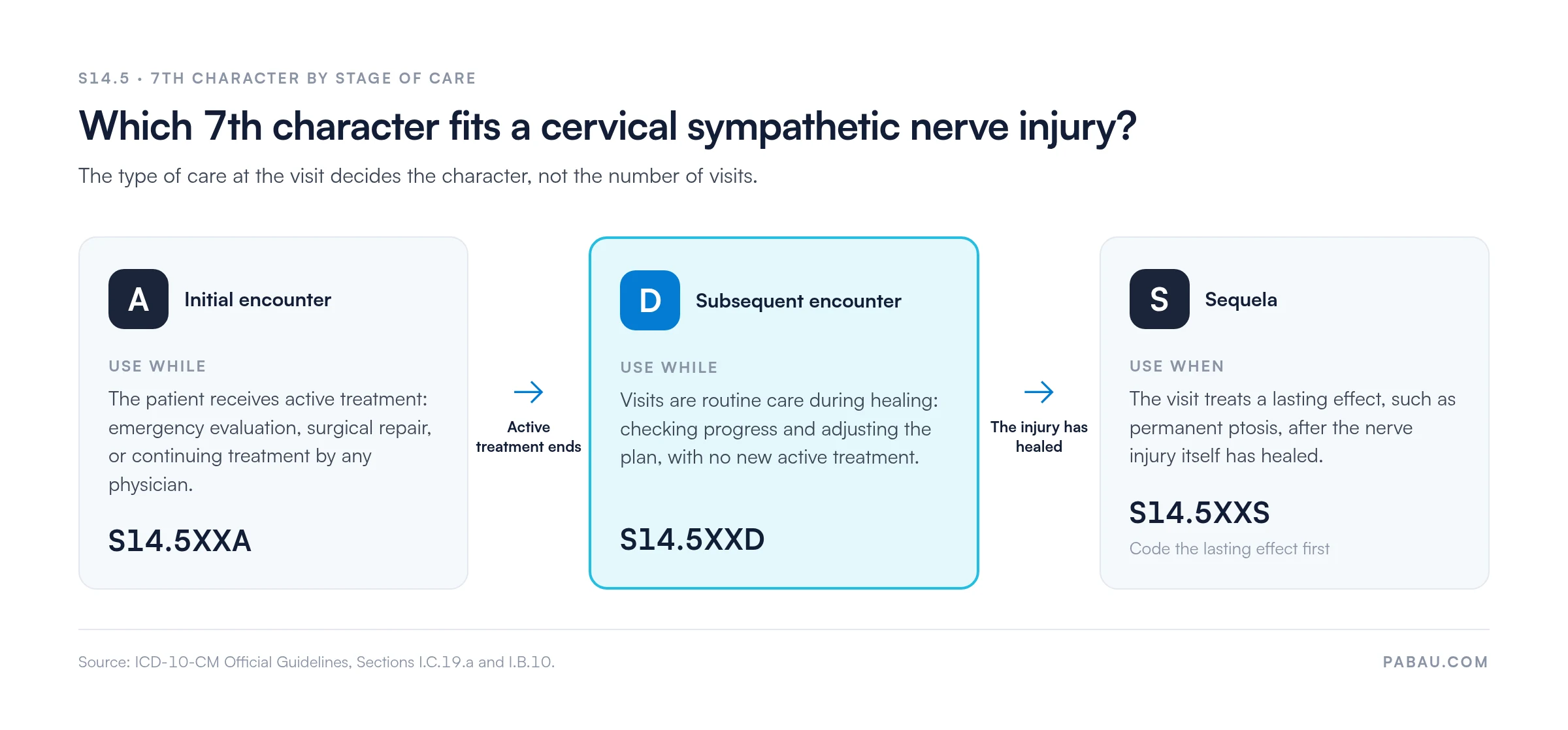
Use D while the nerve injury is still healing. Switch to S once the injury itself has healed and the visit treats a lasting effect, such as permanent ptosis. Under Section I.B.10, the residual condition is sequenced first and S14.5XXS follows it.
In practice, the provider has to say which one applies. A coder cannot work it out from the visit date or the visit type alone.
Category S14 groups several neck nerve and cord injuries that look alike on a code list. The table shows the near neighbors and what separates each one from S14.5XXD. For codes outside this category, search the full list of ICD-10-CM codes.
The cord-lesion mix-up costs the most. Central cord, anterior cord and Brown-Sequard syndromes code to S14.12- through S14.14-. Other incomplete cord lesions code to S14.15-. None of them belong in S14.5, even when the patient also shows Horner-type signs.
When the record documents both a cord lesion and a sympathetic nerve injury, code each one separately. For the cord injury, follow the S14 note and code to the highest level of injury.
A defensible S14.5XXD claim starts in the visit note. Before coding, check that the note answers each of these questions:
A short line often covers most of this. For example: “Follow-up of right cervical sympathetic nerve injury from a fall on [date]. Ptosis improving. Active treatment complete.” If imaging was ordered, reference the report in the note so a reviewer can follow the trail.
Most follow-up claims for this code travel the same route. Knowing each stop helps you see where a problem starts.
External cause codes need a word of their own. Codes from Chapter 20 (V00-Y99) describe how the injury happened. Section I.C.20 does not set a national requirement to report them. Instead, report them when your payer or state rules require it, and give them the same 7th character as the injury.
S14.5XXD denials tend to repeat. A steady denial management process screens for each of these before the claim goes out.
Before you bill D for a sympathetic nerve injury, look at the last claim for the same injury. If the patient still received active treatment at that visit, check whether the plan has since moved to routine checks. Only then does D fit.
Disputes over this code are settled by a short list of official sources. Check them each October, when the ICD-10-CM code set updates.
Most S14.5XXD problems start in the note, long before the claim exists. Pabau, the practice management platform we build, keeps the clinical note, the diagnosis codes and the claim in one patient record. Your coder can then check the injury date and treatment status without chasing a separate chart.
Claims go out through the built-in Claim.MD connection, where the clearinghouse checks the format before the payer sees it. Responses come back to the same record through claims management, so your team can follow up on a rejection from one place.

Pabau keeps notes, diagnosis codes and claims in one patient record, so follow-up injury claims carry the documentation payers expect.

S14.5XXD is a narrow code, and that is its main risk. It covers one set of nerves at one stage of care. A cord lesion, a plexus injury or a non-traumatic Horner syndrome will not fit it, however similar the symptoms look.
So before each follow-up claim, confirm three points: the injury is traumatic, active treatment has ended and healing continues. If the note answers all three, the code holds up. If it answers only two, fix the note before the claim leaves.
Book a demo to see how Pabau keeps injury notes and claims together for your practice.

Need a framework for handling injury claim denials? Denial codes in medical billing explains the most common CARC codes and how to build an appeal workflow.
Want to read payer decisions faster? Electronic remittance advice (ERA) covers how 835 remittances report payments and denial reasons back to your practice.
Checking coverage before a follow-up visit? Insurance eligibility verification shows how eligibility checks catch coverage problems before a subsequent-encounter claim reaches the payer.
Yes. List S14.5XXD first when follow-up of the nerve injury is the main reason for the visit. If the visit mainly treats another condition, that condition goes first and S14.5XXD follows.
There is no fixed time limit. Use D for as long as the patient gets routine care while the injury heals. Once it has healed and only a lasting effect remains, switch to S14.5XXS.
Yes, when the record documents both injuries. Code the cord lesion from S14.1- to its highest level, and add S14.5XXD for the sympathetic nerve injury.
No. The diagnosis code stays S14.5XXD whatever the place of service. The note still has to show follow-up care for the healing injury and record what the provider observed.
Horner syndrome with no documented injury codes to G90.2, Horner’s syndrome. Use S14.5 only when the provider links the signs to a neck injury.



