ICD-10 Code Y74.2: General hospital and personal-use implant failure
ICD-10 code Y74.2: Definition, descriptor, and billable status ICD-10 code Y74.2...

Last Updated: Oct 29, 2026
Billable Code Specific Code
S12.131S is the billable ICD-10-CM code for unspecified traumatic nondisplaced spondylolisthesis of second cervical vertebra, sequela. It applies once the nondisplaced C2 fracture, often called a hangman fracture, has healed and the visit treats a condition it left behind.
While fracture care is still active, the code takes the 7th character A, B, D, G or K instead. On the claim, the code for the residual condition, such as M54.12 for cervical radiculopathy, is listed first and S12.131S second.
Let Pabau's smart automation suggest the right codes, reduce claim denials, and keep your practice compliant—effortlessly.
Automate repetitive tasks and focus on what matters most—your patients.
Reduce coding errors and ensure compliance with the latest regulations.
Clean claims, fewer denials, and faster reimbursements.
Powerful insights and reporting to help your practice thrive.
HIPAA compliant SOC 2 certified GDPR-compliant Trusted by 4,000+ clinics worldwide

S12.131S codes an unspecified traumatic nondisplaced spondylolisthesis of C2 (axis) at the sequela stage, after healing is complete.
The sequela condition’s code, such as cervical radiculopathy or chronic neck pain, is listed first and S12.131S second, per Official Guidelines Section I.B.10.
The 7th character S applies only after fracture care has ended. While surgical or non-surgical management continues, the code takes A, B, D, G or K.
S12.131S needs an imaging report stating the C2 fracture is nondisplaced, plus physician attestation that the original fracture caused the sequela condition.
ICD-10 Code S12.131S is a valid, billable ICD-10-CM diagnosis code for fiscal year 2027, effective October 1, 2026. It reports the sequela of a nondisplaced traumatic spondylolisthesis of C2, the hangman fracture pattern.
Use it once the fracture has healed and the visit treats a condition the fracture left behind, listed after that condition’s code.
Each character in S12.131S narrows the diagnosis, from the injury chapter down to the encounter type. The table decodes the code left to right.
The 6th character (1 vs 0) records displacement. Character 1 means the record documents the fracture as nondisplaced. Character 0 is the displaced sibling, S12.130S. When the record says only “fracture of C2,” ICD-10-CM codes it as displaced, so S12.131S needs the absence of displacement on record.
A nondisplaced traumatic spondylolisthesis of C2 is the anatomical event that S12.131S encodes. Clinicians usually call this injury pattern a hangman fracture. It breaks the pars interarticularis on both sides of C2, the bony bridge between the front and back of the vertebra. In the nondisplaced form, C2 has not slipped forward on C3.
The word “unspecified” in the descriptor refers to the fracture type, not to displacement. Type III traumatic spondylolisthesis of C2 has its own subcategory (S12.14), and other specified patterns code to S12.15.
The typical mechanism is hyperextension combined with axial loading, most often from motor vehicle collisions, diving accidents, or falls. Key features at the sequela stage that coders need to understand:
The anatomy matters for coding because the physician’s documentation must link the sequela condition to this specific injury pattern. That holds for whichever manifestation code accompanies S12.131S.
The 7th character S signals an encounter for a direct late effect of a prior injury. The original fracture must have finished its healing phase. Per CMS ICD-10-CM Official Guidelines Section I.B.10, two things must be true before assigning the S character:
The sequela character is not a time-based designation. A patient who had a hangman fracture two years ago and still has cervical radiculopathy uses S12.131S only if active fracture management has concluded. A patient still in a halo brace for fracture stabilization uses S12.131A or S12.131D, not S12.131S, regardless of how long ago the injury occurred.
Three documented facts decide whether S12.131S is the right code, and the order it takes on the claim.
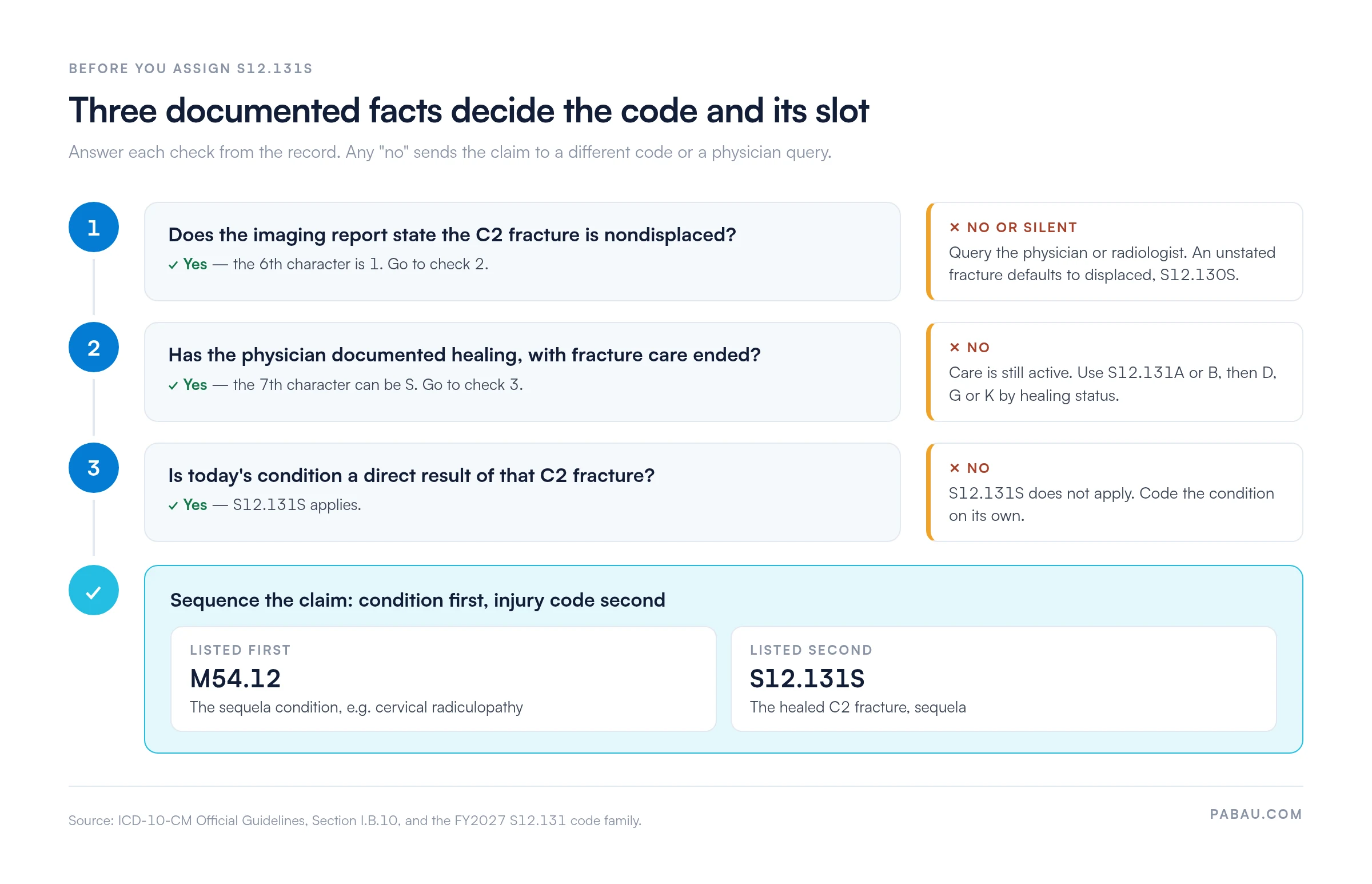
Section I.B.10 of the ICD-10-CM guidelines requires the sequela condition to be coded first. The injury code with 7th character S follows it. The exception is a condition code whose own instructional note directs a different order, such as G99.2 in the table below.
A correct claim lists M54.12 (Radiculopathy, cervical region) first, then S12.131S. Reversed sequencing is an auditable error that payers can deny, so confirm the condition code is primary before submitting.
Before assigning S12.131S, ask two questions: (1) Has the treating physician documented that the fracture is healed and active fracture management has ended? (2) Is the condition being treated today directly caused by that original C2 fracture? If both answers are yes, the S character is correct. If the physician is still directing care at the fracture itself, use D (subsequent encounter, routine healing) instead.
S12.131 has six valid 7th character completions, and each one maps to a different stage of care. The table lists the clinical trigger for each.
S12.130S (unspecified traumatic displaced spondylolisthesis of second cervical vertebra, sequela) is the displaced sibling of S12.131S. Both codes are equally specific, and in both “unspecified” refers to the fracture type. The choice comes down to what the imaging record says about displacement.
Code to what the record states. If the imaging report confirms the fracture is nondisplaced, use S12.131S. If the record is silent on displacement, query the physician or radiologist before the displaced default sends the claim to S12.130S.
ICD-10 Code S12.131S cannot stand alone on a claim. The ICD-10-CM guidelines require a separate code for the condition being treated, which is the nature of the sequela. That condition code is usually sequenced first. Common condition codes reported with S12.131S include the following.
The manifestation code must be supported by the clinical documentation for that visit. A patient with cervical radiculopathy from a healed C2 fracture needs the radicular symptoms, dermatomal distribution, and neurological findings documented. A reference to the prior fracture alone is not enough. Where neck pain is the only residual complaint, M54.2 goes first and S12.131S second.
Several adjacent conditions fall outside the scope of S12.131S. Assigning this code when one of the following applies is an auditable error.
A claim using ICD-10 Code S12.131S is supportable only when the medical record contains four specific documentation elements. Missing any one of them gives a payer grounds for denial or downcoding. Support your clean claim by confirming each element before submission.
Physical therapy practices managing sequela rehabilitation should also document functional limitations and the treatment plan rationale.
Medicare does not maintain a specific national coverage determination (NCD) that governs cervical fracture sequela encounters in isolation. Coverage for services billed with S12.131S depends on the procedure codes reported alongside it, not the diagnosis code alone.
Prior authorization triggers vary by payer and procedure. Common scenarios where prior authorization may be required when S12.131S appears on the claim:
Practices submitting sequela claims through a clearinghouse can run eligibility checks before the visit. A Claim.MD clearinghouse connection adds electronic submission and ERA posting. That shortens the lag between the sequela encounter and payment posting.
Effective denial management workflows start with knowing which errors trigger rejections. The five below follow from how ICD-10 Code S12.131S is built, each with its root cause and the check that prevents it.
Denial code analysis helps practices spot patterns across their claim volume. Review denial codes in medical billing at the remittance level, particularly CO-4, CO-11, and CO-197 on cervical injury claims. They show which of the five errors above is most common in your practice’s data.
Sequela claims for C2 injuries often pass through three systems. The note sits in the EHR, the code goes into a billing tool, and payer details get rekeyed into a portal. Each handoff is a chance for the 6th or 7th character to drift from what the record supports.
Pabau, the practice management and billing platform we build, keeps the record and the claim in one place. Custom charting forms can carry fields for displacement status, healing status and the sequela condition. When the invoice is ready, Pabau pulls the patient, treatment and insurer details into a pre-filled claim.
Validation then runs before the claim leaves. A missing membership number or authorization code blocks the send until someone fixes it.
In the US, Pabau connects to Claim.MD for electronic submission, eligibility checks, claim status and ERA posting. Code selection stays with your coders, so they can focus on the displacement and encounter characters.

Pabau’s claims management tools help practices document, submit, and track sequela encounters from first appointment to payment. See how it works for your practice.

Treat S12.131S as a code the record has to earn, never one picked from memory. Before it goes on a claim, confirm three facts. Imaging states the C2 fracture is nondisplaced, the physician has documented healing, and the treated condition has its own code listed first.
When one of the three is missing, query the physician before submission. A query costs a day, while a denied sequela claim costs a resubmission and an appeal cycle.
Pabau’s error-catching claims software runs eligibility checks and claim validation through Claim.MD before a claim reaches the payer. Book a demo to see how it fits your billing workflow for cervical sequela claims.

Need help submitting cervical injury claims electronically? Medical billing workflows explained walks through the full claim lifecycle from encounter to ERA.
Seeing unexplained denials on sequela codes? Electronic remittance advice (ERA) processing shows how to read denial reason codes at the 835 transaction level.
ICD-10 Code S12.131S is the diagnosis code for an unspecified traumatic nondisplaced spondylolisthesis of the second cervical vertebra (C2/axis), sequela. The original fracture has healed, and the encounter is for a residual condition it caused. Examples are cervical radiculopathy, chronic pain or a neurological deficit. It is valid and billable for FY2027 under Chapter 19 of ICD-10-CM.
S12.131A is used for the initial encounter when the patient first receives active treatment for the nondisplaced C2 fracture. S12.131D covers subsequent routine follow-up visits while the fracture is still healing. S12.131S is used only after healing is complete, for encounters treating a residual condition caused by the original fracture. Using S while active management continues leads to denials in this code family.
Yes, when the hangman fracture was nondisplaced. A hangman fracture breaks the pars interarticularis on both sides of C2, which clinicians describe as traumatic spondylolisthesis of the axis. S12.131S covers the nondisplaced form at the sequela stage. If C2 slipped forward on C3, the sequela code is S12.130S instead. A Type III injury has its own subcategory, S12.14.
No. ICD-10-CM Official Guidelines Section I.B.10 require a companion code for the sequela condition alongside S12.131S. That condition code sequences first. Common companion codes include M54.12 (cervical radiculopathy), M54.2 (cervicalgia), and R13.10 (dysphagia). A claim with S12.131S as the sole diagnosis will typically be denied for missing the required condition code.
The record needs a CT, MRI, or plain radiograph report that identifies the C2 fracture and states it is nondisplaced. A physician note referencing those findings should back it up. If the record never states displacement status, ICD-10-CM codes the fracture as displaced. Query the treating physician before choosing between S12.131S and S12.130S.
Switch from D to S when the physician’s documentation confirms the fracture has healed. Active fracture-directed management (surgery, reduction, a brace for the fracture) must have ended. The patient’s encounters must now focus on a residual condition caused by the original injury. Physician documentation drives the change, not the passage of time. The ICD-10-CM guidelines set no mandated timeline.