ICD-10 Code S42.444P: Medial epicondyle fracture, right humerus
ICD-10 Code S42.444P: full descriptor and code validity ICD-10 Code S42.444P car...

Last Updated: Oct 13, 2026
Billable Code Specific Code
S10.95XA is the billable ICD-10-CM code for superficial foreign body of unspecified part of neck, initial encounter.
Let Pabau's smart automation suggest the right codes, reduce claim denials, and keep your practice compliant—effortlessly.
Automate repetitive tasks and focus on what matters most—your patients.
Reduce coding errors and ensure compliance with the latest regulations.
Clean claims, fewer denials, and faster reimbursements.
Powerful insights and reporting to help your practice thrive.
HIPAA compliant SOC 2 certified GDPR-compliant Trusted by 4,000+ clinics worldwide

ICD-10 Code S10.95XA is a billable ICD-10-CM code for a superficial foreign body of unspecified part of neck, initial encounter.
The code is valid for fiscal year 2026 and took effect on October 1, 2025.
The 7th character ‘A’ marks an initial encounter, ‘D’ marks a subsequent encounter, and ‘S’ marks a sequela.
Documentation has to confirm the encounter type, the neck as the site, and the superficial depth of the foreign body.
Practice management software like Pabau validates S10.95XA before submission, so 7th-character errors surface while you can still fix them.
ICD-10 Code S10.95XA is a billable ICD-10-CM diagnosis code for a superficial foreign body of unspecified part of neck at an initial encounter. The 7th character “A” is what marks the encounter as initial. Submit S10.95XA on a follow-up visit and the payer rejects it, because the encounter no longer qualifies.
“Billable” means the code carries enough clinical specificity to stand alone as a diagnosis on a claim. Payers accept S10.95XA as the principal or secondary diagnosis without asking for a more granular code.
The 2026 edition of ICD-10-CM took effect on October 1, 2025, and S10.95XA remains valid throughout fiscal year 2026. The code sits in chapter S00-T88, injury, poisoning and certain other consequences of external causes. That placement is confirmed on the Centers for Medicare and Medicaid Services (CMS) ICD-10 codes page.
Every field in that table comes from the 2026 ICD-10-CM tabular list. The 7th character row is the one that decides whether the claim pays.
The neck-injury block that holds S10.95XA also carries an Excludes2 note. Excludes2 means the listed condition is not classified here, yet both codes can sit on the same claim when the record documents both.
The T17 and T18 entries are the ones that cause the most confusion. An object embedded in the skin of the neck is S10.95XA. An object swallowed or inhaled into the throat structures belongs in T17 or T18 instead.
T63.4 carries the venomous-sting rule. A venomous bite or sting never lands in category S10, whatever the site on the body. The Excludes2 list above comes from the FY2026 ICD-10-CM tabular list published by the CDC’s National Center for Health Statistics.
S10.95XA sits six levels down the ICD-10-CM tree, from chapter S00-T88 through category S10 to the billable seven-character code. Reading the chain top to bottom shows exactly where a more specific code would live if the documentation supported one.
The “X” in position six is a placeholder character. ICD-10-CM uses placeholder X whenever a code needs a 7th character but the preceding positions run short of six.
Dropping the placeholder or the 7th character makes the code invalid. Many payers auto-reject claims with the wrong character count, so verify the full seven-character string before submission.
The 7th character “A” on S10.95XA means the patient is receiving active treatment for the neck foreign body for the first time. The suffix is a required clinical data point. It tells the payer whether this visit is the first one, a follow-up, or a late effect of the original injury.
Applying the wrong character is the most frequent coding error on S10.95XA claims.
“Initial encounter” does not depend on whether the injury is new to the patient’s record. Active treatment is what defines it. A specialist seeing the patient for the first time after an ER splinter removal still codes an initial encounter while treatment stays active.
Approximate synonyms for S10.95XA are alternative terms that map to the same code, such as splinter of neck or embedded foreign body of neck. ICD-10-CM publishes these as “applicable to” terms.
They turn up in medical records and intake notes far more often than the code number does. A coder searching by clinical description should recognize them all as the same entry.
“Unspecified part of neck” is the qualifier that decides the code. A more precise code may exist elsewhere in the S10 category. That applies when the documentation names the anterior neck, the posterior neck, or a specific anatomical structure. Use S10.95XA when the site within the neck stays ambiguous in the note.
Documentation for S10.95XA has to confirm four elements. Those are an initial encounter, the neck as the site, a foreign body, and superficial depth.
A valid code with thin documentation still creates a clean-claim problem. Payers audit the record against the diagnosis, and a note that does not support the code can be denied on a records request.
Payer-specific rules go beyond these baseline points. Some Medicare Administrative Contractors (MACs) and commercial payers publish Local Coverage Determinations (LCDs) that add site-specific or condition-specific documentation requirements for trauma codes. Check the relevant payer policy before billing.
Document the foreign body type and depth in the clinical note, not just in the procedure description. Payers reviewing S10.95XA claims frequently request records to confirm a superficial, non-penetrating injury. One line stating ‘splinter confirmed superficial to subcutaneous tissue, no deeper penetration’ can stop a records request from becoming a denial.
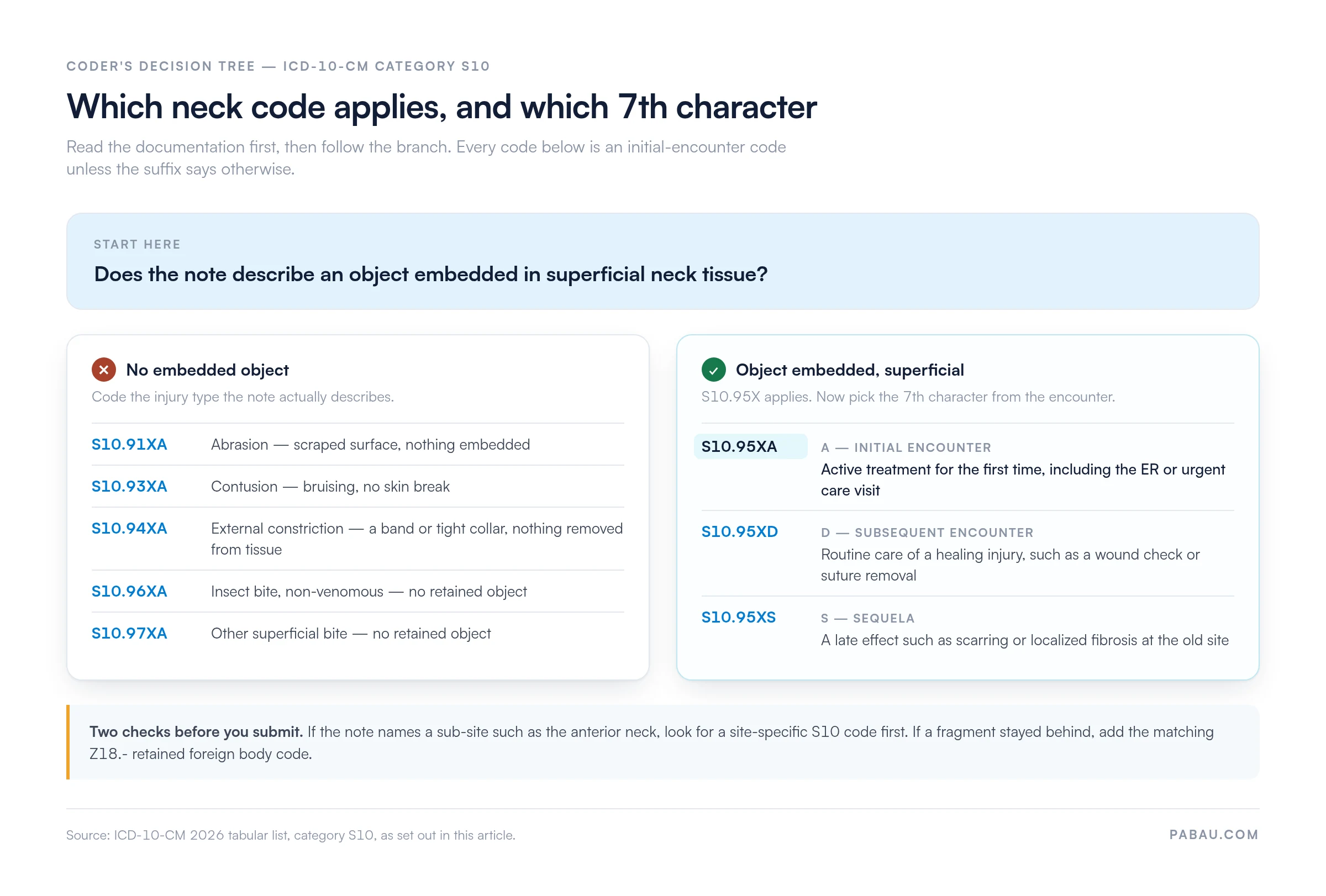
S10.95XA is the S10.9 code for an embedded object, and its sibling codes cover abrasion, blister, contusion, external constriction, and bites of the neck. Each sibling describes a different superficial injury to an unspecified part of the neck.
Picking between them comes down to what the documentation says about injury type and, where it is recorded, the exact neck sub-site.
S10.94XA is the row that trips coders up. A tight collar or a band that constricts the neck leaves marks and needs treatment. Nothing gets removed from the tissue, so the foreign body code does not apply.
If the note describes an object embedded in skin or subcutaneous tissue, S10.95XA is correct for an initial encounter. If it describes a bruise, scrape, bite, or constriction with no embedded object, one of the siblings applies instead.
The documented neck site decides which S10 subcategory you start in. All three subcategories below run on the same A, D and S suffixes.
Where the note names the neck site precisely, look through the wider S10 category for a site-specific code before falling back on the unspecified subcategory. Our ICD-10-CM code index lists the neighboring S10 entries alongside the rest of the chapter.
An ICD-10 code lookup tool such as AAPC Codify allows keyword searches. You can confirm in seconds whether a more specific code exists for the documented sub-site.
The approximate ICD-9-CM equivalent of S10.95XA is 910.6, a superficial foreign body of face, neck, and scalp without open wound. Practices holding legacy billing data or older EHR exports still run into that code.
The crosswalk is approximate rather than exact. ICD-9-CM 910.6 covered superficial foreign body presentations across the face, neck, and scalp together. S10.95XA is scoped to the neck alone and adds encounter-type granularity through the 7th character.
Do not treat the crosswalk as a straight substitution when converting older records. The original ICD-9-CM note may have referenced the face or the scalp rather than the neck. A code from the S00 block (superficial injury of head) then fits better than S10.95XA.
Cross-check the original clinical notes every time. Keeping crosswalk decisions on file cuts re-billing delays when a payer audits historical claims.
S10.95XA groups to MS-DRG 604 or 605, trauma to the skin, subcutaneous tissue and breast, inside MDC 09.
Grouping only comes into play on inpatient claims, where the principal diagnosis drives the payment group. On this code the 7th character also moves the case between two major diagnostic categories.
An initial encounter and a sequela both sit in MDC 09, diseases and disorders of the skin and subcutaneous tissue. A subsequent encounter moves to MDC 23 and pays as aftercare. One character changes the payment group.
S10.95XA is also absent from the CMS complication and comorbidity list, so it adds no CC or MCC weight as a secondary diagnosis. These assignments come from the CMS ICD-10 MS-DRG Definitions Manual, version 43.1.
Most S10.95XA encounters happen in an office, an urgent care, or an emergency department, so they never reach a DRG. The grouping matters when a neck injury is treated during an inpatient stay.
Use ICD-10 Code S10.95XA when the note confirms an embedded superficial object in the neck and this is the first active-treatment visit. The decision tree below resolves the branch first, then the 7th character, which is the order coders work in.
The five presentations below are the ones that generate the most hesitation. Each names the code to submit and the reason behind it.
In the billing setups we onboard, the second scenario is where this code slips most often. A coder duplicates last week’s claim for the follow-up visit, and the suffix never gets touched.
A free ICD-10 lookup in the CDC/NCHS ICD-10-CM web tool confirms current-year validity. The same tool browses the S10 tabular list when a presentation is unusual.
S10.95XA is a diagnosis code, so it pairs with a CPT or HCPCS procedure code on the claim to justify medical necessity. A foreign body removal procedure is the usual partner, and CPT 10120 covers incision and removal from subcutaneous tissue.
Billing that procedure without a diagnosis code that supports it triggers a medical necessity denial, whatever the clinical note says.
The claim also has to carry the encounter type that matches the visit. That makes the 7th character a billing decision as much as a clinical one.
When a claim comes back denied on the 7th character, correct the diagnosis line and leave the procedure code alone. The encounter type changed, and the procedure performed did not.
Check your EHR’s code validation settings before submitting any S10 injury claim. Many systems let you configure a 7th-character rule that flags incomplete codes before they reach the clearinghouse. Setting that up once prevents a whole category of avoidable denials, not only the ones on S10.95XA.
A wrong 7th character usually surfaces the slow way. The claim goes out, and the remittance advice comes back weeks later with a rejection. Someone then reworks a claim that was one character away from paying first time.
The correction itself is cheap. The delay and the staff hours spent reopening a closed job are what cost the practice.
Pabau is an all-in-one practice management system with a Claim.MD clearinghouse integration. That integration validates ICD-10-CM codes against the current CMS tabular list before the claim reaches the payer. Invalid formats get caught at that point, including a missing 7th character or a misplaced placeholder.
Pabau’s claims management software also handles 837P electronic submission and real-time eligibility checks. You can confirm coverage before the appointment instead of after the denial.
The outcome a practice feels is a shorter month-end. Fewer claims come back for rework, the billing team stops chasing corrections, and payment lands closer to the date of service.

Pabau integrates with Claim.MD to validate diagnosis codes like S10.95XA before claims reach the payer. See how clean-claim workflows cut rework and speed up reimbursement for your practice.

S10.95XA is an easy code to get right and an easy one to get wrong on the second visit. Coders who treat the 7th character as part of the diagnosis, rather than a suffix bolted on at the end, rarely see this code denied.
The trade-off worth remembering sits in the word “unspecified”. S10.95XA is the right call when the note leaves the neck sub-site ambiguous. The same code becomes the lazy call when a more specific one was available and nobody looked. Fixing that starts in the clinical note, not in the billing queue.
Make that check automatic instead of manual. Book a demo to see how Pabau validates injury codes before your claims leave the practice.

Need to understand denial patterns on injury codes? Denial management in healthcare covers the most common rejection triggers and how to build a response workflow.
Building a cleaner claims submission process? Submitting a clean claim outlines the documentation and code accuracy checks payers expect before reimbursement.
Want to connect ICD-10 diagnosis codes to your US clearinghouse? Claim.MD clearinghouse overview explains how Pabau’s integration routes and validates claims across 4,000+ US payers.
Need documentation that holds up in an audit? Medical billing compliance sets out the record-keeping standards payers and auditors check against.
Wondering where the diagnosis code lands on the patient’s paperwork? What a superbill includes walks through each field, from diagnosis codes to provider details.
S10.95XA is a billable ICD-10-CM diagnosis code meaning “superficial foreign body of unspecified part of neck, initial encounter.” The code applies when a patient presents for the first time for active treatment of an embedded superficial object in the neck. Examples include a splinter, a thorn, or a fragment. The neck sub-site is not identified in the documentation.
Yes. S10.95XA is a billable, specific ICD-10-CM code valid for the 2026 fiscal year, effective October 1, 2025. The code carries enough clinical specificity to stand alone as a diagnosis on a claim form. Payers accept it as either a principal or a secondary diagnosis.
Use ‘A’ (S10.95XA) when the patient is receiving active treatment for the injury for the first time. Use ‘D’ (S10.95XD) for routine follow-up care of a healing injury, such as a wound check or a post-removal review. Use ‘S’ (S10.95XS) when the patient presents with a residual condition, such as scarring or localized fibrosis from the original injury.
The approximate ICD-9-CM crosswalk for S10.95XA is code 910.6, a superficial foreign body of face, neck, and scalp without open wound. The crosswalk is approximate rather than exact. ICD-9-CM 910.6 covered a broader anatomical range and had no encounter-type designation, so verify against the original clinical documentation.
Yes. S10.95XA is valid for both fiscal year 2025 and fiscal year 2026. The 2026 ICD-10-CM edition took effect on October 1, 2025, and S10.95XA appears unchanged in both editions. Verify currency with the CDC/NCHS ICD-10-CM web tool when coding claims in either year.
Documentation must confirm four elements. Those are an initial encounter for active treatment, the neck as the anatomical site, a superficial foreign body, and the type of object involved. Payer-specific Local Coverage Determinations may add further requirements, so check the relevant MAC or payer policy before billing.
Yes, when part of the object stays in the tissue. The S00-T88 chapter carries a “use additional code” instruction for retained foreign bodies, so add the matching Z18.- code alongside S10.95XA. A fully removed splinter with nothing left behind needs S10.95XA on its own.
The S10-S19 block carries an Excludes2 note, so the listed conditions can be reported with S10.95XA when the record documents both. Those conditions are burns and corrosions (T20-T32), frostbite (T33-T34), and a venomous insect bite or sting (T63.4). The list also covers effects of a foreign body in the esophagus, larynx, pharynx or trachea (T17-T18). Add a Z18.- code when a fragment stays in the tissue.
S10.95XA groups to MS-DRG 604 or 605, trauma to the skin, subcutaneous tissue and breast, inside MDC 09. The subsequent-encounter code S10.95XD moves to MDC 23 and groups to MS-DRG 949 or 950, aftercare. Grouping applies to inpatient claims only, per the CMS ICD-10 MS-DRG Definitions Manual version 43.1.