ICD-10 Code S62.664D: Nondisplaced ring finger fracture
ICD-10 Code S62.664D: quick reference ICD-10 Code S62.664D reports a follow-up v...

Last Updated: Oct 21, 2026
Billable Code Specific Code
S06.6X7A is the billable ICD-10-CM code for traumatic subarachnoid hemorrhage with loss of consciousness of any duration. It applies at the initial encounter, where the patient dies from the brain injury before regaining consciousness.
The 6th character does the work here. "7" does not name a duration bracket the way S06.6X1A through S06.6X6A do. It marks the one outcome where duration stops mattering, because the patient never regains consciousness. Defaulting to S06.6X9A when the record supports "7" under-specifies the claim and invites downcoding or a payer query.
Let Pabau's smart automation suggest the right codes, reduce claim denials, and keep your practice compliant—effortlessly.
Automate repetitive tasks and focus on what matters most—your patients.
Reduce coding errors and ensure compliance with the latest regulations.
Clean claims, fewer denials, and faster reimbursements.
Powerful insights and reporting to help your practice thrive.
HIPAA compliant SOC 2 certified GDPR-compliant Trusted by 4,000+ clinics worldwide

S06.6X7A is a valid, billable ICD-10-CM code within the S06 intracranial injury category.
The 6th character “7” covers loss of consciousness of any duration with death from the brain injury before consciousness returns.
Characters 1 through 6 name a duration bracket instead, so “7” is chosen on outcome rather than on elapsed time.
The 7th character “A” marks the initial encounter, which runs for as long as active treatment continues.
Choosing S06.6X9A when the record supports S06.6X7A under-specifies the claim and invites downcoding or a payer query.
ICD-10 Code S06.6X7A is the billable ICD-10-CM code for traumatic subarachnoid hemorrhage (SAH) with loss of consciousness of any duration. It applies at the initial encounter when the patient dies from the brain injury before regaining consciousness.
The code sits in Chapter 19 of ICD-10-CM (S00-T88, Injury, poisoning and certain other consequences of external causes). Within that chapter it falls under category S06 (Intracranial injury), code group S06.6 (Traumatic subarachnoid hemorrhage).
The table below shows the key reference facts coders and billers need before touching this code on a claim.
Verify the code against the CDC/NCHS official ICD-10-CM web tool for the current fiscal year before submitting. Descriptors and hierarchy can change with each annual ICD-10-CM release.
S06.6X7A is completed by two characters, not one. The 6th character (0 through 9) gives the loss-of-consciousness scenario. The 7th character (A, D, or S) gives the episode of care. Each one carries its own clinical and billing meaning.
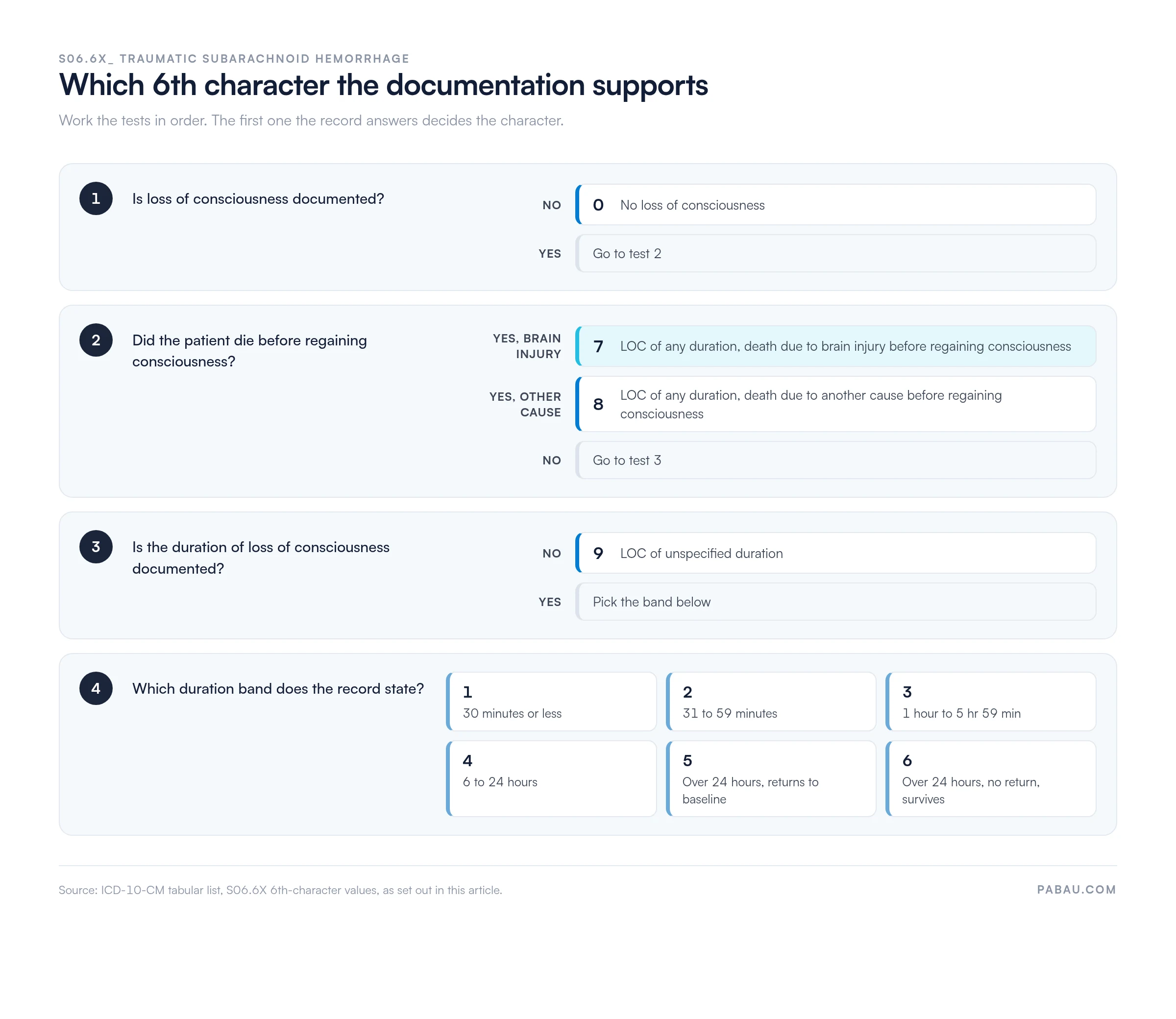
Character “7” means loss of consciousness of any duration with death due to brain injury prior to regaining consciousness. Duration is left unspecified because the outcome overrides it. The patient sustained traumatic SAH, lost consciousness, and died from the brain injury without regaining it.
The clinical record must document that sequence explicitly. Character “7” cannot be assigned from an anticipated outcome or a clinical impression. It needs documented confirmation that the patient died without regaining consciousness.
Character “A” designates the initial encounter, meaning the patient is receiving active treatment for the injury. Per the ICD-10-CM Official Guidelines, that encounter covers the whole period of active care. It holds across multiple providers and settings, for as long as active treatment continues.
Most TBI claims carrying this code are therefore initial-encounter claims. Subsequent encounter (D) and sequela (S) apply only once active treatment concludes.
S06.6X7A applies when a patient sustains traumatic subarachnoid hemorrhage and loses consciousness as a result. The patient then dies from that injury before ever regaining consciousness, during the initial active-treatment encounter. The clinical criteria are exact, and all of them must be documented.
A typical scenario: a 58-year-old patient presents after a high-speed motor vehicle collision. CT head confirms subarachnoid blood. The patient is unresponsive from the time of injury and never regains consciousness. The attending physician documents “traumatic subarachnoid hemorrhage, patient remained unconscious from time of injury until death from brain herniation.” S06.6X7A is the appropriate code for the initial inpatient claim.
Choosing the right code within the S06.6X family depends entirely on what the clinical record documents about LOC duration and outcome. The table below shows the full S06.6X_A series (initial encounter only) so coders can identify the correct alternative when S06.6X7A does not apply.
S06.6X9A is for cases where the LOC duration is genuinely undocumented. Where the record shows the patient died without regaining consciousness, S06.6X7A is the correct and more specific code. Defaulting to S06.6X9A is a common source of downcoding and prior-authorization mismatches.
When the record supports a different 6th character, the sibling code pages set out the same documentation tests. A claim with no documented LOC takes S06.6X0A, and a follow-up claim for brief LOC takes S06.6X1D. Review the AAPC Codify ICD-10-CM lookup alongside the official tabular to confirm the hierarchy for the current year.
The chart below runs the same choice as a sequence of documentation tests, from no recorded LOC through to the six duration bands.
Before coding ICD-10 Code S06.6X7A, review the applicable instructional notes at the category and code-group levels. These notes govern what can and cannot be reported on the same claim.
The Excludes1 note at category S06 names head injury NOS (S09.90). A specific intracranial injury code and the NOS code are never reported together on the same claim.
Nontraumatic subarachnoid hemorrhage (I60.-) is a different etiology rather than a formal Excludes1 entry at S06. SAH caused by aneurysm, arteriovenous malformation, or spontaneous rupture is coded from the I60 series. The documented cause decides which series applies, and the two are not interchangeable.
Auditors and payers review the clinical record against the code’s descriptor element by element. Four documentation requirements must be met to support S06.6X7A on a claim.
Flag S06.6X7A claims for documentation review before submission. A pre-bill checklist needs four items. The imaging report names the SAH as traumatic. The history documents the mechanism of injury. The note states loss of consciousness explicitly. The death summary confirms death from the brain injury without regaining consciousness. Catching a missing attestation before submission costs minutes, while a denial and an appeal cost hours.
S06.6X7A appears predominantly on inpatient claims given its clinical severity. The CPT codes most commonly paired with this diagnosis cover imaging, critical care, and neurosurgical intervention. Confirm the current descriptor for each one in the CPT codes reference before it goes on the claim.
S06.6X7A groups to MS-DRG 082-084 (traumatic stupor and coma, coma more than one hour), a family tiered by MCC and CC status. Verify the tier in the current grouper rather than assuming it. DRG definitions and weights update annually, and the CMS ICD-10 codes page publishes each release.
Payers audit the clinical designation behind the 6th character “7”, which is death before regaining consciousness. The patterns below are the ones that show up on this code, and each one has a documentation fix.
The denial management guide covers root-cause analysis and appeal workflows. Both apply directly to the patterns above.
ICD-10-CM Section I.C.19 (Injury, poisoning and certain other consequences of external causes) carries the chapter-specific rules that govern S06.6X7A and the whole S06 category. Coders working TBI cases should know these sections before assigning any S06 code.
When the traumatic SAH is the condition that occasioned the admission, it is the principal diagnosis. Section I.C.19 affirms that the most severe injury should be sequenced first when multiple injuries are present, with the others reported as additional diagnoses. For a patient with traumatic SAH and a concurrent rib fracture, the S06.6X7A is the principal code when the SAH drove the admission.
The ICD-10-CM Official Guidelines require a 7th character on every code that calls for one. S06.6X7, without the episode-of-care character, is not a complete code and is not billable. Every claim carries the full seven-character code, so S06.6X7A, S06.6X7D, or S06.6X7S. “A” is the one that fits an active-treatment initial encounter.
Guideline Section I.C.18.e states that the R40.2- codes may be reported as additional codes alongside a traumatic brain injury code. For S06.6X7A patients the GCS at first presentation is typically very low. A GCS of 3 means no eye opening, no verbal response, and no motor response.
Reporting it adds clinical specificity that supports medical necessity, and it may affect DRG assignment.
Clean claim construction for complex diagnoses is covered in the clean claim guide. The wider workflow around coding, submission, and remittance sits in this guide to medical billing.
S06.6X7A does not exist in isolation. Coders frequently need to distinguish it from codes in adjacent injury categories, and to understand when a concurrent or secondary code is appropriate alongside it.
The S06.3 contusion and laceration codes often co-occur with traumatic SAH. Each injury is coded separately when the record documents both, and the S06.3 subcategories carry their own 6th and 7th characters.
S06.6X7A is almost exclusively an inpatient diagnosis code. It groups to MS-DRG 082-084 (traumatic stupor and coma, coma more than one hour), a family tiered by MCC and CC status. The tier is not guaranteed, so confirm it in the current grouper.
For Medicare claims the code contributes to DRG assignment under the MS-DRG grouper, and weights are updated every year. On the practice side, Pabau’s claims management software runs the eligibility check against the record that carries the diagnosis code. Coverage is confirmed before the claim goes out.
Commercial payers generally follow Medicare DRG logic for similar claim types, though payer-specific policies vary. Where the diagnosis is established before admission, check coverage and prior authorization through the payer’s provider portal. Those portals typically ask for the ICD-10-CM code, the expected procedures, and a clinical summary.
A coding problem on a claim like this usually surfaces after the remittance arrives. The claim went out carrying S06.6X9A, and the payer paid the less specific code. Someone reopens the chart weeks later and finds the attending’s attestation sitting in it.
Pabau, the practice management platform we build, keeps the diagnosis code, the clinical note, and the invoice on one patient record. The code is assigned where the documentation lives, so a biller checking the death attestation never has to leave the chart.
Claims go out electronically through the Claim.MD integration as a CMS-1500, with real-time eligibility checks run beforehand. ERA remittances come back matched to the claim they settle, and denied claims are flagged for rework.
Fewer claims leave the practice under-specified, and the route from a denial back to the note that answers it gets a good deal shorter.

Pabau connects to Claim.MD for electronic claim submission, real-time eligibility checks, and ERA matching. Diagnosis codes, notes, and invoices stay on one patient record, so claims leave with the documentation behind them.

ICD-10 Code S06.6X7A rewards a documentation review before submission rather than after it. The 6th character “7” is not a fallback. It needs documented clinical evidence that the patient died from the brain injury without ever regaining consciousness. Where the record carries that evidence, S06.6X7A is the most accurate code in the S06.6 family.
Build a four-point pre-bill checklist covering imaging confirmation, trauma mechanism, an explicit LOC statement, and the death attestation. Apply it before every submission, and the arguments with payers largely stop being about the code. Book a demo to see how Pabau keeps diagnosis codes, notes, and claim submission on one record.

Need a framework for managing claim denials? Denial management in healthcare covers root-cause analysis, appeal workflows, and CARC denial reason tracking for complex inpatient claims.
Want to understand the clearinghouse submission process for ICD-10 claims? The Claim.MD clearinghouse guide explains how electronic claims travel from the practice to the payer, and where submission errors typically occur.
Looking for guidance on constructing clean inpatient claims? The 837 file guide breaks down the electronic claim format used for Medicare and commercial payer submission.
ICD-10 Code S06.6X7A is the billable ICD-10-CM diagnosis code for traumatic subarachnoid hemorrhage with loss of consciousness of any duration. It applies at the initial encounter where the patient dies from the brain injury before regaining consciousness. The 6th character “7” carries that fatal outcome, and the 7th character “A” marks the active-treatment encounter.
Yes, S06.6X7A is a valid, billable ICD-10-CM code that can be submitted on a claim. It is fully specified within the S06.6 group, traumatic subarachnoid hemorrhage. The CDC/NCHS tabular list and commercial lookups such as AAPC Codify both confirm it as billable.
S06.6X7A specifies that the patient died from the brain injury before regaining consciousness. S06.6X9A applies where the LOC duration is genuinely unspecified and no such outcome is documented. Where the record confirms death before consciousness returned, S06.6X7A is the correct choice. Using S06.6X9A instead under-specifies the claim and invites downcoding or a payer query.
“A” (initial encounter) is used throughout the period of active treatment, regardless of whether the patient sees multiple providers or receives care across multiple settings. For inpatient TBI claims, “A” applies for the entire admission during active treatment. Subsequent encounter (D) is used only after active treatment concludes, and sequela (S) is reserved for late effects of the injury.
Four elements must be documented. Imaging confirms traumatic subarachnoid blood, the clinical history states the mechanism of trauma, and a physician documents loss of consciousness. A death summary or attending note then confirms the patient died from the brain injury without regaining consciousness. Where that fourth element is missing, the code cannot be defended on audit.
Denials and coder queries on this code usually come from a handful of patterns. The record may be missing the death-before-regaining-consciousness documentation, or it may carry S06.6X9A where S06.6X7A is clinically supported. Others include no external cause code for the mechanism, or the code sequenced as secondary when it drove the admission. SAH is also sometimes coded as traumatic where the record suggests a spontaneous etiology.