ICD-10 Code S42.444P: Medial epicondyle fracture, right humerus
ICD-10 Code S42.444P: full descriptor and code validity ICD-10 Code S42.444P car...

Last Updated: Oct 13, 2026
Billable Code Specific Code
S00.85XD is the billable ICD-10-CM code for superficial foreign body of other part of head, subsequent encounter.
It applies when a splinter, glass shard, or metal fragment sits in the skin of the head, and the patient returns after initial treatment. The code took effect on October 1, 2025 under the 2026 edition of ICD-10-CM.
The 7th character does the work here. Per the Centers for Medicare and Medicaid Services (CMS), traumatic injury codes in Chapter 19 need one before a claim is valid. Send S00.85XA on a follow-up visit and the claim reads as a first presentation, which payers flag.
Let Pabau's smart automation suggest the right codes, reduce claim denials, and keep your practice compliant—effortlessly.
Automate repetitive tasks and focus on what matters most—your patients.
Reduce coding errors and ensure compliance with the latest regulations.
Clean claims, fewer denials, and faster reimbursements.
Powerful insights and reporting to help your practice thrive.
HIPAA compliant SOC 2 certified GDPR-compliant Trusted by 4,000+ clinics worldwide

S00.85XD is a billable ICD-10-CM code for a superficial foreign body of other part of head, subsequent encounter.
The code is valid for fiscal year 2026 and took effect on October 1, 2025.
The 7th character D marks a subsequent encounter, so it covers every visit after the initial active treatment.
Parent code S00.85 is not billable on its own, and HIPAA-covered claims need the full seven-character code.
Practice management software like Pabau submits claims electronically through Claim.MD, with real-time eligibility checks and remittance tracking.
ICD-10 code S00.85XD describes a superficial foreign body of other part of head, subsequent encounter. It is a billable, specific ICD-10-CM code valid for HIPAA-covered claim submission in fiscal year 2026. The code became effective on October 1, 2025, as confirmed by the CDC/NCHS ICD-10-CM web tool.
A superficial foreign body injury is a small object lodged in the skin or subcutaneous tissue. Splinters, glass shards, and metal fragments all qualify, as long as the object has not reached muscle, bone, or organ.
“Other part of head” covers the head regions that have no subcategory of their own in ICD-10-CM. Cheek, chin, forehead, temple, and occiput all sit here, inside the same S00.8 subcategory as S00.85XD. The scalp is coded separately under S00.05X, and the lip and oral cavity under S00.55X.
The table below summarizes the key reference data for S00.85XD that coders need at the point of claim submission.
The 7th character is the most consequential element of S00.85XD. Per CMS Official Guidelines Section I.C.19, traumatic injury codes in Chapter 19 carry a 7th character that identifies the phase of care. There are three options for the S00.85 code family.
A common misconception is that “subsequent encounter” means the patient has seen a different provider. It does not. The 7th character D applies whenever the patient returns for routine care of the same injury. Any provider can deliver that care, as long as the initial active treatment has happened.
Say a patient had a splinter removed from the back of the head on Monday and returns Thursday for a wound check. Thursday’s visit is coded S00.85XD, whichever clinician sees them.
The sequela character S is reserved for conditions that arise as late effects after the original injury has fully resolved. That is distinct from ongoing healing. Coding S while the wound is still in the recovery phase is incorrect and may trigger a payer audit.
S00.85XD covers any small object that has penetrated the superficial layers of the head. The region has to be one without a subcategory of its own. Common presentations include:
The injury counts as superficial because it does not extend into fascia, muscle, or bone.
Several synonym descriptions map to this code in clinical documentation and EMR systems. Coders may meet any of the following phrases in clinical notes, all of which point to S00.85XD when the encounter is subsequent:
When reviewing a note, look for three elements: the object type, the site on the head, and confirmation that this is a follow-up visit. All three support accurate assignment of S00.85XD.
S00.85XD sits within a well-defined hierarchy in ICD-10-CM Chapter 19. Knowing where the code lives helps coders navigate crosswalks, query related codes, and identify the correct parent when a more specific child code is needed.
The parent code S00.85 is not billable on its own. It needs a 7th character to become a valid claim code, which makes S00.85XA, S00.85XD, and S00.85XS the only submittable options. These are the neighboring S00 codes coders reach for most often alongside S00.85XD:
Three questions separate S00.85XD from each of those neighbors, and a note that answers all three settles the code on its own.
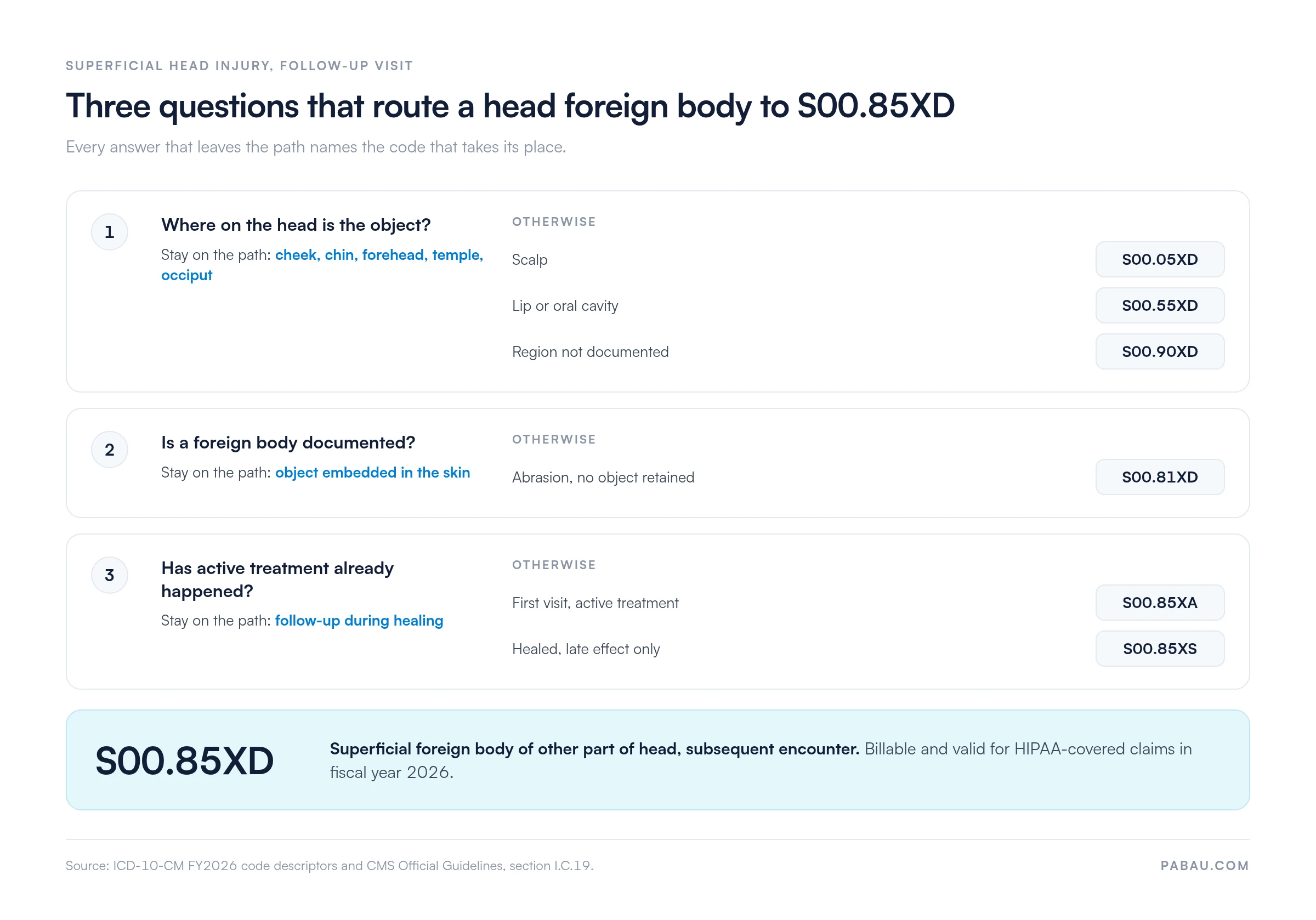
If you code head injuries regularly, it helps to keep the wider ICD-10-CM code library open alongside the chart. The AAPC groups the same codes under the head injury block in its ICD-10-CM code lookup by range. It is a fast way to scan the neighbors.
S00.85XD is valid for HIPAA-covered claim submission and accepted by Medicare, Medicaid, and most commercial payers for subsequent-encounter visits. Payer-specific coverage policies still vary, and prior authorization requirements differ by insurer. Verify payer acceptance before submitting claims for higher-complexity associated procedures.
The most common denial trigger on S00.85 claims is submitting S00.85XA on a follow-up visit where the chart documents a prior treatment date. Payers flag that as an encounter-type mismatch. Catching it is a chart-review step, not something a clearinghouse edit does for you.
Denials on this code usually trace back to one of two causes. Either the 7th character is wrong, or the note does not support the subsequent-encounter designation. Both are preventable at the point of documentation, well before the claim is built.
S00.85XD is a diagnosis code. When you bill for a removal at a subsequent visit, pair it with the right CPT procedure code. That usually means a retained fragment needing a second extraction attempt. These are the codes used most often alongside S00.85XD:
Check payer-specific medical necessity requirements before billing a removal CPT code at a subsequent visit. Some payers want documentation that the foreign body was not fully removed at the initial encounter. A simple removal at follow-up is usually billed as 10120, so the note has to say why the fragment was still in place.
Check the original encounter date in the chart before assigning S00.85XD. If the chart lacks a documented initial treatment date or initial encounter code, the subsequent-encounter designation cannot be supported and a payer audit may result. Request the referring or treating provider’s prior visit notes before billing.
The S00 category carries coding notes that restrict which conditions may be coded here. These exclusions matter for claim integrity and are worth reviewing before you finalize S00.85XD on a claim.
Do not assign S00.85XD when the object sits in the scalp (S00.05XD) or in the lip or oral cavity (S00.55XD). Sites with their own subcategory, such as the eyelid, ear, or nose, are excluded too. The code also stops applying once the object has reached deeper than superficial tissue. These conditions are specifically excluded from the S00 block:
A documentation ambiguity shows up when a patient presents with both a superficial foreign body and an abrasion at the same site. Code only the foreign body, because the abrasion is integral to the injury. Do not add S00.81XD alongside it.
Most S00.85XD denials trace back to incomplete documentation rather than the wrong code. The following elements have to appear in the clinical note to support this code at a subsequent visit.
Structured note templates cut encounter-type errors. The template prompts the provider to record the prior treatment date and the current wound status at every visit. Consistent templates also shorten the documentation review a coder has to do before billing.
Getting the 7th character right is the coder’s job. What happens next usually is not. In many practices the claim leaves through a separate portal and the remittance arrives somewhere else. Someone then rekeys the result back into the patient record days later.
Practice management software like Pabau keeps that chain in one place. The platform submits electronically through the Claim.MD integration, checks patient eligibility in real time, and tracks each claim’s status after it leaves. Electronic remittance advice comes back into the same record, and standard field validation catches an incomplete claim before it goes out.
The practical benefit is a shorter loop, and that is most of what cleaner claims management buys a billing team. When a S00.85XD claim is rejected for an encounter-type mismatch, you see it against the patient record that produced it. You can correct the note and resubmit in the same sitting.

Pabau submits claims electronically through Claim.MD, checks eligibility in real time, and brings remittance advice back into the patient record. Less rekeying, faster follow-up on rejections.

S00.85XD is a straightforward code with one hard edge. The 7th character has to match the phase of care, and the note has to prove it. Read the chart for the initial treatment date before you assign it. If that date is missing, the designation is not supportable, whatever the visit looks like clinically.
The trade-off worth remembering is where the work sits. A minute spent confirming the prior encounter and naming the head region is cheap. A rejected claim, the rework, and a second wait for payment are not.
Want the claim, the note, and the remittance in one record instead of three systems? Book a demo and we’ll walk your billing team through it.

Need to understand how clearinghouse submissions work? Medical claims clearinghouse guide explains how electronic claims are routed, validated, and tracked from practice to payer.
Want to reduce claim denial rates across your practice? Denial codes in medical billing covers the most common CARC codes and how to respond to each one.
Building a compliant ICD-10 documentation workflow? Superbill guide for practices walks through how a correctly structured superbill supports accurate ICD-10 and CPT code pairing at every visit.
S00.85XD is an ICD-10-CM diagnosis code for a superficial foreign body of other part of head, subsequent encounter. It classifies a small embedded object lodged in the superficial tissue of the head, such as a splinter, glass shard, or metal fragment. The visit is a follow-up, after the initial treatment has been provided.
Yes. S00.85XD is a billable, specific ICD-10-CM code valid for HIPAA-covered claim submissions in fiscal year 2026. The parent code S00.85 is not billable on its own and requires a 7th character to produce a valid submission code.
S00.85XA designates the initial encounter, used when the patient first presents for active treatment of the foreign body. S00.85XD designates the subsequent encounter, used for all follow-up visits during the healing phase. Using S00.85XA on a documented follow-up visit is an encounter-type mismatch and a common denial trigger.
Use the 7th character D for every visit that occurs after the initial active treatment, while the patient is still recovering from the injury. This includes wound checks, dressing changes, suture removal, and infection monitoring. Use D until the injury is fully resolved. After that, switch to S (sequela) if late effects require treatment.
Closely related codes include S00.85XA (initial encounter) and S00.85XS (sequela). S00.05XD covers a superficial foreign body of scalp, and S00.55XD covers the lip and oral cavity. S00.81XD is an abrasion of other part of head. When the head region is not documented, use S00.90XD.
Yes. S00.85XD is valid for fiscal year 2026, effective October 1, 2025. This is confirmed by the official CDC/NCHS ICD-10-CM web tool and the CMS annual code update tables. No changes were made to this code in the FY2026 edition.
The parent code is S00.85, which represents “Superficial foreign body of other part of head” without specifying the encounter type. S00.85 is not billable on its own. A 7th character (A, D, or S) must be added to produce a valid, submittable diagnosis code.