ICD-10 code Y83.0: Surgical operation with whole organ transplant
ICD-10 code Y83.0 names the transplant as the cause, not the problem ICD-10 code...

Last Updated: Nov 19, 2026
Billable Code Specific Code
R53.1 is the billable ICD-10-CM code for weakness. It covers generalized weakness and asthenia NOS when the provider has not yet found a cause. Once a cause is confirmed, the definitive diagnosis replaces it.
The code sits in category R53 (Malaise and fatigue), in Chapter 18 of ICD-10-CM. Muscle weakness (M62.81), age-related weakness (R54) and sarcopenia (M62.84) are Excludes1 codes, so none of them is ever coded with R53.1.
Let Pabau's smart automation suggest the right codes, reduce claim denials, and keep your practice compliant—effortlessly.
Automate repetitive tasks and focus on what matters most—your patients.
Reduce coding errors and ensure compliance with the latest regulations.
Clean claims, fewer denials, and faster reimbursements.
Powerful insights and reporting to help your practice thrive.
HIPAA compliant SOC 2 certified GDPR-compliant Trusted by 4,000+ clinics worldwide

R53.1 is the billable ICD-10-CM code for weakness, and its only inclusion term is asthenia NOS. It is valid in the FY2027 code set.
Debility is not coded here. Debility NOS goes to R53.81, and age-related debility goes to R54.
Use R53.1 only while no cause explains the weakness, and replace it once a diagnosis is confirmed.
R53.1 never shares a claim with M62.81, M62.84, or R54, because all three are Excludes1 codes.
Pabau keeps the diagnosis code on the encounter in the patient record and sends US claims through the Claim.MD clearinghouse.
ICD-10 Code R53.1 is the billable ICD-10-CM diagnosis code for weakness, and its only inclusion term is asthenia NOS. It is listed as a valid, billable code in CMS’s FY2027 ICD-10-CM code files, which apply to encounters from October 1, 2026. The code falls under category R53 (Malaise and fatigue), in Chapter 18 of ICD-10-CM.
R53.1 is a symptom code, not a definitive diagnosis. Use it when generalized weakness is the presenting or documented finding and no underlying cause has been identified yet. If the provider documents tiredness rather than weakness, the neighboring code is R53.83.
R53.1 covers generalized weakness that is widespread and not tied to a specific muscle group, nerve distribution, or organ system. Two documented terms route here: weakness, the descriptor itself, and asthenia NOS, the code’s one inclusion term.
Debility does not. Debility NOS and chronic debility route to R53.81 (Other malaise), and age-related or senile debility routes to R54.
Clinical presentations appropriate for R53.1 include:
Because R53.1 sits in Chapter 18, it represents a finding, not a diagnosis. Under the CMS ICD-10 coding guidelines, a symptom code is not added when a confirmed diagnosis already explains the symptom. Once a cause is established, the definitive diagnosis replaces R53.1.
R53.1 carries three Excludes1 notes and no code-specific Excludes2 notes. Excludes1 means the excluded code is never reported together with R53.1, because the two describe conditions that can’t be coded at the same time.
Knowing these three codes prevents the most common R53.1 coding errors. Weakness the provider attributes to aging belongs at R54, which also holds senile asthenia.
The M62.81 exclusion trips up coders most often. When the provider documents muscle weakness, usually during a neuromuscular workup, M62.81 applies instead of R53.1. R53.1 fits when the weakness is described as generalized, constitutional, or systemic, with no musculoskeletal attribution.
Several codes sit close to R53.1 in both the tabular list and clinical use. The provider’s exact wording decides between them, as the chart below shows.
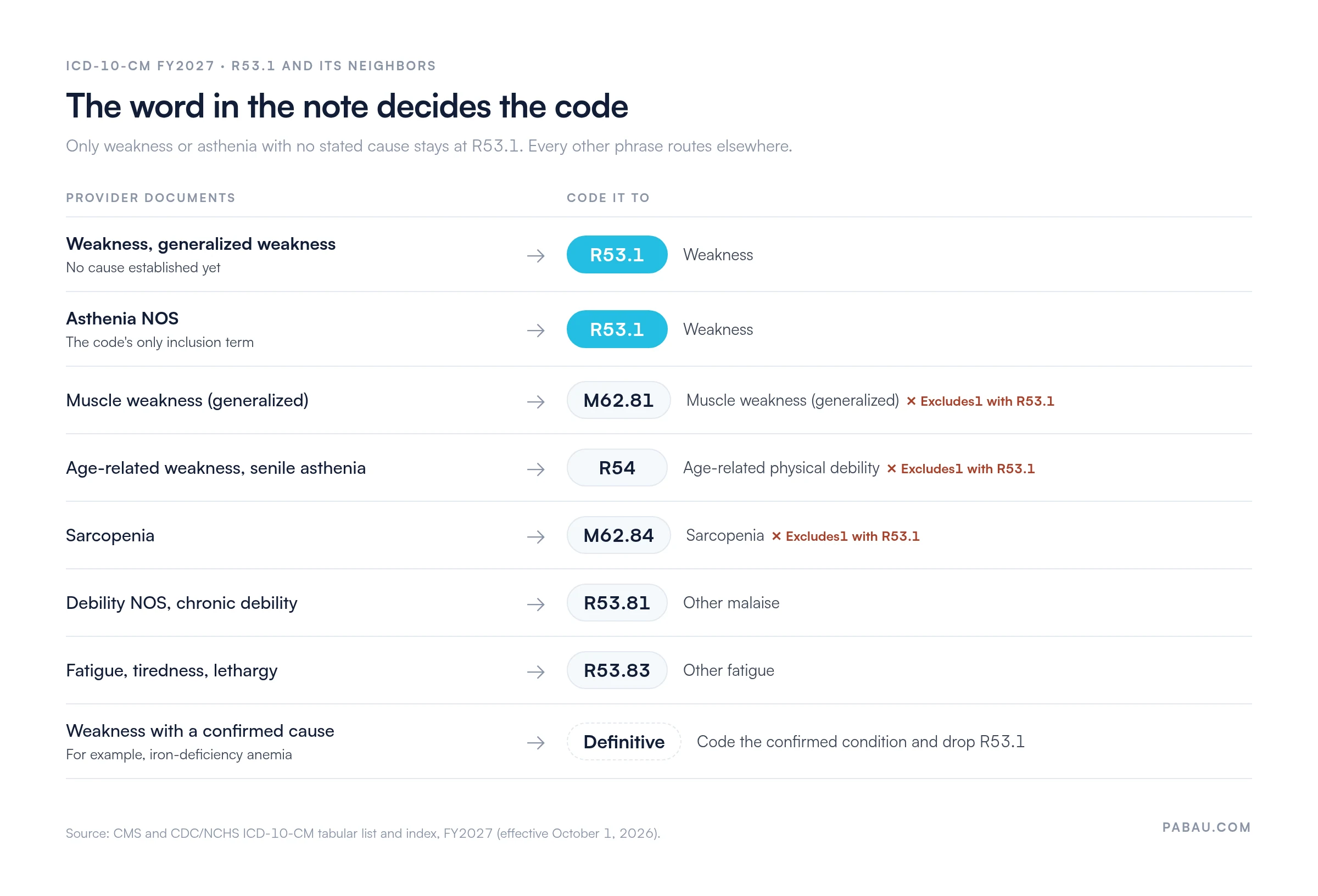
The table below adds the clinical differentiator for each neighbor. For codes outside this family, the diagnostic codes guide indexes the wider code library.
Check the provider’s exact words before assigning R53.1. ‘Fatigue’ routes to R53.83, and ‘muscle weakness’ routes to M62.81. ‘Debility’ on its own routes to R53.81, and weakness attributed to aging routes to R54. Only ‘weakness’ or ‘asthenia’ with no stated cause or anatomical attribution belongs at R53.1.
Documentation must support two facts: generalized weakness is present, and no definitive diagnosis has been confirmed. The ICD-10-CM Official Guidelines (Section I.C.18) let coders assign a symptom code only when the provider has not established a diagnosis that explains it.
The clinical record supporting R53.1 should contain:
UHDDS defines the principal diagnosis as the condition established after study to be chiefly responsible for the admission. When no such condition is established, R53.1 may stand as the principal diagnosis.
Document the negative workup explicitly. A record that shows only “weakness,” with no workup context, is thin for medical necessity review.
R53.1 can be the principal (first-listed) diagnosis when workup has found no cause for the weakness, and the weakness itself drove the encounter or admission. The ICD-10-CM Official Guidelines allow symptom codes as principal diagnoses in outpatient and inpatient settings when this condition is met.
Two sequencing rules differ by setting:
Some coders believe symptom codes can never be the principal diagnosis. The Official Guidelines permit it when no definitive condition is established. Payers may still apply medical necessity review, particularly to inpatient admissions coded to R53.1 as principal. That is why a documented workup matters.
Medicare, Medicaid, and commercial payers treat R53.1 as a symptom code and review its medical necessity closely. Because R53.1 is not a definitive diagnosis, payers expect the claim to tell the clinical story through supporting codes and documentation.
A clean claim submission with R53.1 generally needs:
Medicare LCD policies vary by contractor jurisdiction. Some MACs look harder at R53.1 when it is the principal inpatient diagnosis with no supporting procedure codes. Review your MAC’s LCD for the specialty driving the admission before sending R53.1 as a standalone primary code.
R53.1 denials follow predictable patterns. Good denial management in healthcare starts by naming the pattern and correcting it at the source, before the claim goes out.
These three scenarios show R53.1 assigned, sequenced, and replaced as a case moves from presentation to diagnosis.
A 76-year-old is discharged from a rehabilitation facility after hip replacement surgery. The provider documents “generalized weakness, etiology unclear, workup pending,” and no other condition explains it. Assign R53.1 as the principal diagnosis. The note ties the weakness neither to aging (R54) nor to a muscular cause (M62.81). Had the provider written “debility” alone, R53.81 would apply instead. If labs later confirm anemia, replace R53.1 with the anemia code.
A patient presents two weeks after a respiratory infection with persistent weakness. The provider documents “post-infectious asthenia, possible post-viral syndrome, further evaluation required.”
Postviral fatigue syndrome (G93.31) has not been confirmed. Assign R53.1 for this outpatient encounter. If a later visit confirms postviral fatigue syndrome, switch to G93.31 at that point.
A patient is admitted with a chief complaint of generalized weakness, and the inpatient workup finds iron-deficiency anemia. Under UHDDS, the principal diagnosis is the condition established after study. Here that is the anemia code, D50.9, or a more specific one.
R53.1 is not coded as the principal diagnosis. It isn’t needed as an additional code either, unless the provider documents that the weakness needs attention beyond the anemia treatment.
Document the resolution step in the record. R53.1 may be the working code on admission. If a diagnosis is confirmed during the stay, the discharge summary should name the condition that replaced it. That leaves a clear audit trail, so the coder doesn’t carry R53.1 through to the final claim.
R53.1 has stayed stable across recent ICD-10-CM annual updates. Its descriptor, its inclusion term (asthenia NOS), and its billable status are unchanged through FY2026 and FY2027. FY2027 took effect on October 1, 2026, and the R53 category gained no new child codes that change R53.1’s scope.
Weakness after COVID-19 has its own coding path. U09.9 (Post COVID-19 condition, unspecified) has been in the code set since FY2022. Coders should note:
To cross-reference R53.1 against the full tabular list and annual addenda, the AAPC ICD-10-CM code lookup and ICD List both reflect current-year CMS data. Either one confirms billable status and excludes notes.
Most R53.1 denials start where the note and the claim drift apart. The provider confirms anemia on day two, but R53.1 stays on the claim. Or M62.81 is added from a therapy referral and lands on the same claim as R53.1.
Pabau, the practice management platform we build, keeps the diagnosis code on the encounter inside the patient record. The billing team reads the same note the provider wrote, so a confirmed diagnosis replaces the symptom code before submission. Pabau’s claims management software then sends CMS-1500 claims through the Claim.MD clearinghouse in the US.
Eligibility checks, claim status, and ERA remittances come back against the same record. A rejection for a sequencing error surfaces while the visit is still fresh, instead of at month-end reconciliation.

Pabau keeps the diagnosis code on the encounter in the patient record and sends claims through the Claim.MD clearinghouse. Eligibility checks and remittances come back to the same record, so fixes happen before resubmission.

R53.1 is a holding code. It belongs on a claim only while the provider is still looking for a cause. Once a cause is confirmed, it should leave the claim. Treat every R53.1 on an open claim as a question: has the workup answered it yet?
The wording in the note does most of the coding work. “Weakness” and “asthenia” stay at R53.1, while “debility,” “fatigue,” “muscle weakness,” and age-related weakness each go elsewhere. When the wording is vague, a provider query before submission costs far less than an appeal after the denial.
Book a demo to see how Pabau keeps the provider’s note and the claim’s diagnosis codes in step.

Need to understand clean claim requirements? Clean claim submission covers the elements every R53.1 claim needs to avoid preventable edits.
Want to understand US billing fundamentals? What is medical billing explains how ICD-10 diagnosis codes connect to the broader claim lifecycle.
ICD-10 Code R53.1 is the billable diagnosis code for generalized weakness, including asthenia NOS, when no anatomical cause or confirmed condition has been found. It is a Chapter 18 symptom code used on outpatient, inpatient, and professional claims. Replace it with a definitive diagnosis code once the cause is confirmed.
Yes, R53.1 is a billable ICD-10-CM code for Medicare, Medicaid, and commercial claims. It is valid in the FY2027 code set, effective October 1, 2026, with its descriptor unchanged. It can be the principal or an additional diagnosis, depending on sequencing rules and whether a cause has been confirmed.
R53.1 and M62.81 are linked by an Excludes1 note, so they are never coded on the same claim. R53.1 applies when weakness is generalized, constitutional, or systemic, with no musculoskeletal attribution. M62.81 applies when the provider attributes the weakness to the muscles. Let the provider’s wording decide: “generalized weakness” routes to R53.1, and “muscle weakness” routes to M62.81.
Yes. R53.1 can be the principal (first-listed) diagnosis when workup has found no cause and the weakness drove the encounter or admission. Outpatient coding follows the highest degree of certainty, and inpatient coding follows the condition established after study. If workup confirms a cause, that diagnosis becomes principal and R53.1 is usually dropped.
The five most common reasons are lack of medical necessity documentation and a confirmed diagnosis that should have replaced R53.1. The others are an Excludes1 conflict with M62.81, M62.84, or R54, incorrect sequencing, and missing CPT codes for the workup.
R53.1 (Weakness) applies when the provider documents weakness or asthenia. R53.83 (Other fatigue) applies when the provider documents fatigue, tiredness, or lethargy instead. They are separate ICD-10-CM findings, so code the one the provider wrote and never substitute one for the other.
No. Debility NOS and chronic debility code to R53.81 (Other malaise). Age-related or senile debility codes to R54. R53.1 covers only weakness and its inclusion term, asthenia NOS.