ICD-10 code V43.42XS: Car boarding injury, sequela
ICD-10 code V43.42XS covers the late effects of a car boarding injury ICD-10 cod...

Last Updated: Oct 7, 2026
Billable Code Specific Code
R46.3 is the billable ICD-10-CM code for overactivity. It records excess motor or behavioral activity that a provider has observed and documented before a definitive diagnosis, such as ADHD, is confirmed.
Once ADHD (F90.x) or another mental disorder is diagnosed, that code replaces R46.3. The R46 category's Excludes1 note bars coding both for the same presentation.
Let Pabau's smart automation suggest the right codes, reduce claim denials, and keep your practice compliant—effortlessly.
Automate repetitive tasks and focus on what matters most—your patients.
Reduce coding errors and ensure compliance with the latest regulations.
Clean claims, fewer denials, and faster reimbursements.
Powerful insights and reporting to help your practice thrive.
HIPAA compliant SOC 2 certified GDPR-compliant Trusted by 4,000+ clinics worldwide

ICD-10 code R46.3 records overactivity as a symptom, so it sits in the R chapter rather than the F (mental disorder) chapter.
R46.3 is billable on FY 2027 claims until a provider confirms a definitive diagnosis such as ADHD (F90.x).
Most R46.3 denials trace back to thin medical necessity notes or to coding it alongside an existing F90 diagnosis.
Before assigning R46.3, check the problem list for a confirmed F90.x code, because the R46 Excludes1 note bars coding both.
Pabau’s claims management software checks each claim for missing details before it goes out and tracks it through to payment.
ICD-10 code R46.3 is the billable ICD-10-CM code for overactivity that a provider has observed before a definitive diagnosis is made. It is complete as written, with no extra characters needed. The table below sums up the reference data coders check before submitting a claim.
Clinically, R46.3 captures overactivity as an observable sign, not as a confirmed disorder. It sits in the R46 category because the provider has documented motor or behavioral activity beyond normal expectations. What the provider has not yet established is a definitive psychiatric or neurological cause.
R46.3 covers three presentations, listed below with the age rule that applies to all of them. In each one, the provider can see and document the behavior but cannot yet assign it to a specific disorder.
In ICD-10-CM, R46.3 sits within category R46, which groups signs and symptoms tied to a patient’s observable appearance and behavior. Knowing where R46.3 sits keeps coders from confusing it with sibling codes that describe neighboring presentations.
R46.3 is not a US-only code. WHO-based national classifications, such as Germany’s ICD-10-GM and Spain’s CIE-10, carry it as Overactivity too. Practices billing US payers still code from ICD-10-CM, which is maintained by CMS and the NCHS and updated every October 1.
The ICD-10-CM tabular list contains no specific Includes or Excludes notes directly attached to R46.3 as a standalone code. However, coders must apply the category-level exclusion instructions at R46, which carry significant practical weight.
The Excludes1 note is the critical gate. It means R46.3 and an F-chapter diagnosis for the same behavioral presentation are mutually exclusive in a single encounter. A chart that documents both a confirmed ADHD diagnosis and R46.3 overactivity as separate codes will fail payer edit checks.
R46.3 is a symptom observed before a diagnosis is confirmed. F90 and its subcodes record the confirmed ADHD diagnosis itself. Putting both on one claim for the same presentation is a common trigger for behavioral health denials.
Before assigning R46.3, check the problem list and prior claims for an F90.x entry. A conflict caught at the point of coding takes a minute to fix, while one caught by the payer costs a resubmission.
Several codes describe presentations that overlap with overactivity. Picking the wrong one, even a clinically similar code, changes reimbursement eligibility and documentation requirements.
R46.3 and R45.1 (restlessness and agitation) are easy to mix up in outpatient behavioral health. R45.1 fits when agitation is the main complaint. R46.3 fits when excess motor activity is the dominant observed sign. The two questions below settle which code applies at a given visit.
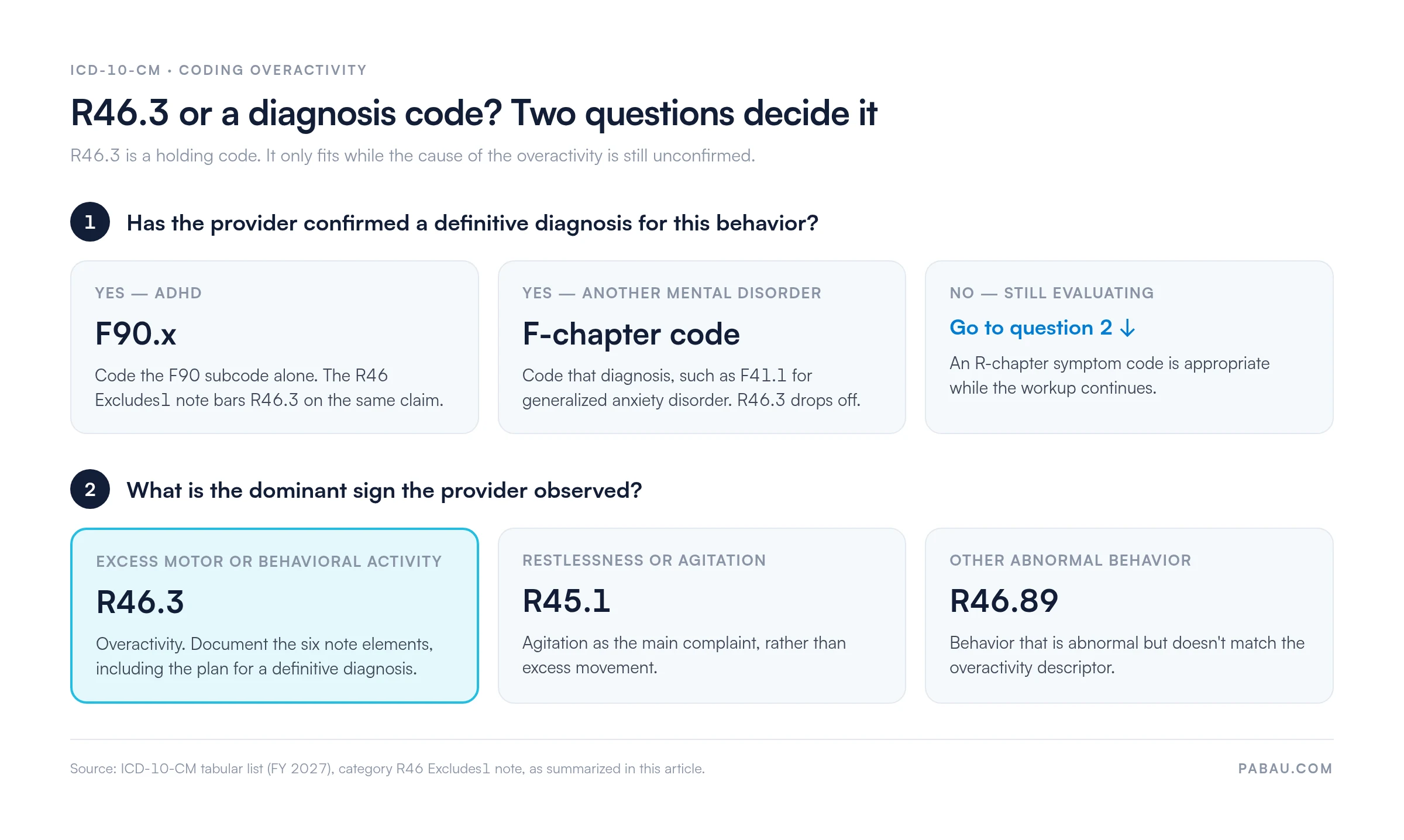
The ICD-10-CM Official Guidelines accept symptom codes only when the provider has not yet established a definitive diagnosis. That rule shapes how every R46.3 note is written. When a claim carries R46.3 and the chart holds a confirmed F90.x diagnosis, payers routinely reject it.
Effective documentation for submitting a clean claim with R46.3 requires six elements in the encounter note:
Medicare and most commercial payers treat R46.3 as a medically acceptable primary diagnosis code when the documentation supports an ongoing evaluation. Prior authorization is not typically triggered by R46.3 alone, but it may be required for the specific CPT service billed alongside it.
R46.3 denials follow predictable patterns. Four root causes come up again and again, and a pre-submission review can stop all four.
Log R46.3 denials by code and by payer as part of your denial management workflow. When the same reason repeats across a few claims, fix the note template before the next batch goes out.
Run a monthly audit of R46.3 denials by filtering your clearinghouse rejection report by code. If denials cluster around one CPT pairing or one payer, review the note template before you question the code. Fix the template first, then resubmit.
Pediatric practices use ICD-10 code R46.3 often, especially between a teacher or parent raising a concern and a completed ADHD workup. A pediatrician documenting a parent’s concern about a 7-year-old who can’t stay on task in class is in exactly the situation R46.3 was designed for.
Structured behavioral documentation templates make pediatric R46.3 encounters easier to defend on payer review. The note records what the provider observed, with the parent’s suspicions logged as history.
Without a connected system, a biller copies insurer details from the front desk and builds the claim by hand. Then someone checks a clearinghouse portal to see what happened. A missing authorization code often surfaces only when the payer sends the claim back.
In Pabau’s claims management software, the claim starts from the invoice raised at checkout. Validation checks run every time you send a claim. The Send button stays disabled until required details, such as membership numbers and authorization codes, are in place.
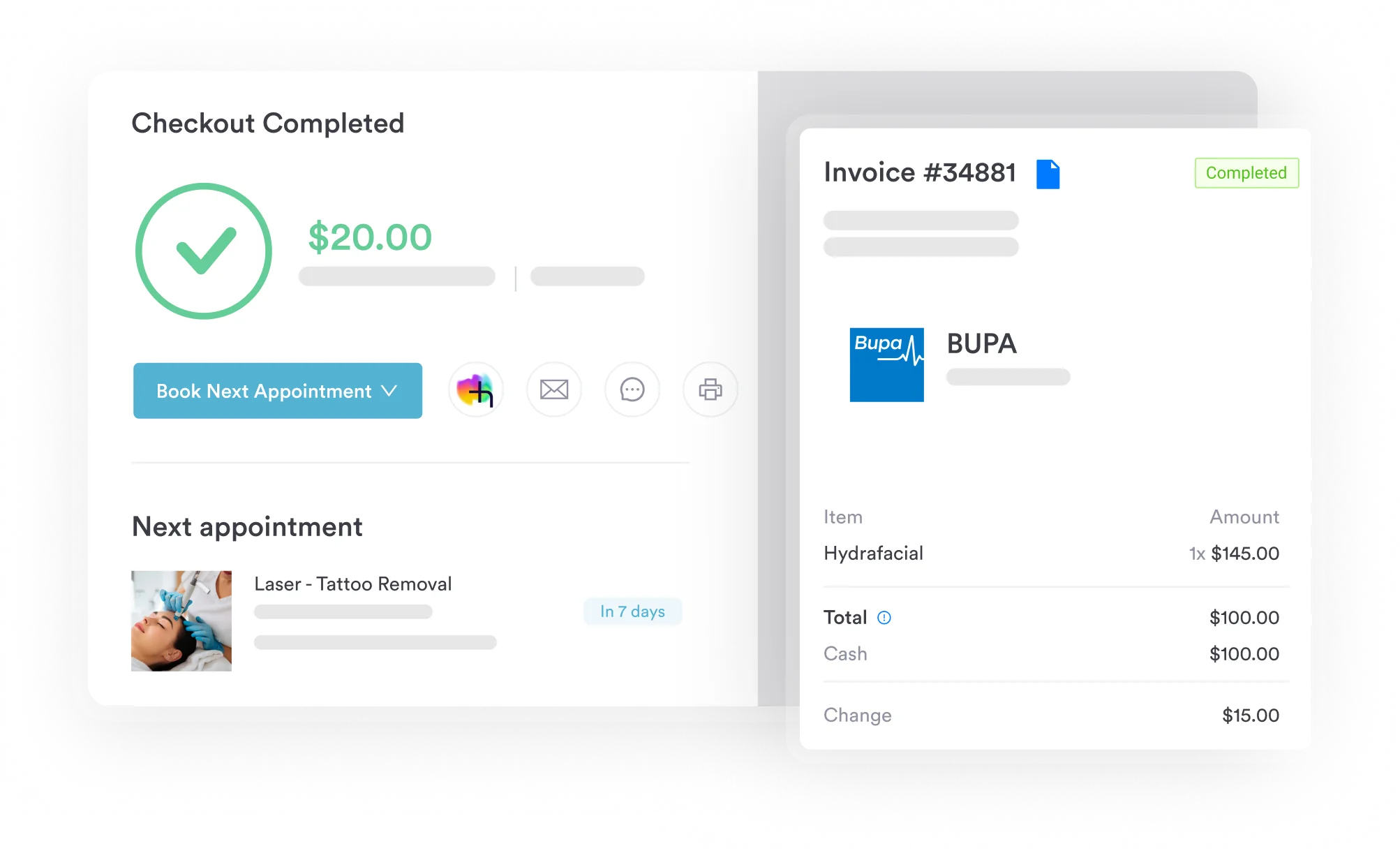
US practices send electronic claims via Claim.MD, Pabau’s US clearinghouse partner. It runs real-time eligibility checks and submits CMS-1500 claims to thousands of US payers. Every claim’s status, from pending to paid or error, sits on one dashboard, so a rejected R46.3 claim gets fixed the day it comes back.

Pabau checks each claim for missing details before it goes out, runs real-time eligibility checks through Claim.MD, and tracks every claim to payment. See how it fits your behavioral health billing.

Treat R46.3 as a code with an end date. It belongs on the visits between the first documented concern and a confirmed diagnosis, and on none after that.
Build that end date into your workflow. Write the plan for a definitive diagnosis into every R46.3 note, and update the problem list the day F90.x is confirmed. The cost is a few extra lines of charting per visit. The return is fewer claims bounced back for an Excludes1 conflict.
Book a demo to see how Pabau tracks your behavioral health claims from checkout to payment.

Diagnosis confirmed as combined-type ADHD? ICD-10 code F90.2 covers the documentation and billing rules once R46.3 no longer applies.
Screening a child’s development at the same visit? CPT code 96110 explains how to bill the developmental screening that often sits alongside R46.3.
Seeing R46.3 claims come back? Denial codes in medical billing explains what each payer denial code means and how to respond.
Building a behavioral health billing workflow? What is medical billing covers the process from code assignment through claim payment.
ICD-10 code R46.3 is the billable diagnosis code for overactivity, a sign or symptom in the R46 category “Symptoms and signs involving appearance and behavior.” It applies when a provider documents elevated motor or behavioral activity before a definitive diagnosis, such as ADHD, is established.
Yes, R46.3 is a valid, billable ICD-10-CM code for fiscal year 2027, which took effect October 1, 2026. No additional characters are required. Check it again each October, when the annual ICD-10-CM update takes effect.
R46.3 is a symptom code for overactivity observed before a definitive diagnosis. F90.x codes (F90.0 through F90.9) record ADHD confirmed against DSM-5 criteria. The R46 Excludes1 note bars using both for the same behavioral presentation in one encounter.
Yes, R46.3 can be the principal diagnosis when overactivity is the main reason for the encounter and no definitive diagnosis has been established. Listing it as secondary when it drove the visit is a common denial trigger, so review sequencing before submission.
Yes, R46.3 applies to all age groups and is common in pediatric behavioral health visits before ADHD is confirmed. Pediatric notes should include caregiver and teacher reports, direct clinical observations, and any rating scale results that fall short of diagnostic thresholds.
The ICD-10 codes most often added alongside R46.3 are context Z codes. For a documented family history of ADHD, that is Z81.8 (family history of other mental and behavioral disorders). Any F-chapter code for the same presentation is excluded. On the procedure side, R46.3 usually supports office visits (99213, 99214) and behavioral screening (96127).