ICD-10 Code R34: Anuria and oliguria
ICD-10 Code R34 is the billable ICD-10-CM diagnosis code for anuria and oliguria...

Last Updated: Oct 6, 2026
Billable Code Specific Code
Q81.0 is the billable ICD-10-CM code for epidermolysis bullosa simplex. It covers the inherited form of epidermolysis bullosa in which blisters split within the epidermis, caused by KRT5 or KRT14 keratin gene mutations.
Q81.0 sits in category Q81 alongside epidermolysis bullosa letalis (Q81.1), epidermolysis bullosa dystrophica (Q81.2), other types (Q81.8) and the unspecified code (Q81.9). Assign it only when genetic, electron microscopy, or immunofluorescence testing confirms the simplex type. Until then, Q81.9 applies.
Let Pabau's smart automation suggest the right codes, reduce claim denials, and keep your practice compliant—effortlessly.
Automate repetitive tasks and focus on what matters most—your patients.
Reduce coding errors and ensure compliance with the latest regulations.
Clean claims, fewer denials, and faster reimbursements.
Powerful insights and reporting to help your practice thrive.
HIPAA compliant SOC 2 certified GDPR-compliant Trusted by 4,000+ clinics worldwide

Q81.0 is the billable ICD-10-CM code for epidermolysis bullosa simplex (EBS), a congenital keratin-mutation disorder distinct from junctional (Q81.1) and dystrophic (Q81.2) epidermolysis bullosa.
All EBS subtypes (Koebner, Dowling-Meara, Weber-Cockayne) share Q81.0 because ICD-10-CM has no deeper codes, so the chart has to name the subtype for payers.
Q81.0 is exempt from present-on-admission (POA) reporting and valid in the current ICD-10-CM code set. Once confirmed, it carries forward as a chronic congenital diagnosis.
Pabau’s claims management software helps dermatology practices submit Q81.0 claims with the documentation payers require, which cuts denials on rare congenital diagnoses.
ICD-10 code Q81.0 is the valid, billable ICD-10-CM code for epidermolysis bullosa simplex in the current code set. It is a leaf-node code, so no further characters are needed. The table below summarizes the attributes to check before you submit a claim.
Q81.0 covers epidermolysis bullosa simplex (EBS), an inherited mechanobullous disorder in which blisters form within the epidermis rather than below the dermal-epidermal junction.
Mutations in KRT5 (keratin 5) or KRT14 (keratin 14) weaken the cytoskeleton of basal keratinocytes. Even minor friction or trauma then ruptures the cells and forms an intraepidermal blister.
According to WHO’s ICD-10 browser, Q81 encompasses all inherited forms of epidermolysis bullosa, with Q81.0 capturing the simplex variant specifically.
EBS is autosomal dominant in most cases, meaning a single inherited copy of the mutated allele is sufficient to cause disease. Onset is congenital or present within the first months of life.
The blistering is generally less severe than in junctional or dystrophic EB. The cleavage plane stays within the epidermis and spares the basement membrane zone.
Three clinically recognized EBS subtypes all map to Q81.0 because ICD-10-CM does not provide separate codes at a deeper level of specificity. Coders and clinicians often assume a more specific code exists, but the current edition has none.
Because all three subtypes share a single ICD-10-CM code, the subtype documentation in the clinical record carries disproportionate weight. Payers approving specialty biologics or gene therapies for Dowling-Meara, the most severe subtype, look for that detail in the chart note. The diagnosis code itself does not show it. Document the subtype by name whenever the clinical record establishes it.
Q81 is the parent category for all inherited forms of epidermolysis bullosa under the CDC/NCHS ICD-10-CM tabular list. Q81 is not billable on its own, so coders must assign a specific child code. The table below shows the full Q81 hierarchy and when to select each code.
Use Q81.0 only when the clinical record documents epidermolysis bullosa simplex specifically. If EB is confirmed but the type is not yet specified, use Q81.9 while genetic panel results are pending. Update to Q81.0 or the right sibling code once the subtype is confirmed.
The ICD-10-CM code guides in our library follow the same format for other diagnosis codes, from chapter placement to common denial triggers.
ICD-10-CM pairs the congenital Q81 codes with an Excludes1 note against acquired epidermolysis bullosa (L12.3). An Excludes1 note means the two conditions are mutually exclusive, so their codes never appear together on the same encounter claim.
Coding errors for epidermolysis bullosa simplex almost always fall into two patterns. Coders either pick an imprecise sibling code within the Q81 family, or select an acquired blistering code when the record supports a hereditary diagnosis.
Epidermolysis bullosa acquisita (L12.30) is the most frequent non-Q81 confusion. EBA is autoimmune and acquired in adulthood, so it is a different condition despite the shared name. A patient with adult-onset blistering driven by anti-collagen VII antibodies should never receive Q81.0.
The decision path below turns the onset history and the testing result into the right code.
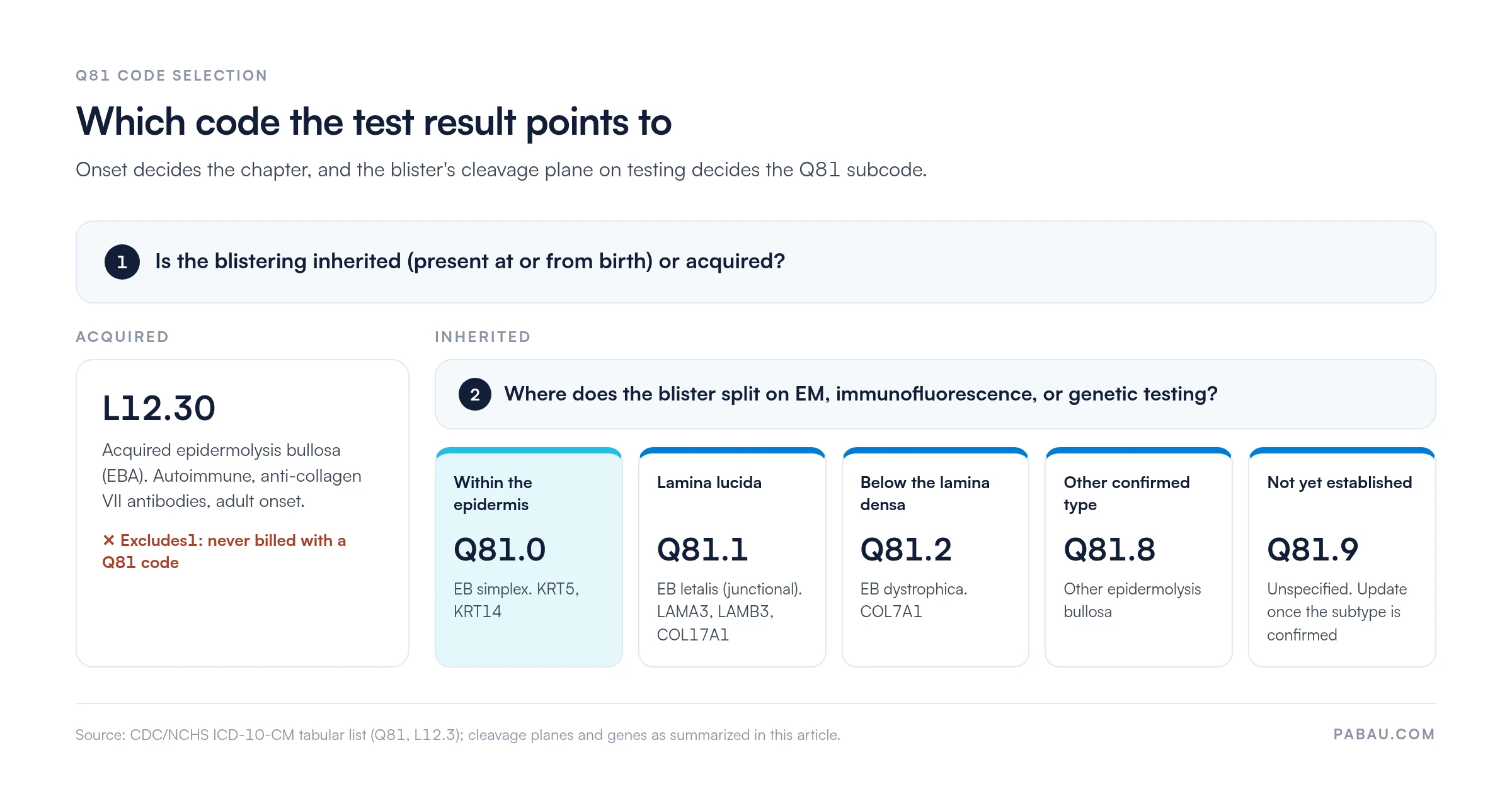
Congenital codes carry a documentation burden that acquired-condition codes do not. The record must establish that the condition was present at or from birth, not simply that the patient has it now. For a Q81.0 claim, the chart must contain at minimum:
Once Q81.0 is established in the chart, it works as a permanent chronic diagnosis. Coders may carry it forward to later encounters without the treating clinician re-documenting the original workup each time. That holds as long as the note where the diagnosis was first established stays accessible.
That makes the initial diagnostic note the most important document to protect in the patient file.
Flag Q81.0 in your EHR as a chronic condition at first confirmation. Coders can then add it to later encounter claims without querying the physician each time. The original workup note also stays linked to the active problem list.
Q81.0 is exempt from present-on-admission (POA) reporting. As a congenital condition, epidermolysis bullosa simplex is present at birth and cannot be a hospital-acquired complication of care. Appendix I of the ICD-10-CM Official Guidelines tells inpatient coders to leave the POA field blank for exempt codes. Y, N, U, and W do not apply.
As a result, Q81.0 does not affect hospital-acquired condition (HAC) payment adjustments. Payers and auditors will not penalize a facility for a congenital blistering disorder, because the condition predates the encounter by definition. Reporting a Y or N indicator against Q81.0 on an inpatient claim is a coding error that may attract payer review.
Q81.0 alone does not guarantee reimbursement, because it must support a covered service. Medicare and commercial payers evaluate coverage at the procedure level. The diagnosis provides medical necessity.
Each CPT code billed alongside Q81.0 is then assessed against the relevant Local Coverage Determination (LCD) or National Coverage Determination (NCD).
Check the CMS ICD-10 codes page and your Medicare Administrative Contractor (MAC) LCD database before billing associated wound care, genetic testing, or biologic therapies.
Three coverage areas need specific attention for Q81.0 encounters. Ensuring medical billing compliance across all three protects the practice from retrospective audits.
Rare congenital diagnosis codes attract more scrutiny than high-volume codes because payers have fewer reference claims to benchmark against. The denial patterns below account for most Q81.0 rejections, along with corrective actions for each.
The CPT codes below represent the most frequent procedure pairings with ICD-10 code Q81.0 in dermatology and wound care settings. Confirm current CMS and MAC LCD coverage before billing. The AAPC’s ICD-10-CM lookup tool is a useful starting point for crosswalk verification.
For the diagnostic workup, a punch biopsy of a single lesion is billed as CPT 11104. A tangential sample, such as a shave, takes 11102 instead, and an incisional sample takes 11106.
Many Q81.0 denials trace back to a claim that left the practice without its supporting documents. The confirmatory test report sits in a lab portal, the subtype sits in a referral letter, and the payer sees neither.
Pabau, the practice management and billing platform we build, keeps the diagnosis, the visit note, and the claim in one patient record. With error-catching claims management connected to a US clearinghouse, pairing the right CPT code with Q81.0 and submitting a clean claim happen in one workflow.
Through Pabau’s Claim.MD clearinghouse integration, your front desk can also run eligibility checks before the encounter. You confirm coverage for Q81.0-associated procedures before the claim goes out, rather than after a denial comes back.


Pabau’s claims management tools help dermatology practices submit rare congenital diagnosis claims with the documentation payers require. Run eligibility checks, attach supporting notes, and track claim status in one place.

Q81.0 rewards the practice that does its confirmation work once and does it well. Get the genetic, electron microscopy, or immunofluorescence result into the chart and name the subtype. From then on, the code can carry forward for the rest of the patient’s care.
The trade-off to remember is timing. Billing Q81.9 while the workup is pending is correct, but leaving it there after the subtype is confirmed invites avoidable denials. Build the switch to Q81.0 into the step where test results are filed.
To see how Pabau attaches that documentation before a rare congenital diagnosis claim leaves your practice, book a demo.

Looking for clearinghouse integration options? Medical claims clearinghouse explains how clearinghouses work, what they validate, and how to choose one for dermatology billing workflows.
ICD-10 code Q81.0 is the billable diagnosis code for epidermolysis bullosa simplex. This hereditary skin-fragility disorder is caused by KRT5 or KRT14 keratin gene mutations, which lead to intraepidermal blistering after minor trauma. It sits in ICD-10-CM Chapter 17 (Q00-QA0, congenital malformations, deformations, chromosomal abnormalities, and genetic disorders), within category Q81.
Yes. Q81.0 is a valid, billable leaf-node ICD-10-CM code in the current code set. It can be used on both inpatient and outpatient claims when confirmatory diagnostic documentation supports it.
Q81.0 is epidermolysis bullosa simplex, where blistering occurs within the epidermis due to keratin gene mutations. Q81.1 is epidermolysis bullosa letalis, clinically known as junctional EB, where cleavage occurs at the lamina lucida of the basement membrane zone. Q81.2 is epidermolysis bullosa dystrophica, where cleavage is sub-laminal and linked to COL7A1 mutations and scarring. Each type needs its own confirmatory testing to tell it apart. Coders should not default to Q81.9 when the record already documents the subtype.
Yes. Q81.0 is POA exempt. As a congenital condition, epidermolysis bullosa simplex is always present at birth. Inpatient coders leave the POA field blank for Q81.0 instead of entering a Y or N value. Reporting a Y or N indicator against an exempt code is a coding error that can trigger an audit.
The most common reason is missing confirmatory testing in the medical record, such as no electron microscopy, immunofluorescence, or genetic test report. Other triggers are the wrong Q81 subcode (usually Q81.9 when the record supports Q81.0) and an incorrect POA indicator on inpatient claims. Claims also fail when the paired CPT code lacks LCD support for this diagnosis. A specialty biologic or gene therapy billed without a prior authorization number is denied too.
Medicare coverage for Q81.0-associated services depends on the specific procedure billed and the applicable LCD or NCD. Standard wound debridement is generally covered. Genetic testing and specialty biologics need LCD verification with the relevant Medicare Administrative Contractor and may require prior authorization. Q81.0 alone does not guarantee coverage. The procedure must independently meet medical necessity criteria under the applicable coverage determination.