ICD code Q92.5 – Chromosomal duplications with complex rearrangements
Billable Code•Specific Code
Code Definition
Q92.5 is the billable ICD-10-CM code for duplications with other complex rearrangements. It applies when a cytogenetics report shows extra chromosomal material alongside a structural event, such as a translocation, inversion, or deletion.
Q92.5 sits in category Q92, other trisomies and partial trisomies of the autosomes, not elsewhere classified. An isolated segmental gain with no rearrangement codes to Q92.2 instead, so assignment turns on what the laboratory report describes.
Related Information
Chapter
Q00-QA0 Congenital malformations, deformations, chromosomal abnormalities, and genetic disorders
Category
Q92 Other trisomies and partial trisomies of the autosomes, not elsewhere classified
Group
Q92.5 Duplications with other complex rearrangements
Billable
Yes
Code also known as
CNV with structural rearrangement, complex chromosomal duplication, derivative chromosome duplication, segmental duplication with rearrangement
Save time. Improve accuracy. Get paid faster.
Automate coding with Pabau
Let Pabau's smart automation suggest the right codes, reduce claim denials, and keep your practice compliant—effortlessly.
Chromosomal duplications with complex rearrangements
Codes
Suggested by Pabau AI
Q92.5Chromosomal duplications with complex rearrangements
ICD Code Suggestion
AI
Suggested code
Q92.5Chromosomal duplications with complex rearrangementsHigh match
Confidence score
98%
Why this code?
Matches patient diagnosis
Supported by clinical notes
Commonly used for this condition
Why practices choose Pabau
Save hours every week
Automate repetitive tasks and focus on what matters most—your patients.
Improve accuracy
Reduce coding errors and ensure compliance with the latest regulations.
Get paid faster
Clean claims, fewer denials, and faster reimbursements.
Grow with confidence
Powerful insights and reporting to help your practice thrive.
HIPAA compliant•SOC 2 certified•GDPR-compliant•Trusted by 4,000+ clinics worldwide
Key takeaways
Q92.5 is a billable ICD-10-CM code for chromosomal duplications that come with a structural rearrangement, such as a translocation, inversion, or deletion.
A simple segmental gain with no rearrangement codes to Q92.2, not Q92.5.
Code assignment requires a cytogenetics laboratory report (CMA, FISH, or karyotype) and a treating physician’s documented confirmation of the finding.
Submitting the non-specific parent code Q92 instead of the terminal code Q92.5 is the most common denial trigger.
Pabau, the practice management platform we build, submits Q92.5 claims through its Claim.MD clearinghouse integration and posts the remittances that come back.
ICD-10 Code Q92.5: Quick reference
ICD-10 Code Q92.5 is the billable, specific ICD-10-CM code for duplications with other complex rearrangements. It sits in category Q92 of Chapter 17, which covers congenital malformations and chromosomal abnormalities. The table below gives the core facts to check before the code goes on a claim.
Field
Detail
Code
Q92.5
Official descriptor
Duplications with other complex rearrangements
Billable (terminal)
Yes. Billable and specific in the current FY2027 code set.
ICD-10-CM chapter
Q00-QA0: Congenital malformations, deformations, chromosomal abnormalities, and genetic disorders
Parent category
Q92: Other trisomies and partial trisomies of the autosomes, not elsewhere classified
Code type
Diagnosis code (ICD-10-CM); US clinical modification
What ICD-10 Code Q92.5 covers: Official descriptor and clinical meaning
ICD-10 Code Q92.5 covers chromosomal duplications where the copied genetic material comes with a structural rearrangement. The extra material is more than a clean, isolated segment of one chromosome.
The “other complex rearrangements” wording signals that two or more structural events happened together. It also fits a duplication that appears alongside a translocation, inversion, or deletion elsewhere in the genome.
Two findings most often lead to Q92.5. The first is a copy number variant (CNV) on chromosomal microarray analysis (CMA) where the gain involves a rearranged segment.
The second is a FISH result that confirms a duplication alongside a structural abnormality. The CDC/NCHS ICD-10-CM web tool lists Q92.5 as a valid billable code in the current FY2027 code set.
Three clinical concepts coders need to separate before assigning this code:
Simple partial trisomy: an extra segment of a chromosome with no concurrent structural event. This maps to Q92.2, not Q92.5.
Duplication with complex rearrangement (Q92.5): the duplicated material coexists with a translocation, inversion, insertion, or deletion elsewhere. The cytogenetics report must explicitly describe the rearrangement or the complexity.
CNV as a concept vs. as a coded finding: not every copy number variant maps to Q92.5. CNVs that represent simple gains without structural complexity may code to Q92.2 or Q92.8. The rearrangement component is the differentiator.
The test method doesn’t change the code. A finding from CMA (array CGH or SNP array), FISH, or karyotype codes the same way. What matters is the laboratory’s documented interpretation, confirmed by the treating physician.
Where Q92.5 sits: Category Q92 and surrounding codes
Knowing how category Q92 is laid out prevents the most common wrong-code errors. The table below covers the main Q92 codes and the neighboring categories, so coders can confirm their selection before submission.
Code
Descriptor
Billable
Key differentiator
Q90
Down syndrome (Trisomy 21)
No, use a subcode
Complete extra chromosome 21; use Q90.0-Q90.9
Q92
Other trisomies and partial trisomies of the autosomes, NEC
Full extra chromosome present in a subset of cells
Q92.2
Partial trisomy
Yes
Segment duplication without concurrent structural rearrangement
Q92.5
Duplications with other complex rearrangements
Yes
Duplication concurrent with structural rearrangement (translocation, inversion, deletion)
Q92.7
Triploidy and polyploidy
Yes
Entire genome multiplied; not a segmental event
Q92.8
Other specified trisomies and partial trisomies of autosomes
Yes
Specified duplication not fitting Q92.0-Q92.7
Q92.9
Trisomy and partial trisomy of autosomes, unspecified
Yes
Use only when cytogenetics report does not specify the type
Q93
Monosomies and deletions from the autosomes, NEC
No, use a subcode
Loss of chromosomal material; duplications go to Q92.x
Excludes1 and Excludes2 notes that affect Q92.5
Excludes notes at the Q92 category level govern which codes can and cannot be reported alongside Q92.5. Misreading an Excludes1 as an Excludes2 is a direct path to a claim edit or denial. The CMS ICD-10 coding page contains the full annual tabular list where these notes appear.
Q90-Q99 is the ICD-10-CM block for chromosomal abnormalities not elsewhere classified. Within it, category Q92 covers abnormalities of the autosomes only. Sex chromosome abnormalities fall in Q96-Q98 instead.
Key distinctions for Q92.5 specifically:
Excludes1 (never code together): conditions that are mutually exclusive with Q92.5. If an Excludes1 condition is listed, it means the two diagnoses cannot coexist by definition. Always verify the current CMS FY tabular list for exact Excludes1 pairs before submission, as these can change with annual code updates.
Excludes2 (may code together if both present): conditions that are clinically distinct and may coexist. A patient with Q92.5 may also meet criteria for an Excludes2 condition. Both codes may then be reported, as long as both are documented and clinically supported.
No 7th-character extension: Q92.5 does not require a 7th character for encounter type. It is reported as-is regardless of whether the visit is for initial or follow-up management of the condition.
Before submitting any claim with Q92.5, pull the current fiscal year’s CMS tabular list. Check that no Excludes1 note conflicts with another diagnosis code on the claim.
How to assign Q92.5, step by step
Assigning Q92.5 correctly takes six checks, in this order. Skipping one raises the risk of a wrong code or an unsupported claim.
Obtain the cytogenetics laboratory report. The report must come from an accredited laboratory and include a formal interpretation. Acceptable tests include chromosomal microarray analysis (CMA), FISH, or karyotype with FISH follow-up. The report must explicitly identify a duplication and describe the structural complexity or concurrent rearrangement.
Confirm the physician’s documented diagnosis. ICD-10-CM Official Guidelines require that the physician (not the coder) make the clinical diagnosis. The treating clinician’s note must document the chromosomal finding based on the lab report. A report filed in the chart without the physician’s acknowledgment doesn’t support the code.
Verify the rearrangement component. If the cytogenetics report describes only a simple segmental gain, use Q92.2 (partial trisomy), not Q92.5. The word “complex,” a description of concurrent structural events, or a notation about a derivative chromosome is what pushes the code to Q92.5.
Check for Excludes1 conflicts. Review every other diagnosis code on the claim against the Q92 block’s Excludes1 notes in the current CMS tabular list. Any Excludes1 match requires resolving the conflict before submission.
Identify additional codes to sequence. Q92.5 is the diagnosis code for the chromosomal finding. If the patient also has documented associated congenital anomalies (cardiac defects, developmental delay, etc.), code those separately. Sequence Q92.5 as the primary diagnosis when the chromosomal finding is the reason for the encounter. Sequence it as secondary when a specific anomaly is the focus of the visit.
Select the correct CPT procedure codes. Pair Q92.5 with the procedure code that matches the test performed. See the CPT pairing section below.
Pro Tip
When a cytogenetics report uses the term ‘derivative chromosome’ (e.g., ‘der(5)t(5;10)(p15;q22)’), that notation confirms both a duplication component and a structural rearrangement. Those are the two elements that define Q92.5. Flag this language during chart review to avoid defaulting to Q92.2 or Q92.8 on complex FISH and microarray findings.
Q92.5 vs adjacent codes: Choosing the right one
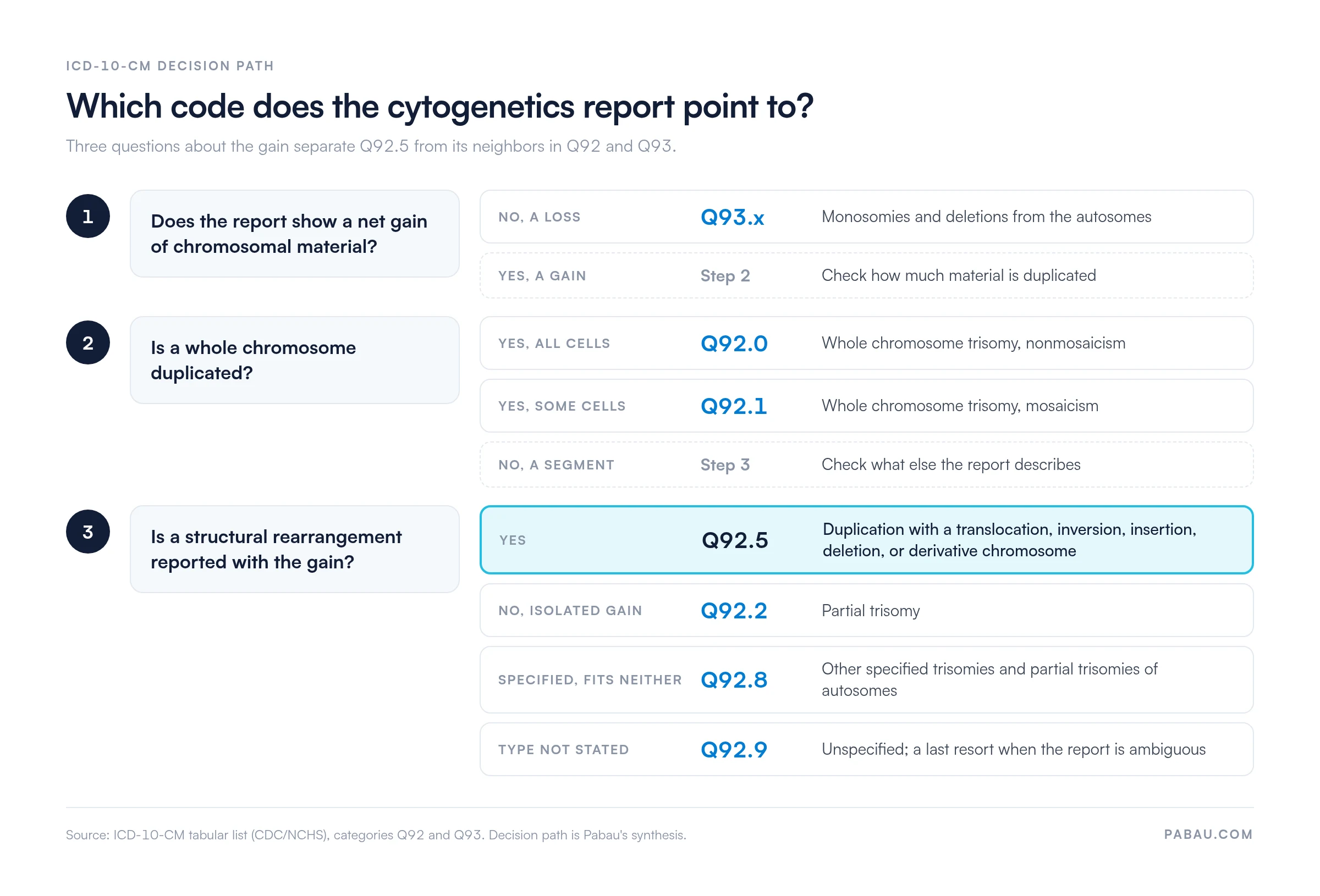
The codes most often confused with Q92.5 share its Q92 parent category, plus two deletion codes from Q93. The decision path below shows how the wording of the cytogenetics report leads to each one.
Q92.5 is the only outcome that needs a rearrangement reported alongside the gain, so that line of the report decides the code. Path built from the ICD-10-CM tabular list.
The report describes a concurrent structural rearrangement alongside the duplication. Q92.2 applies to isolated segmental gains only.
Q92.8
Other specified trisomies and partial trisomies
The duplication is explicitly described as complex or involves a derivative chromosome. Q92.8 is for specified duplications that do not fit Q92.0-Q92.7.
Q92.9
Trisomy and partial trisomy, unspecified
Always, if the cytogenetics report specifies the type. Q92.9 is a last resort when the report is genuinely ambiguous.
Q93.4
Deletion of short arm of chromosome 5 (Cri-du-chat)
The finding is a gain (duplication), not a loss. Q93.x codes are for deletions/monosomies, not duplications.
Q93.5
Other deletions of part of a chromosome
The laboratory report confirms a net gain of chromosomal material. If both a gain and a deletion are present on the same report, code both Q92.5 and the appropriate Q93 code, subject to Excludes1 review.
Pro Tip
Sometimes one CMA report confirms both a chromosomal duplication and a concurrent deletion. In that case, code both Q92.5 and the appropriate Q93 deletion code. First verify no Excludes1 conflict exists between the two codes in the current CMS tabular list. Document clearly in the claim that both findings were independently confirmed on the same laboratory report.
Documentation requirements for Q92.5 claims
Payers auditing Q92.5 claims look for specific documentation elements. A claim may pass front-end edits and still trigger a retrospective audit if the medical record does not support the chromosomal diagnosis. Understanding medical billing documentation standards helps prevent both denials and recoupments.
Required documentation elements for Q92.5:
Cytogenetics laboratory report: the complete report from an accredited laboratory. It must identify the type of chromosomal finding and describe the structural complexity. The report must be in the medical record at the time of claim submission.
Laboratory interpretation: a formal written interpretation by the laboratory geneticist or cytogeneticist, signed and dated. A raw array data printout without interpretation does not satisfy this requirement.
Ordering clinician’s note: documentation of the clinical indication for testing. That means the symptom, developmental concern, or family history that triggered the genetic workup. This establishes medical necessity.
Treating physician’s documented diagnosis: a note from the treating physician explicitly documenting the chromosomal abnormality as a confirmed diagnosis, referencing the laboratory finding. This is the anchor for code assignment per ICD-10-CM Official Guidelines Section I.C.17.
Clinical correlation statement: if the chromosomal finding is related to a presenting congenital anomaly, the physician’s note should link the two. This supports sequencing Q92.5 correctly against the presenting diagnosis code.
Payer requirements and prior authorization for Q92.5
Q92.5 itself never needs prior authorization, because it records the result of testing that has already happened. Many Medicare and commercial payers do require authorization for the genetic test that produces the finding.
Start with insurance eligibility verification before the testing encounter. Beyond eligibility, payer-specific policies govern coverage for chromosomal microarray analysis:
Medicare LCDs: chromosomal microarray analysis is governed by Local Coverage Determinations issued by Medicare Administrative Contractors (MACs). The MolDX program, administered by Palmetto GBA and adopted by several MACs, manages LCDs for molecular diagnostic tests, including CMA. These LCDs specify covered indications (e.g., unexplained developmental delay, multiple congenital anomalies, autism spectrum disorder workup). Claims with Q92.5 paired to CMA codes must map to a covered indication listed in the applicable LCD.
Commercial payer policies: coverage policies vary significantly by payer and state. Some commercial plans follow ACMG guidelines for CMA indications; others have proprietary medical necessity criteria. Obtain the patient’s plan-specific policy before the test encounter, not after.
Medicaid: coverage for genetic testing with Q92.5 varies by state program. Some state Medicaid programs require prior authorization for all molecular genetic testing; others follow a fee schedule with no prior auth requirement.
Prior authorization timing: for services requiring prior auth, the authorization must be obtained before the testing procedure is performed. Retroactive authorization for genetic tests is frequently denied by both Medicare MACs and commercial payers.
Common claim denials for Q92.5 and how to prevent them
Most Q92.5 denials fall into a small set of repeating patterns. Recognizing the CARC denial code on the remittance advice and tracing it back to the root cause is faster than working each denial in isolation.
Claim status and ERA data from your clearinghouse show these patterns early. Strong denial management workflows then reduce the time between denial receipt and corrected claim submission.
Denial reason
CARC code
Root cause
Corrective action
Non-specific code submitted
CO-4 or CO-11
Parent code Q92 submitted instead of terminal code Q92.5
Correct to Q92.5 and resubmit. Verify the encoder is not defaulting to the parent block.
Medical necessity not established
CO-50
Ordering note does not document a covered clinical indication for genetic testing
Obtain an addendum from the ordering physician documenting the clinical indication. Appeal with the LCD-listed covered indication code.
Missing cytogenetics report
CO-16 or CO-97
Lab report not attached or not retrievable on records request
Attach the full signed cytogenetics report with interpretation to the appeal. Verify the report was in the chart at the time of original submission.
Excludes1 conflict on claim
CO-4
A second diagnosis code on the claim triggers an Excludes1 rule at the Q92 level
Review the current CMS tabular list Excludes1 notes. Remove the conflicting code or determine whether it actually represents a distinct, separately documented condition.
Prior authorization not obtained
CO-15
Genetic testing performed without securing required pre-authorization
Retroactive authorization is rarely granted. Focus prevention on verifying auth requirements before scheduling the test.
Wrong code selected (deletion vs. duplication)
CO-4
Q93.x deletion code submitted when the cytogenetics report shows a duplication (net gain)
Re-read the lab report. If gain is confirmed, correct to Q92.5 and resubmit. Train coders on Q92 vs. Q93 differentiation.
Reviewing denial codes in medical billing alongside the CARC table above helps teams build systematic denial prevention for chromosomal coding claims.
CPT codes commonly paired with Q92.5
The procedure code records which test was performed, and Q92.5 records why. The table below lists the CPT codes most often billed with Q92.5 as the primary or secondary diagnosis. Verify each pairing against the applicable MAC LCD before submission. A valid pairing still doesn’t guarantee reimbursement.
CPT code
Descriptor
Pairing notes
81228
Cytogenomic constitutional (genome-wide) microarray analysis; interrogation of genomic regions for copy number variants (CNVs)
Genome-wide CNV array. Requires an LCD-covered indication.
81229
Cytogenomic constitutional (genome-wide) microarray analysis; interrogation of genomic regions for copy number and single nucleotide polymorphism (SNP) variants for chromosomal abnormalities
Adds SNP analysis to CNV detection. Verify the MolDX LCD covered indication.
88261
Chromosome analysis; count 5 cells, 1 karyotype, with banding
Karyotype used as initial screen; may precede CMA confirmation
88271
Molecular cytogenetics; DNA probe, each (FISH)
FISH used to confirm specific duplication or rearrangement identified on array
96041
Medical genetics and genetic counseling services, each 30 minutes
Genetic counseling billed with Q92.5 as a secondary diagnosis after the cytogenetic finding. Replaced 96040 on January 1, 2025.
CPT code descriptors above follow the current AMA CPT code set, where 96041 replaced 96040 on January 1, 2025. Payer coverage and reimbursement rates vary by MAC jurisdiction and plan. The CMS ICD-10 codes page and applicable MAC LCD documents are the authoritative sources for coverage determinations.
How Pabau keeps Q92.5 claims moving from submission to payment
Without one system, a Q92.5 claim lives in three places: the clearinghouse portal, a denials spreadsheet, and the remittance file. A rejection can sit unnoticed until someone reconciles the month.
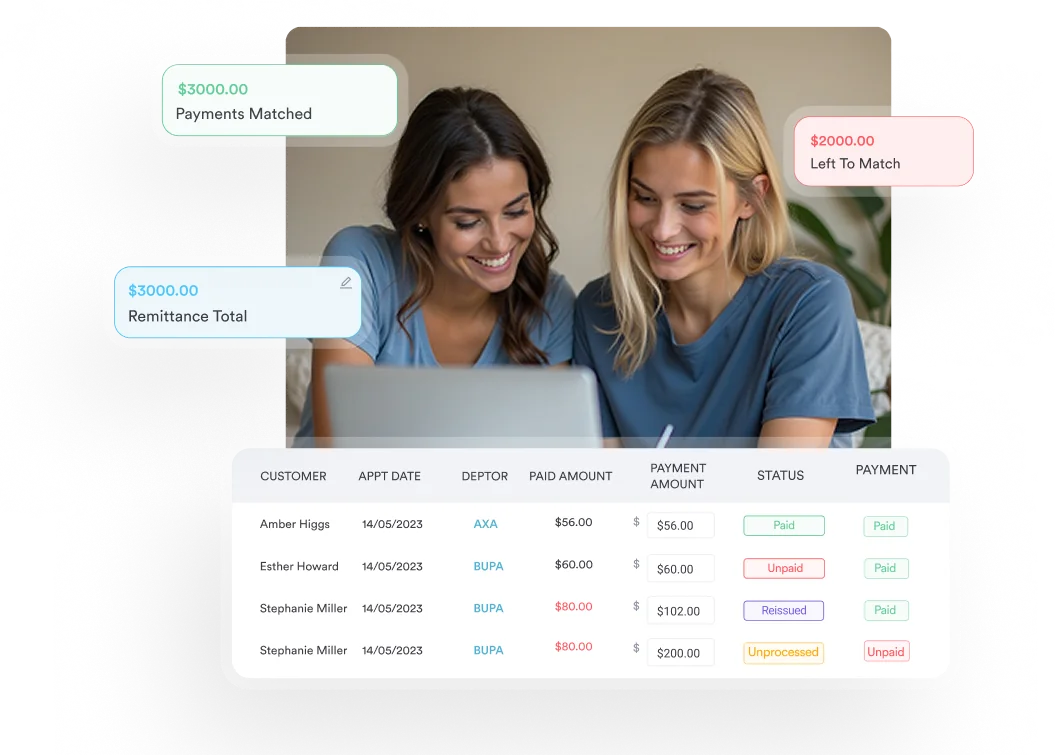
Pabau runs validation checks before a claim leaves, so missing details such as authorization codes are caught first. Claims reach US payers through the Claim.MD clearinghouse integration. The claims management software then posts ERA remittances to the same dashboard.
Each claim shows as pending, submitted, processing, paid, or error. Your billing team can filter by insurer, spot a repeat CO-50 pattern, and fix the documentation behind it before the next test is ordered.
Pabau’s billing dashboard keeps each Q92.5 claim, its status, and its remittance in one view, so a denial gets worked the day it arrives.
Streamline genetic coding and claims workflows
Pabau integrates with Claim.MD to submit, track, and reconcile ICD-10 diagnostic code claims including chromosomal abnormality codes. See how Pabau supports genetics and pediatrics practices.
The cytogenetics report decides Q92.5. When it names a rearrangement alongside the gain, Q92.5 is correct. When it describes an isolated segmental gain, Q92.2 is the right code, whatever the referral letter suggests.
The bigger risk sits upstream of the code. Secure prior authorization for the microarray before the sample is drawn, and get the physician’s diagnosis note into the chart before the claim goes out. Both are far harder to fix after a denial than before submission.
Book a demo to see how Pabau handles chromosomal coding claims from submission to payment.
Continue your research
Working on clean claim submission standards for genetic testing?Medical billing compliance outlines the documentation and regulatory standards that support accurate ICD-10 claim submission.
Exploring how clearinghouse integration supports diagnostic code claims?Claim.MD clearinghouse explains how Pabau’s US clearinghouse partner handles electronic 837P submission and ERA processing for diagnostic code claims.
Frequently asked questions
What does ICD-10 code Q92.5 mean?
ICD-10 code Q92.5 is the billable diagnosis code for duplications with other complex rearrangements. It describes extra chromosomal material that comes with a structural event, such as a translocation, inversion, or deletion elsewhere in the genome. It’s assigned when a cytogenetics report confirms both the duplication and the structural complexity, which separates it from simpler partial trisomy codes in Q92.
Is Q92.5 a billable ICD-10-CM code?
Yes, Q92.5 is a billable, specific ICD-10-CM diagnosis code, and it remains valid in the current FY2027 code set. It can go directly on a claim. The parent category Q92 isn’t billable and should never be submitted in place of Q92.5.
What is the difference between Q92.5 and Q93 deletion codes?
Q92.5 codes a chromosomal duplication, a gain of genetic material, that comes with a structural rearrangement. Q93 codes cover monosomies and deletions, which are losses of genetic material. Gains go to Q92.x and losses go to Q93.x. When one CMA report documents both a gain and a deletion, code Q92.5 and the matching Q93 code after checking for an Excludes1 conflict.
What documentation is required to assign Q92.5?
Three documents must be in the medical record when the claim is submitted. The first is a signed cytogenetics report from CMA, FISH, or karyotype that documents the duplication and its structural complexity. The second is the treating physician’s note confirming the diagnosis from that report. The third is the ordering clinician’s note documenting the clinical indication for testing.
How does Q92.5 differ from Q92.2 partial trisomy?
Q92.2 (partial trisomy) applies when the cytogenetics report shows an isolated extra chromosomal segment with no concurrent structural events. Q92.5 applies when the duplication is accompanied by a structural rearrangement such as a translocation or inversion. The presence of a derivative chromosome notation or explicit description of structural complexity in the laboratory report is the deciding factor.
Why would a claim with Q92.5 be denied?
Most Q92.5 denials trace back to five causes. The parent code Q92 goes out instead of Q92.5, or the cytogenetics report is missing from the record. The ordering note may not establish medical necessity (CO-50). Another diagnosis on the claim can trigger an Excludes1 conflict. The genetic test may also have been performed without a required prior authorization (CO-15).
Which CPT codes are commonly paired with Q92.5?
CPT 81229 and CPT 81228 are the microarray codes most often paired with Q92.5. Both are genome-wide arrays, and 81229 adds SNP analysis to copy number variant detection. CPT 88271 (FISH, per probe) is paired when FISH confirms the rearrangement. CPT 96041, which replaced 96040 in 2025, covers genetic counseling with Q92.5 as a secondary diagnosis. Check every pairing against the applicable MAC LCD for covered indications.