ICD-10 Code S42.444P: Medial epicondyle fracture, right humerus
ICD-10 Code S42.444P: full descriptor and code validity ICD-10 Code S42.444P car...

Last Updated: Oct 13, 2026
Billable Code Specific Code
O92.3 is the billable ICD-10-CM code for agalactia.
The code is current for FY2026, effective for dates of service October 1, 2025 through September 30, 2026.
According to the WHO ICD-10 browser, agalactia falls within the puerperium complications block. The Centers for Medicare and Medicaid Services (CMS) and the National Center for Health Statistics (NCHS) jointly maintain ICD-10-CM. Every year, they publish updates that decide which codes are valid for billing. As a result, the valid code set can shift from one fiscal year to the next.
Let Pabau's smart automation suggest the right codes, reduce claim denials, and keep your practice compliant—effortlessly.
Automate repetitive tasks and focus on what matters most—your patients.
Reduce coding errors and ensure compliance with the latest regulations.
Clean claims, fewer denials, and faster reimbursements.
Powerful insights and reporting to help your practice thrive.
HIPAA compliant SOC 2 certified GDPR-compliant Trusted by 4,000+ clinics worldwide

ICD-10 Code O92.3 is the billable ICD-10-CM diagnosis code for agalactia, the absence or failure of breast milk production following childbirth.
O92.3 is current for FY2026 (effective for dates of service October 1, 2025 – September 30, 2026) and belongs to Chapter XV (Pregnancy, childbirth and the puerperium), Block O85-O92, Category O92.
Approximate synonyms include failure of lactation, inability to breastfeed, and primary agalactia; O92.3 carries an Excludes1 note for secondary, elective, and therapeutic agalactia, which are coded instead to O92.5 (suppressed lactation).
Pabau’s OB/GYN EMR and claims management tools support accurate ICD-10-CM code attachment and documentation at the point of postpartum care.
Understanding the code hierarchy helps coders navigate nearby codes and apply the right level of detail. Specifically, O92.3 sits four levels deep in the ICD-10-CM coding structure.
Coders working across Chapter XV diagnoses can cross-reference nearby codes. The full tabular list for Chapter XV is available via the CDC/NCHS ICD-10-CM web tool, which provides the official US code lookup by fiscal year.
Agalactia is the complete absence or failure of breast milk production following childbirth. It is distinct from hypogalactia (low milk supply) and suppressed lactation (a deliberate or drug-induced stop to an already-established supply).
ICD-10-CM draws a firm line between two clinical pictures that are easy to mix up in a chart note. In fact, the tabular list backs that line with an Excludes1 note under O92.3. Excludes1 means the excluded condition can never be coded together with, or in place of, O92.3:
In practice, this O92.3-vs-O92.5 distinction matters for accurate clinical records: if the note describes milk that was present and later stopped, or was suppressed on purpose or by a clinician, O92.5 is the correct code, not O92.3. Confirming which picture applies also supports medical necessity for lactation counseling encounters billed alongside either code.
The ICD-10-CM Alphabetic Index maps several clinical terms to O92.3. Using any of these in a chart note will lead a coder directly to this code during lookup, provided the encounter context confirms a postpartum setting.
Overall, these synonyms reflect how clinicians phrase the diagnosis in dictation or typed notes. For example, “failure of lactation” is the most common phrasing found in postpartum visit notes, and coders searching the AAPC Codify ICD-10-CM lookup will find O92.3 under this term.
“Inability to breastfeed” also maps here, though the underlying reason (supply failure vs infant latch issue) may affect which additional code, if any, accompanies O92.3.
Do not confuse this with “secondary agalactia,” “elective agalactia,” or “therapeutic agalactia.” O92.3’s Excludes1 note routes these terms to O92.5 (suppressed lactation) instead, since they describe milk that was established and then stopped or was deliberately suppressed.
Similarly, this kind of Alphabetic Index mapping is common across Chapter XV. A code like O75.0 maps from several distinct clinical phrasings the same way.
The O92 category contains several closely related codes. Notably, picking the wrong one is the most common coding error in postpartum lactation visits. The table below covers the codes coders most frequently encounter alongside O92.3.
Other Chapter XV categories follow the same table-driven structure.
Three codes in the O92 category cover failure or change in milk production, and coders often ask which one applies. Ultimately, the clinical note is the deciding factor in every case.
Key rule: O92.3 applies only when milk production is completely absent, not merely reduced. If the chart note says “low supply” but does not state absence of milk, O92.4 is the correct code. When the note describes a patient who never produced milk despite postpartum time having passed, O92.3 applies.
This three-way distinction also matters when reviewing postpartum patient care management workflows, where coding accuracy directly affects which follow-up services qualify for payment.
O92.3 is a breastfeeding failure diagnosis code used at postpartum visits, lactation support visits, and any clinical visit where the provider notes agalactia as a diagnosis.
Because it belongs to Chapter XV (pregnancy and puerperium), it applies only to visits within the postpartum period, usually defined as up to six weeks after delivery. Clinical notes should establish the visit context clearly.
Several charting patterns cause coders to select the wrong code or miss a secondary code opportunity.
Review the chart note for the phrase ‘no milk’ or ‘failure to produce milk’ before assigning O92.3. If the note says ‘low supply,’ query the provider or default to O92.4 (hypogalactia) until clarified. A single-word difference between ‘absent’ and ‘insufficient’ changes the code and affects claim outcomes.
Most coders look up O92.3, confirm it is billable, and then switch to a separate system to attach it to the claim. That context switch is where errors happen: the code is correct, but the visit notes, supporting diagnosis, or sequencing detail get lost in translation.
By contrast, practice management platforms with built-in ICD-10-CM code lookup remove the switch. Clinicians record the visit, the system surfaces the right code, and the claim is built from the same record without re-keying.
For OB/GYN and postpartum practices, this matters because puerperium encounters often involve multiple codes that must be sequenced correctly. A standalone lookup tool cannot enforce sequencing logic; an integrated platform can prompt for it.
Pabau’s OB/GYN EMR software supports structured clinical records and postpartum documentation workflows. Providers can use digital intake forms to capture lactation history at the point of the encounter, creating the record trail that supports accurate O92.3 coding.
Likewise.
Practices that use structured clinical records in Pabau can template the postpartum note to include fields for agalactia presentation (primary, coded O92.3, versus secondary, elective, or therapeutic, coded O92.5), onset timing, and any underlying diagnoses.
That structure feeds directly into the coding and HIPAA compliance for billing requirements without extra manual work. As a result, you get fewer queries to providers, fewer coding errors, and fewer claim rejections on postpartum lactation visits.
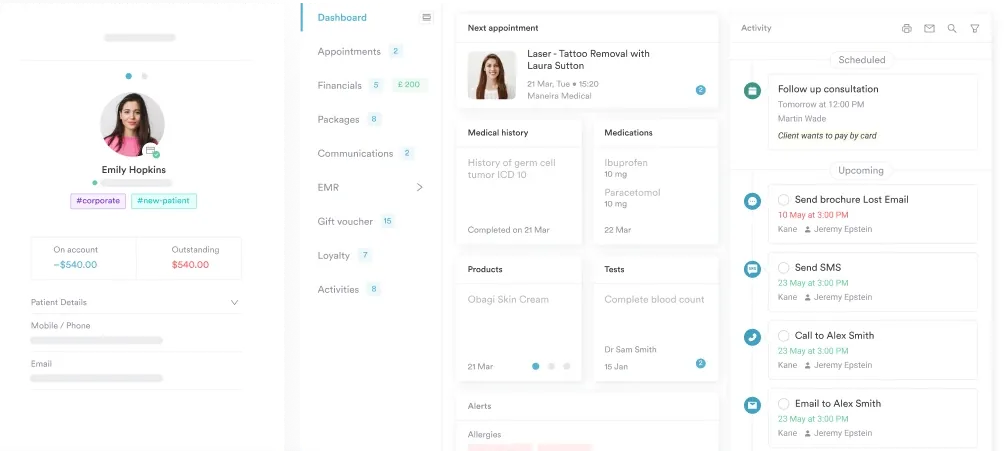

Pabau’s OB/GYN EMR supports structured postpartum documentation and integrated claims management, so your team spends less time querying providers and more time on care.

Postpartum lactation coding is a narrow field where one wrong code choice between O92.3, O92.4, and O92.5 changes the claim outcome. Ultimately, the distinction hinges on documentation detail, not just the clinical situation.
Pabau’s structured postpartum forms and built-in claims management tools help OB/GYN and lactation-focused practices capture the right records at the point of care, so coders have what they need to assign ICD-10 Code O92.3 correctly the first time. Fertility and reproductive health practices face the same record-keeping demands; book a demo and see how fertility clinic software supports them. Claim accuracy is cheaper to build at entry than to repair in an appeal. A billing workflow that separates coding from submission creates a handoff where claims stall.

Coding a related postpartum complication? ICD-10 Code O90.89 covers postpartum subinvolution of the uterus, another puerperium diagnosis coders frequently pair with lactation-related visits.
Documenting trauma from delivery? ICD-10 Code O71.9 is the billable code for unspecified obstetric trauma occurring during labor and delivery.
Coding a device-related obstetric encounter? ICD-10 Code Y76.8 covers miscellaneous obstetric and gynecological devices associated with adverse incidents.
ICD-10 Code O92.3 is the billable ICD-10-CM diagnosis code for agalactia, defined as the complete absence or failure of breast milk secretion following childbirth. It belongs to Chapter XV (Pregnancy, childbirth and the puerperium) and is current for FY2026, effective for dates of service October 1, 2025 through September 30, 2026.
Yes. O92.3 is a billable/specific ICD-10-CM code, valid for reimbursement purposes in postpartum and lactation-related encounters. It is current for FY2026, effective for dates of service October 1, 2025 through September 30, 2026.
Agalactia coded to O92.3 refers only to primary agalactia: milk secretion that never begins at all. Suppressed lactation (O92.5) covers secondary, elective, and therapeutic agalactia, meaning milk that was established and then stopped, whether from illness, medication, stress, or a deliberate decision not to breastfeed. O92.3 carries an Excludes1 note for secondary, elective, and therapeutic agalactia, meaning these can never be coded as O92.3; they must be coded to O92.5 instead.
The ICD-10-CM Alphabetic Index maps the following terms to O92.3: failure of lactation, inability to breastfeed, primary agalactia, and absence of milk secretion. Secondary agalactia, elective agalactia, and therapeutic agalactia are NOT synonyms for O92.3; the tabular list excludes them (Excludes1) and routes them to O92.5 (suppressed lactation) instead. Any of the O92.3 phrasings in a chart note should lead a coder to O92.3, provided the encounter occurs in the postpartum period.
Confirm and document whether milk was ever produced. If the note describes milk that never started, that supports O92.3 (primary agalactia). If milk was present and then stopped, whether from illness, medication, stress, insufficient stimulation, or a deliberate decision to stop breastfeeding, document it as secondary, elective, or therapeutic agalactia and code it O92.5 (suppressed lactation), since O92.3 carries an Excludes1 note for these presentations. Also record the clinical reason if known and the encounter purpose, and include a separate diagnosis code for any documented underlying cause. Note that vague language like “low supply” maps to O92.4 (hypogalactia), not O92.3.
The O92 category includes O92.4 (hypogalactia: insufficient but not absent milk supply), O92.5 (suppressed lactation), and O92.6 (galactorrhea). Z39.1 (encounter for care and examination of lactating mother) may accompany O92.3 as an encounter code when the visit focus is lactation support.