ICD-10 Code R34: Anuria and oliguria
ICD-10 Code R34 is the billable ICD-10-CM diagnosis code for anuria and oliguria...

Last Updated: Oct 6, 2026
Billable Code Specific Code
O21.0 is the billable ICD-10-CM code for mild hyperemesis gravidarum. It covers hyperemesis gravidarum, mild or unspecified, that starts before the end of the 20th week of gestation.
Assignment turns on two documented facts. The provider diagnoses hyperemesis without a metabolic disturbance such as dehydration, electrolyte imbalance or carbohydrate depletion, which would make it O21.1. Vomiting that starts after 20 completed weeks codes to O21.2 instead.
Let Pabau's smart automation suggest the right codes, reduce claim denials, and keep your practice compliant—effortlessly.
Automate repetitive tasks and focus on what matters most—your patients.
Reduce coding errors and ensure compliance with the latest regulations.
Clean claims, fewer denials, and faster reimbursements.
Powerful insights and reporting to help your practice thrive.
HIPAA compliant SOC 2 certified GDPR-compliant Trusted by 4,000+ clinics worldwide

O21.0 covers mild or unspecified hyperemesis gravidarum that starts before the end of the 20th week of gestation.
The provider’s documented diagnosis decides between O21.0 and O21.1, not a coder’s review of lab values.
Once the provider documents a metabolic disturbance, such as dehydration, electrolyte imbalance or carbohydrate depletion, the code moves to O21.1.
Vomiting that starts after 20 completed weeks codes to O21.2, and O21.0 takes no trimester or seventh character.
Pabau lets US practices submit claims electronically through Claim.MD and track their status.
ICD-10 code O21.0 is the billable code for mild or unspecified hyperemesis gravidarum that starts before the end of the 20th week of gestation. It applies when the provider documents no metabolic disturbance.
The table below lists the attributes to check before you assign it. Details follow the ICD-10-CM tabular list, which is maintained by the CDC/NCHS ICD-10-CM team at the National Center for Health Statistics.
O21.0 captures hyperemesis gravidarum in its mild or unspecified form. That means persistent nausea and vomiting in pregnancy that the provider diagnoses as hyperemesis, without documenting a metabolic disturbance.
Four facts decide whether O21.0 applies:
The O21 category covers excessive vomiting in pregnancy, and its child codes split by onset, diagnosis and documented metabolic impact. O21.0 is the mildest hyperemesis code in the category, but it still needs a clinical diagnosis of hyperemesis.
The most common error in the O21 category is choosing O21.0 when O21.1 applies, or the reverse. The split follows what the provider documents, not how sick the patient looks or what a coder reads into a lab printout.
A practical rule: code from the provider’s assessment, not from the lab results. If labs look abnormal but the note says only “hyperemesis gravidarum”, send a provider query asking whether a metabolic disturbance is present. Don’t assign O21.1 on your own reading of the values.
The three questions below run in the order a coder should ask them, and each one can end the search early.
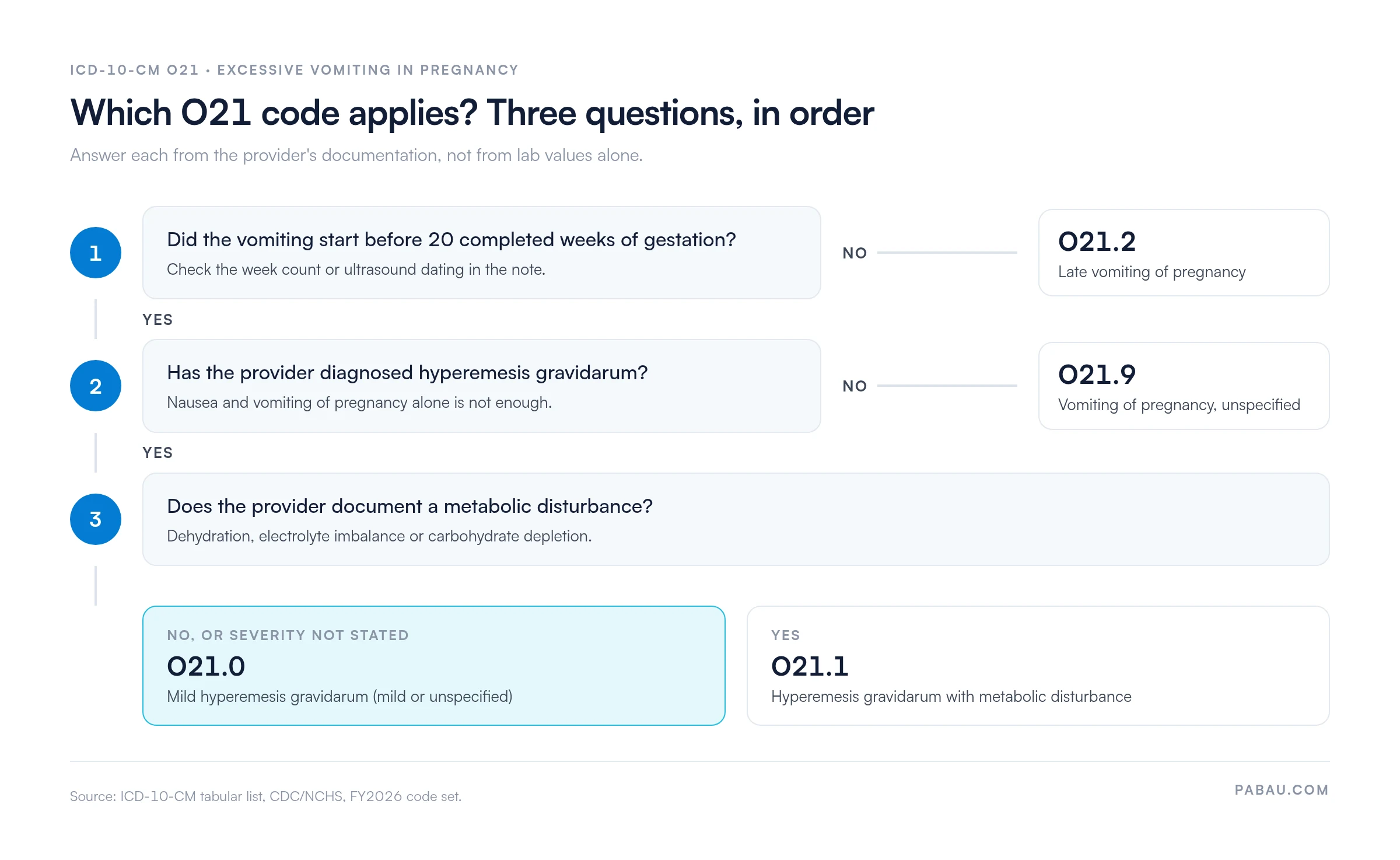
The O21 category carries no Excludes1 or Excludes2 notes of its own. The notes that govern O21.0 come from the Chapter 15 heading and the general coding guidelines, which you can check in our quick ICD-10-CM lookups.
No code-first (etiology/manifestation) instruction applies to O21.0. It is sequenced as the principal or first-listed diagnosis when hyperemesis gravidarum is the reason for the encounter.
O21.0 has no trimester character, and the Chapter 15 trimester rules apply only to codes that carry a trimester digit. Gestational age still matters, because it decides between O21.0 and O21.2.
How to handle gestational age on an O21.0 encounter:
When gestational age appears as a week count, check it against the 20-week line before coding. A note at 19 weeks 6 days still supports O21.0, while 20 weeks 0 days moves late-onset vomiting to O21.2. Pair the code with the matching Z3A week so the claim shows why you chose it.
Defensible coding for ICD-10 code O21.0 depends on four elements in the provider note. Missing any one of them weakens the claim on audit.
Only a few codes belong on the same claim as O21.0, and one common pairing contradicts the code split.
Outpatient management of mild hyperemesis gravidarum usually falls under standard obstetric benefits. Friction tends to show up in three scenarios.
Payer edits and prior authorization both sit inside the wider claims process. Our guide to medical billing fundamentals shows how the steps connect from encounter to payment.
Denials on O21.0 follow predictable patterns, and each one traces back to something the provider note does or doesn’t say.
Logging O21.0 denials by root cause, as part of your denial management workflows, shows billing teams which documentation template to fix. A clean claim submission checklist catches the most frequent errors, such as missing gestational age or the wrong O21 code, before claims leave the practice.
Run a monthly denial report filtered to O21.x codes and sort it by denial reason. If the top reason is incomplete documentation, the fix is a documentation template update, not a coding correction. If it is code not supported by documentation, start provider queries on hyperemesis encounters that lack an explicit diagnosis.
O21.0 is valid and billable in the current FY2026 code set, with no change to the code or its descriptor. The FY2027 code set takes effect on October 1, 2026, and keeps O21.0 with the same descriptor.
Check the status each year after the October 1 update, using the official CMS ICD-10 code files. The WHO ICD-10 browser gives the international reference for the O21 category, but US claims follow ICD-10-CM.
Every denial reason above starts in the provider note, so the coding fix belongs to documentation and a pre-billing check. Once the code is right, the slow part is following each claim through a clearinghouse portal that sits apart from the patient record.
Pabau is the practice management platform we build for private practices and women’s health teams. It keeps the encounter note, the diagnosis and the invoice in one patient record. Its streamlined claims management lets US practices submit claims electronically through Claim.MD and track their status.
Your billing team can see which hyperemesis claims were accepted and which came back, without switching systems. When a claim needs a provider query, the note it depends on is already in the same record.

Pabau keeps the provider note and the claim in the same patient record. US practices submit claims electronically through Claim.MD and track their status.

Code O21.0 from what the provider wrote, and let the calendar settle the rest. A hyperemesis diagnosis before 20 completed weeks, with no documented dehydration, electrolyte imbalance or carbohydrate depletion, is O21.0. Once any of those appears in the assessment, it’s O21.1, whatever the symptoms look like.
The trade-off is speed against certainty. A provider query when the labs and the note disagree holds up one claim. It also keeps an unsupported O21.1 off the claim and out of an audit.
Book a demo to see how Pabau keeps hyperemesis encounter notes and their claims in one record for US women’s health practices.

Need a reference for obstetric billing workflows? Revenue cycle management explained covers how the coding-to-payment workflow connects across obstetric and specialty practices.
Submitting claims electronically to US payers? How the Claim.MD clearinghouse works explains eligibility checks, 837P submission and ERA retrieval for billing teams.
Seeing repeated denials across obstetric codes? Denial codes in medical billing maps the most common remittance denial codes back to documentation and coding fixes.
Vomiting caused by another condition in pregnancy? ICD-10 code O21.8 covers other vomiting complicating pregnancy and its use-additional-code instruction.
Coding nausea and vomiting outside pregnancy? ICD-10 code R11.2 explains the symptom code for nausea with vomiting when no pregnancy diagnosis applies.
ICD-10 code O21.0 is the billable diagnosis code for mild or unspecified hyperemesis gravidarum that starts before the end of the 20th week of gestation. It covers persistent nausea and vomiting of pregnancy with no documented metabolic disturbance, such as dehydration or electrolyte imbalance. It sits in ICD-10-CM Chapter 15 (O00-O9A) and is valid in the FY2026 code set.
No. O21.0 has no trimester character, and the Chapter 15 trimester rules apply only to codes that carry a trimester digit. Gestational age still matters, because it decides between O21.0 and O21.2 at 20 completed weeks. Record the week in the note and add a Z3A code where the week is known.
Not for dehydration caused by the hyperemesis. Dehydration is an inclusion term under O21.1, hyperemesis gravidarum with metabolic disturbance. When the provider documents it, the correct code is O21.1 rather than O21.0 plus E86.0.
Most O21.0 denials trace back to the provider note. Common reasons are missing gestational age, O21.0 used at or after 20 completed weeks, and O21.0 used when the provider documented a metabolic disturbance. A missing explicit hyperemesis diagnosis is the fourth. Provider education and a pre-billing checklist address each one.