ICD-10 Code Y76.0: Diagnostic obstetric and gynecological devices
ICD-10 Code Y76.0: Definition and billable status ICD-10 Code Y76.0 is a valid, ...

Last Updated: Oct 23, 2026
Billable Code Specific Code
O16.4 is the billable ICD-10-CM code for unspecified maternal hypertension, complicating childbirth. It applies to the delivery encounter when hypertension is documented but the record does not specify its type.
O16.4 belongs to O16, the last category of the O10-O16 hypertensive disorders block. Coders use it only when, after a provider query, the documentation cannot support a gestational, preeclamptic, or pre-existing code.
Let Pabau's smart automation suggest the right codes, reduce claim denials, and keep your practice compliant—effortlessly.
Automate repetitive tasks and focus on what matters most—your patients.
Reduce coding errors and ensure compliance with the latest regulations.
Clean claims, fewer denials, and faster reimbursements.
Powerful insights and reporting to help your practice thrive.
HIPAA compliant SOC 2 certified GDPR-compliant Trusted by 4,000+ clinics worldwide

O16.4 covers unspecified maternal hypertension at the childbirth encounter only, not during pregnancy or the postpartum period.
Use O16.4 only when provider documentation cannot specify the hypertension type, because it is the code of last resort in the O10-O16 block.
Every delivery claim needs a Z37.x outcome code alongside O16.4, and a Z3A.x weeks-of-gestation code should be added when gestational age is known.
Pabau, the practice management platform we build, supports claim submission and status tracking through Claim.MD.
ICD-10 Code O16.4 carries the official descriptor “Unspecified maternal hypertension, complicating childbirth.” It is a billable ICD-10-CM code for the current fiscal year, FY2026, reportable on facility and professional claims for a delivery encounter. Use it when hypertension is documented at delivery and the record, after a provider query, cannot support a more specific type.
The O16 category holds six billable subcodes organized by encounter timing. O16.1 covers the first trimester, O16.2 the second, O16.3 the third, O16.4 the delivery encounter, O16.5 the puerperium, and O16.9 an unspecified trimester. The choice among them turns on the timing of the encounter, or on an unspecified trimester. Hypertension severity plays no part in it. Coders should verify code validity against the current-year CMS ICD-10-CM tabular list, since code status is updated annually.
The most consequential decision in obstetric hypertension coding is whether to assign O16.4 or one of the more specific codes in the O10-O16 block. Selecting O16.4 when a more specific code is supportable creates audit risk. The table below organizes the four most commonly confused codes by their defining clinical criteria.
The ICD-10-CM Official Coding Guidelines specify that O13 requires a provider-documented diagnosis of gestational hypertension. If the note says “hypertension in pregnancy” without clarifying gestational onset, O13 is not supportable and O16.4 is appropriate. Similarly, ACOG’s practice bulletin on gestational hypertension and preeclampsia ties the O14 codes to documented proteinuria or end-organ involvement alongside the blood pressure threshold. When those findings are absent from the record, the coder should not apply an O14 code, even if the blood pressure values alone look preeclamptic.
Pre-existing hypertension with superimposed preeclampsia has its own category, O11, split by timing in the same way as O16. The first-trimester code O11.1 shows how that documentation is built, and O11.4 is its childbirth counterpart. The decision list below puts these checks in the order a coder works through them at delivery.
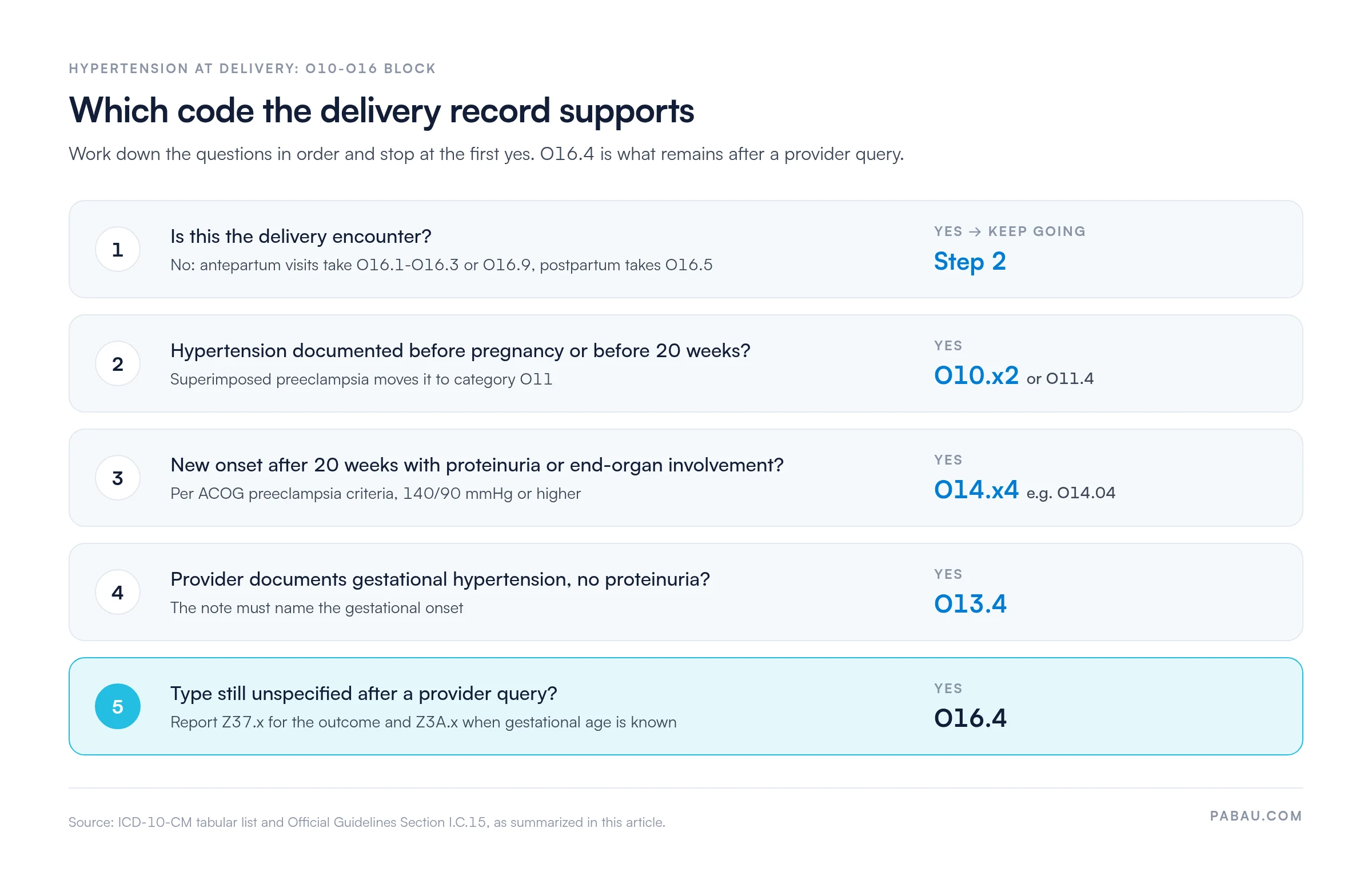
O16.4 applies only to the childbirth encounter. O16.5 covers unspecified maternal hypertension complicating the puerperium. The encounter date decides between them, whatever the clinical presentation.
The Excludes1 note that applies to O16.4 is supervision of normal pregnancy (Z34.-). Excludes1 means the two conditions are mutually exclusive, so a Z34.- code and O16.4 never appear together. A pregnancy complicated by hypertension is no longer a normal pregnancy.
The line between O16.4 and O13, O14, or O10 works differently, because no Excludes1 note bars those codes. It is a documentation-specificity rule: when the record supports a specified hypertension type, the coder reports that code instead of O16.4. Check the exact Excludes1 wording in the current-year tabular list on the CMS ICD-10 codes page. Note text can change with annual updates.
O16.4 is a valid code, but some payers may review unspecified obstetric hypertension codes more closely and question claims that lack supporting documentation. Solid medical billing compliance starts with the record, not the claim.
The following documentation elements should be present in the delivery record to support O16.4:
When the record is ambiguous, AHIMA and ACDIS query guidelines support querying the provider to clarify the hypertension type before assigning O16.4. Coding to O16.4 without a query, when the record points to a more specific type, creates a compliance risk that outlasts the minutes saved.
Before submitting an O16.4 claim, audit the delivery note for three items. Look for a documented BP reading, no proteinuria findings, and no prior hypertension in the problem list. If any of these is ambiguous, query the provider before coding. A queried, documented O16.4 claim holds up far better on audit.
For delivery encounter claims, O16.4 functions as the principal diagnosis when unspecified maternal hypertension is the condition chiefly responsible for the admission. Official Coding Guidelines Section I.C.15.b.5 requires an outcome of delivery code from category Z37 on every maternal delivery record. A Z3A code for weeks of gestation should also be reported when the gestational age is known.
These diagnosis codes sit on the claim beside the procedure code for the delivery itself. For routine global obstetric care with a vaginal delivery, that is usually 59400.
A delivery claim without its Z37.x code is incomplete under the guidelines, so check for it before the claim goes out. Pabau’s claims management software supports claim submission and status tracking through Claim.MD. Your coders still choose and check the codes, and the claim then moves from the patient record to the clearinghouse without re-keying.
Problems on O16.4 claims tend to follow four patterns. Each has a specific corrective action, and most are preventable at the point of coding rather than during appeals. Structured denial management workflows should track these reasons separately from general obstetric denials, so the patterns stay visible.
For denial appeals, the key supporting document is the delivery note showing BP readings, the absence of proteinuria documentation, and the provider’s clinical reasoning. The denial codes reference breaks down the CARC codes that often accompany obstetric billing rejections.
Medicare and Medicaid policies on unspecified obstetric codes vary by state contractor and managed care plan. No universal coverage assertion applies across all payers. However, several compliance principles hold broadly across government and commercial payers.
Sound revenue cycle management for OB practices includes a payer-specific matrix noting which plans require documentation on appeal for unspecified obstetric hypertension codes. This is distinct from general coding compliance and should be maintained by the billing team separately from the coding policy.
Many OB practices document the delivery in one system, build the claim in another, and check its status on a payer portal. Each hand-off is a chance for a Z37.x code or a supporting note to go missing.
Pabau keeps the delivery note, the diagnosis codes your coders enter, and the claim on one patient record. Claims go out through Claim.MD and their status comes back into Pabau, so your team can see which claims are waiting and which need follow-up.
The coding decision stays with your coders. What shrinks is the time spent moving data between systems and hunting for the note a payer asks for on appeal.

Pabau supports claim submission and status tracking through Claim.MD, with the delivery note and the codes your team enters kept on the same patient record.

O16.4 is a legitimate code when it is a deliberate decision. Used as a default, it invites audit questions the record cannot answer. Before you assign it, query the provider, confirm no gestational, preeclamptic, or pre-existing type is documented, and add the Z37.x outcome code.
The trade-off is a few minutes per chart against a claim that holds up on review. Build the query into your delivery workflow and O16.4 becomes the exception it was designed to be. Book a demo to see how Pabau keeps OB delivery notes, codes, and claim status in one place.

Need help understanding electronic claim submission for obstetric codes? Claim.MD clearinghouse overview explains how electronic claims validation works for US payer submissions.
Seeing repeated claim rejections on delivery encounters? Clean claim requirements covers the fields and codes that must be correct for a claim to pass payer edits without manual review.
Managing billing across an OB/GYN practice? Medical billing fundamentals outlines the end-to-end revenue cycle from encounter documentation through payment posting.
ICD-10 Code O16.4 is the billable ICD-10-CM diagnosis code for unspecified maternal hypertension complicating childbirth. It is used when a provider documents elevated blood pressure at delivery but does not specify whether it is gestational, pre-existing, or preeclamptic. It is billable on delivery encounter claims in the current fiscal year, FY2026.
Use O14.x codes only when the provider documents new-onset hypertension at or above 140/90 mmHg after 20 weeks, with proteinuria or end-organ involvement. That matches ACOG preeclampsia criteria. If neither proteinuria nor end-organ findings are documented, O14.x is not supportable and O16.4 is appropriate.
Common triggers are a missing Z37.x outcome of delivery code, O16.4 submitted on a non-delivery encounter, or a payer specificity edit that requests supporting notes. A Z3A.x weeks-of-gestation code should also be reported when gestational age is known. Some state Medicaid programs add their own requirements for unspecified codes.
Yes, O16.4 is a billable ICD-10-CM code for fiscal year 2026, reportable on facility and professional claims for delivery encounters. Coders should verify it against the current-year CMS tabular list, since code status is updated each fiscal year.