

ICD-10 Code S42.444P: Medial epicondyle fracture, right humerus
ICD-10 Code S42.444P: full descriptor and code validity ICD-10 Code S42.444P car...

Last Updated: Oct 13, 2026
Billable Code Specific Code
M85.2 is the billable ICD-10-CM code for hyperostosis of skull. It covers abnormal thickening or overgrowth of cranial bone, most often the inner table of the frontal bone.
The code sits in category M85, Other disorders of bone density and structure, inside the musculoskeletal chapter M00-M99. It took effect for the 2026 ICD-10-CM edition on October 1, 2025. M85.2 is a terminal code, so no site digit or seventh character is added. Assignment turns on a physician-confirmed diagnosis in the note, not a radiologist's description of the image.
Let Pabau's smart automation suggest the right codes, reduce claim denials, and keep your practice compliant—effortlessly.
Automate repetitive tasks and focus on what matters most—your patients.
Reduce coding errors and ensure compliance with the latest regulations.
Clean claims, fewer denials, and faster reimbursements.
Powerful insights and reporting to help your practice thrive.
HIPAA compliant SOC 2 certified GDPR-compliant Trusted by 4,000+ clinics worldwide

ICD-10 code M85.2 is the billable code for hyperostosis of skull, effective for the 2026 edition on October 1, 2025.
M85.2 is a terminal code, so no site digit and no seventh character are added to it.
The code covers the skull only, so ossification of the spinal ligaments is coded to M48.1 instead.
The M85 category carries a Type 1 Excludes note for osteogenesis imperfecta, osteopetrosis, osteopoikilosis, and polyostotic fibrous dysplasia.
A payable claim needs the confirmed diagnosis in the physician’s assessment, not only in the radiology report.
ICD-10 code M85.2 is the billable diagnosis code for hyperostosis of skull, meaning abnormal thickening or overgrowth of cranial bone. One code, one site. If the bony overgrowth sits anywhere below the neck, M85.2 is the wrong answer.
The code sits in category M85, Other disorders of bone density and structure. One level up is the M80-M85 block, officially titled Disorders of bone density and structure. Both live inside the musculoskeletal chapter, M00-M99.
M85.2 takes no extra characters. It is the terminal, billable node, with no site digit, no laterality, and no seventh character. What you read in the tabular list is what you submit.
The CDC/NCHS ICD-10-CM web tool lists M85.2 as a valid, terminal code with nothing beneath it. That detail helps on audit. A payer cannot ask for a more specific code when no more specific code exists.
Hyperostosis of the skull is an overgrowth of cranial bone, and it turns up most often on the inner table of the frontal bone.
Presentation runs a wide range. Plenty of cases are incidental, spotted on a scan ordered for something else in an older adult. Others bring headaches or a sense of pressure. Rarely, the overgrowth crowds nearby structures and produces neurological signs.
The note should carry the imaging findings, usually a CT or MRI showing cortical thickening, plus any symptoms the patient reports. Copying the radiologist’s descriptive phrase into the assessment is not the same as making a diagnosis.
The WHO ICD-10 browser lists one formal inclusion term under M85.2: hyperostosis interna generalisata. It describes generalized endosteal thickening across several skull bones, and payers accept it as a valid alternate descriptor when it appears in the record.
Any of the terms below can map to M85.2 when a provider’s notes use them, provided the physician has confirmed the diagnosis:
Write the clinical presentation into the note rather than leaning on the synonym alone. A payer may ask for the imaging report on audit, and the record should support the code on its own.
M85 carries a Type 1 Excludes note, and four congenital bone disorders sit on it. Type 1 means the two conditions do not occur together, so none of them pairs with M85.2 on the same encounter.
DISH is the condition coders expect to find on that list, and it is not there. Diffuse idiopathic skeletal hyperostosis is coded to M48.1. It is a spinal condition marked by ossification along the anterior longitudinal ligament, usually in the thoracic spine.
So can one patient carry both? Yes. ICD-10-CM publishes no excludes relationship between M85.2 and M48.1, in either direction. The two describe different findings at different sites. Code each one from its own documentation, then sequence by whatever drove the encounter.
Assign M85.2 only where a physician has written the diagnosis down as confirmed. That single rule settles most of the questions coders bring to this code.
The CMS ICD-10-CM official guidelines require physician documentation behind every diagnosis code, and the rules shift with the care setting.
Clean submission depends on a note that would hold up under a payer audit or a Recovery Audit Contractor review. The physician has to establish medical necessity and confirm the diagnosis, not restate the imaging language.
Read the imaging report and the physician’s note side by side before you assign M85.2. Say the radiologist writes ‘hyperostosis frontalis interna’ while the ordering physician’s note says ‘rule out skull lesion’. The code is not ready for an outpatient claim. Wait for the confirmed diagnosis in the assessment.
M85 covers more than hyperostosis, and several of its subcodes sit close enough to catch a busy coder. The table below sets out the ones most likely to surface on an M85.2 encounter.
Two traps come up again and again. The first is a bone disorder at a non-skull site, which needs M85.8 plus its own site character. The second is reaching for M85.9 when the note actually supports something specific. Keeping the ICD-10-CM code library open beside the chart beats coding from memory.
The table says what each code means. The faster question is which one the record supports, so here is the same decision in one view.
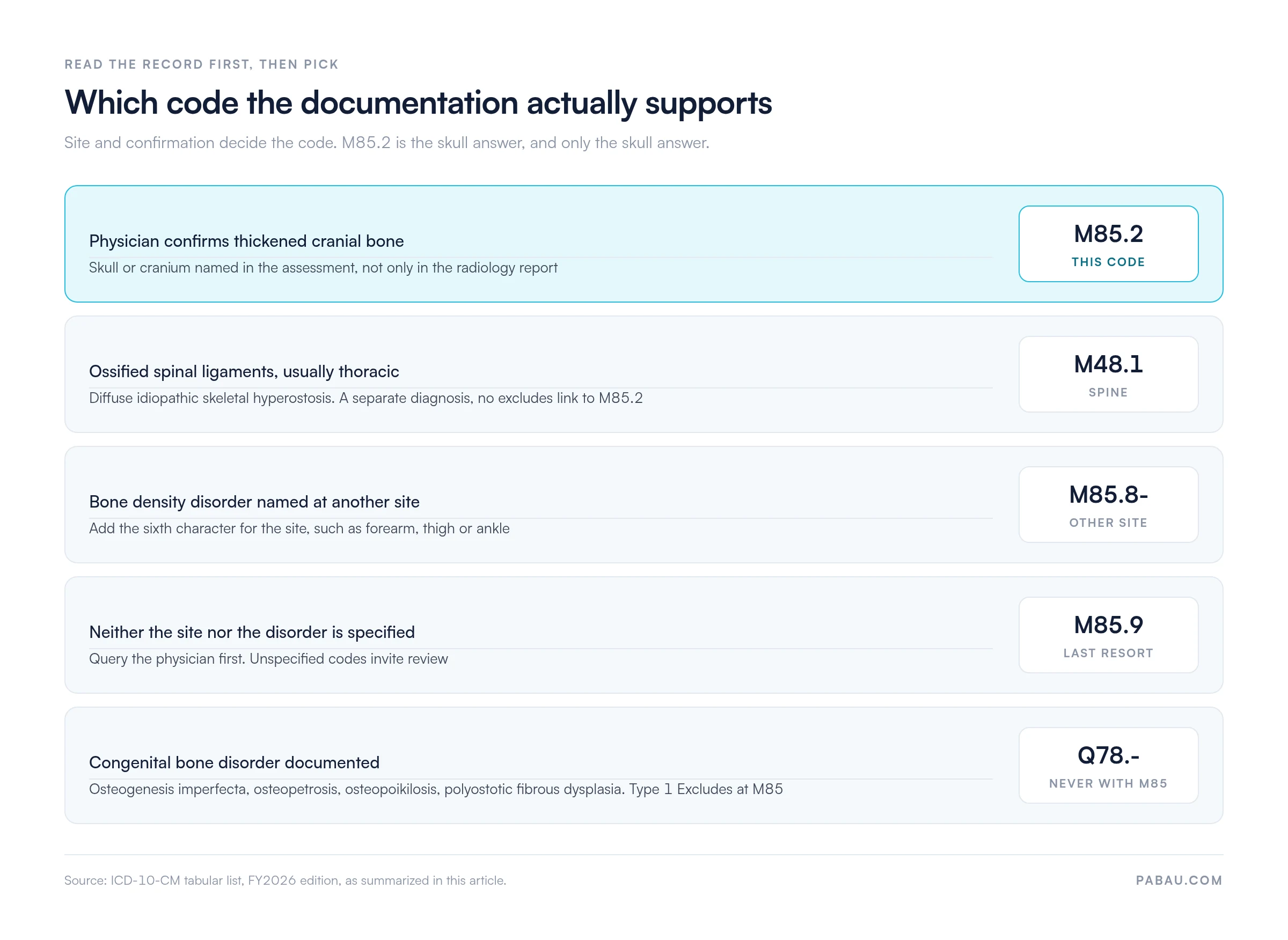
When M85.2 and M85.8 both look plausible, check whether the note names the skull or the cranium. M85.2 is site-specific by design. A similar disorder at another bone belongs in M85.8 with the appropriate site character.
Paget’s disease of bone thickens the calvarium too, and that presentation belongs to ICD-10 code M88.0 rather than M85.2. Check the note for a stated Paget’s diagnosis before you settle on hyperostosis of skull.
An M85.2 claim moves like any other diagnosis claim, and it stalls in three predictable places. Here is the whole path, from the encounter to the payment.
Coverage is where practices get caught out. M85.2 is valid on both the CMS-1500 and the UB-04, but payment depends on clinical context. Imaging ordered to evaluate a skull abnormality, a neurosurgical consult, or follow-up on a known hyperostosis can each justify the code.
No national Medicare LCD governs M85.2 directly. Individual payers may still fold it into their coverage policies for neuroimaging or musculoskeletal evaluation, so verify the policy before you submit.
Denials on M85.2 cluster around three causes. The first is a note that never confirms the diagnosis, leaving only the imaging report behind it. The second is a missing POA indicator on an inpatient claim. The third is muddled sequencing when DISH appears in the same record.
Run this before the superbill is generated. It takes under a minute, and getting a clean claim out the first time saves the whole appeal.
Build a note template for skull imaging follow-ups with a required field for the physician’s own diagnostic impression, kept separate from the radiology report. That one field is what turns a radiologist’s description into a codable diagnosis, well before the claim is generated.
Coding for M85.2 starts well before anyone opens a claim form. It starts with a note structured for what a payer will audit.
That means the confirmed diagnosis, the site, the supporting imaging, and the reason for the encounter. In a lot of practices that happens by hand, with the radiology report in one system and the consult note in another.
Practice management software like Pabau connects the clinical record to the billing workflow. The documentation M85.2 needs gets entered once in the patient record, then carries through to the claim without a rekey.
Pabau’s software for billing teams handles the submission end, including eligibility checks and remittance posting.
Pabau Scribe, our AI scribe, transcribes and structures the consult note while the physician talks. It captures the confirmed diagnosis statement, the imaging reference, and the symptom detail that supports M85.2.
That solves a familiar problem: the physician says “confirmed hyperostosis” out loud, then the written note softens it to “probable”.
For a biller, the result is a note that already holds what the payer wants, before the claim is built. Fewer queries back to the physician. Fewer M85.2 denials that turn on one missing sentence.

Pabau links the confirmed diagnosis in the patient record straight to claim submission. Codes like M85.2 reach the payer with their documentation attached.

M85.2 is a narrow code doing a narrow job, and that is exactly what makes it easy to get right. The site is the skull. The trigger is a confirmed physician diagnosis. The rest, including the M85 Excludes list and the M48.1 question, follows from those two facts.
So the work sits upstream, in the documentation that lands before a coder ever opens the chart. Fix the note template once and the code stops generating queries.
If your team still chases physicians for a confirmed diagnosis after the encounter, the answer is a note that carries straight into the claim. Book a demo to see how Pabau structures clinical documentation for diagnostic coding.

Need a framework for managing claim denials on diagnostic codes? Denial codes in medical billing covers the most common CARC codes and how to action them before an appeal deadline.
Want to see how the diagnosis reaches the claim? Superbill guide explains how the superbill feeds the 837P claim and the remittance cycle for outpatient practices.
Preparing for a medical billing compliance review? Medical billing compliance sets out the audit and documentation standards that overlap with ICD-10 coding reviews.
Losing time to rework on denied claims? Denial management in healthcare walks through triage, appeal and prevention for a small billing team.
Still posting remittances by hand? Electronic remittance advice explains how the 835 file maps adjustments back to individual claim lines.
Yes. ICD-10-CM publishes no excludes relationship between M85.2 and M48.1, so both can appear on the same record when both are documented. They describe different findings at different sites: M85.2 is cranial bone thickening, while M48.1 is diffuse idiopathic skeletal hyperostosis in the spine. Code each one from its own documentation, then sequence by what drove the encounter.
ICD-9-CM 733.3, hyperostosis of skull. The CMS General Equivalence Mappings treat it as an exact one-to-one match, with no approximation flag attached. You will only meet 733.3 on claims dated on or before September 30, 2015. It matters for old-record review and appeals, not current billing.
No. Prior authorization attaches to services, not to diagnosis codes, so M85.2 never triggers one by itself. The CT or MRI ordered to evaluate the skull may well need authorization under the payer’s imaging policy. Check the procedure code and the payer’s rules, then use M85.2 to support medical necessity on the request.
M85.8, other specified disorders of bone density and structure, with a sixth character naming the site. M85.2 needs no site character because the skull is built into the code itself. If the note names neither a site nor a specific disorder, M85.9 is the unspecified option, though a physician query is the better first move.




