ICD-10 Code S42.444P: Medial epicondyle fracture, right humerus
ICD-10 Code S42.444P: full descriptor and code validity ICD-10 Code S42.444P car...

Last Updated: Oct 13, 2026
Billable Code Specific Code
M88.0 is the billable ICD-10-CM code for osteitis deformans of skull. It applies when Paget's disease of bone is confirmed at the skull and the physician has said so in the chart.
Most M88.0 denials start in that chart. The note establishes Paget's disease but never names the skull, so the coder has to choose between M88.0 and the unspecified M88.9. That choice is what payers review on audit.
Let Pabau's smart automation suggest the right codes, reduce claim denials, and keep your practice compliant—effortlessly.
Automate repetitive tasks and focus on what matters most—your patients.
Reduce coding errors and ensure compliance with the latest regulations.
Clean claims, fewer denials, and faster reimbursements.
Powerful insights and reporting to help your practice thrive.
HIPAA compliant SOC 2 certified GDPR-compliant Trusted by 4,000+ clinics worldwide

M88.0 is a billable ICD-10-CM code for osteitis deformans of skull, valid for FY2026 diagnosis coding (October 1, 2025 through September 30, 2026).
The code requires an explicit skull-site statement in the clinical note. Without one, coders default to M88.9 (unspecified site), which may trigger medical necessity denials.
An Excludes1 note bars coding M88.0 with osteitis deformans in neoplastic disease (M90.6-). M88.0 is also distinct from M88.1 (vertebrae) and the M88.8- site codes.
Practice management software like Pabau validates ICD-10-CM pairing and runs eligibility checks, reducing denials on M88.0 claims before they reach the payer.
The table below summarizes the core attributes of ICD-10 code M88.0 as published in the FY2026 ICD-10-CM tabular list.
According to the CMS ICD-10 codes page, M88.0 remains an active, billable leaf node for FY2026 with no pending revision or inactivation notice. Verify against the annual tabular list update effective October 1 each year.
M88.0 captures Paget’s disease of bone when the disease process is confirmed at the skull. Paget’s disease is a chronic metabolic bone disorder in which abnormal bone remodeling produces structurally disorganized, enlarged, and mechanically weakened bone.
At the skull, this shows up as progressive calvaria thickening and a cotton-wool appearance on plain X-ray. It also carries a risk of cranial nerve compression, hearing loss and, rarely, high-output cardiac failure from hypervascularized bone.
The code applies when the physician’s documentation explicitly identifies skull or cranial involvement. Structures the code can capture include the calvaria, frontal bone, parietal bone, occipital bone, and temporal bone where Paget’s disease is confirmed. It does not apply where the skull involvement arises from a malignant process, which takes M90.6- instead.
M88.0 sits as a billable child code under the M88 parent category. Review the full hierarchy before selecting a sibling code, since site specificity governs both the code choice and the payer’s medical-necessity requirements.
Billing an excluded condition alongside M88.0 on the same claim produces an NCCI edit failure or a medical-necessity denial. The exclusion logic at M88.0 differs from what applies to neighboring ICD-10 categories. Review the parent-level and the code-level notes before you submit.
Excludes1 vs Excludes2 distinction: The M88 Excludes1 note means the excluded condition (neoplastic osteitis deformans, M90.6-) and M88.0 are mutually exclusive on the same claim. There is no Excludes2 note at M88, meaning there is no circumstance in which M88.0 and M90.6- may be coded together. Verify excludes notes verbatim in the CDC/NCHS ICD-10-CM web tool before submission, since notes are occasionally revised in annual updates.
The most common site-selection error is assigning M88.9 when the chart clearly discusses the skull. That happens when the coder does not query the physician, or when the note carries a generic Paget’s disease label with no site qualification.
M88.0 must not be assigned the other way round either, where skull involvement is suspected but never confirmed. The order of the questions below settles most of these cases before site selection is even reached.
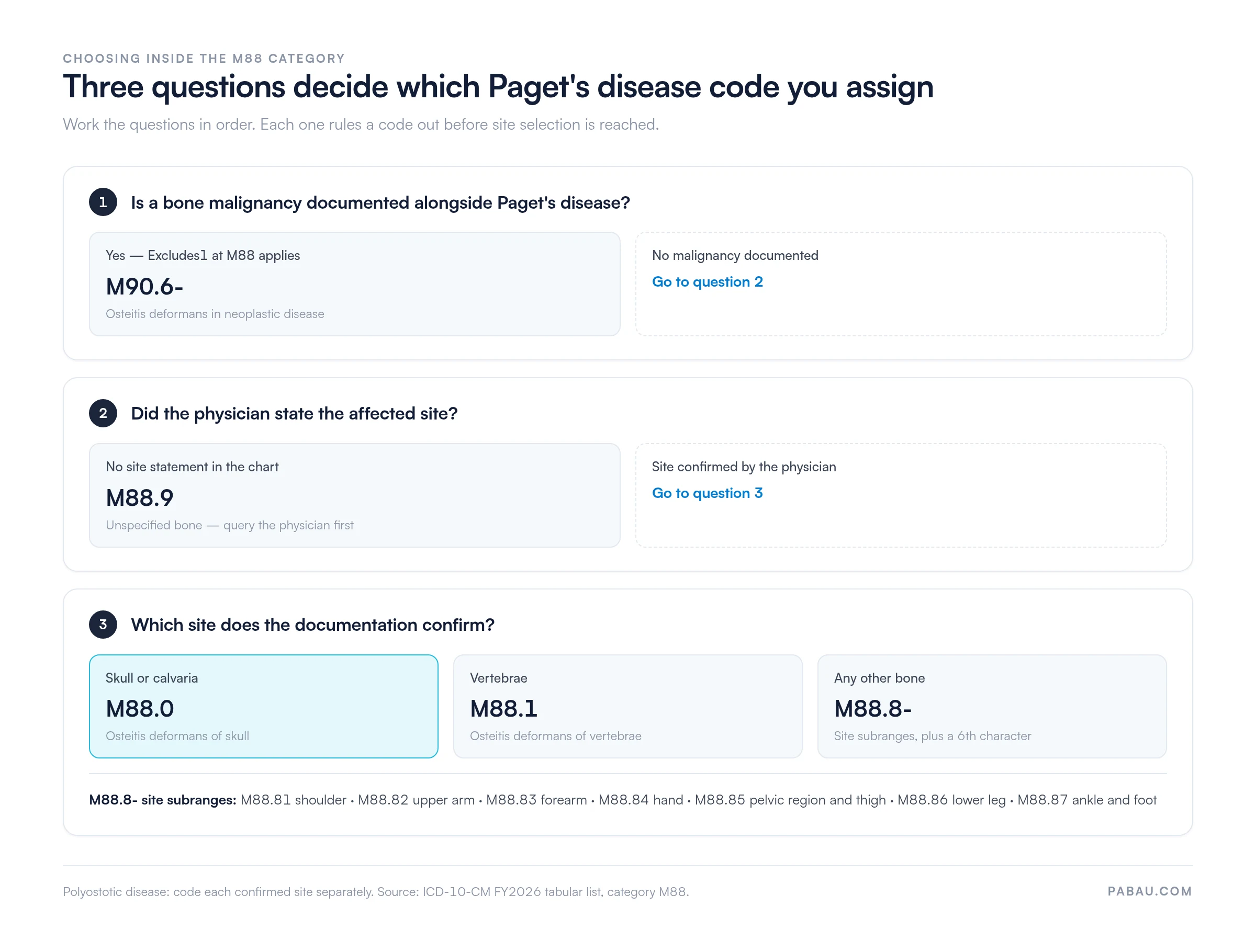
The scenario table below gives the same decision as a lookup.
A claim for M88.0 survives payer audit only when the clinical note carries an explicit skull-site statement from the treating physician. Coders cannot infer skull involvement from elevated alkaline phosphatase or from a generic Paget’s diagnosis alone. Anatomic specificity has to be physician-stated, never coder-derived.
Coders reviewing charts for M88.0 need to know which findings support a skull-site diagnosis, and which only support a generic Paget’s finding.
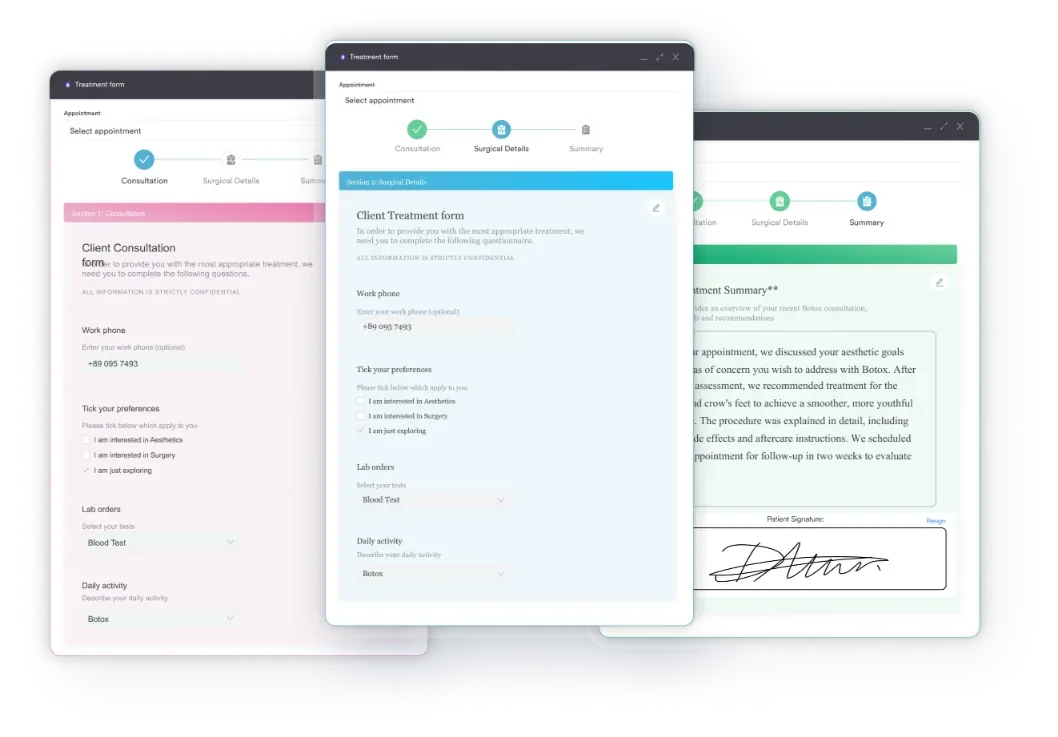
Structured digital forms make that statement easier to capture at the point of care. A site-specific field on the intake form prompts the clinician to record skull confirmation alongside the relevant lab values.
No CMS National Coverage Determination (NCD) exists specifically for Paget’s disease of bone. Coverage for the associated procedures therefore sits with the Local Coverage Determinations (LCDs) published by each Medicare Administrative Contractor (MAC). Commercial payer policies govern the rest.
Check the CMS list of CPT/HCPCS codes and the applicable MAC LCD for every procedure billed alongside M88.0. Payers expect medical necessity to be established before they authorize a high-cost procedure.
Confirm insurance eligibility and benefit limits before the date of service. That matters most for infusion procedures, where a failed prior authorization generates an immediate denial.
M88.0 is denied more often than most metabolic bone disease codes, because a reviewer can see straight away whether the chart names the skull. The five patterns below are the ones worth building a check around. For the wider process, denial management workflows cover how practices catch these errors before submission.
Each of those five is catchable at the claim-build stage, while the claim can still be corrected. Claim scrubbing inside practice management software like Pabau checks the diagnosis-procedure pair against payer edits before the file leaves the practice.
Correct CPT-to-diagnosis pairing reduces edit failures and supports medical necessity. The CPT codes below are the procedures most often ordered in the evaluation and management of Paget’s disease of the skull. Cross-reference each one against your MAC’s current LCD and CCI edits before use, since LCD policies are updated quarterly.
A structured superbill keeps these pairings explicit on the way out. Listing each CPT line against the diagnosis it supports removes the ambiguity that slows a claim at the clearinghouse.
Run a bone-specific ALP result alongside your nuclear bone scan report before billing M88.0 with CPT 96413. Payers approving IV bisphosphonate infusion for Paget’s disease of skull expect both biochemical disease activity and imaging-confirmed site involvement in the prior-authorization package. Missing either increases the likelihood of a medical-necessity denial.
In most practices the skull-site check happens twice, by hand. A coder reads the note and decides whether M88.0 is supportable. A biller then re-checks the pairing against the payer’s edits once the claim is built. Neither check leaves a record the next person can follow.
Pabau’s claims management software moves both checks into the claim itself. Diagnosis-procedure pairs are validated at the claim-build stage. Eligibility is confirmed before the date of service, so a prior-authorization problem surfaces while there is still time to fix it.
The charting side feeds the same record. Intake and consultation forms carry the site-specific fields that make skull confirmation explicit. The coder then reads a stated diagnosis instead of inferring one from an imaging report.

Pabau integrates with Claim.MD to validate ICD-10-CM codes and run real-time eligibility checks before claims leave your practice. Fewer rejections, faster payment.

Accurate assignment of ICD-10 code M88.0 depends on a single, non-negotiable requirement: Physician-stated skull-site documentation backed by imaging confirmation. Without it, coders default to M88.9 and claims enter a medical-necessity review cycle that delays reimbursement and consumes staff time.
The trade-off worth remembering is that a query to the physician costs minutes, while an M88.9 denial costs a full rework cycle. Ask the question before the claim goes out, not after the remittance comes back. Book a demo to see how Pabau keeps skull-site documentation and M88.0 claim validation in one workflow.

Need a framework for managing ICD-10-CM claim rejections? Denial codes in medical billing explains CARC and RARC codes so your billing team can action M88.0 rejections systematically.
Submitting ICD-10 claims electronically for the first time? 837 electronic claim file guide walks through the 837P format requirements for professional claims, including diagnosis code placement.
Want to verify eligibility before billing M88.0-linked procedures? Insurance eligibility verification covers real-time benefit checks that reduce prior-auth surprises on M88.0 claims.
ICD-10 code M88.0 is the billable ICD-10-CM diagnosis code for osteitis deformans of skull. It is also called Paget’s disease of bone limited to the skull. It belongs to the M88 parent category (Osteitis deformans / Paget’s disease of bone) and is valid for FY2026 diagnosis coding. The code requires documented skull involvement confirmed by physician statement and supported by imaging such as skull X-ray, CT, or nuclear bone scan.
Yes, M88.0 is a billable ICD-10-CM code valid for diagnosis submission in FY2026 (October 1, 2025 through September 30, 2026). It is a leaf-node code, meaning it has sufficient specificity for claim submission without requiring an additional character. Verify against the annual CDC/NCHS ICD-10-CM tabular list at each code-year update to confirm it remains active.
M88.0 designates osteitis deformans of the skull. M88.1 designates osteitis deformans of the vertebrae. Both are site-specific child codes under the M88 parent category. Choose M88.0 when imaging and physician documentation confirm skull involvement, and M88.1 when spinal involvement is confirmed. Do not assign both for polyostotic disease unless both sites are explicitly confirmed. Where a patient has Paget’s at the skull and another non-vertebral site, pair M88.0 with the applicable M88.8- code.
The M88 Excludes1 note prohibits coding M88.0 alongside osteitis deformans in neoplastic disease (M90.6-). These two codes are mutually exclusive. When Paget’s disease occurs alongside a bone malignancy, M90.6- is the correct code. M88.0 must not appear on the same claim. There is no Excludes2 note at M88.0, so no circumstance permits coding both simultaneously.
Elevated serum alkaline phosphatase (ALP), particularly bone-specific ALP, is the primary biochemical marker for Paget’s disease activity, per Endocrine Society clinical practice guidelines. However, ALP elevation alone does not confirm skull involvement and cannot substitute for imaging or physician site documentation. Urinary hydroxyproline, though historically used, has largely been replaced by bone-specific ALP and bone turnover markers in current practice.
The most common M88.0 denial reason is absent skull-site documentation. The physician recorded Paget’s disease without naming the skull, and the coder assigned M88.0 anyway. Other triggers include coding M88.0 alongside an excluded neoplastic osteitis code, or submitting a mismatched CPT-to-diagnosis pairing. A missing prior authorization for IV bisphosphonate infusion will also stop the claim.