ICD-10 Code S42.444P: Medial epicondyle fracture, right humerus
ICD-10 Code S42.444P: full descriptor and code validity ICD-10 Code S42.444P car...

Last Updated: Oct 13, 2026
Billable Code Specific Code
M27.0 is the billable ICD-10-CM code for developmental disorders of jaws.
Let Pabau's smart automation suggest the right codes, reduce claim denials, and keep your practice compliant—effortlessly.
Automate repetitive tasks and focus on what matters most—your patients.
Reduce coding errors and ensure compliance with the latest regulations.
Clean claims, fewer denials, and faster reimbursements.
Powerful insights and reporting to help your practice thrive.
HIPAA compliant SOC 2 certified GDPR-compliant Trusted by 4,000+ clinics worldwide

ICD-10 code M27.0 is a billable, specific diagnosis code for developmental disorders of jaws, effective October 1, 2025.
M27.0 covers four conditions: torus mandibularis, torus palatinus, Stafne cyst, and latent bone cyst of jaw.
The FY2026 tabular list gives M27.0 inclusion terms only. It carries no excludes note of its own.
M27.0 is a diagnosis code only. Tori removal is billed beside it with CPT 21031 or CDT D7473.
Practice management software like Pabau links the jaw finding to the code, so claims ship with the documentation behind them.
ICD-10 code M27.0 is defined as “Developmental disorders of jaws” in the 2026 edition of the CDC/NCHS ICD-10-CM code set. It is billable and specific, so no further digits are needed and it can go straight onto a claim. The 2026 edition took effect on October 1, 2025 and is valid through September 30, 2026. That window follows the annual Centers for Medicare and Medicaid Services (CMS) update cycle.
M27.0 sits within a four-level hierarchy in the ICD-10-CM tabular list. Knowing that hierarchy helps you navigate to the right subcategory and defend your code choice during an audit. The table below shows the full classification path.
M27.0 sits at the most specific level of this branch, so it is a complete code for claim submission under the CMS ICD-10-CM framework.
The ICD-10-CM tabular list gives M27.0 four inclusion terms. Each one is a benign developmental variant of jaw anatomy rather than a tumor or an inflammatory lesion. Check that the documented diagnosis matches one of the four before you assign the code.
Torus mandibularis is a bony protuberance on the lingual surface of the mandible, usually bilateral and in the premolar region. Torus palatinus forms along the midline of the hard palate. Both are benign developmental variants. They rarely need treatment unless they interfere with prosthetic fitting, speech, or oral hygiene.
Neither torus has a code of its own. A torus palatinus ICD 10 search and a mandibular tori ICD 10 search both resolve here. The classification treats the two tori as one developmental group.
Prevalence studies put torus mandibularis at roughly 5% to 40% of adults, with wide variation by ethnicity. Neither condition is neoplastic. The clinical record should confirm that the lesion is bony, non-tender, and consistent with a developmental origin. When an oral surgeon documents removal of a torus, M27.0 is the primary diagnosis code driving the procedure.
Stafne’s cyst, also called a latent bone cyst of the jaw or a Stafne bone cavity, usually turns up incidentally on a panoramic radiograph. It appears as a well-defined radiolucency near the angle of the mandible, below the inferior dental canal. Despite the name, the lesion is a corticated depression in the mandibular cortex, caused by the position of the submandibular salivary gland.
Because a Stafne’s cyst is asymptomatic and benign, many clinicians confirm it radiographically and then monitor it. When an encounter documents the finding and needs a diagnosis code, M27.0 is the right choice. Record the imaging characteristics that support the Stafne bone cavity before you assign the code. The differential includes other jaw lesions that take different codes.
The FY2026 tabular list gives M27.0 inclusion terms only. It carries no Excludes1 or Excludes2 note of its own, so the boundaries come from the descriptions of the neighboring codes. Reading those neighbors wrongly is a common cause of claim rejection on jaw disorder codes.
Dentofacial anomalies belong in M26. That category covers relationship and positional problems between the teeth and the jaws, including malocclusion. M27.0 covers developmental structural variants of the jaw bone itself. The two sit side by side in the same block, which is why they get mixed up.
M27.0 versus M27.4. M27.4 covers cysts of the jaw that are not classified elsewhere in the category. A Stafne’s cyst is named in the M27.0 inclusion terms, so it never migrates to M27.4. M27.4 also needs a fifth character, either M27.40 for an unspecified jaw cyst or M27.49 for another specified one.
Inflammatory conditions sit elsewhere in M27. Osteitis and related inflammation of the jaws go to M27.2, and alveolitis of the jaws goes to M27.3. Central giant cell granuloma takes M27.1. None of the three belongs with the developmental variants under M27.0.
Before you assign M27.0, check that the notes call the finding developmental or congenital and benign. It also has to match one of the four inclusion terms. If the notes say only ‘jaw cyst’, query the provider rather than defaulting to M27.0 or M27.4.
The M27 category spans M27.0 through M27.9 and covers a range of jaw pathology. Coders in oral surgery, maxillofacial surgery, and dental practices meet several of these codes regularly. The AAPC ICD-10-CM lookup tool and the official CDC tabular list are the references for confirming subcategory descriptions. The table below summarizes the most commonly used M27 subcategories and their billable status.
M27.4, M27.5, and M27.6 all need a fifth character before a payer will accept them. M27.0 is one of the simpler codes in the category, because it is complete and specific at four characters. When the documentation supports nothing more precise, M27.9 is the fallback.
Recording these codes is quicker in osteopathy practice software that links diagnoses to treatment plans.
Applying M27.0 correctly depends on what the provider actually wrote down. Solid compliance management in oral surgery billing starts with the four requirements below.

Common errors include assigning M27.0 to a jaw cyst that belongs in M27.40 or M27.49, or to an inflammatory lesion that belongs in M27.2. Both hurt claim accuracy and raise audit risk. Checking the alphabetic index entry for “Torus mandibularis” confirms the direct reference to M27.0, which is a quick pre-submission check. Structured practice management workflows that link diagnosis selection to note templates cut these errors down.
M27.0 is valid for FY2026 billing under the CMS ICD-10-CM annual update that took effect on October 1, 2025. Its billable and specific status means payers will adjudicate a claim on it without any further digits.
Reimbursement for the associated procedure depends on the payer and the procedure itself, not on the diagnosis code. Coverage for torus removal varies between commercial carriers. Some require documented functional impairment, such as interference with denture placement or recurrent trauma, before they approve surgical removal.
Others treat the removal as a non-covered cosmetic procedure unless necessity is established. Correct code assignment does not guarantee payment.

For a Stafne’s cyst, the reimbursement question is usually whether treatment happened at all. Most cases are monitored rather than treated, so the encounter often bills as an evaluation and management visit with M27.0 as the diagnosis. Practices running that kind of visit through primary care software still need the finding, the imaging, and the monitoring plan in one note.
Check payer LCD or NCD policies before you pair a surgical CPT code with M27.0. The WHO ICD-10 framework is the foundational reference, but US payer adjudication follows CMS rules and individual plan policies.
M27.0 never pays a practice on its own. It is a diagnosis code, so a tori removal claim has to carry a procedure code beside it. Dental plans use CDT codes for the excision, and medical plans use the CPT equivalents. The mandibular tori removal CPT code is 21031, and the palatal equivalent is 21032.
M27.0 still belongs on that claim as the supporting diagnosis. Without it the payer has no documented reason for the excision, which is where denials start.
When you bill torus removal with M27.0, add a short medical necessity statement to the note. Name the functional impact, such as interference with a mandibular denture or recurrent soft tissue trauma. That one paragraph often decides approval on a commercial payer claim.
Oral surgery and maxillofacial practices that handle torus removal and Stafne’s cyst monitoring face the same task every time. The clinical finding has to connect to the right ICD-10 code, and that connection has to survive all the way to the claim.
Generic note templates and freehand notes tend to produce records that are clinically sound but thin on billing detail. Practice management software like Pabau lets you build structured note templates in its clinical record management tools. The template prompts the clinician to name the developmental lesion, confirm it is benign, and attach the imaging reference.
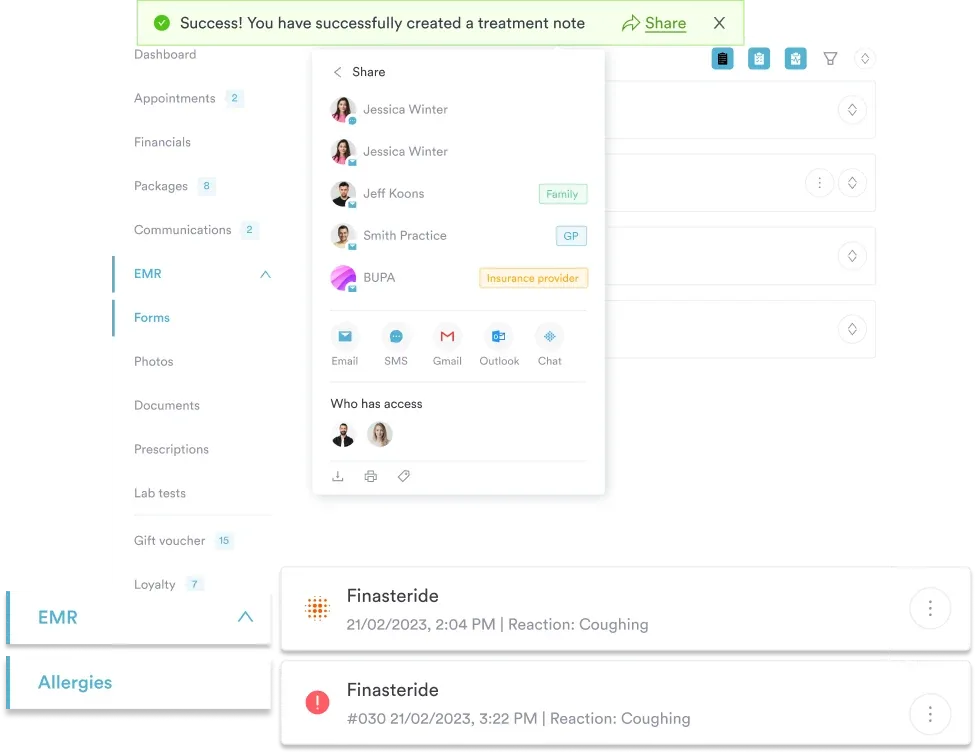
When a torus removal flows through that template, the coder gets a consistent record that supports M27.0 without a follow-up query. Your billing team then works from the same fields the clinician filled in, so nothing has to be reconstructed weeks later.

For a practice billing several jaw pathology encounters a week, structured workflows also cut the time billers spend chasing paperwork. Pabau’s digital intake forms and clinical notes feed the billing process directly. Surgical teams can see how the same tooling works in a procedure-heavy setting through Pabau’s plastic surgery software.

Pabau helps oral surgery and maxillofacial practices capture structured notes, record the diagnosis, and send claims with the documentation that supports M27.0. Fewer queries come back from the billing team.

M27.0 rewards precision in the note rather than precision in the codebook. The code has one job, and the four conditions under it are unambiguous. What decides the claim is whether the record states the developmental origin in words a payer can read.
So build that prompt into the template instead of relying on memory at the end of a busy list. Do it and the M27.0 versus M27.40 question stops coming up, and torus removal claims carry their necessity statement the first time. Skip it and you will keep querying providers weeks after the encounter.
For practices processing jaw pathology claims every week, the documentation setup matters as much as the coding knowledge. Book a demo to see how Pabau connects a jaw diagnosis to a clean claim for oral surgery teams.

Reconstructing a mandible after a larger jaw lesion? CPT code 20970 sets out the free osteocutaneous flap billing rules and the operative detail behind them.
Coding a head or face injury months after the event? S01.05XS shows how the sequela extension changes what a claim needs.
Coding a late effect of pregnancy? sequelae of pregnancy complication code applies once the original complication has resolved and the patient returns for a residual condition it caused.
Coding a NICU admission diagnosis? respiratory distress syndrome of newborn code is the billable diagnosis for a surfactant-deficiency condition common in NICU admissions.
ICD-10 code M27.0 reports developmental disorders of jaws, specifically torus mandibularis, torus palatinus, Stafne’s cyst, and latent bone cyst of jaw. Use it when a clinician has diagnosed one of those four benign developmental variants. The encounter also has to need a billable diagnosis code for a claim or for the record.
Yes. M27.0 is a billable and specific ICD-10-CM code, valid for fiscal year 2026 from October 1, 2025. No additional digits are required, so it can go straight onto a claim without a further specificity code.
M27.0 covers developmental disorders of jaws, and its inclusion terms name torus mandibularis, torus palatinus, Stafne’s cyst, and latent bone cyst of jaw. M27.4 covers other and unspecified cysts of jaw that are not classified elsewhere in the M27 category. A Stafne’s cyst is listed under M27.0, so it should never be coded to M27.4. M27.4 also needs a fifth character, either M27.40 or M27.49.
No. The FY2026 ICD-10-CM tabular list gives M27.0 inclusion terms only, with no Excludes1 or Excludes2 note attached to the code. The boundaries come from the neighboring code descriptions instead. Dentofacial anomalies such as malocclusion belong in the M26 category, and inflammatory jaw conditions belong in M27.2 or M27.3.
Torus mandibularis is a benign bony protuberance on the lingual surface of the mandible, usually bilateral. It is a developmental variant rather than a pathological lesion. Code it to M27.0 when a clinician documents it. When surgical removal is performed, usually for prosthetic fitting, M27.0 is the primary diagnosis supporting the procedure claim.
M27.0 for FY2026 became effective on October 1, 2025 and runs through September 30, 2026. That follows the annual CMS update cycle. The definition and the included conditions are unchanged from prior editions, and the 2026 update confirms continued billable status.
A Stafne cyst, also called a latent bone cyst of jaw, is classified under ICD-10 code M27.0. It is one of the code’s four inclusion terms. The diagnosis is usually confirmed radiographically, so M27.0 fits an office encounter where the finding is documented and monitored.
Tori removal is billed with a procedure code, not with M27.0. Dental plans use CDT D7473 for a torus mandibularis and D7472 for a torus palatinus. A medical plan claim uses CPT 21031 for the mandible and 21032 for the maxillary torus palatinus. M27.0 goes on the claim as the supporting diagnosis.