ICD-10 Code S42.444P: Medial epicondyle fracture, right humerus
ICD-10 Code S42.444P: full descriptor and code validity ICD-10 Code S42.444P car...

Last Updated: Oct 13, 2026
Billable Code Specific Code
M27.3 is the billable ICD-10-CM code for alveolitis of jaws. It covers dry socket and alveolar osteitis, the inflammation of an extraction socket that follows a failed or dissolved blood clot. The 2026 edition took effect on October 1, 2025.
The code turns on the wording of the note. Clinical documentation has to confirm alveolitis as the active diagnosis, not post-extraction discomfort, for the claim to hold up under payer review.
Let Pabau's smart automation suggest the right codes, reduce claim denials, and keep your practice compliant—effortlessly.
Automate repetitive tasks and focus on what matters most—your patients.
Reduce coding errors and ensure compliance with the latest regulations.
Clean claims, fewer denials, and faster reimbursements.
Powerful insights and reporting to help your practice thrive.
HIPAA compliant SOC 2 certified GDPR-compliant Trusted by 4,000+ clinics worldwide

M27.3 is the billable ICD-10-CM code for alveolitis of jaws, effective October 1, 2025.
Dry socket and alveolar osteitis are the two official synonyms, so the note must name one of them.
M27.3 covers socket-specific inflammation, while M27.2 covers wider jaw conditions such as osteomyelitis.
Five documentation elements decide whether an M27.3 claim survives a payer audit.
Pabau links the clinical note to claim submission, so the code you document is the code you bill.
ICD-10 Code M27.3 is the billable diagnosis code for alveolitis of jaws, the condition most practices chart as dry socket. It sits in the M27 category, other diseases of jaws, inside chapter M00-M99 of the WHO ICD-10 classification system. The US adaptation of that system is ICD-10-CM.
The table below captures every reference field a coder needs before assigning the code.
Alveolitis of the jaws is inflammation of the alveolar bone socket. It occurs when the protective blood clot that normally forms after a tooth extraction dissolves or never develops. That leaves the underlying bone and nerve endings exposed to the oral environment.
The result is severe, poorly localized pain that usually begins two to four days after the extraction. It is far worse than what the patient reported in the immediate post-operative period.
The pathophysiology matters for coding because the condition has to be documented as a distinct diagnosis, not as post-extraction soreness. Clinicians should record the absent clot, the exposed bone, and the radiating pain pattern that supports M27.3.
The official ICD-10-CM tabular index lists two approximate synonyms for M27.3:
Practices also chart the same condition under informal variants. These are not index entries, but they describe alveolitis of the jaws and point to the same code:
When a patient chart uses any of these terms, M27.3 is the correct ICD-10-CM code. The documentation signal is that the note names the condition, rather than recording “pain after extraction.”
ICD-10 code M27.3 applies when the clinical record documents alveolitis as an active, confirmed diagnosis. Tooth extraction is the most common trigger. The code can still be assigned whenever alveolitis of the jaw is the treating provider’s stated diagnosis, whatever the cause. The CMS ICD-10-CM coding guidance asks coders to reflect the condition the encounter is chiefly treating.
Clinical scenarios that warrant M27.3:
Do not assign M27.3 for generalized post-extraction discomfort or expected healing tenderness. The record must show a provider assessment naming alveolitis, or one of its synonyms, as the active condition.
The CDC/NCHS ICD-10-CM official coding tool and the annual ICD-10-CM Official Guidelines for Coding and Reporting govern how M27.3 is assigned. The clinical record needs all five elements below before the code can be assigned with confidence.
A note that records only “patient returned with dry socket, irrigated and packed” leaves out the clinical findings and the affected site. An auditor reads both omissions as unsupported coding, so capturing all five elements protects the practice.
Flag alveolitis visits in your practice management system as post-procedure complication encounters. This bills the visit with M27.3 as the primary diagnosis rather than a follow-up visit code. It also creates an audit trail linking the extraction date to the complication.
M27.3 sits within the M27 parent category alongside several sibling codes covering other jaw conditions. Picking the wrong sibling is the most common error on this code. The table below shows every M27 sibling with its descriptor and its coding distinction from M27.3.
M27.2 and M27.3 are the two codes coders confuse most often in this category. The split comes down to what the note names. M27.3 is correct when the record specifically states alveolitis, dry socket, or alveolar osteitis. M27.2 covers the wider jaw conditions in its own descriptor, where alveolitis is not the documented diagnosis.
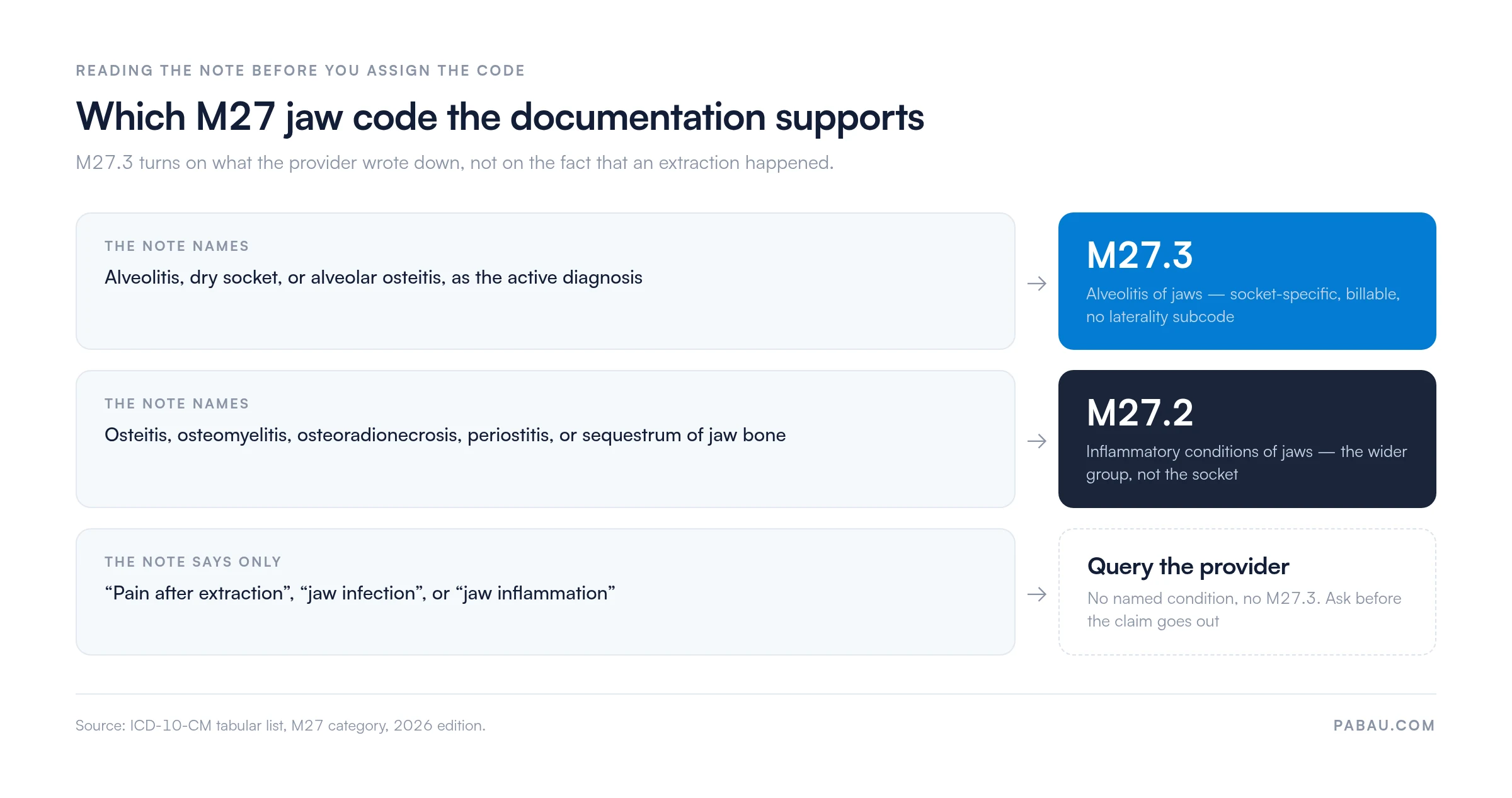
ICD-10-CM guidelines direct coders to assign the most specific code available. Where the documentation is clear, M27.3 beats M27.2 for alveolitis. Where the note says only “jaw infection” or “jaw inflammation”, M27.2 may be the right choice until the treating provider clarifies.
Most M27.3 encounters follow a tooth extraction. Working the claim in a fixed sequence reduces errors and supports medical billing compliance. Per the AAPC ICD-10-CM code reference, a post-procedural complication is coded as the principal diagnosis when the encounter exists to treat it.
M27.3 is billable, but reimbursement varies by payer. Medical insurance covers post-extraction alveolitis when it follows a covered medical procedure. Dental coverage depends on the patient’s plan and on whether the extraction itself was a covered benefit. Verify coverage before submitting, and document medical necessity clearly.
Payers often deny M27.3 claims when the supporting documentation never separates alveolitis from routine post-operative recovery. Reviewing denial codes in medical billing helps billing staff spot patterns in M27.3 rejections before they turn into write-offs.
Practice management software like Pabau submits claims electronically through Claim.MD, a clearinghouse that reaches thousands of US payers. Eligibility is checked in real time before the claim leaves the practice, so a coverage problem surfaces while you can still act on it.
Three reasons account for most M27.3 rejections. The note never states the alveolitis diagnosis, the billed procedure does not match the stated diagnosis, or the payer enforces a complication window. Reading the remittance line by line is how billing staff recover that revenue instead of writing it off.
Accurate ICD-10 coding needs two pieces working together. The clinical note has to capture every required element at the point of care. The billing workflow then carries that note into the claim without manual re-entry. Where a coder has to chase the provider to learn whether the patient had dry socket or post-op pain, M27.3 denials climb.
Pabau’s claims management software connects the clinical note to ICD-10 code selection inside one platform, so the diagnosis reaches the claim as written. Structured intake forms capture patient history, the current complaint, and clinical findings in a consistent format that feeds the encounter note.
Documentation arrives complete, the billing team stops sending clarification requests, and the chart holds up at audit without pulling the treating provider back into it.

Pabau connects your clinical documentation to billing and electronic claim submission in one workflow. Code M27.3 accurately and the clean claim goes out the door.

M27.3 is an easy code to assign and an easy one to lose at audit. The difference is never the extraction. It is whether the note names alveolitis, dry socket, or alveolar osteitis. The findings, the extraction history, the affected jaw, and the treatment have to sit alongside that name.
So treat the documentation template as the coding control, not the coder’s judgment after the fact. Practices that fix the note fix the denial rate with it. Book a demo to see how Pabau carries a dental or oral surgery note straight through to a clean M27.3 claim.

Need guidance on clean claim submission? Clean claim best practices covers the field-level requirements that prevent denials before submission.
Want to understand how clearinghouses process claims? Medical claims clearinghouse explained walks through how 837P transactions reach payers and what happens when they reject.
Looking to improve your revenue cycle documentation? Revenue cycle management overview covers the end-to-end process from code assignment through payment posting.
ICD-10 Code M27.3 is the billable ICD-10-CM diagnosis code for alveolitis of jaws. The condition is inflammation of the alveolar bone socket, most often dry socket following a tooth extraction. M27.3 became effective October 1, 2025 under the 2026 ICD-10-CM edition and sits in the M27 category of the musculoskeletal chapter (M00-M99).
Yes, M27.3 is a billable and specific ICD-10-CM code. It can be reported as a standalone diagnosis for reimbursement without a more specific subcode. Payer acceptance still varies, and individual insurers may set their own documentation requirements or coverage windows for post-extraction complication encounters.
Dry socket is coded with M27.3 (alveolitis of jaws). Dry socket and alveolar osteitis are the two terms the official ICD-10-CM tabular index lists as approximate synonyms for M27.3. Informal chart variants such as post-extraction dry socket point to the same code, but they are not index entries. The record must name the condition rather than describe post-extraction pain.
M27.3 is specific to alveolitis of the jaw socket, meaning dry socket and alveolar osteitis. M27.2 covers inflammatory conditions of the jaws more broadly, including osteitis, osteomyelitis, osteoradionecrosis, periostitis, and sequestrum of jaw bone. When the documentation names alveolitis or dry socket, M27.3 is the more precise and correct choice.
Assign M27.3 when the provider’s note explicitly diagnoses alveolitis, dry socket, or alveolar osteitis as the active condition. That typically happens at a return visit two to five days after the extraction. Do not assign M27.3 for routine post-operative pain or expected healing discomfort, because the diagnosis has to be stated in the record.
M27.3 requires no mandatory additional diagnosis codes. Pair it with the procedure code for the treatment rendered, such as irrigation, a medicated dressing, or the follow-up visit. Where the alveolitis followed a prior surgical extraction, some payers ask for documentation linking the two encounters rather than an extra diagnosis code.