ICD-10 code S90.475A: Other superficial bite of left great toe
What is ICD-10 code S90.475A? ICD-10 code S90.475A is the billable diagnosis cod...

Last Updated: Nov 18, 2026
Billable Code Specific Code
M25.511 is the billable ICD-10-CM code for pain in right shoulder. It covers right shoulder joint pain when the note confirms no more specific diagnosis.
The code sits in Chapter 13 of ICD-10-CM, Diseases of the musculoskeletal system and connective tissue, within the M25 category for other joint disorders. When a structural diagnosis such as a rotator cuff tear or shoulder impingement is confirmed, its more specific code replaces M25.511.
Let Pabau's smart automation suggest the right codes, reduce claim denials, and keep your practice compliant—effortlessly.
Automate repetitive tasks and focus on what matters most—your patients.
Reduce coding errors and ensure compliance with the latest regulations.
Clean claims, fewer denials, and faster reimbursements.
Powerful insights and reporting to help your practice thrive.
HIPAA compliant SOC 2 certified GDPR-compliant Trusted by 4,000+ clinics worldwide

M25.511 covers right shoulder pain only, so use M25.512 for the left shoulder and M25.519 when the note names no side.
The code is valid and billable for FY2027 HIPAA-covered transactions, with no 7th-character extension required.
Once a structural diagnosis such as a rotator cuff tear is confirmed, its more specific code replaces M25.511 on the claim.
Pabau, the practice management platform we build, validates each claim for missing or invalid details before it reaches the clearinghouse.
ICD-10 Code M25.511 is the billable ICD-10-CM code for pain in the right shoulder, titled “Pain in right shoulder” in the tabular list.
It appears in CMS’s 2027 ICD-10-CM code files, which apply to encounters from October 1, 2026, through September 30, 2027. The code is valid on CMS-1500 and 837P claims, and no 7th-character extension applies.
The M25.51 parent code is not itself billable, so coders pick a laterality-specific child code instead. That means M25.511 for the right shoulder, M25.512 for the left, or M25.519 when the note names no side. Submitting the parent code M25.51 returns an immediate rejection from most clearinghouses.
M25.511 covers joint pain of the right shoulder when no more specific musculoskeletal diagnosis has been established or documented.
Clinically, this includes right-sided glenohumeral joint pain, right acromioclavicular joint pain, and general right shoulder arthralgia attributed to joint pathology without a confirmed structural diagnosis. The code functions as a symptom code rather than a definitive diagnosis code.
The ICD-10-CM tabular list attaches no Excludes1 note to M25.511 itself. The notes that shape its use sit at the parent levels and at R52:
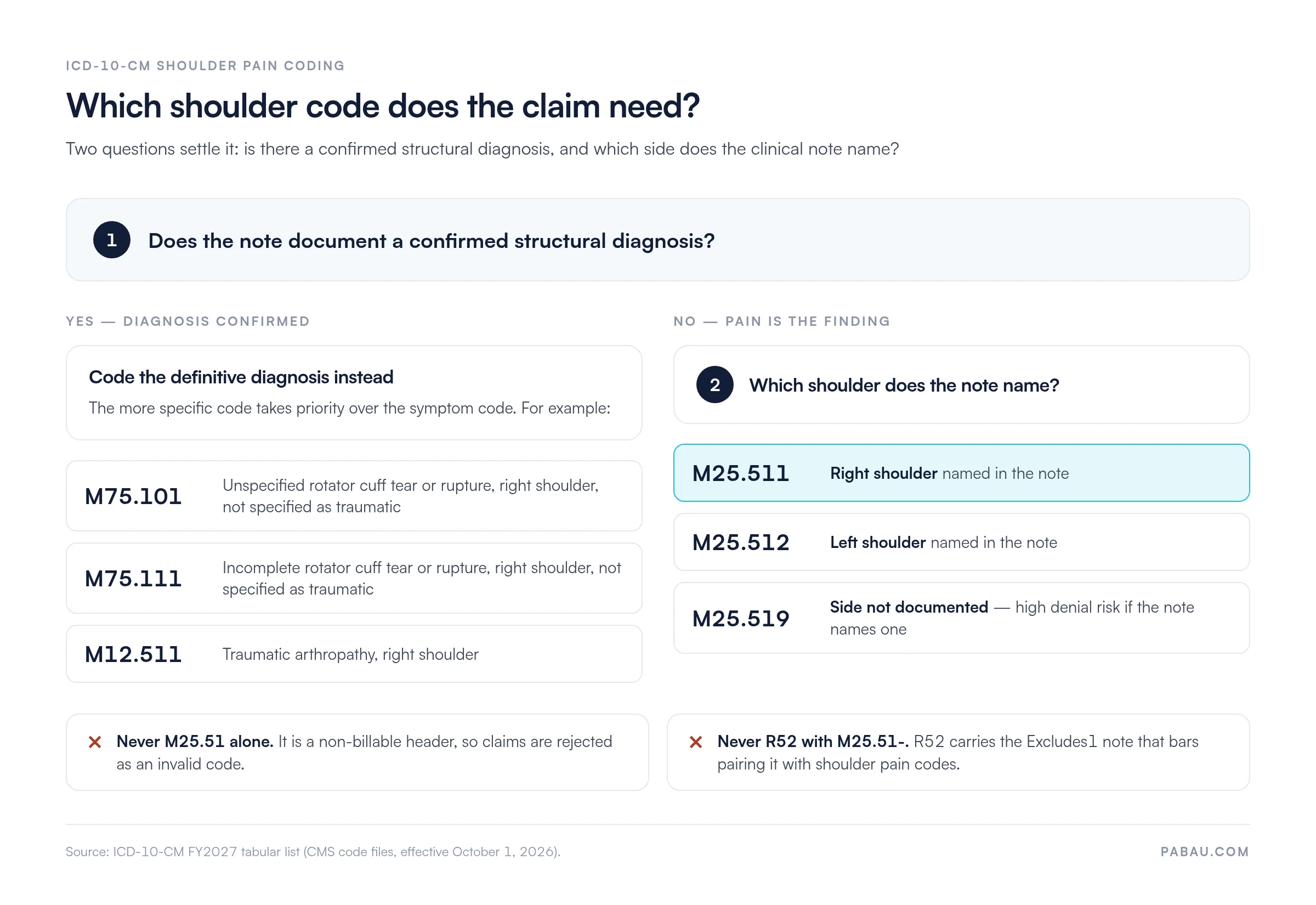
No tabular note bars M25.511 from a claim that also carries a rotator cuff code. The rule that applies is specificity: once the note confirms a structural diagnosis from the M75 category, that code replaces the symptom code. A nontraumatic tear of the right rotator cuff, for example, codes to M75.101 when unspecified or M75.111 when incomplete.
Three codes share the M25.51 family, differentiated only by laterality. Choosing the wrong one is a common and avoidable cause of shoulder pain denials.
Beyond the M25.51 family, two other right shoulder codes are easy to confuse with M25.511:
Choosing among all of these comes down to two checks, shown in the flow below. Rule out a confirmed structural diagnosis first, then match the code to the side the note names.
Accurate use of M25.511 begins with the clinical note. For the code to hold up under payer audit, the following elements must appear in the record.
A detail that looks minor at the point of care becomes a denial trigger at the clearinghouse. A note that says “right shoulder pain, see imaging” without exam findings will not satisfy payer medical necessity criteria for most procedures.
Run a documentation audit before submitting shoulder pain claims. Pull ten recent M25.511 encounters and confirm each note states explicit laterality, joint location, onset, and exam findings. Missing any one of these elements puts the claim at risk, so fix each note before the claim goes out.
M25.511 pairs with a predictable set of CPT procedure codes across evaluation, imaging, and treatment. The table below lists the most frequently co-billed codes and the medical necessity connection each requires.
Payer acceptance of these pairings varies by plan and local coverage determination. Confirm current LCD policies before submission, particularly for 73221 and 20610, which often carry prior authorization requirements. In the US, Pabau checks insurance eligibility through Claim.MD before the visit, so coverage is confirmed before the appointment instead of after a denial.
M25.511 is a symptom code, and that designation influences how payers evaluate medical necessity and authorization requests. Medicare and many commercial payers will accept M25.511 as the primary diagnosis for E&M visits and plain-film X-rays without prior authorization. Advanced services typically require more.
M25.511 denials cluster around a small set of preventable errors. Understanding each one makes it straightforward to build a checklist into the billing workflow.
Many M25.511 denials start before billing, when the note and the code disagree about the side or the diagnosis. Catching that mismatch late means a rejected claim, a correction and a resubmission weeks after the visit.
In Pabau’s claims management software, claim validation checks every claim for missing or invalid details before it leaves the practice. A rejected claim is flagged “Needs action,” and its fix link opens the exact field that needs correcting.
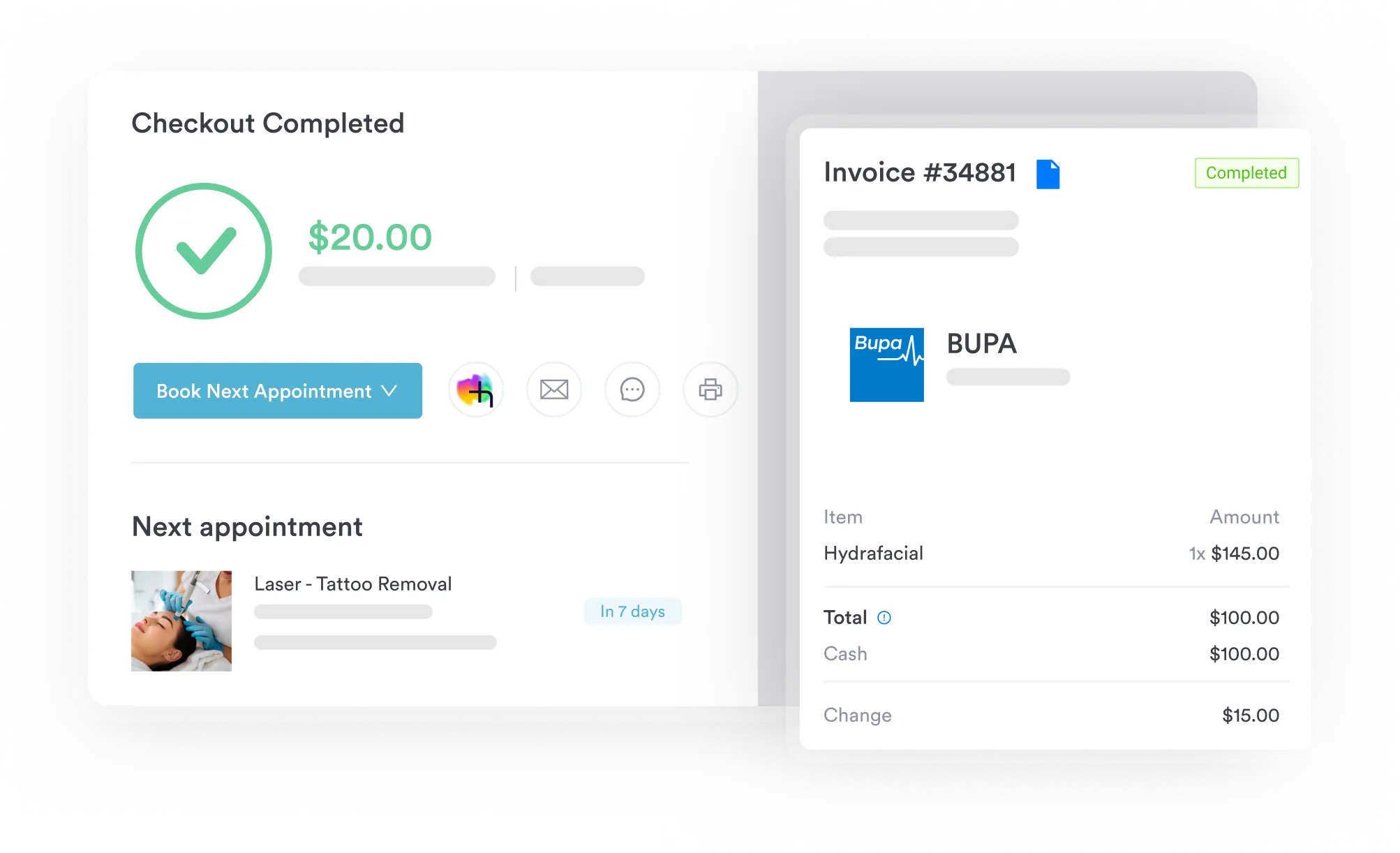
When shoulder pain moves on to imaging or therapy, Pabau stores each prior authorization as a case. The authorization code follows the appointment through to the claim, and the case shows how many approved sessions remain. That record supports the re-authorization requests that physical therapy plans ask for.
In the US, claims go out as CMS-1500 submissions through Claim.MD, and ERA files settle each payment against the original claim.
Before you submit a shoulder pain claim, compare the side named in the note with the sixth character of the code. A 1 means right, a 2 means left and a 9 means unspecified. M25.519 on a note that names a side is a denial waiting to happen.

Pabau’s claim validation, prior authorization tracking and Claim.MD connection help billing teams catch laterality errors and missing details before claims leave the practice.

M25.511 holds up on a claim when three facts line up in the note. The right shoulder is named, joint pain is documented, and no structural diagnosis is confirmed. When any one of those changes, the code should change with it.
The practical step is to make the side and the diagnosis status part of every shoulder note, then check both before the claim is built. That few seconds of review costs far less than a rejection and a resubmission. Book a demo to see how Pabau validates claims and tracks authorizations for musculoskeletal billing.

Need to understand how claims reach payers? Pabau’s clearinghouse guide explains how electronic claims are validated and transmitted to thousands of US payers.
Seeing ERA or remittance issues after submission? Electronic remittance advice explained breaks down 835 remittance files and how to reconcile them against submitted claims.
Want to verify eligibility before the appointment? Insurance eligibility verification covers how real-time benefit checks reduce authorization surprises.
Referring right shoulder pain to physical therapy? CPT code 97162 covers the moderate-complexity PT evaluation that often follows an M25.511 visit.
ICD-10 Code M25.511 is the billable ICD-10-CM diagnosis code for pain in the right shoulder. It covers right glenohumeral and shoulder joint pain when no more specific structural diagnosis has been confirmed. It sits under Chapter 13 (Diseases of the musculoskeletal system) within the M25 block for other joint disorders not elsewhere classified.
Yes, M25.511 is a billable, specific ICD-10-CM code valid for HIPAA-covered transactions in fiscal year 2027. The parent code M25.51 is not billable, so always submit the laterality-specific child code.
M25.511 is for right shoulder pain, M25.512 is for left shoulder pain, and M25.519 is for shoulder pain when the note names no side. Using M25.519 when the note documents a side is a denial risk. It breaks the ICD-10-CM guideline to code to the highest specificity available.
The most common pairings are E&M visits (99202-99215), shoulder X-ray (73030), joint MRI (73221) and musculoskeletal ultrasound (76881, 76882). Joint injection (20610) and physical therapy evaluation (97162) round out the list. Payer acceptance of each pairing depends on current local coverage determinations and prior authorization requirements.
Yes, M25.511 can be the primary diagnosis code when right shoulder pain is the main reason for the visit. That holds as long as no definitive structural diagnosis has been established. If a confirmed diagnosis is documented, such as a rotator cuff tear or glenohumeral osteoarthritis, that more specific code becomes the primary diagnosis instead.
The most common triggers are submitting M25.519 when the note names the right side and submitting the non-billable parent code M25.51. Payers also deny claims that keep M25.511 after a definitive diagnosis, such as a rotator cuff tear, is confirmed. Thin medical necessity documentation for imaging or injections is the fourth common cause.
A nontraumatic tear of the right rotator cuff codes to the M75.1- family. Use M75.101 when the tear is unspecified and M75.111 when it is incomplete. Rotator cuff syndrome indexes to M75.10- as well. No Excludes1 note bars these codes from M25.511, but once the diagnosis is confirmed, the M75.1- code is the more specific choice and replaces M25.511.
No. Laterality is built into the ICD-10-CM code itself, and the 1 in the sixth character position specifies the right shoulder. Modifiers such as RT belong on CPT procedure lines, so the diagnosis code needs no laterality designation of its own.