ICD-10 Code S42.444P: Medial epicondyle fracture, right humerus
ICD-10 Code S42.444P: full descriptor and code validity ICD-10 Code S42.444P car...

Last Updated: Oct 13, 2026
Billable Code Specific Code
H82.3 is the billable ICD-10-CM code for vertiginous syndromes in diseases classified elsewhere, bilateral. It reports vestibular symptoms in both ears that a separately coded underlying disease has caused.
Most denials on H82.3 claims come from one mistake. The claim goes out without the etiology code sequenced ahead of H82.3, or without documentation tying the bilateral symptoms to a named disease.
Let Pabau's smart automation suggest the right codes, reduce claim denials, and keep your practice compliant—effortlessly.
Automate repetitive tasks and focus on what matters most—your patients.
Reduce coding errors and ensure compliance with the latest regulations.
Clean claims, fewer denials, and faster reimbursements.
Powerful insights and reporting to help your practice thrive.
HIPAA compliant SOC 2 certified GDPR-compliant Trusted by 4,000+ clinics worldwide

H82.3 is a billable ICD-10-CM manifestation code covering bilateral vertiginous syndromes caused by an underlying disease coded elsewhere.
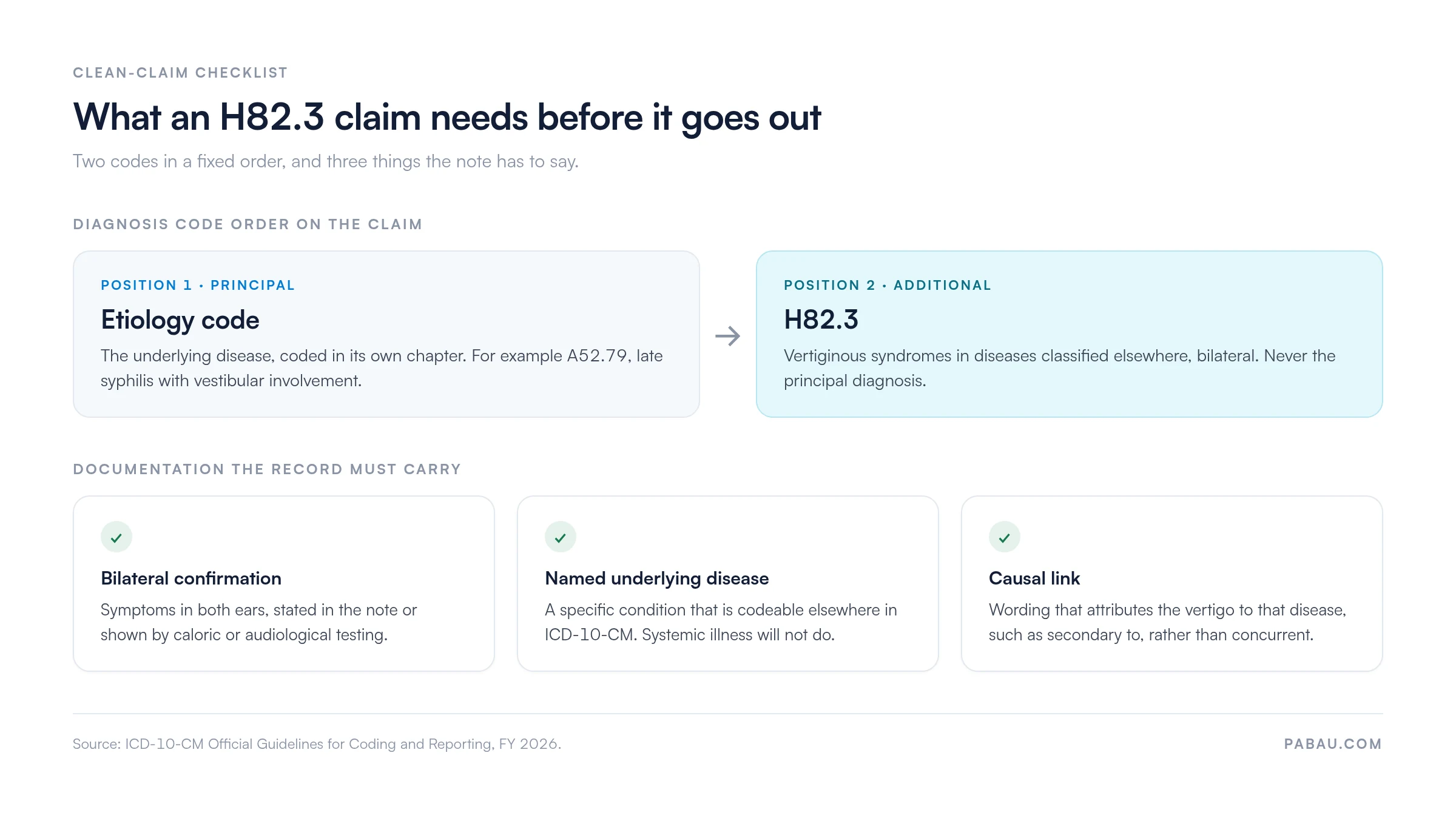
The etiology code for the underlying condition must always be sequenced before H82.3, per ICD-10-CM Official Guidelines Section I.C.
Documentation must state bilateral presentation and explicitly link the vestibular symptoms to the causative disease to avoid payer denial.
Practice management software like Pabau submits H82.3 claims through the Claim.MD clearinghouse and tracks each one to adjudication.
ICD-10 Code H82.3 is the billable diagnosis code for vertiginous syndromes in diseases classified elsewhere, bilateral. It belongs to Chapter 8 (Diseases of the Ear and Mastoid Process, H60-H95) and sits within the H82 category. The table below captures the key attributes coders verify before submitting a claim.
Vertiginous syndromes in diseases classified elsewhere, bilateral means vestibular symptoms affecting both ears at once. Those symptoms include dizziness, a false sense of motion, or disequilibrium. They arise as a direct consequence of an underlying systemic or neurological disease coded under a different ICD-10-CM chapter.
The phrase “classified elsewhere” is the operative signal. It tells the coder that the primary pathology lives in another part of the classification, and that H82.3 documents only its inner-ear manifestation.
Bilateral laterality is clinically significant here. A patient with unilateral vestibular symptoms from an underlying disease would be coded H82.1 (right ear) or H82.2 (left ear), not H82.3. If both labyrinths are affected, the bilateral code is the only correct choice.
H82.3 follows the etiology/manifestation sequencing rule defined in the ICD-10-CM Official Guidelines for Coding and Reporting (CMS). The code for the underlying disease is always sequenced first, and H82.3 is sequenced as an additional code. Payers enforce that order, and a claim carrying H82.3 in the principal diagnosis field will typically deny.
A manifestation code has no standalone clinical meaning without the disease that caused it. That is why the sequencing mandate holds across every code family, rather than varying by payer preference.
Some code pairings carry a “use additional code” note in the tabular list, which reinforces the requirement. Even where that note is absent, the general guideline applies. The provider’s documentation must make the causal relationship explicit, stating that bilateral vestibular symptoms are a direct consequence of the named underlying condition.
Audit the claim before you submit H82.3. The etiology code must appear in field 21 ahead of it. If your billing system auto-populates codes alphabetically, override it manually. One sequencing error means a corrected claim and re-adjudication, which adds days to your collection cycle.
Any systemic or neurological disease that bilaterally damages or disrupts the vestibular apparatus can generate an H82.3 manifestation code. The conditions below are the ones a coder is most likely to meet as the etiology behind bilateral vertiginous symptoms.
Certain psychiatric medications, particularly lithium and tricyclic antidepressants at toxic doses, carry documented vestibulotoxic potential. Where bilateral vestibular symptoms follow drug toxicity, adverse-effect coding rules apply and the appropriate T-code precedes H82.3.
Clean-claim submission for H82.3 depends on three documentation elements being present in the clinical record before coding begins. Missing any one of them creates grounds for a payer denial.
Put together, those three elements and the two-code sequence are what a reviewer looks for on an H82.3 claim.
A pairing check belongs in the billing workflow itself, so every manifestation code leaves the practice with its etiology code attached. Pabau’s claims management software then submits that coded claim through the Claim.MD clearinghouse. It tracks the status back to adjudication, so a rejected pair surfaces within hours rather than at the end of the month.
H82.3 is valid for all HIPAA-covered transactions, but payer policies vary. Some require prior authorization or extra specificity when bilateral vestibular dysfunction follows an autoimmune or drug-induced etiology. Confirm payer LCD and NCD policies before submitting high-dollar claims. Denial management workflows help coders anticipate which reason codes to watch if H82.3 sequencing is challenged.
The H82 category covers vertiginous syndromes in diseases classified elsewhere across four laterality subclassifications. Selecting the wrong subcode is one of the most common errors on vestibular manifestation claims, because the laterality modifier changes the code entirely.
The CDC/NCHS ICD-10-CM web tool lets coders navigate the full H82 family hierarchically and confirm the subcode against the current tabular list. Avoid H82.9 wherever the clinical record documents laterality, since payers increasingly flag unspecified codes for additional documentation requests. If you need to check a related diagnosis code while you work, our ICD-10-CM code library indexes the codes we cover.
Coders often encounter the following terms in clinical documentation that map to H82.3. Recognizing them prevents under-coding (missing the bilateral qualifier) or miscoding to a primary ear disorder code.
Terms like “bilateral Meniere’s disease” do NOT map to H82.3. Meniere’s disease has its own primary code (H81.0x) and is not a disease classified elsewhere. Bilateral benign paroxysmal positional vertigo codes to H81.13 for the same reason. The distinction turns on whether the vestibular pathology is primary or secondary to a separately classifiable condition.
The AAPC ICD-10-CM code lookup carries a synonym index that helps coders cross-reference documentation language against the correct code. That matters most when the provider’s phrasing is non-standard.
H82.3 is not a new code for fiscal year 2026. It has been in the ICD-10-CM tabular list since US adoption of ICD-10-CM, with no description revisions in recent annual updates. The 2026 edition, effective October 1, 2025, retains H82.3 as an active billable code with no new notes and no laterality changes.
Coders can verify the current edition status through the CMS ICD-10 codes page, which publishes tabular list updates and addenda files each August. Staying current on those releases prevents billing against retired or revised codes. Confirm that your billing system’s code catalogue refreshes on the same October schedule.
Set a calendar reminder for early August each year to download the ICD-10-CM addenda file from CMS. Changes take effect October 1. Claims submitted between that date and your own system update may carry retired or revised codes. Even a stable code like H82.3 warrants an annual review for new excludes notes.
In most practices, a sequencing error on an H82.3 claim only surfaces when the remittance advice arrives. By then the coder has moved on, the encounter is weeks old, and someone has to reconstruct what the provider documented.
Pabau keeps the coded encounter, the invoice and the claim on one patient record. Claims go out through the Claim.MD clearinghouse, and every acknowledgment, rejection and payment message comes back to the same screen. Your billers do not log into a separate portal to find out where a claim stopped.
That shortens the loop on the denials this code attracts. A rejected H82.3 pair lands in front of the person who coded it, while the note is still fresh. The corrected claim then goes back out in the same billing cycle.

Pabau sends your coded claims through the Claim.MD clearinghouse and tracks each one to adjudication. Your billers see a rejection the day it lands, not at the end of the month.

The most preventable H82.3 denial is a sequencing error: the manifestation code submitted without the etiology code in position one. Build an edit rule into the billing workflow that requires an etiology code alongside any H82 submission. That removes most of the denial volume before the claim ever leaves the building.
The trade-off worth remembering is that no software supplies the causal statement. That sentence has to come from the provider’s note, so the query happens at documentation time, not at appeal time.
Pabau’s claims management, connected to the Claim.MD clearinghouse, submits your H82.3 claims and tracks each one through to adjudication. Book a demo to see how your coders and billers work from one record instead of two systems.

Need a reference for clean-claim submission standards? Clean claim requirements in medical billing covers the technical and documentation standards payers enforce before adjudicating a claim.
Want to understand how 837 files carry your ICD-10 codes to the payer? The 837 electronic claim file explained breaks down how diagnosis codes, including manifestation code sequences, are structured in HIPAA EDI transactions.
Looking to verify eligibility before submitting an H82.3 claim? Insurance eligibility verification explains how real-time eligibility checks reduce denials on specialty ear and vestibular claims.
ICD-10 Code H82.3 is the billable ICD-10-CM code for vertiginous syndromes in diseases classified elsewhere, bilateral. It covers dizziness, vertigo or disequilibrium affecting both ears as a manifestation of a separately coded disease. The code sits in Chapter 8 and is valid for all HIPAA-covered transactions in the 2026 edition.
Yes. H82.3 is billable in all HIPAA-covered transactions, including CMS-1500 and 837P claims. It is a manifestation code, so the etiology code for the underlying disease must be sequenced first. Submitting H82.3 as a standalone primary diagnosis typically results in denial.
The underlying etiology code goes first, in the principal or primary diagnosis field, and H82.3 follows as an additional code. The ICD-10-CM Official Guidelines for Coding and Reporting mandate that order. On a CMS-1500 the etiology code sits in field 21 ahead of H82.3. On an 837P it occupies the first diagnosis position in Loop 2300.
H82.3 has been in the US ICD-10-CM tabular list since national adoption of ICD-10-CM. The 2026 edition, effective October 1, 2025, retains it as an active billable code. There are no description revisions, no new excludes notes and no pairing changes from the prior edition.