ICD-10 Code S42.444P: Medial epicondyle fracture, right humerus
ICD-10 Code S42.444P: full descriptor and code validity ICD-10 Code S42.444P car...

Last Updated: Oct 13, 2026
Billable Code Specific Code
H46.8 is the billable ICD-10-CM code for other optic neuritis.
Let Pabau's smart automation suggest the right codes, reduce claim denials, and keep your practice compliant—effortlessly.
Automate repetitive tasks and focus on what matters most—your patients.
Reduce coding errors and ensure compliance with the latest regulations.
Clean claims, fewer denials, and faster reimbursements.
Powerful insights and reporting to help your practice thrive.
HIPAA compliant SOC 2 certified GDPR-compliant Trusted by 4,000+ clinics worldwide

ICD-10 Code H46.8 is a billable ICD-10-CM diagnosis code for other optic neuritis (optic neuritis NEC), valid for reimbursement in the 2026 edition effective October 1, 2025.
Use H46.8 only when optic neuritis does not meet criteria for more specific subcategories: H46.0 (optic papillitis, coded by laterality), H46.1 (retrobulbar neuritis, coded by laterality), H46.2 (nutritional), or H46.3 (toxic optic neuropathy).
MS-associated demyelinating optic neuritis requires a code from the G35 family (G35.A–G35.D by MS subtype, effective FY2026) alongside H46.8 when both diagnoses are documented; H46.8 alone does not capture the MS association.
Practice management software like Pabau supports accurate ICD-10 code entry, clean encounter linking, and structured clinical documentation for ophthalmology and neurology practices.
Most optic neuritis cases fit a specific subcategory. When they don’t, ICD-10 Code H46.8 is the correct choice. It is a billable/specific ICD-10-CM diagnosis code used when optic neuritis is documented but does not correspond to any more precisely defined subtype within the H46 category.
According to the CDC/NCHS ICD-10-CM web tool, H46.8 became effective October 1, 2025 for the FY2026 edition of ICD-10-CM. It is valid for use in diagnosis coding and reimbursement across all payer types that accept ICD-10-CM codes.
The full official descriptor is “Other optic neuritis.” Its canonical inclusion term is “optic neuritis NEC” (not elsewhere classified), meaning it serves as the residual category for optic neuritis presentations that lack a more specific code. Understanding where this code sits in the classification system is essential before applying it in practice.
ICD-10 Code H46.8 belongs to a precise four-level hierarchy within the ICD-10-CM system. Knowing this structure helps coders and billing staff navigate the tabular list and select the right level of specificity. The table below shows the full classification breadcrumb. H46 sits alongside category H47, both within the shared H46-H47 block; H47 also covers codes such as H47.43.
The CMS ICD-10 codes page provides the annual update files and the full tabular list confirming H46.8’s position within Chapter 7. This is the American ICD-10-CM version; international ICD-10 editions (maintained by the WHO ICD-10 browser) may differ in structure or code assignment.
The official tabular descriptor for H46.8 is “Other optic neuritis.” In ICD-10-CM terminology, the NEC designation (not elsewhere classified) signals that the code is intended for conditions that cannot be assigned to a more specific code within the same category. This is distinct from NOS (not otherwise specified), which indicates insufficient documentation.
The following approximate synonyms and inclusion terms are associated with H46.8 in the ICD-10-CM index and tabular list. Coders may encounter these terms in provider documentation when considering whether H46.8 applies.
When provider documentation uses any of these terms, or simply confirms optic neuritis without matching a more specific subtype, ICD-10 Code H46.8 is the appropriate selection.
Symptom-based codes such as R81 follow the same logic, defaulting to the standalone code only once a more specific underlying cause has been ruled out. Secondary-cause codes like M34.2 work the same way, requiring the causative agent to be named before they can be assigned.
Eye and ear complaints flow through busy general practices, where medical practice management software keeps referrals moving.
The most common coding error in this category is selecting H46.8 when a more specific sibling code applies, or selecting a specific code without adequate documentation to support it. This table clarifies when each H46 subcode is appropriate.
The critical distinction between H46.8 and H46.9 is documentation quality, not clinical severity. H46.8 implies the provider has identified that a specific subtype does not apply. H46.9 is appropriate when the documentation is simply insufficient to characterize the neuritis further. Avoid defaulting to H46.9 when the record supports a more definitive coding decision.
Where a nutritional deficiency such as B12 or folate is documented as the cause, code H46.2 instead of the residual H46.8.
Optic neuritis coded under H46.8 typically presents with a recognizable cluster of signs and symptoms. Good patient care documentation of these findings supports the diagnosis and the coding decision. Common clinical features include:
Optic neuritis coded as H46.8 is frequently associated with demyelinating disease, most commonly multiple sclerosis (MS). When MS is separately documented and confirmed, coders should assign a code from the G35 family alongside H46.8 for a complete diagnostic picture.
Effective October 1, 2025 (FY2026), G35 was subdivided by MS course: G35.A for relapsing-remitting MS, G35.B0–B2 for primary progressive MS, G35.C0–C2 for secondary progressive MS, and G35.D when the type is unspecified. A bare G35 is no longer a valid code. H46.8 alone does not encode the MS relationship; both codes are required when the association is clinically documented.
Practices managing patients with both conditions benefit from mental health practice software that supports multi-code encounter documentation.
H46 also carries an Excludes2 note for ischemic optic neuropathy (H47.01-) and neuromyelitis optica [Devic] (G36.0). Neither condition is considered part of optic neuritis, but because Excludes2 permits dual coding, both may be reported alongside an H46 code when the documentation supports both diagnoses.
Claims submitted with H46.8 require supporting documentation that demonstrates medical necessity and justifies the NEC designation. Incomplete records are the leading cause of denials for this code. Well-structured documentation workflows help ensure every required element is captured at the point of care.
Provider notes should include all of the following to support H46.8:
Using digital clinical forms with structured fields for ocular examination findings reduces the risk of missing documentation elements at the time of encounter. For practices managing higher volumes of neuro-ophthalmology encounters, this is particularly valuable.
Coders reviewing notes for H20.9 follow a comparable documentation-first review process.

Flag encounters where documentation says optic neuritis without specifying type or location. Query the provider before assigning H46.8 or H46.9. A brief clarification note in the record eliminates the ambiguity and prevents downstream claim edits or denials.
For inpatient hospital claims, H46.8 maps to a single CMS MS-DRG grouping based on the principal diagnosis, with no CC/MCC severity split. Coders should verify current MS-DRG assignments against the active version of the CMS MS-DRG Definitions Manual, as DRG assignments are updated annually.

When H46.8 is coded as a principal diagnosis in the inpatient setting, it groups to MS-DRG 123 regardless of complication or comorbidity status, since this DRG carries no CC/MCC split. Practices should verify current values against the CMS MS-DRG v43.0 Definitions Manual, the sole authoritative source for DRG grouper logic.
H46.8 does not exist in isolation. Coders managing encounters with optic neuritis will frequently need to reference adjacent codes in the H46-H47 block, as well as codes from other chapters when comorbidities are present. Cross-referencing H53.2 alongside neurological codes illustrates how multi-code encounters are structured in ICD-10-CM across specialties.
For practices that code encounters involving both ocular and neurological diagnoses. Multi-specialty encounters require accurate linkage between the primary ocular code and any associated systemic condition codes.

Pabau’s practice management platform supports accurate diagnosis code entry, clean encounter linking, and structured clinical documentation for ophthalmology and neurology practices. See how it works.

Most coding errors with H46.8 occur not in code selection but in the workflow steps between diagnosis and claim submission. Three workflow points deserve attention.
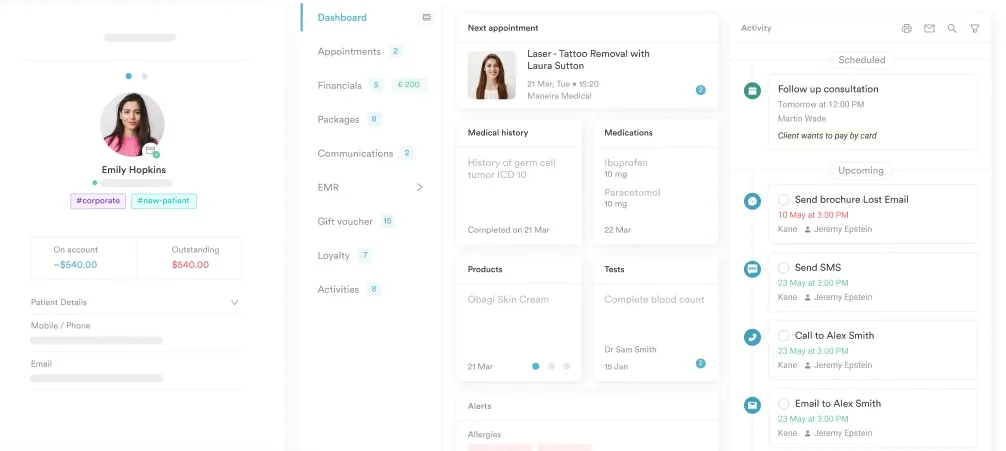
Code entry and encounter linking: When entering H46.8 in an EHR, confirm the code is linked to the correct encounter date and the correct clinical note. Linking the wrong encounter date is a common claim rejection trigger for outpatient ophthalmology visits. Pabau’s clinical records tools keep diagnosis codes, encounter dates, and treatment notes in a single linked record.
Secondary code sequencing: When H46.8 accompanies a G35-family code (MS), sequencing depends on the reason for the visit. If the encounter is primarily for the optic neuritis episode, H46.8 leads. If the visit is for MS management and the optic neuritis is an associated finding, the G35 code leads. This sequencing rule affects DRG assignment and medical necessity review for insurers.
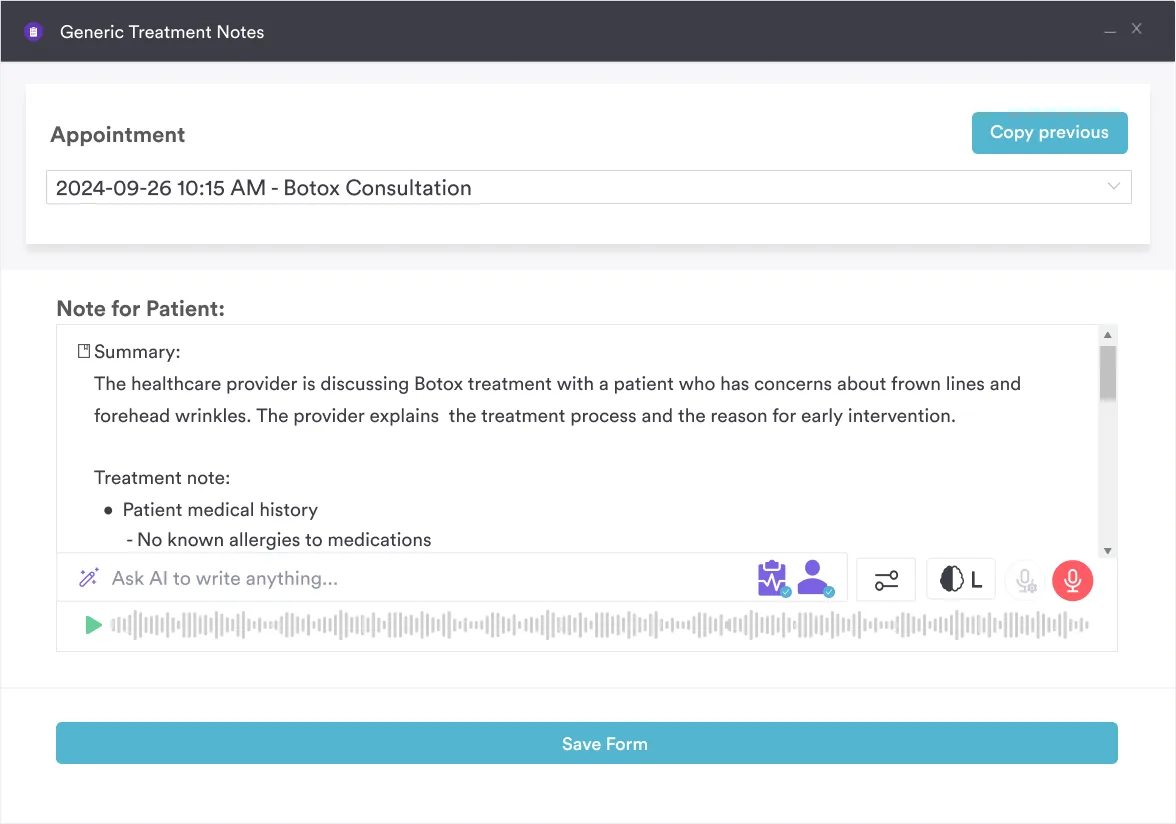
AI-assisted documentation: Using an AI scribe reduces the risk of diagnosis codes being omitted from encounter notes entirely. When a clinician’s note captures the examination findings, associated conditions, and ruling-out language automatically, coders have the evidence they need to assign H46.8 with confidence. Practices should also consider patient data security when handling diagnostic records that include neurological comorbidities like MS. Documentation that arrives after the claim raises audit risk even when the coding was correct. Coding names the service; medical billing gets it submitted, adjudicated and paid.
Run a quarterly audit of H46.8 and H46.9 claim denials side by side. If H46.9 denials exceed H46.8 denials, your documentation query process may need strengthening. If H46.8 denials are high, review whether supporting records are being attached to claims at submission.
Optic neuritis billing hinges on one clear question: does the documentation support a more specific subcode, or not? When it doesn’t, ICD-10 Code H46.8 is the right answer. If MS is also documented, a code from the G35 family (subtype required as of FY2026) is coded alongside it. Where documentation is genuinely absent, H46.9 applies instead.
Practices that catch these distinctions at the encounter level, rather than during claim review, eliminate rework later in the revenue cycle.
Practice management software, including Pabau, keeps diagnosis coding, encounter documentation, and treatment notes linked in one record, so ophthalmology and neurology practices build every encounter on clean, complete documentation. To see how it works in a live workflow, book a demo.

Coding insomnia tied to depression? Insomnia due to mental disorder guide explains why F51.05 exists when insomnia accompanies another diagnosed mental health condition.
Distinguishing postpartum depression from baby blues? Postpartum depression coding guide distinguishes persistent postpartum depression from transient baby blues that resolve within two weeks.
Coding another eye diagnosis this week? ICD-10 Code H52.03 covers bilateral hypermetropia, another common ophthalmology billing scenario.
H46.8 is the diagnosis code for other optic neuritis, used when optic neuritis is confirmed but fits no more specific H46 subtype (e.g., H46.0 papillitis, H46.1 retrobulbar, H46.2 nutritional, H46.3 toxic). It carries the NEC designation and is billable in FY2026.
H46.8 (other optic neuritis) applies when the provider has established that no more specific subtype fits. H46.9 (unspecified optic neuritis) applies when documentation is insufficient to characterize it. H46.8 reflects a deliberate NEC decision; H46.9 reflects incomplete documentation.
H46.8 does not capture the MS association by itself. When MS-associated optic neuritis is documented, assign both H46.8 and a code from the G35 multiple sclerosis family (G35.A to G35.D, effective FY2026); sequence by the primary reason for the encounter.
Use H46.1 when documentation explicitly identifies retrobulbar neuritis (normal-appearing disc). Use H46.8 when optic neuritis is confirmed but retrobulbar involvement is not specified and the presentation fits no other H46 subcode. Always code to the highest specificity supported.
H46.8 groups to MS-DRG 123, Neurological Eye Disorders, under MDC 02 (eye). This is a single DRG with no CC/MCC severity split, so complications do not change the assignment. Verify it against the active CMS MS-DRG Definitions Manual, updated annually on October 1.
NEC stands for not elsewhere classified. It indicates the classification has no code more specific than the one used, even when the condition is precisely identified clinically. For H46.8, the provider has confirmed optic neuritis that matches no more specific H46 subtype.