ICD-10 Code S42.444P: Medial epicondyle fracture, right humerus
ICD-10 Code S42.444P: full descriptor and code validity ICD-10 Code S42.444P car...

Last Updated: Oct 13, 2026
Billable Code Specific Code
H46.2 is the billable ICD-10-CM code for nutritional optic neuropathy. It applies when the record names a nutritional deficiency, such as vitamin B12, folate, or thiamine, and ties it to the optic nerve damage.
Two habits cost practices money on this code. The first is appending a laterality character, which H46.2 does not carry. The second is defaulting to H46.9 once the deficiency is already documented. H46.2 differs from H47.01- and from the H46.1x retrobulbar series by mechanism rather than by site.
Let Pabau's smart automation suggest the right codes, reduce claim denials, and keep your practice compliant—effortlessly.
Automate repetitive tasks and focus on what matters most—your patients.
Reduce coding errors and ensure compliance with the latest regulations.
Clean claims, fewer denials, and faster reimbursements.
Powerful insights and reporting to help your practice thrive.
HIPAA compliant SOC 2 certified GDPR-compliant Trusted by 4,000+ clinics worldwide

H46.2 is a billable ICD-10-CM code for optic neuropathy caused by a documented nutritional deficiency such as B12 or folate.
H46.2 does not require a laterality modifier, unlike the H46.1x retrobulbar neuritis series. Adding one is a coding error.
Documentation must name the specific nutritional deficiency to justify H46.2 over the unspecified fallback H46.9.
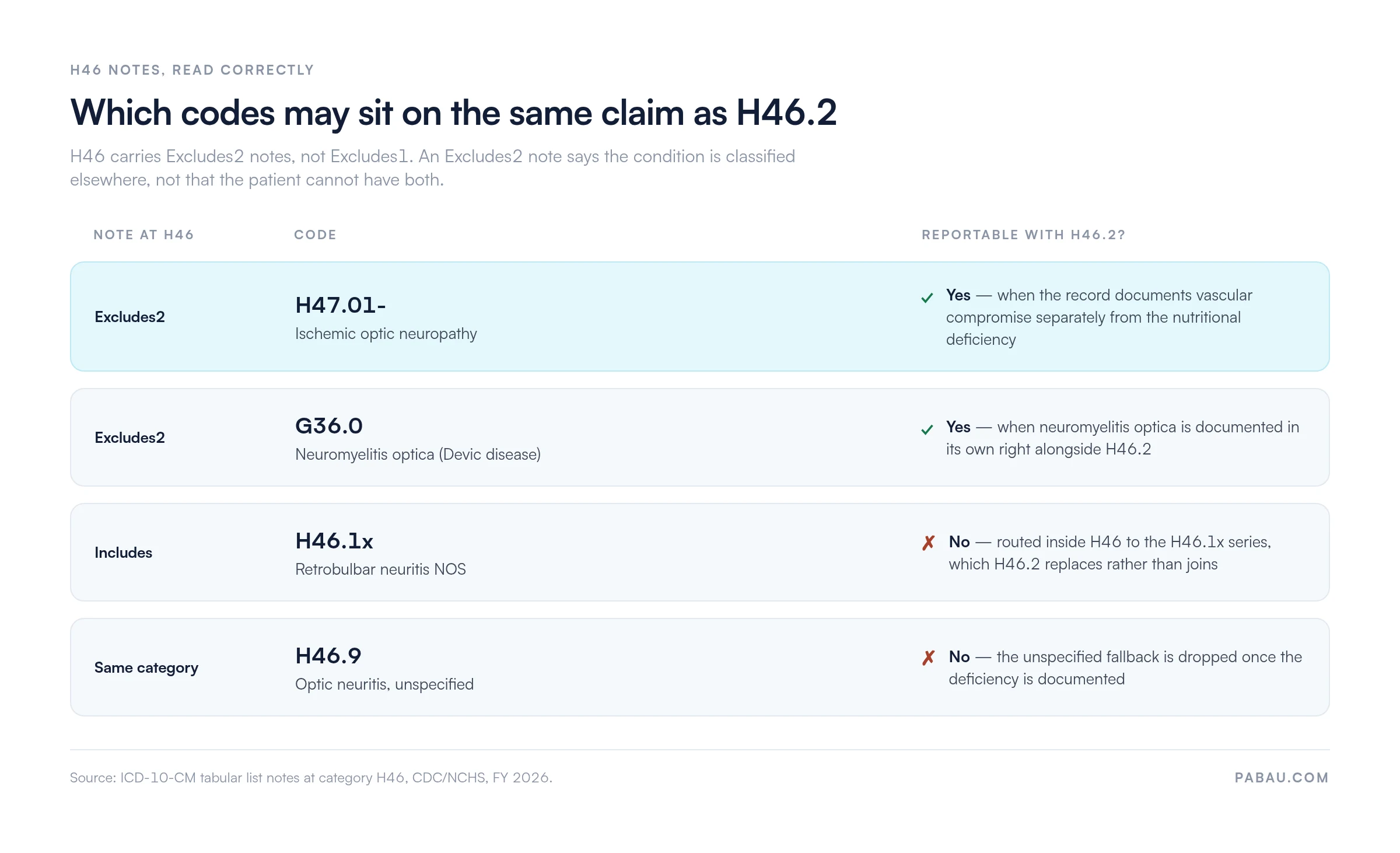
H46 carries Excludes2 notes for H47.01- and G36.0, so those codes may be reported alongside H46.2 when each mechanism is documented.
Pabau’s claims management software checks the fields a payer requires on each claim before it is sent, reducing avoidable rejections.
ICD-10 code H46.2 is the billable ICD-10-CM diagnosis code for nutritional optic neuropathy. Assign it when the record attributes optic nerve damage to a confirmed nutritional deficiency.
The code sits in the H46 Optic neuritis category, inside the H46-H47 block for disorders of optic nerve and visual pathways. That block belongs to chapter H00-H59, diseases of the eye and adnexa. H46.2 reached the 2026 ICD-10-CM release without revision and stays valid for HIPAA-covered electronic transactions.
The table below summarizes the quick-reference facts coders check first.
H46 is the parent code for optic neuritis. It is not billable on its own, so coders reach for one of its six specific subcodes. The split that matters most is laterality. The H46.0x and H46.1x series carry laterality extensions, while the etiology-based subcodes from H46.2 onward do not.
H46.3 (toxic optic neuropathy) is the closest structural parallel to H46.2. Both are etiology-specific, both lack laterality extensions, and both need documented causation in the clinical record. Coders who hold that parallel in mind stop defaulting to H46.9 when the cause is already sitting in the note.
Nutritional optic neuropathy results from deficiency of micronutrients essential to optic nerve function. The clinical record must specify the nutritional etiology, not just note optic nerve damage, to support H46.2. The deficiencies most commonly associated with this diagnosis include the following.
The B12 and folate associations above come from published clinical literature on nutritional optic neuropathy. Where a specific deficiency type is in question, check the WHO ICD-10 classification notes and current AHA Coding Clinic guidance. If the record does not specify the deficiency, H46.2 is not supportable regardless of clinical suspicion.
The includes and excludes notes at the H46 parent level define the outer boundaries of H46.2. Misreading them is the primary route to a misassigned or denied claim. Per the CDC/NCHS ICD-10-CM tool, the relevant notes at the H46 block level are as follows.
Excludes2 is the permissive note, and reading it as Excludes1 is the error that costs practices legitimate revenue. It tells the coder that the excluded condition belongs elsewhere in the classification. It does not say the patient cannot have both. The table below sets out what each note at H46 actually allows.
No, ICD-10 code H46.2 does not require laterality. That is the most operationally important structural fact about the code, and it is where preventable errors cluster.
The H46.1x series (retrobulbar neuritis) carries four laterality extensions: H46.10 (unspecified eye), H46.11 (right eye), H46.12 (left eye), and H46.13 (bilateral). Coders working across H46.1x and H46.2 in the same session often carry the laterality habit over.
H46.2 has no such extensions in the ICD-10-CM tabular list. Submitting it with an appended laterality character produces an invalid code, and the claim picks up an edit before it reaches the payer.
When nutritional optic neuropathy affects only one eye, H46.2 is still the correct code. The laterality does not change the code assignment. Document the laterality in the clinical record for completeness, but do not append it to the code.
Run a monthly audit of H46.2 claims in your ophthalmology or neurology billing queue. Filter for any claim where a 7th-character extension or laterality suffix has been appended to H46.2. Each such instance is an invalid code submission. Clear the extension, resubmit with the bare H46.2 code, and flag the EHR template that generated the error for correction.
Supporting ICD-10 code H46.2 takes documentation that ties the optic nerve findings directly to a nutritional deficiency. A clinical impression of “nutritional optic neuropathy” with no lab data or dietary history behind it will not pass payer scrutiny. The CMS ICD-10 coding guidelines require clinical evidence in the medical record to support every diagnosis code.
The list below sets out the essential documentation elements for H46.2.
Structured note templates that capture these four elements at the point of care cut the volume of coding queries that come back later. Pabau, our practice management platform, adds software for billing teams that checks each claim for the fields the payer requires before it goes out. Membership and authorization numbers are the usual omissions. Judging whether the documentation supports H46.2 rather than H46.9 stays with the clinician and the coder.

Three errors account for the majority of H46.2 claim problems. Each is preventable with the right documentation habits and billing workflow.
A fourth, less common error is coding neuromyelitis optica presentations to H46.2. Devic disease belongs to G36.0, and the Excludes2 note at H46 classifies it apart from the optic neuritis category. That note separates the two conditions rather than barring them from the same claim.
The decision between H46.2 and its nearest differentials comes down to documented mechanism. The table below maps each code to its etiology and the documentation required to support it.
A patient can present with optic neuropathy, low B12 levels, and cardiovascular risk factors for ischemia at once. The coder is not forced to choose between H46.2 and H47.01- there. Both may be reported when the clinician documents each mechanism separately. Where only one mechanism is supported, that determination decides the single code.
H46.9 is the unspecified fallback within the H46 family. Use it when the clinical record carries no confirmed etiology for the optic neuritis.
H46.9 is the defensible choice while laboratory results are pending or the workup is incomplete. It also fits where the clinician has listed optic neuropathy with no cause attached. Once the deficiency is confirmed and documented, correct the claim or code the next encounter to H46.2.
H46.2 is a valid code for HIPAA-covered electronic transactions, including CMS-1500 and 837P claim submissions. Practices submitting ophthalmology or neurology claims with H46.2 should still check payer-specific coverage policies. Some commercial payers want a nutritional deficiency code from the E40-E64 range as a secondary diagnosis, to corroborate the etiology.
Submitting through a clearinghouse puts a checking layer between your practice management system and the payer. Pabau integrates with Claim.MD, a US clearinghouse that reaches thousands of payers and handles 837P claim submission. The integration also carries real-time eligibility checks and electronic remittance advice, so posting and follow-up run off the payer’s own response.
Our guide to the Claim.MD clearinghouse walks through that submission path end to end. Reading it before you switch H46.2 billing over saves a round of rejected test claims.
Billing teams should also confirm that the claim form carries every required data element. H46.2 is valid for submission, but a missing subscriber or authorization field will stop the claim whatever the diagnosis code says.
Yes, ICD-10 code H46.2 is valid for fiscal year 2026. The code appears in the 2026 ICD-10-CM tabular list without revision. Its descriptor, billable status, and position within the H46 family are unchanged from prior years. FY 2026 added no new Excludes notes or inclusion terms that affect H46.2 specifically.
Coders can verify current-year validity directly through the AAPC ICD-10-CM code lookup or the official CMS release files. Annual code set updates take effect October 1 each year. The draft FY 2026 update tables did not flag H46.2 for deletion or revision. Practices that set calendar reminders to re-verify code validity each October avoid submitting claims under retired codes.
Bookmark the CDC ICD-10-CM web tool at icd10cmtool.cdc.gov and the CMS ICD-10 update page at cms.gov. Check both each October when the new fiscal year tables take effect. For H46.2 specifically, confirm the code is still in the tabular list and check whether any note at H46 has changed. Then update any EHR code templates that reference the H46.x family.
Most ophthalmology and neurology teams find a bad H46.2 claim only after the payer returns it. The note goes back to the clinician, the coder re-reads it, and the practice resubmits the claim weeks later. The deficiency was documented the whole time.
Pabau, our practice management software, holds the note, the code and the claim in one patient record. Charting templates can prompt for the serum B12 or folate value and for the clinician’s causal statement at the point of care. The coder then works from a note that already carries what H46.2 needs.
Before submission, Pabau checks each claim for the fields the payer requires and routes it electronically through Claim.MD. Remittance advice returns into the same record, so your team can see which H46.2 claims paid without exporting a separate report.

Pabau checks every required field on a claim before it reaches the clearinghouse. Your ophthalmology and neurology claims stop coming back for missing data.

Two rules prevent most of the trouble with H46.2. Confirm the nutritional etiology in writing before you assign the code, and never append a laterality character to it. Everything else on this code follows from documentation that was either done at the visit or was not.
The Excludes2 notes at H46 are worth re-reading if your team has been treating them as prohibitions. Where ischemia or Devic disease is documented alongside the nutritional mechanism, H47.01- or G36.0 belongs on the claim next to H46.2. Coding one and dropping the other understates the encounter and the revenue attached to it.
For teams submitting H46.2 at volume, the fix sits upstream of billing, in the note rather than the claim scrubber. Book a demo to see how Pabau links the deficiency lab, the clinical note and the H46.2 claim in one record.

Need to understand how clearinghouse validation works for ICD-10 claims? Medical claims clearinghouse guide explains how real-time code validation reduces optic nerve and other specialty claim denials.
Want a systematic approach to reducing coding denials across your practice? Denial management in healthcare shows billing teams how to read denial reasons and spot a trend before it compounds.
Looking for billing compliance guidance for your clinic software? Medical billing compliance outlines the documentation and submission standards that support accurate ICD-10 code assignment.
ICD-10 code H46.2 is used to code nutritional optic neuropathy. The diagnosis applies when optic nerve damage is caused by a confirmed deficiency of vitamin B12, folate, or thiamine. It is assigned after the clinician documents both the deficiency and a causal relationship to the optic nerve findings. It is not used when the cause of optic neuritis is vascular, autoimmune, or unspecified.
Yes, H46.2 is a billable, specific ICD-10-CM code valid for HIPAA-covered electronic transactions. Its parent code H46 is not billable on its own. H46.2 can be submitted directly on a CMS-1500 or 837P claim, with no more specific subcode needed.
No. H46.2 does not require a laterality modifier. The code has no right, left, bilateral, or unspecified extensions in the ICD-10-CM tabular list. This distinguishes it from the H46.1x retrobulbar neuritis series, which does carry laterality subcodes. Appending a laterality character to H46.2 produces an invalid code.
Use H46.9 (optic neuritis, unspecified) when the clinical record does not document a confirmed etiology. If lab results are pending, the workup is incomplete, or the clinician has not specified the cause, H46.9 is the appropriate choice. Once a nutritional deficiency is confirmed and documented with a causal link, H46.2 becomes the correct code for that encounter or a corrected claim.
Yes. H46.2 is a valid, billable ICD-10-CM code for fiscal year 2026. The code, its descriptor, and its position within the H46 family are unchanged from prior years. No revisions, deletions, or new exclusion notes were applied to H46.2 in the FY 2026 update tables.