CCSD code G5100: Bypass of duodenum billing guide
CCSD code G5100 bills a bypass that leaves the duodenum in place CCSD code G5100...

Last Updated: Oct 16, 2026

CPT Code 83735 describes measurement of magnesium in serum or plasma, classified under the 80000-series chemistry procedures.
Medicare covers 83735 under LCD L36700 only when the claim carries an approved ICD-10-CM diagnosis, so an unlisted code denies automatically.
The Clinical Laboratory Fee Schedule pays one flat national rate for 83735, currently around $5 to $7, with no locality or facility adjustment.
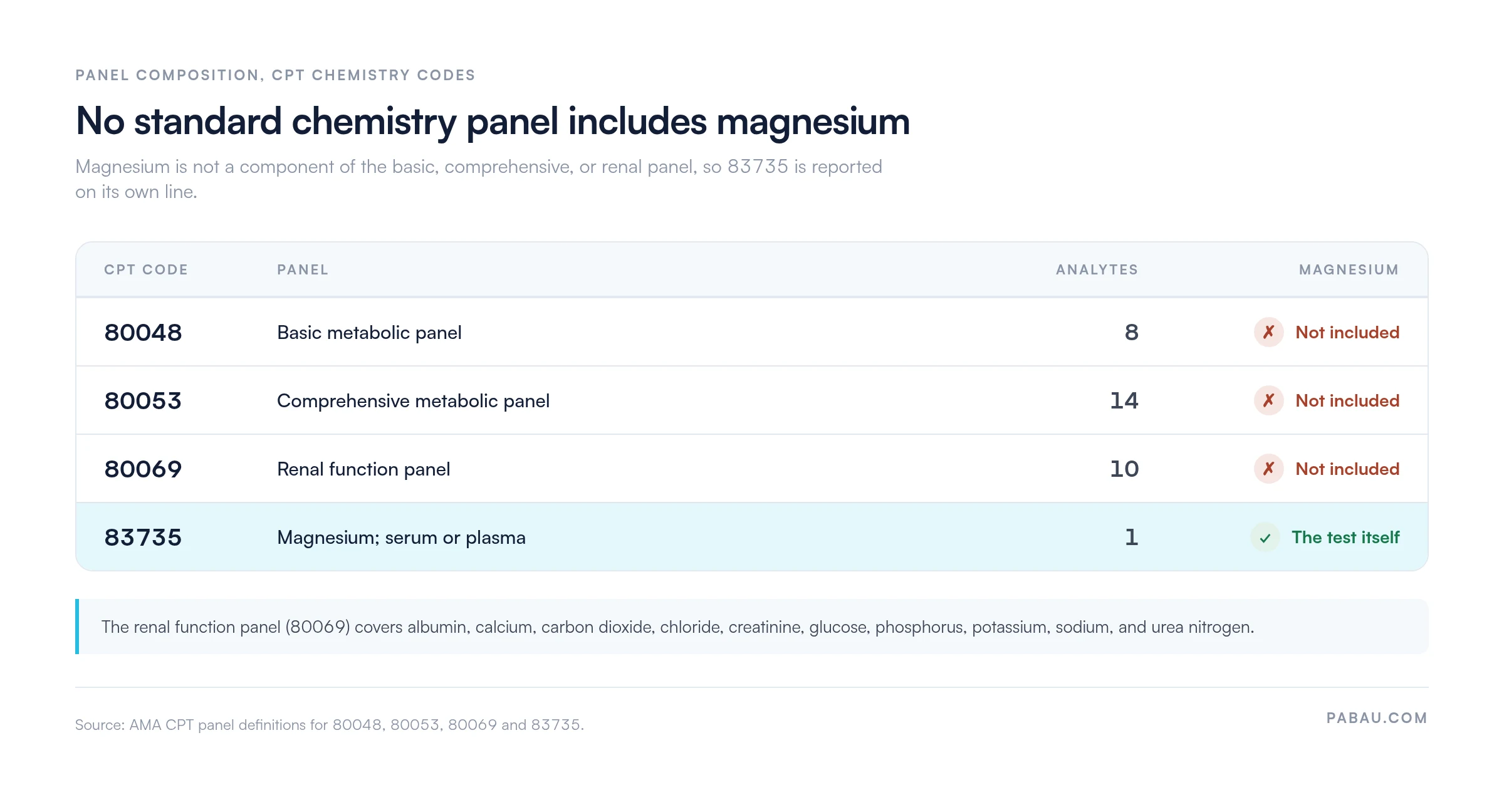
No standard chemistry panel includes magnesium, so 83735 is reported separately alongside 80048, 80053 and 80069.
Pabau’s Claim.MD integration submits the CMS-1500 claim, checks eligibility in real time, and tracks claim status and remittance advice.
CPT Code 83735 is the chemistry code for a quantitative magnesium measurement in serum or plasma. Medicare pays it under the Clinical Laboratory Fee Schedule at a single national rate of roughly $5 to $7. Coverage runs through LCD L36700, which pays the test only when the claim carries an ICD-10-CM diagnosis from the CMS-approved list.
Denials on this code come from a short list. Either the paired diagnosis is not on the approved list, or modifier 91 is missing on a same-day repeat. The third cause is a chart that never says why the test was ordered.
One assumption causes more trouble than any of those. Magnesium is not a component of the basic, comprehensive, or renal function panel. That makes 83735 its own claim line every time.
CPT Code 83735 is a chemistry procedure in the American Medical Association’s 80000-series code range. The AMA CPT code set assigns it the short descriptor Magnesium; serum, indicating a quantitative measurement of magnesium concentration in a serum or plasma specimen.
The code covers the full quantitative assay, not a qualitative screen. A whole-blood magnesium measurement uses a different code. 83735 applies only when the specimen is serum or plasma collected by venipuncture or an equivalent method.
Medicare’s Local Coverage Determination L36700 defines the clinical scenarios in which a serum magnesium test is considered medically necessary. Ordering outside these scenarios means the claim carries a diagnosis code that is not on the CMS-approved list, which triggers a denial before adjudication begins.
Each of these scenarios maps to one or more ICD-10-CM codes that CMS has approved to support medical necessity for CPT 83735. The diagnosis code must reflect the clinical finding or monitoring rationale, not a generic or unrelated condition.
CMS Billing and Coding Article A57198 publishes the approved ICD-10-CM list for CPT 83735. The table below covers the primary supporting codes. Always verify against the current version of A57198 in the CMS Medicare Coverage Database, since the list is updated with each ICD-10 fiscal year release. Pairing 83735 with a code outside this list produces an automatic medical necessity denial.
CMS Article A57198 also lists codes that produce a denial when billed with CPT 83735. Routine screening without a documented clinical indication falls outside coverage, so codes for general health screenings, wellness exams, or administrative purposes are not accepted.
Using Z00.00 or Z00.01, the general adult examination codes, as the sole paired diagnosis produces an automatic non-covered denial. The test has to be ordered in response to a specific clinical finding or monitoring protocol, with a diagnosis code that reflects it.
Laboratory codes, including CPT 83735, are paid under the Clinical Laboratory Fee Schedule (CLFS), not the Medicare Physician Fee Schedule (MPFS). The distinction matters because the two schedules are built and published separately. The CMS Physician Fee Schedule lookup tool covers MPFS codes only, so it returns nothing useful for 83735.
The CLFS pays one national amount for each test. Since the PAMA reform took effect in 2018, lab codes carry no locality adjustment. A magnesium level pays the same in Los Angeles as it does in rural Iowa. Confirm the current figure in the CMS Clinical Laboratory Fee Schedule file rather than an RVU tool, which will not carry the code.
The electronic remittance advice from the payer confirms the allowed amount after adjudication. Reviewing it line by line is how an underpayment on a low-dollar lab code gets noticed at all.
Local Coverage Determination L36700 governs Medicare coverage for serum magnesium testing. Billing and Coding Article A57198 carries the code lists and documentation guidance that accompany it. Both matter: the LCD defines the coverage policy, and the article defines how to bill against it.
The medical record must contain enough information to support the clinical rationale for ordering CPT 83735. CMS auditors assess documentation at the time of a claim review, not at the time of ordering. Thin documentation is the most common reason a covered test gets denied on appeal.
Bill type codes and revenue codes required for institutional billing are enumerated in CMS Article A57198. For Part B claims submitted by independent laboratories, refer to the Medicare contractor’s billing guidance for the applicable form and revenue code requirements.
Check the CMS Medicare Coverage Database at cms.gov before submitting any 83735 claim. LCD L36700 and Article A57198 are publicly accessible and updated periodically. Coding against an outdated ICD-10 list is one of the most preventable denial causes for this code.
Modifiers clarify the circumstances under which CPT 83735 was performed. Using the wrong modifier, or omitting a required one, causes a rejection or a payment reduction. The AAPC Codify CPT lookup includes modifier guidance for individual codes alongside fee schedule data.
Modifier 91 is the most frequently omitted modifier on 83735 claims. When a clinician orders a repeat magnesium level to assess the response to IV replacement given earlier the same day, modifier 91 is required. Without it, the second claim line is rejected as a duplicate.
Magnesium is rarely measured in isolation. Most ordering patterns involve a panel or an electrolyte workup, so CPT 83735 frequently appears alongside these chemistry codes. The CMS CPT/HCPCS code list and the NCCI edits govern which codes can be billed together.
The renal function panel is the one that trips people up, because coders often assume it carries magnesium. It does not. Its ten components are albumin, calcium, carbon dioxide, chloride, creatinine, glucose, phosphorus, potassium, sodium, and urea nitrogen.
The basic metabolic panel carries eight analytes and the comprehensive metabolic panel fourteen, and magnesium is in neither. No NCCI edit bundles 83735 into any of the three, so it is reported as its own line whenever it is ordered.
Beyond the panels, magnesium is also co-ordered with parathyroid hormone testing, billed under CPT code 83970, in endocrine and renal workups. Each test still needs its own order and its own clinical indication.
The steps below consolidate the CMS coverage requirements, the NCCI considerations, and the documentation standards into one end-to-end process. Work through them in order at the point of ordering, rather than at the point of appeal.
Most 83735 denials fall into a short list of avoidable categories. Knowing which denial codes come back most often on lab claims tells you which check to add first. The table below maps each error to the denial it produces and how to prevent it.
A clean claim for CPT 83735 carries the correct code, an approved paired ICD-10 code, any required modifier, and chart documentation that supports the diagnosis. Logging denial reason codes by CPT code shows which of those four fails most often in your own practice.
Set up a same-day repeat lab flag in your billing workflow. When 83735 appears twice on the same date for the same patient, the system should prompt the coder to check modifier 91. It should also confirm that the documentation supports each order independently.
In most practices the magnesium order lives in one system and the claim for it lives in another. Someone re-keys the code, the diagnosis, and the modifier into a billing portal. The outcome then gets chased by phone or on a payer website days later.
Pabau, an all-in-one practice management system, connects to the Claim.MD clearinghouse instead. The CMS-1500 claim goes out electronically from the patient record. Coverage is checked in real time before the visit, and the claim’s status and remittance advice come back to the same record.
That does not pick the code for you. The ICD-10 pairing, the modifier decision, and the NCCI check stay with your coder, where LCD L36700 puts them. Pabau’s claims management software removes the re-keying and the blind wait between submission and payment. That wait is where low-dollar lab claims usually get lost.

Pabau connects to Claim.MD to submit CMS-1500 lab claims, check eligibility in real time, and track status and remittance advice against the patient record. See how it runs in your practice.

CPT 83735 is a straightforward chemistry code with predictable denial patterns. Three things decide whether it pays. They are the paired ICD-10 code, modifier 91 on same-day repeats, and a chart note stating why the test was ordered.
Fix those three at the point of ordering and the code largely bills itself. The payment is small enough that reworking a denial costs more than the claim is worth. That arithmetic is the whole argument for getting it right the first time.
Book a demo to see how Pabau submits and tracks lab claims like 83735 without pulling your team into a second billing portal.

Need to understand how clearinghouse submissions work? Medical claims clearinghouse guide explains the 837P claim path from practice to payer.
Looking to reduce claim rework across all your lab codes? How Claim.MD clearinghouse works covers real-time eligibility checks and ERA processing that apply to every chemistry code you submit.
Want to benchmark your denial rate against industry norms? Best medical billing software in the US compares tools that include denial analytics and reporting for lab-heavy practices.
CPT Code 83735 covers quantitative measurement of magnesium in a serum or plasma specimen. It is classified under the AMA’s 80000-series chemistry procedures and describes a standalone serum magnesium assay, not a panel component. The test is used to detect hypomagnesemia, hypermagnesemia, or to monitor magnesium levels in patients on diuretics, proton pump inhibitors, or with chronic kidney disease.
Yes. Medicare covers CPT 83735 under Local Coverage Determination L36700. Payment depends on the claim carrying an ICD-10-CM diagnosis from the approved list in Billing and Coding Article A57198. Claims paired with unapproved codes, or submitted without a clinical indication in the chart, are denied as not medically necessary.
Medicare pays roughly $5 to $7 for CPT 83735 under the 2026 Clinical Laboratory Fee Schedule. The CLFS sets one flat national rate for each test, so the amount does not change by locality or by place of service. Confirm the exact figure in the published 2026 CLFS file, since lab codes are paid under the CLFS and not the Physician Fee Schedule.
The medical record must state the ordering rationale, for example that the patient is on furosemide and being monitored for diuretic-induced hypomagnesemia. It also needs the specific diagnosis or monitoring indication, the medication list for drug-monitoring claims, and prior results for a repeat test. Documentation must be in the chart at the time of claim submission, not added retrospectively after a denial.