ICD-10 code S90.475A: Other superficial bite of left great toe
What is ICD-10 code S90.475A? ICD-10 code S90.475A is the billable diagnosis cod...

Last Updated: Nov 18, 2026
Billable Code Specific Code
D69.6 is the billable ICD-10-CM code for thrombocytopenia, unspecified. It applies when a physician documents a low platelet count but records no underlying cause.
It sits in the D69 block (Purpura and other hemorrhagic conditions) under Chapter 3: Diseases of the blood and blood-forming organs (D50-D89). The code is valid for FY2027 in outpatient and inpatient encounters, as long as the documentation supports no more specific thrombocytopenia code.
Let Pabau's smart automation suggest the right codes, reduce claim denials, and keep your practice compliant—effortlessly.
Automate repetitive tasks and focus on what matters most—your patients.
Reduce coding errors and ensure compliance with the latest regulations.
Clean claims, fewer denials, and faster reimbursements.
Powerful insights and reporting to help your practice thrive.
HIPAA compliant SOC 2 certified GDPR-compliant Trusted by 4,000+ clinics worldwide

D69.6 is the billable ICD-10-CM code for thrombocytopenia, unspecified, and applies only when the physician documents no cause.
Use D69.3 for immune thrombocytopenic purpura (ITP) and D69.59 when a drug or other secondary cause is documented.
Heparin-induced thrombocytopenia takes a 6th-character D75.82- code, such as D75.822, and neonatal thrombocytopenia takes P61.0.
Pabau’s claims management software sends claims through the Claim.MD clearinghouse and runs eligibility checks before the visit.
ICD-10 Code D69.6 is the billable ICD-10-CM code for thrombocytopenia, unspecified, used when a physician confirms a low platelet count but documents no cause.
It is valid in the CMS FY2027 ICD-10-CM code set, which covers encounters from October 1, 2026 through September 30, 2027. The table below collects the details to confirm before a claim goes out.
Thrombocytopenia is a reduction in circulating platelets below the normal reference range, typically defined as a platelet count under 150,000 per microliter. The “unspecified” qualifier means the physician has documented the condition but has not identified or recorded an underlying cause in the clinical notes.
That distinction decides the code. D69.6 is correct only when the documentation shows a confirmed diagnosis of thrombocytopenia with no stated etiology. Once the record names a cause, whether autoimmune, drug-related, secondary to another disease, or inherited, ICD-10-CM guidelines require the more specific code.
Three scenarios where D69.6 is correctly applied:
Per the CDC/NCHS ICD-10-CM coding tool, D69.6 also covers documentation that reads “thrombocytopenia NOS” (not otherwise specified). Unspecified codes pay, but payers review them more closely, a pattern our guide to medical billing explains for practices new to diagnosis coding.
The D69 block carries several notes that restrict how D69.6 may be used. An Excludes1 note means the two codes are never reported together for the same condition.
D69.3 (immune thrombocytopenic purpura, ITP) is not interchangeable with D69.6. Choosing the wrong one can trigger medical necessity rejections and audit flags, especially on claims for ITP drugs.
If the word “immune,” “idiopathic,” or “ITP” appears anywhere in the physician’s documentation, D69.3 is required. D69.6 is reserved for charts that are silent on mechanism.
Before defaulting to D69.6, review the adjacent codes in the D69 family and the related hematology codes below. Using D69.6 when a more specific alternative is available counts as improper coding under ICD-10-CM guidelines.
Read in order, the codes above turn into a short sequence of checks. The first statement the chart supports decides the code, and D69.6 is what remains.
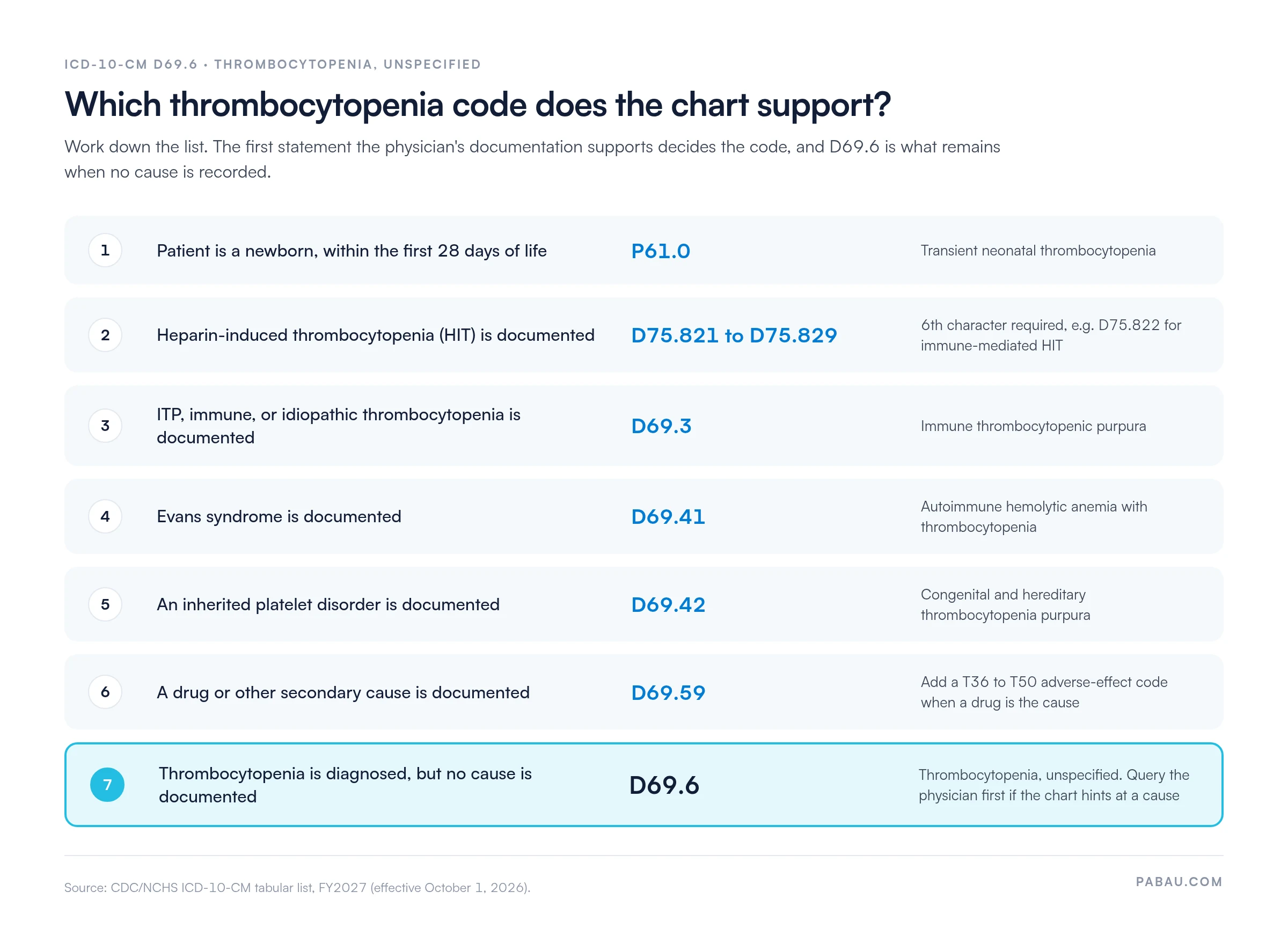
Run a physician query before coding D69.6 when the chart contains bone marrow biopsy results, anti-platelet antibody titers, or documented heparin exposure. Each of these findings points toward a specific code, such as D69.3, D69.59, or a D75.82- code like D75.822. An AHIMA-compliant query asking the physician to confirm the etiology settles the code before the claim is submitted.
Two of the most consequential D69.6 coding errors involve medication-related causes. Both have their own codes, and both require specific sequencing rules that D69.6 cannot satisfy.
When a drug causes a patient’s platelet count to fall, the correct path is adverse effect coding under ICD-10-CM Chapter 19. D69.59 (other secondary thrombocytopenia) replaces D69.6 as the thrombocytopenia code.
A T-code from the T36-T50 range is sequenced alongside it to identify the drug, with a 5th or 6th character “5” for adverse effect. Coding D69.6 instead understates the encounter and can produce a denied or underpaid claim.
Chemotherapy-induced thrombocytopenia follows similar logic. Code the neoplasm, code the thrombocytopenia as a secondary condition, and add the adverse effect code for the antineoplastic agent. D69.6 alone does not capture this sequencing.
Heparin-induced thrombocytopenia has its own subcategory, D75.82, which has needed a 6th character since FY2023. D75.82 on its own is not billable, so the claim carries one of four codes:
When HIT is documented, D69.6 is never correct. Immune-mediated HIT calls for different treatment, such as stopping heparin at once and switching anticoagulant. Coding it as D69.6 can trigger a denial for HIT-specific therapies such as argatroban or fondaparinux.
D69.6 carries an Excludes1 note for neonatal and transient neonatal thrombocytopenia, so the code is not used for newborns. P61.0 (Transient neonatal thrombocytopenia) is the correct code during the perinatal period.
P61.0 covers immune neonatal thrombocytopenia (antibody transfer from mother), other neonatal thrombocytopenia, and thrombocytopenia due to exchange transfusion. The neonatal period covers the first 28 days of life. After it, D69.6 or a more specific code may apply if the condition persists with no established etiology.
Under ICD-10-CM Official Guidelines Section IV (Outpatient), D69.6 may be the first-listed diagnosis. That applies when thrombocytopenia is the reason for the visit and no more specific code is supported. The same section bars coding uncertain diagnoses (“possible,” “probable”) as confirmed in the outpatient setting. Only established diagnoses qualify.
Under Section II (Inpatient), D69.6 may serve as the principal diagnosis when thrombocytopenia is the condition established after study that chiefly occasions the admission. When the thrombocytopenia is incidental to the admission reason, it is coded as an additional diagnosis.
Inpatient coders must also apply the “code first” instruction if an underlying condition causing thrombocytopenia is present and meets inpatient reporting criteria.
Payers and auditors look for four elements in the clinical record before allowing D69.6 on a claim. A missing element is the usual cause of a correctable denial.
Unspecified codes attract more scrutiny than specific ones across Medicare, Medicaid, and commercial payers. D69.6 is not denied by default, but claims carrying it may be held for additional review. A denial management routine catches the ones that come back, and the table below covers how to stop them going out wrong.
These are the most common D69.6 denial reasons, with the step that prevents each one.
When a D69.6 claim does come back, the CARC on the remittance says why, and our list of denial codes explains each payer rejection category. The documentation habits in the previous section are also the core of medical billing compliance for hematology claims.
The CPT codes below often appear on claims alongside D69.6. A CBC under 85025 usually confirms the low count, and 38221 covers the bone marrow biopsy ordered when the cause stays unclear. Confirm the documentation supports each pairing before submitting.
Verify NCCI edits before submitting 85025 with an E/M code on the same date. The Medicare National Correct Coding Initiative applies bundling rules that restrict certain lab codes from being billed alongside E/M services without a modifier. The AAPC Codify ICD-10 crosswalk tool shows active NCCI edit pairs for common D69.6 submissions.
Every denial reason in the table above starts as a mismatch between the chart and the claim. In many practices the coder reads the note in one system and keys the claim into another. A cause added to the note after coding then never reaches the claim.
Pabau, the practice management platform we build, keeps the clinical note and the claim in one system. Its claims management software sends CMS-1500 claims through the Claim.MD clearinghouse and runs eligibility checks before the visit. Remittances post back against the same patient record.
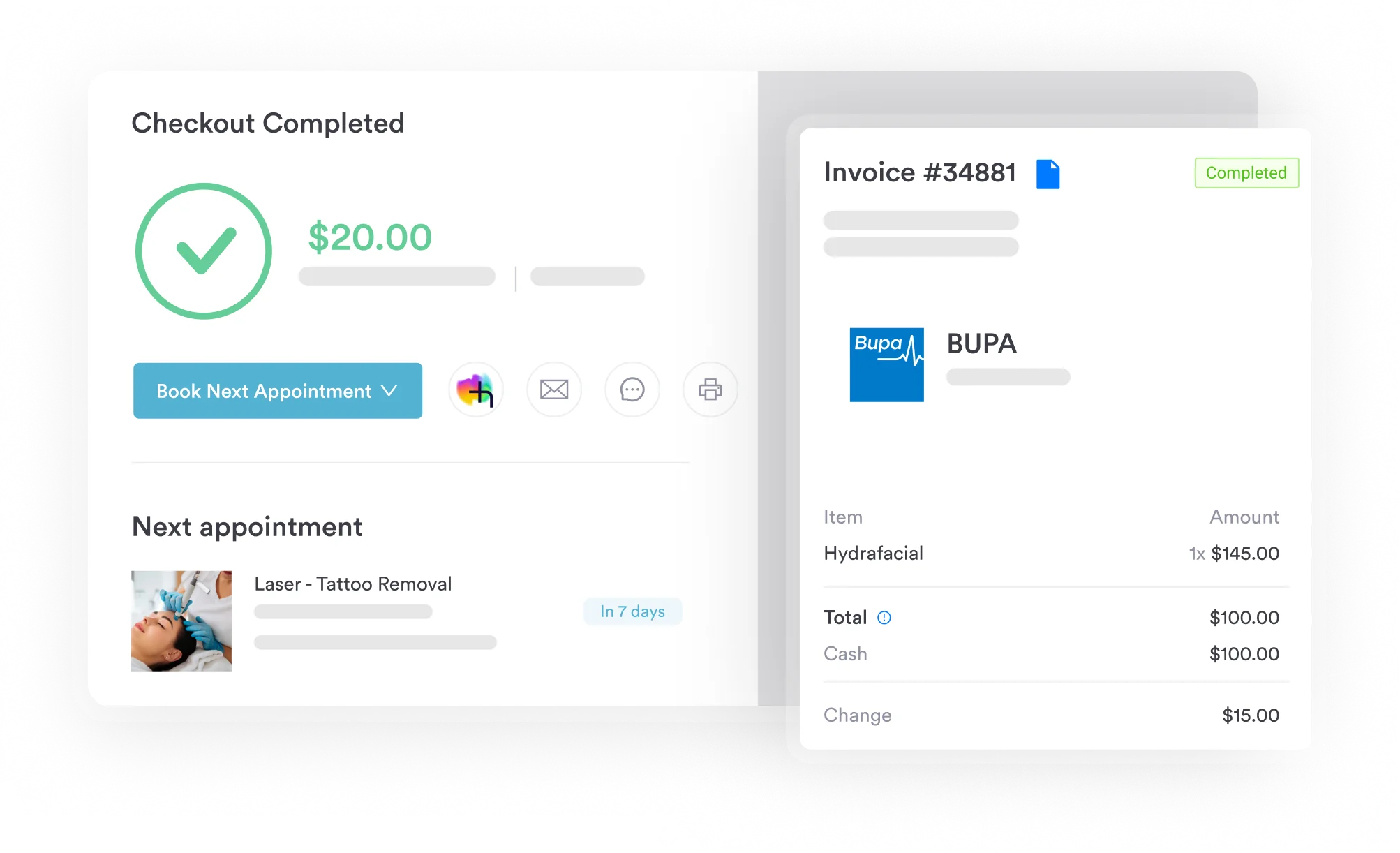
When a payer rejects a D69.6 claim, your billing team sees it against the patient record the day it comes back. They can query the physician, recode to D69.3 or D69.59, and resubmit while the encounter is still fresh.

Pabau keeps the clinical note and the claim in one system and sends claims through the Claim.MD clearinghouse. Eligibility checks and remittances come back against the patient record, so rejections get fixed while the encounter is fresh.

D69.6 is a legitimate billable code, and it is the code of last resort. ICD-10-CM has a specific alternative for almost every documented cause of low platelets, from D69.3 for ITP to D75.822 for immune-mediated HIT. Reach for D69.6 only once the chart has been checked for a cause and none is recorded.
The trade-off is a little time up front for less rework later. Make the physician query a standing step for any chart that hints at an etiology without naming one. Fewer D69.6 claims will then come back for recoding. Book a demo to see how Pabau keeps the note, the code and the claim together for hematology billing.

Need a full clearinghouse integration reference? Pabau’s Claim.MD clearinghouse guide explains how the integration handles ICD-10 validation, ERA processing, and secondary claims.
Seeing repeated claim rejections? Electronic remittance advice (ERA) processing breaks down how to read 835 remittance files and identify denial patterns before they compound.
Need to verify eligibility before the encounter? Insurance eligibility verification covers the real-time 270/271 eligibility transaction workflow that surfaces coverage issues before the visit.
ICD-10 Code D69.6 is the billable ICD-10-CM diagnosis code for thrombocytopenia, unspecified. It covers a low platelet count where the treating physician has documented no underlying cause. It sits in Chapter 3 (Diseases of the blood and blood-forming organs) under the D69 block, and it is valid for FY2027.
Use D69.3 when the physician explicitly documents immune thrombocytopenic purpura (ITP), idiopathic thrombocytopenic purpura, or immune thrombocytopenia. Use D69.6 only when thrombocytopenia is documented but no etiology is stated. If the chart names an immune mechanism, D69.3 is required. When the chart only hints at one, query the physician rather than falling back on D69.6.
Yes. D69.6 is valid in both outpatient and inpatient settings. Outpatient, it may be first-listed when thrombocytopenia is the reason for the visit and no more specific code applies. Inpatient, it may be the principal diagnosis when thrombocytopenia is the condition chiefly occasioning admission after study, or an additional diagnosis when incidental.
Yes. Per ICD-10-CM guidelines, coders must use the most specific code the documentation supports. A documented cause takes its own code, and D69.6 is then incorrect. Drug-induced takes D69.59 plus a T-code, immune takes D69.3, and hereditary takes D69.42. Heparin-induced takes a D75.82- code such as D75.822.
The most common reasons are a missing physician diagnosis and D69.6 used when a more specific code exists. A lab value alone does not qualify as a diagnosis. Missing CBC results and incorrect inpatient sequencing, where an underlying condition should come first, cause the rest.
No. D69.6 carries an Excludes1 note for neonatal thrombocytopenia. P61.0 (Transient neonatal thrombocytopenia) is the correct code during the first 28 days of life. Using D69.6 for a neonatal patient is a coding error that will trigger a claim rejection.