ICD-10 code D50.9: Iron deficiency anemia, unspecified
ICD-10 code D50.9: Definition, descriptor, and billable status ICD-10 code D50.9...

Last Updated: Nov 13, 2026
Billable Code Specific Code
C34.90 is the lung cancer code to reach for last. It's the billable ICD-10-CM code for a confirmed primary lung or bronchus cancer when no report names the site or side. The official descriptor is "Malignant neoplasm of unspecified part of unspecified bronchus or lung."
Two errors keep this code under scrutiny. One is coding a lung metastasis here instead of C78.0-. The other is settling for C34.90 when a CT, PET or pathology report already names the lobe or side.
Let Pabau's smart automation suggest the right codes, reduce claim denials, and keep your practice compliant—effortlessly.
Automate repetitive tasks and focus on what matters most—your patients.
Reduce coding errors and ensure compliance with the latest regulations.
Clean claims, fewer denials, and faster reimbursements.
Powerful insights and reporting to help your practice thrive.
HIPAA compliant SOC 2 certified GDPR-compliant Trusted by 4,000+ clinics worldwide

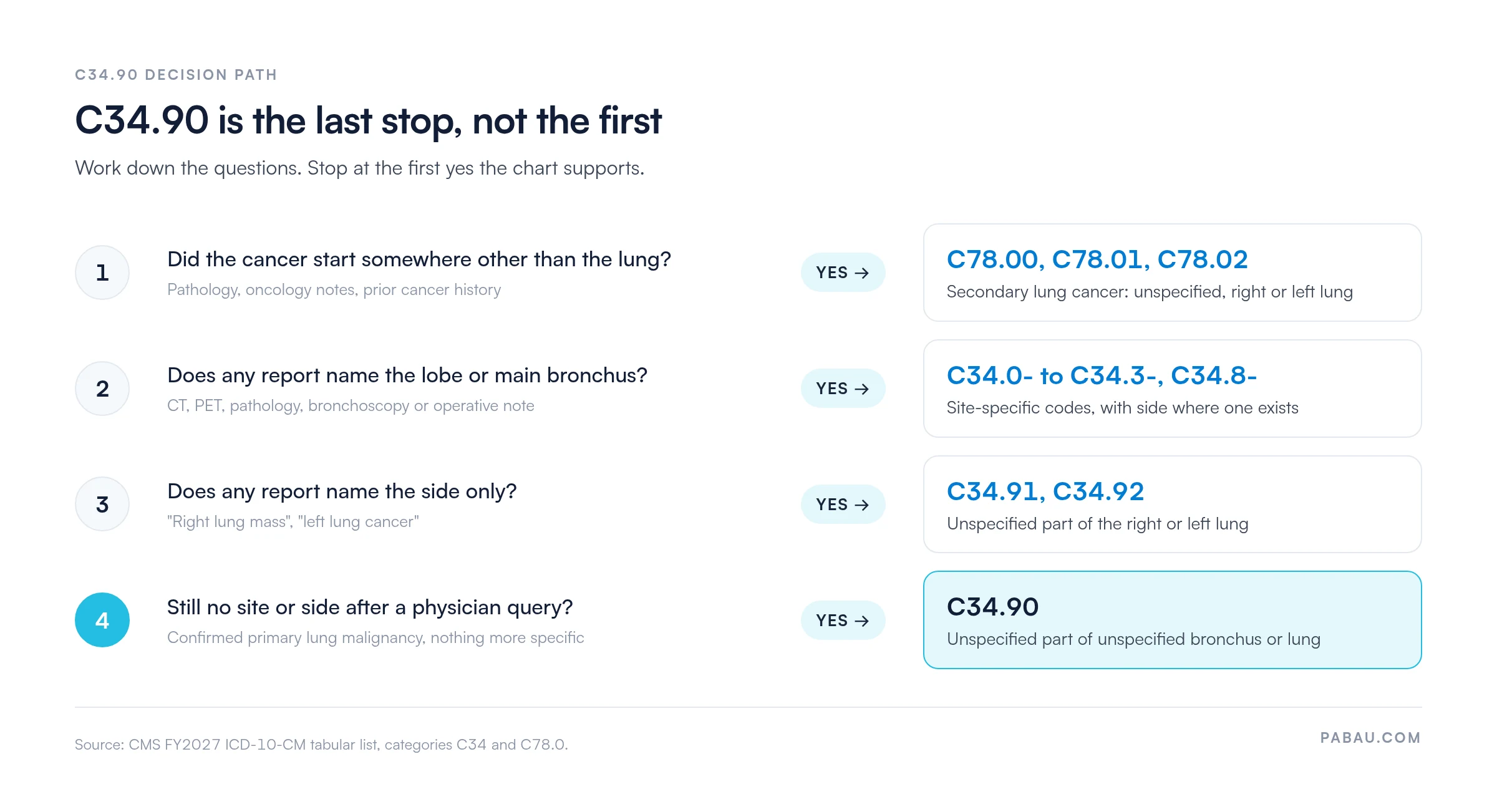
C34.90 is for a confirmed primary lung cancer when no report in the record names the site or the side.
Read the imaging, pathology and operative notes first, because a named lobe or side moves the claim to a more specific C34 code.
A lung metastasis from another primary never takes C34.90. Code it to C78.00, C78.01 or C78.02 instead.
C34 carries use-additional-code notes for tobacco, so add F17.-, Z87.891, Z72.0 or the exposure code the chart documents.
Pabau sends US claims electronically through Claim.MD and tracks prior authorization codes on each patient’s case.
ICD-10 code C34.90 is the billable code for a confirmed primary lung or bronchus cancer when no report names the site or the side. Its descriptor in CMS’s FY2027 ICD-10-CM files reads “Malignant neoplasm of unspecified part of unspecified bronchus or lung.” The tabular list also indexes “Lung cancer NOS” to it.
The C34 category carries use-additional-code notes for tobacco, and they apply to C34.90. When the chart documents tobacco use, dependence, history or exposure, add the matching code. The options are F17.-, Z72.0, Z87.891, Z77.22, Z57.31 or P96.81.
The CDC/NCHS ICD-10-CM web tool shows the same notes. Chapter 2 of the ICD-10-CM Official Guidelines accepts unspecified codes when the record supports no greater detail. Coders are still expected to query the physician before settling for one.
The C34 category splits primary lung cancer by site and side. C34.90 is the fallback for a record that names neither.
C34.91 and C34.92 name the side but not the site, while C34.90 names neither. So when the physician writes “right lung cancer” without a lobe, C34.91 is the better code. The middle lobe is the one site with a single code, C34.2, because only the right lung has one.
C34.90 takes any histologic type of primary bronchus or lung cancer when the record names no site or side. That puts both main lung cancer types under it.
ICD-10-CM claims carry no separate histology code. The pathology report records whether it’s adenocarcinoma, squamous cell or small cell, but C34.90 covers all of them.
C34.90 fits only when the record supports no site or side. It’s never a shortcut for a chart nobody read in full. Work through the questions below in order, and stop at the first one the documentation answers.
Payers notice when an unspecified code sits beside imaging that names a side. A C34.90 claim filed while the CT report shows a right upper lobe mass is a documentation mismatch. It can draw a records request or a denial.
Before assigning C34.90, read the whole encounter record, not just the physician’s assessment. Radiology, operative and pathology reports often name the site or side when the progress note doesn’t. Ask the physician to confirm that detail in their note, then code to it.
The distinction with the biggest consequences in lung cancer coding is primary versus secondary. C34.90 means the cancer started in the bronchus or lung. C78.0- means it spread to the lung from somewhere else.
Sequencing follows where the treatment is aimed. Under the Chapter 2 guidelines, treatment aimed only at a lung metastasis puts C78.0- first, even while the primary is still present. An encounter solely for chemotherapy leads with Z51.11 instead, then the cancer codes. C34.90 doesn’t belong on either claim when the lung lesion is secondary.
ICD-10-CM doesn’t build stage into C34.90. Spread and risk factors go on the claim as additional codes, while the TNM stage stays in the clinical record.
For a current cigarette smoker without complications, F17.210 is the usual tobacco code. AJCC TNM staging supports medical necessity and treatment authorization. It never adds a digit to C34.90 or replaces it.
Three documentation elements are required before C34.90 goes on a claim, and a fourth is best practice.
A pre-submission review is what turns this documentation into a clean claim. It catches a missing side or an unconfirmed diagnosis before the payer does.
Most lung cancer claims follow the same four steps. Each one has its own failure point.
C34.90 tends to pair with the same procedure codes from diagnosis through treatment. Chemotherapy infusion starts with 96413 for the first hour. Staging PET/CT from skull base to mid-thigh bills as 78815.
A peripheral lesion often needs radial endobronchial ultrasound to reach. That adds 31654 to the base bronchoscopy code, and the biopsy result decides between C34 and C78.0-.
Authorization rules for C34.90 claims depend on the payer and the service. Medicare, Medicare Advantage, Medicaid and commercial plans each set their own policies for lung cancer care.
Medicare covers most lung cancer diagnostics and treatment under its NCDs and LCDs. NCD 220.6.17 covers FDG PET for initial treatment strategy in solid tumors when its conditions are met. Traditional Medicare doesn’t require prior authorization for chemotherapy, but Part B drug policies govern J-code coverage.
Medicare Advantage plans may require prior authorization that traditional Medicare doesn’t. Many require it for PET scans, immunotherapy infusions and stereotactic body radiotherapy (SBRT). A claim for an auth-required service without the authorization number will deny, whatever the diagnosis.
Commercial payer policies vary widely. Some request records when C34.90 arrives with imaging that names a side, so code to the side whenever the chart supports it.
Each state Medicaid agency or managed-care plan sets its own policies for unspecified diagnosis codes. Some accept C34.90 without extra review, and others want supporting documentation for high-cost oncology claims. Check the state agency or plan’s rules each year, because they can change with the October code update.
C34.90 denials trace back to a handful of root causes, and each one can be caught before submission. A wider denial management process then handles the appeals and tracking. The table covers the patterns specific to C34.90.
Our guide to denial codes explains each adjustment code and its appeal path. CO-4 relates to a missing or inconsistent modifier, so it rarely points at a diagnosis problem. Laterality appeals land best with a physician attestation explaining why the side couldn’t be documented.
Audit your C34.90 claims each quarter against the radiology and pathology reports. Any claim where the imaging names a lobe but the claim went out as C34.90 is a missed specific code. One recoupment can cost more than the audit.
Yes. C34.90 is valid in FY2026, which took effect on October 1, 2025, and in FY2027, which took effect on October 1, 2026. The FY2027 code files keep the descriptor “Malignant neoplasm of unspecified part of unspecified bronchus or lung” unchanged.
The C34 use-additional-code notes for tobacco and the Excludes1 notes for Kaposi sarcoma and malignant carcinoid carry into FY2027 too. Check them each October, when the new edition takes effect.
The CMS ICD-10 codes page publishes the annual code files, addenda and official guidelines. It’s the most reliable place to confirm a C34 revision. The AAPC Codify ICD-10-CM lookup and ICD List mirror the official data for quick checks.
Lung cancer claims tend to stall at the same points. An authorization number is missing, eligibility wasn’t checked, or a remittance sits unread while the denial window runs.
Pabau, the practice management platform we build, sends US claims through Claim.MD in the CMS-1500/837P format. Its claims management software runs eligibility checks before the visit and brings in ERA remittances when payers respond. Your team files secondary claims from the same patient record.
Prior authorization sits on the patient’s case in Pabau. The auth code, dates and sessions are tracked there, and you get a warning when one is missing. That matters for PET scans and immunotherapy, where a missing auth number denies the claim regardless of the code.
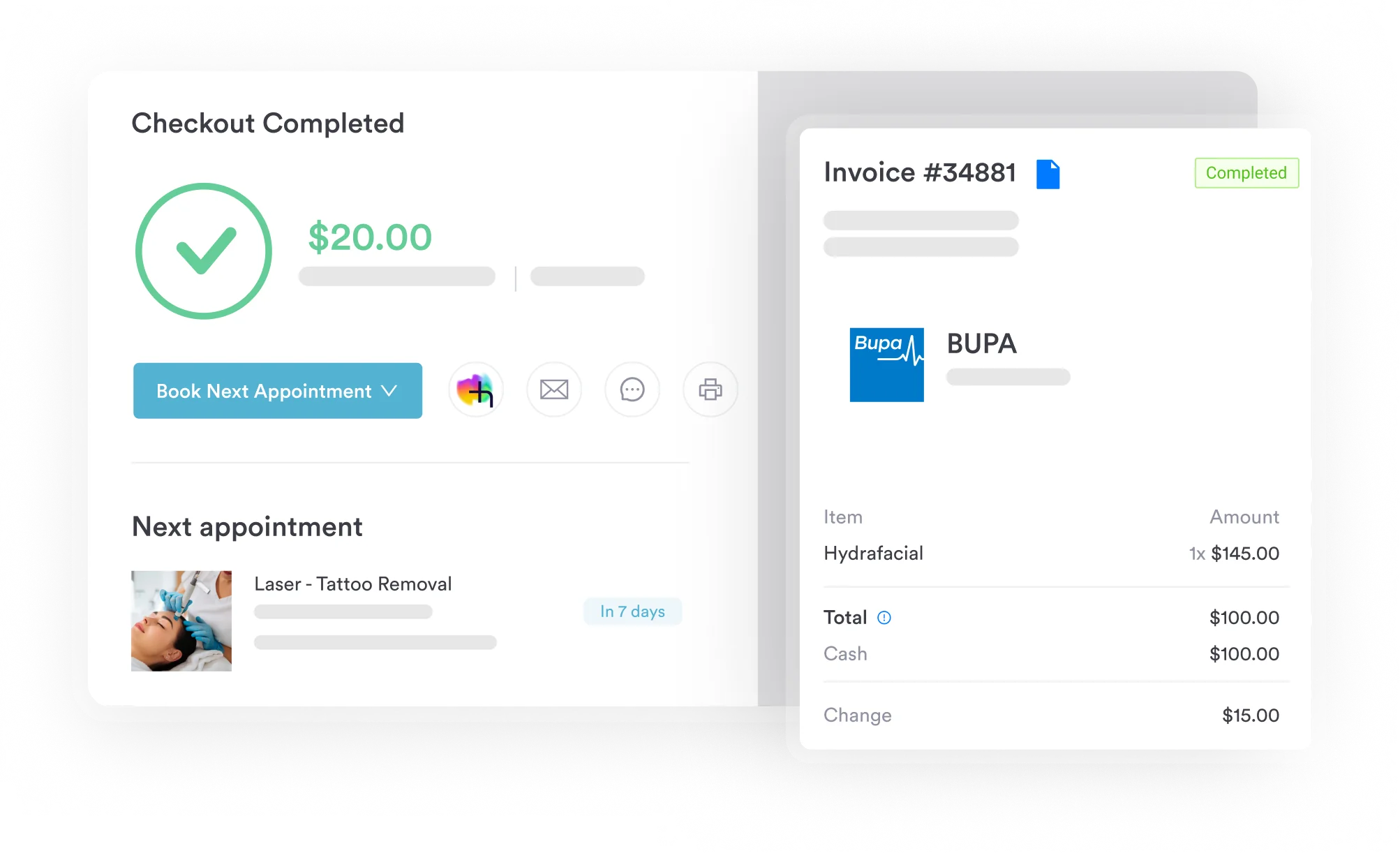

Pabau sends US claims through Claim.MD, runs eligibility checks and brings in ERA remittances. It tracks each prior authorization on the patient’s case and warns you when one is missing.

Treat C34.90 as the code you land on after reading the chart, not the one you start from. Read the CT, PET and pathology reports before you code. Query the physician when the reports disagree or leave the site out.
Two habits carry most of the weight. Confirm the lung is the primary before any C34 code goes on the claim, and add the tobacco code whenever the chart documents it. The cost is a few minutes of chart review per encounter, against a records request or a recoupment later.
Book a demo to see how Pabau handles Claim.MD submission, eligibility checks and prior authorization tracking for your oncology claims.

Need a framework for working denials? Denial management in healthcare covers root-cause analysis, appeal strategies and tracking for busy practices.
Looking for clearinghouse guidance? Our Claim.MD clearinghouse guide explains how electronic claim validation works and what payer edits to expect.
Coding tobacco use alongside lung cancer? ICD-10 code Z72.0 covers tobacco use without dependence and when to report it.
Keeping oncology billing audit-ready? Medical billing compliance sets out the rules and controls that keep claims defensible.
Want to understand the full revenue cycle? What is revenue cycle management walks through how claims move from encounter to payment.
Code the finding until cancer is confirmed. R91.1 covers a solitary pulmonary nodule, and R91.8 covers a lung mass found on imaging. Move to a C34 code once pathology or the physician confirms malignancy.
Use the C34 code for the lung primary plus C79.31 for the brain metastasis. When treatment is aimed only at the brain lesion, C79.31 is listed first.
ICD-10-CM has no remission code for lung cancer. Once the tumor is removed, treatment has ended and no disease remains, use Z85.118. Keep the C34 code while adjuvant chemotherapy or radiation continues.
Low-dose CT screening uses Z12.2, encounter for screening for malignant neoplasm of respiratory organs. Add the tobacco code that applies, such as F17.210 or Z87.891. C34.90 never belongs on a screening claim.
No. A malignant carcinoid tumor of the bronchus or lung is coded C7A.090, per the Excludes1 note at C34. A benign carcinoid of the bronchus and lung has its own code, D3A.090.